
The best commercial LED grow light for your operation is the one that delivers the right PPFD at canopy level, covers your actual footprint uniformly, runs efficiently enough to justify the capital cost, and holds up for 50,000+ hours without becoming a support headache. That's the whole answer. Everything else is just figuring out which specific fixture checks those boxes for your space, crop, and stage.
Best Commercial LED Grow Lights: Buying Guide for Any Farm
Marcus Rutherford
3 Apr 2026
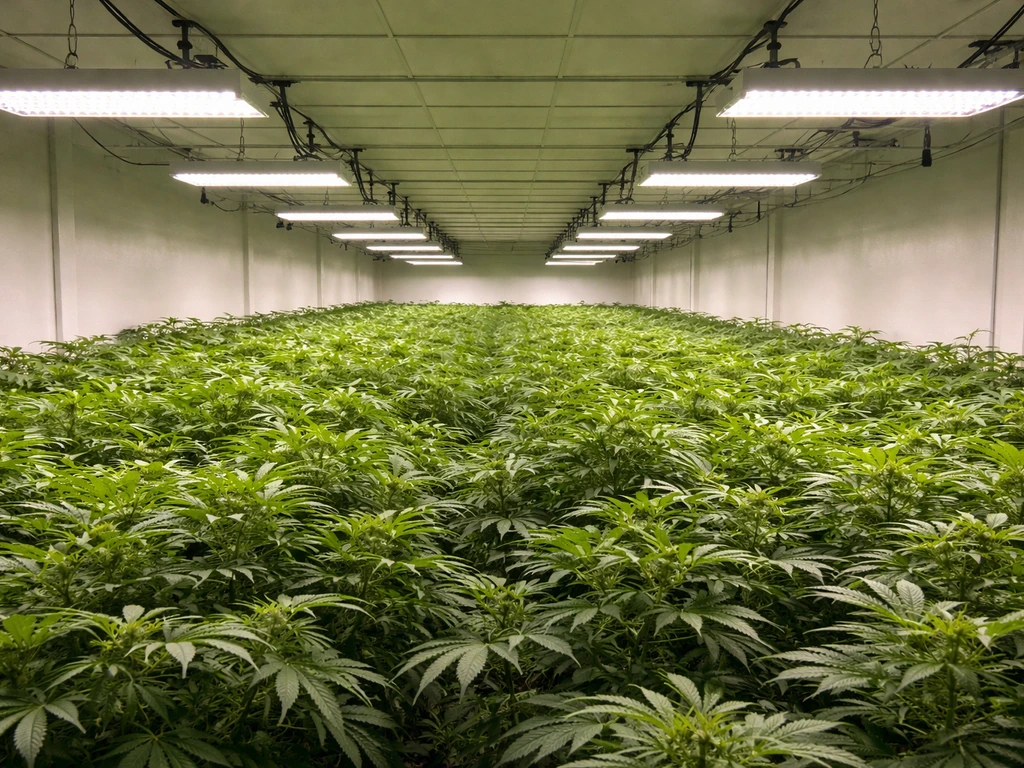
How to choose the right commercial LED grow light for your space, crop, and goals
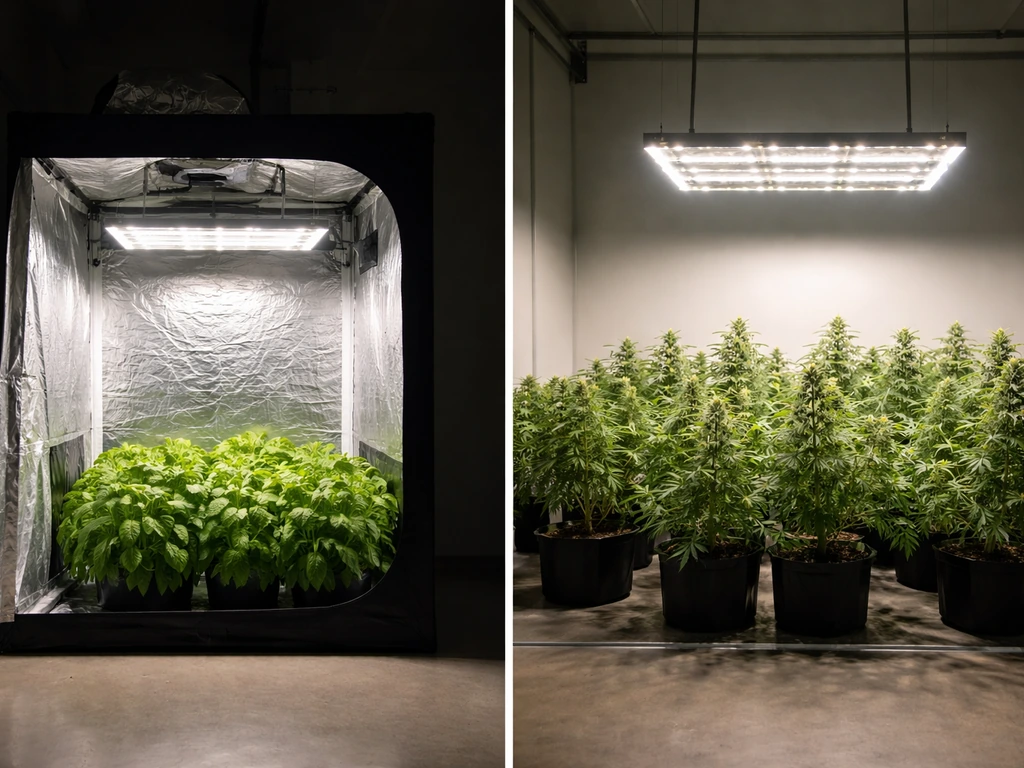
Before you look at a single spec sheet, nail down three things: your footprint, your crop, and your growth stage target. A 4x4 veg tent and a 10,000 sq ft flowering room are both 'commercial' to someone, but they need completely different solutions. A 4x4 space wants a single fixture in the 600-700W range delivering around 800-1,000 µmol/m²/s at canopy. A full production room needs a fixture-per-zone plan, controlled by a central dimming system, probably running closer to 1,200-1,500 µmol/m²/s for heavy-flowering crops.
Crop type matters enormously here. Leafy greens and herbs are happy at 200-400 µmol/m²/s. Tomatoes, peppers, and cannabis in flower want 800-1,500 µmol/m²/s to reach their genetic ceiling. If you're running a mixed operation, that changes your fixture choice toward dimmable units or zone-controlled arrays rather than fixed-output panels.
Your goal (veg, flower, or full-cycle) also determines spectrum priority. Veg stages do well with a blue-heavy spectrum around 3,500-6,500K. Flowering crops push yield and density with more red (620-680nm). Full-cycle fixtures need to cover both without forcing you to swap hardware mid-cycle, which is where broad-spectrum white-LED designs or tunable fixtures earn their premium.
Finally, be honest about your infrastructure. High-output commercial lights often run 480V three-phase power in large facilities. If you're on a 120V or 240V single-phase circuit, that limits your fixture options and your per-circuit load. Plan your electrical capacity before committing to a wattage class.
Key performance specs that actually matter at commercial scale
Efficacy (µmol/J) is the number that separates real commercial performers from glorified home-grow lights. Best-in-class fixtures are hitting 3.0-3.5 µmol/J as of 2026. Anything below 2.5 µmol/J is leaving real money on the table in electricity costs over a multi-year run. At commercial scale, even 0.2 µmol/J of difference adds up to thousands of dollars annually.
PPFD maps are more important than peak PPFD numbers. A fixture that claims 1,500 µmol/m²/s at center but drops to 400 at the edges is practically useless for canopy uniformity. Ask for the full PPFD map at your target mounting height, and look for uniformity ratios above 0.7 (ideally 0.8+) across the full target footprint. If a manufacturer won't provide a third-party-verified PPFD map, walk away.
Dimming range and control protocol matter at commercial scale. Look for 0-10V dimming at minimum. Dali or wireless controls (Zigbee, proprietary networks) are worth the premium for large facilities where you're managing hundreds of fixtures. A good dimming range (10-100%) lets you dial in DLI targets precisely rather than relying on photoperiod alone.
Driver quality is where budget fixtures cut corners. Mean Well HLG series drivers are the industry benchmark for reliability and efficiency. Proprietary drivers from reputable brands can match them, but unknown-brand drivers in cheap fixtures are a warranty nightmare. Check driver efficiency separately: a 95%+ efficient driver means less heat dumped into your grow space.
Thermal management is a real differentiator at high wattages. Passive aluminum heat sinks work fine up to around 600W in adequately ventilated spaces. Above that, passive cooling struggles unless the fixture design is specifically engineered for high-output passive dissipation, as many bar-style commercial lights are. Junction temperature directly affects lumen maintenance, so poor thermal design accelerates depreciation regardless of what the spec sheet claims.
Safety certification is non-negotiable for commercial operations. The current dedicated standard for horticultural lighting is blank" rel="noopener noreferrer">UL 8800, which covers photobiological safety concerns including human eye and skin exposure risks specific to grow light spectra. UL also states that UL 8800 was published in August 2019 and includes safety requirements for horticultural lighting equipment intended for installation in the United States and Canada blank" rel="noopener noreferrer">UL 8800 was published in August 2019 and addresses safety requirements for horticultural lighting equipment in the United States and Canada. It also incorporates photobiological standards like IEC 62471, and Risk Group 3 lights cannot receive a safety listing under ANSI/CAN/UL 8800:2019. For insurance, facility compliance, and long-term liability protection, only run UL 8800-listed fixtures in commercial environments.
DLC listing is the other box to check. The DesignLights Consortium requires UL 8800 certification as part of its horticultural Qualified Products List (QPL) pathway, and DLC QPL status is typically required to qualify for utility rebates. On a large commercial installation, those rebates can offset 20-40% of fixture cost, so DLC listing isn't just a checkbox, it's a financial tool. DLC's V4.0 technical requirements also mandate standardized testing inputs including ANSI/IES LM-79 for fixture photometrics, LM-80 and TM-21 for lumen maintenance projection, and ANSI/UL 8800 for safety certification, so a DLC-listed fixture has gone through rigorous third-party verification.
LED fixture types and form factors for commercial grows
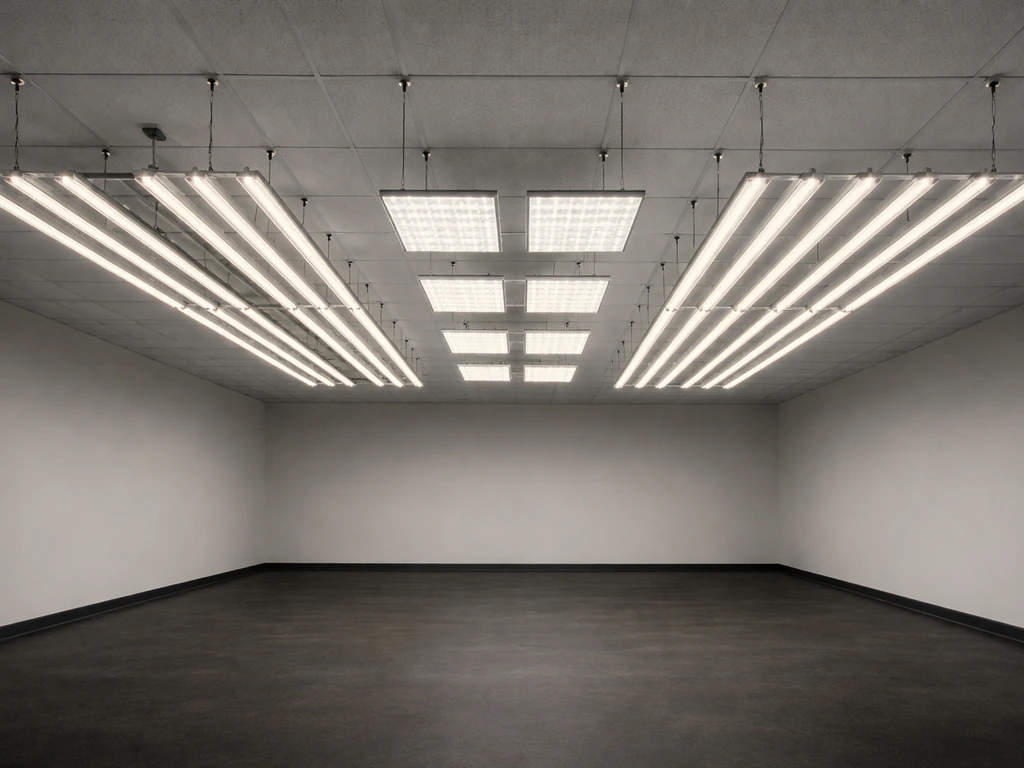
There are four main form factors you'll encounter in commercial LED horticulture, and they each have a real niche. Choosing wrong here affects installation cost, uniformity, and maintenance access.
Bar-style fixtures
Bar-style fixtures (also called multi-bar or spider-style lights) are the dominant choice in commercial cannabis and high-value crop production right now. The distributed light source across multiple bars produces far better canopy uniformity than a single central source. They run cooler per watt because the heat is spread across more surface area, and most can be mounted relatively close to the canopy (12-24 inches) without hotspots. Fixtures like the Fluence SPYDR series, Gavita Pro 1700e LED, and similar multi-bar designs dominate production rooms for exactly these reasons.
Panel fixtures
Panel fixtures are a practical choice for smaller commercial footprints, grow tents, and operations where mounting infrastructure is limited. They're simpler to hang and replace. The trade-off is that a single large panel creates more of a point-source hotspot effect at shorter mounting heights, which hurts uniformity. If you're working in a space where a 4x4 grow tent LED setup makes sense, a well-designed panel can absolutely perform at commercial-grade levels, especially in the 600-800W range with proper mounting height.
Strip and canopy-style fixtures
Strip lights and interlighting canopy systems are specialized tools for vertical farms and high-density multi-tier systems. Strip fixtures mount between rows or on side rails in vertical racks, delivering light directly to the canopy at minimal mounting height. They're low-heat-per-fixture by design, which is critical in tight vertical configurations. The trade-off is that you need more fixtures to cover equivalent area, which increases fixture count, wiring complexity, and points of potential failure.
Retrofit and upgrade fixtures
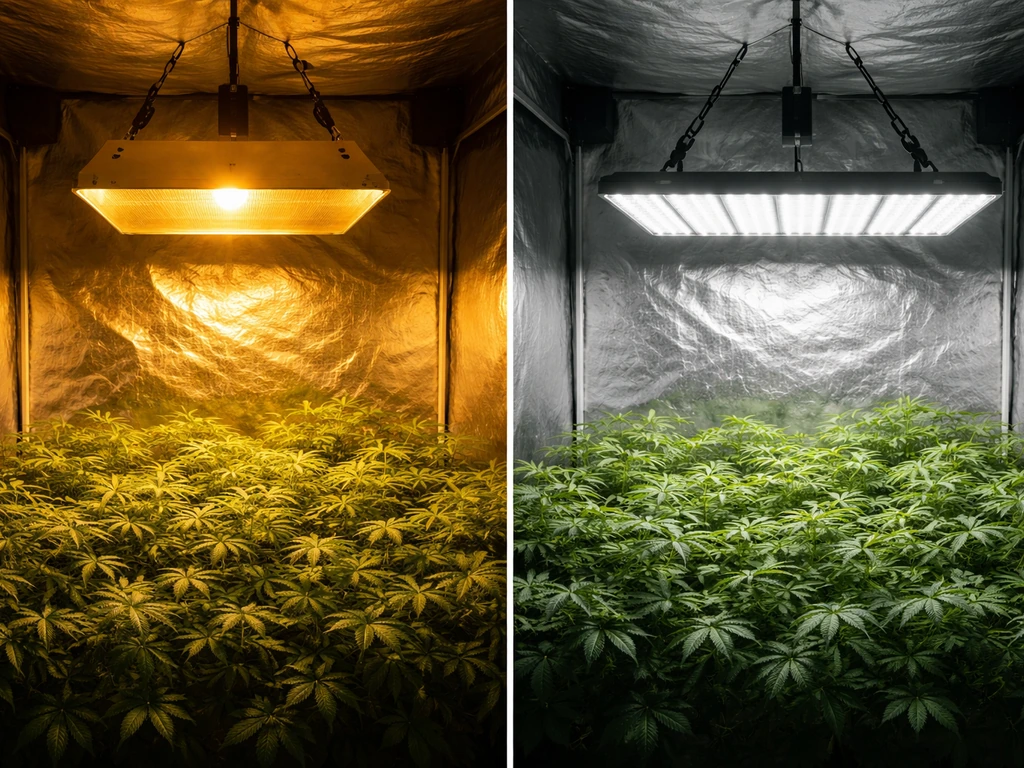
If you're converting an existing HPS or CMH facility, retrofit fixtures that drop into existing DE HPS reflector positions are worth considering. They simplify installation and let you reuse existing mounting infrastructure. The downside is that you're somewhat constrained by the existing hanging points and spacing, which may not be optimal for LED uniformity. Purpose-built LED installations almost always outperform retrofits on uniformity metrics, but the retrofit path is a legitimate stepping stone when capital is the constraint.
Spectrum, PPFD, and DLI targets by crop and stage
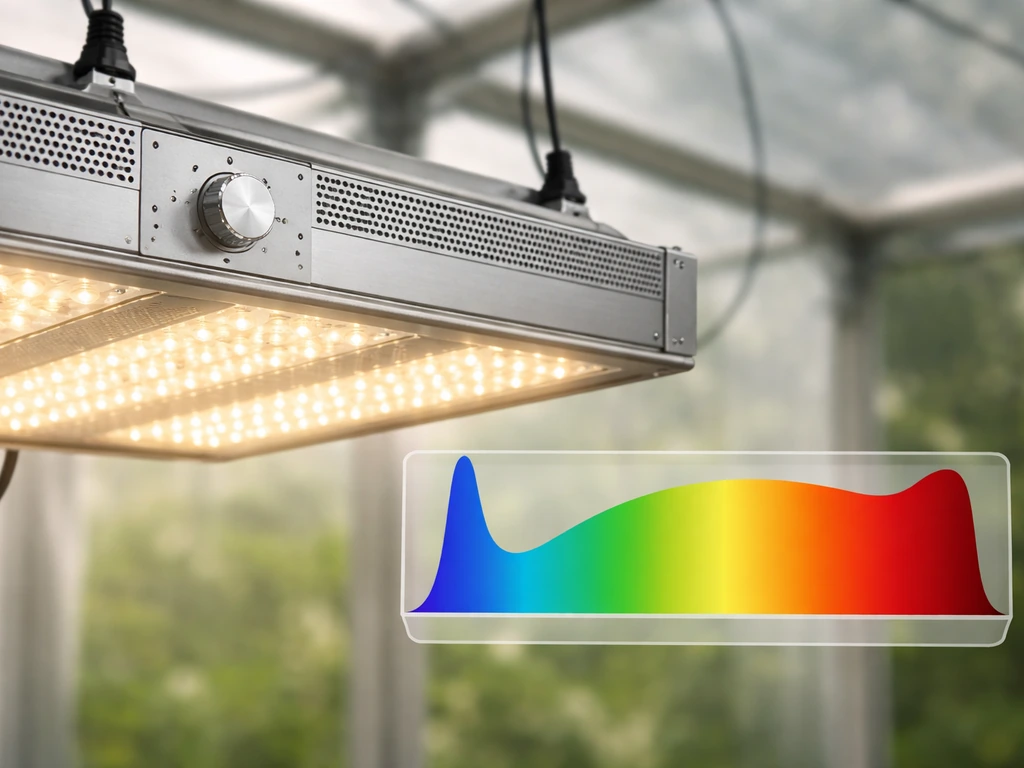
Spectrum is where a lot of growers get lost in marketing language. Here's the practical reality: plants primarily use light in the PAR range (400-700nm), with photosynthetic efficiency peaking around 660nm (red) and 450nm (blue). Far-red (700-750nm) matters too, as it influences stem elongation, flowering triggers, and the Emerson enhancement effect that can boost photosynthesis beyond what the McCree curve alone predicts.
Full-spectrum white LED designs (3000K-4000K phosphor-converted with red supplementation) generally produce the best visual inspection environment and strong yields. Purpose-built red/blue 'blurple' fixtures are outdated and underperform full-spectrum designs in canopy penetration and yield uniformity. UV (280-400nm) supplementation has real evidence behind it for secondary metabolite production (terpenes, cannabinoids, flavonoids) but should be used carefully given photobiological safety concerns addressed by UL 8800 standards.
| Crop / Stage | Target PPFD (µmol/m²/s) | Daily Light Integral (DLI) | Photoperiod |
|---|---|---|---|
| Leafy greens / herbs | 200–400 | 12–17 mol/m²/d | 16–18 hrs |
| Cannabis — veg | 400–600 | 20–30 mol/m²/d | 18 hrs |
| Cannabis — flower | 800–1,500 | 40–65 mol/m²/d | 12 hrs |
| Tomatoes / peppers | 600–1,000 | 20–30 mol/m²/d | 16–18 hrs |
| Strawberries | 300–500 | 12–20 mol/m²/d | 14–16 hrs |
| Microgreens | 150–300 | 8–12 mol/m²/d | 12–16 hrs |
DLI is the number you should be managing operationally, not just PPFD. DLI (mol/m²/day) is PPFD multiplied by photoperiod duration, and it's the actual dose of light your plants receive. A fixture that delivers 800 µmol/m²/s for 12 hours gives a DLI of 34.6 mol/m²/d. Understanding this relationship lets you use dimming to hit target DLI rather than running lights at full throttle unnecessarily, which saves electricity and extends fixture lifespan.
Climate, mounting height, coverage, and uniformity planning
Mounting height is the lever that controls both PPFD intensity and coverage area simultaneously. Raise a fixture and you cover more area at lower intensity. Lower it and you get higher PPFD at a smaller footprint. Most commercial bar fixtures are designed to operate between 12-36 inches above canopy, with manufacturer PPFD maps typically shown at 18 and 24 inches. Match your mounting height to your target PPFD, not to what looks convenient.
Uniformity is almost always better in multi-fixture arrays than with single large fixtures. When planning a room, overlap adjacent fixture coverage zones by about 20-30%. This fills in the edge drop-off that every fixture experiences and keeps your uniformity ratio above 0.75. Tools like the manufacturer's photometric files (IES files) loaded into free software like AGi32 or DIALux let you model this before buying a single fixture.
Heat management is a real operational cost. High-efficiency LED fixtures (3.0+ µmol/J) still convert roughly 40-50% of electrical input to heat. At commercial scale in a sealed room, your HVAC system has to remove all of that. Budget for cooling capacity that matches your lighting load. A 1,000W fixture room requires about 3,400 BTU/hr of cooling per kilowatt of lighting. If you're sizing a new HVAC system, get your lighting plan finalized first so the mechanical engineer has accurate heat load numbers.
Reflective walls dramatically affect effective PPFD at canopy, especially near room edges. Flat white paint reflects about 85-90% of light. Mylar and similar reflective films can hit 95%+. In smaller commercial rooms, properly reflective walls can effectively add 10-20% to your usable light without adding a single watt. Don't overlook this when planning a retrofit.
Top commercial LED grow light picks by scenario and budget
Here are honest scenario-based recommendations based on real-world performance data and use cases. Prices reflect approximate 2026 market pricing and will vary by distributor.
Best for 4x4 to 5x5 commercial-grade tent or small room
For a single-tent or small-room setup where you want commercial-grade output without full-scale infrastructure, the 630-720W bar-style fixtures from brands like Spider Farmer (SE7000), AC Infinity (Iongrid T88), and similar are genuinely excellent value. They deliver 2.7-3.0 µmol/J, have solid dimming control, and don't require three-phase power. If you're building out a 5x5 grow tent with full LED coverage, a single 720W bar-style fixture at 24 inches of mounting height will comfortably hit 900-1,000 µmol/m²/s across the canopy.
Best for mid-scale production rooms (500-2,000 sq ft)
The Gavita Pro 1700e LED and Fluence SPYDR 2x both benchmark well in this segment. The Gavita runs at 645W, delivers 1,700 µmol/s total output, and has a solid 5-year warranty with real dealer support. Fluence SPYDR 2x operates at 680W with 3.0 µmol/J efficacy and excellent uniformity at 18-24 inch mounting height. Both are DLC-listed, which means you can pursue utility rebates. At this scale, those rebates often offset $50,000-$100,000+ in fixture costs on a full room build-out.
Best for large-scale industrial production (2,000+ sq ft)
At true industrial scale, Fluence (now a Signify/Philips brand), Gavita, and Hortilux are the most common choices, partly for performance and partly for the service infrastructure they provide. When you're running 500+ fixtures, you need a manufacturer that will answer the phone, honor warranty claims, and provide replacement parts within days, not weeks. Look at the Fluence RAZR series for high-ceiling production rooms where you need broader coverage from greater mounting height. If you're evaluating the highest-output LED grow lights on the market, the 1,000W+ commercial units from these brands routinely hit 3.0-3.4 µmol/J at rated wattage.
Best budget option that still performs
Mars Hydro FC-E and Spider Farmer SE series fixtures have closed the gap considerably with premium brands in the $300-$600 price range. They won't match Gavita or Fluence on support infrastructure or warranty confidence, but the LED components and efficacy numbers (2.7-2.9 µmol/J) are genuinely competitive. For small commercial operators or serious hobbyists who are comfortable doing their own PPFD verification and don't need enterprise-level support, these are the honest value picks.
Cost, ROI, and electrical efficiency: the real math
Let's run real numbers. A 1,000W fixture operating 18 hours/day at $0.12/kWh costs $0.78/day or about $286/year in electricity. Scale that to a 100-fixture room and you're at $28,600/year in electricity for lighting alone. Moving from a 2.5 µmol/J fixture to a 3.2 µmol/J fixture (with equivalent PPF output) reduces your wattage requirement by roughly 22%, saving about $6,300/year on a 100-fixture room. Over a 5-year fixture lifespan, that's $31,500 in savings from the efficiency upgrade, often more than the fixture cost difference.
LED fixture lifespan is typically rated at 50,000 hours to L90 (90% of initial output). At 18 hours/day, that's about 7.6 years before you hit significant light depreciation. HPS fixtures lose output much faster and require lamp replacement every 1-2 years at $50-$150 per lamp. At commercial scale, lamp replacement labor and consumable cost alone can justify an LED upgrade within 2-3 years.
Utility rebates are available in most U.S. states and Canadian provinces for DLC QPL-listed horticultural fixtures. Rebate amounts vary by utility but commonly run $0.05-$0.25 per kWh saved (calculated from baseline HPS replacement), or flat per-fixture rebates of $30-$150 per unit. On a 200-fixture installation, that can mean $6,000-$30,000 in direct rebates. Contact your utility's commercial energy efficiency program before purchasing, because some rebates require pre-approval.
Heat reduction from switching HPS to LED also reduces HVAC operating costs. A commercial-grade LED running at 3.0 µmol/J produces roughly 40-50% less heat than an equivalent-output HPS fixture. In a climate-controlled room, that translates directly to lower cooling costs year-round and lower heating costs in cold climates where you were relying on HPS waste heat. Factor this into your ROI model, because it's often 15-25% of total operational savings.
If you want to understand how wattage scales with space and why it affects your per-cycle cost, understanding LED grow light wattage requirements for different footprints will help you right-size fixtures rather than over-buy on wattage.
Installation checklist and buying guidance
Before you buy
- Map your exact grow footprint in square feet and confirm your ceiling or rafter height to establish realistic mounting height options.
- Calculate your target DLI for your crop and stage, then back-calculate the PPFD you need at canopy level based on your planned photoperiod.
- Verify your electrical panel capacity: total amperage, voltage (120V/240V/480V), and available circuits.
- Request full PPFD maps (not just peak numbers) from the manufacturer at your target mounting height.
- Confirm DLC QPL listing and contact your utility about rebate pre-approval requirements.
- Check warranty terms carefully: 5 years is the minimum for commercial use; confirm whether the warranty covers both fixture and driver separately.
- Verify UL 8800 listing, not just CE or FCC marks, for proper horticultural safety certification.
During installation
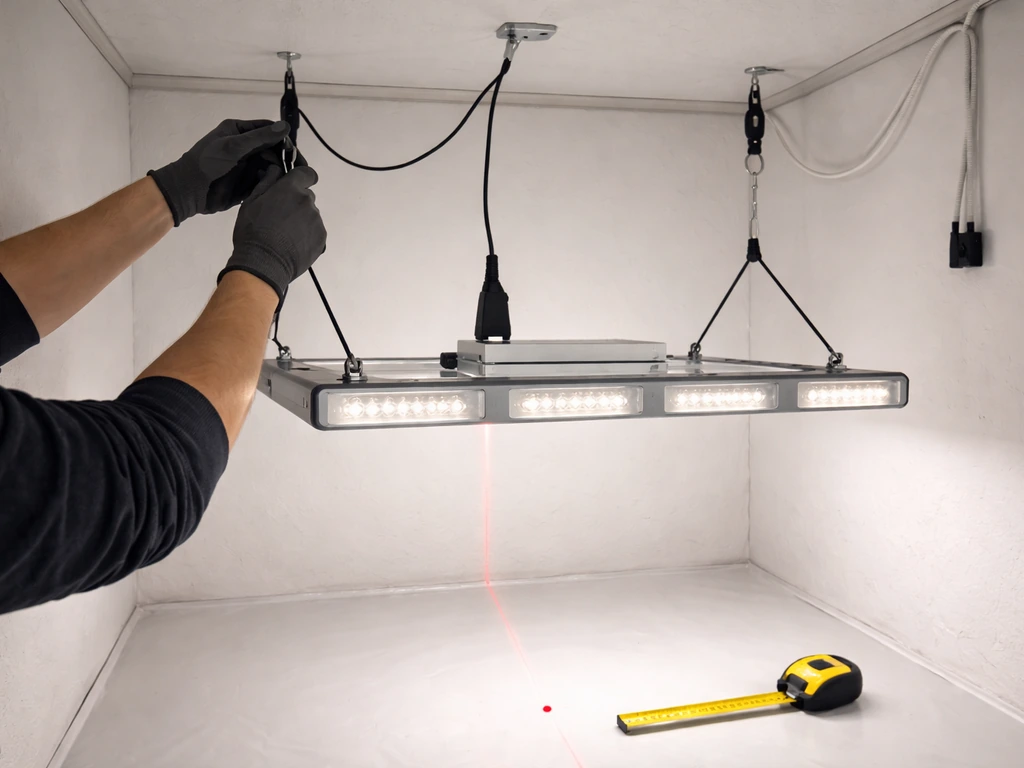
- Hang fixtures at the manufacturer's recommended height for your target PPFD, not at whatever height is convenient.
- Use a calibrated quantum sensor (Apogee SQ-520 or equivalent) to measure actual PPFD at canopy across a grid of at least 9 points per fixture zone.
- Compare measured PPFD to the manufacturer's map; if readings are significantly lower, check for driver issues or fixture defects before proceeding.
- Set up your dimming controls and verify the full 0-10V (or DALI) range actually dims linearly with no flickering at low output.
- Log baseline electricity consumption at commissioning so you have a reference for ongoing efficiency tracking.
- Verify airflow and temperature at canopy level: leaf surface temperature should stay below 82°F (28°C) for most crops.
Common mistakes to avoid
- Trusting peak PPFD claims without a full uniformity map: a hotspot fixture will burn center plants while starving edges.
- Skipping DLC verification and missing out on rebates that could fund 20-40% of your fixture cost.
- Underestimating heat load: even efficient LEDs add significant BTU load; confirm HVAC capacity before commissioning.
- Buying from brands with no domestic service presence: when a driver fails at 2am before a harvest, you need a replacement unit, not a ticket to an overseas support queue.
- Running full-output LEDs on plants that don't need it: overshooting DLI wastes electricity and can cause light stress in sensitive crops.
- Ignoring lumen maintenance data: fixtures without published LM-80 and TM-21 data have no verifiable depreciation curve, which makes their lifespan claims unverifiable.
- Assuming all 'full-spectrum' claims are equivalent: check the actual spectral power distribution chart, not just the marketing label.
Brands worth trusting at commercial scale
For production-scale operations where support and reliability are paramount: Fluence (Signify), Gavita, Hortilux, and Heliospectra. For mid-scale and serious hobby operations where value matters more: Spider Farmer, Mars Hydro FC-E series, AC Infinity Iongrid, and Growers Choice. If you're specifically evaluating full-spectrum LED grow light options for a flowering room, prioritize brands that publish a full spectral power distribution chart alongside their PPFD maps rather than relying on vague 'sunlike spectrum' claims.
The commercial LED grow light market has matured significantly. Top-tier efficacy, solid warranties, and DLC listing are no longer rare or premium-only features. What separates the best options now is build quality, support infrastructure, verified performance data, and the specific match between fixture design and your grow environment. Run the numbers on your space, verify the PPFD maps, confirm the certifications, and you'll have a clear answer on which fixture belongs in your room.
FAQ
If two fixtures both hit the target PPFD, how do I tell which one is actually better for my room?
Not necessarily. Many commercial fixtures can hit the same PPFD using different wattages because of efficacy and beam spread, so your real comparison is PPF (total photon output) plus the manufacturer’s PPFD map at your mounting height. If two fixtures claim similar center PPFD but one has better edge uniformity (higher uniformity ratio), the “higher PPFD” one can still underperform in canopy coverage.
What happens to performance if I mount the fixtures at a different height than the manufacturer’s map?
Yes, if you have to move the lights or change canopy height mid-cycle. Dimming helps, but if your mounting height changes beyond what the PPFD map assumptions cover, your edges and average PPFD can drift. The safer move is to select fixtures whose published maps include the mounting height range you expect (for example 18 to 24 inches) and then verify with a quick on-site PPFD reading after installation.
How do I confirm I’m hitting the right DLI if I plan to use dimming and not run at 100%?
You should verify DLI using both PPFD and photoperiod limits in your control plan. If you dim to hit DLI precisely, ensure your dimming system maintains stable output without flicker or unexpected curve changes at low percentages. Also confirm your facility software or controller is actually sending the dimming signal range you expect (for example 0-10V scaling) to avoid systematic under-lighting.
Is it better to buy fewer high-output fixtures or more fixtures for better uniformity?
In many commercial installs, “more fixtures” can be cheaper than “bigger fixtures” for uniformity. When coverage zones overlap correctly, the per-fixture intensity can be lower and more evenly distributed, which improves uniformity and often reduces hotspot risk near edges. If you already know your target uniformity ratio goal, you can decide fixture count by modeling overlap (about 20-30%) instead of only matching total watts to floor area.
Manufacturers list efficacy numbers, but how do I make sure they’re comparable across brands?
Watch for re-labeled numbers. Some listings describe efficacy (µmol/J) at a rated operating point, others describe only system efficacy for a specific mounting or ambient temperature. Request the PPFD map at your mounting height and ask for driver input power and how efficacy is calculated, then compare apples-to-apples rather than relying only on the “headline” efficacy spec.
Are strip lights always the best choice for vertical farms, or are there layout pitfalls?
For multi-tier or vertical racks, strip and interlighting systems can work very well, but you still need aisle-to-canopy geometry modeled. The edge of the rack and side walls can drastically change effective PPFD, so your layout should include reflectivity and spacing, not just fixture PPFD. Plan for more fixture count, then budget for wiring, segregation, and failure isolation (for example zoning by rack rows) to keep down-time low.
When converting from HPS, how do I decide whether retrofit mounting will hurt uniformity too much?
A retrofit can be “good enough” for ROI, but uniformity is often constrained by the existing reflector spacing. If your current HPS hanging points create long spans between centers, the LED conversion may leave edge drop-offs that you cannot fully correct with dimming. A practical step is to check your existing center-to-center spacing against the LED fixture’s recommended overlap and uniformity targets before you commit.
How can thermal management issues show up in real commercial operations, even when the fixture is “passive”?
Driver heat rise and junction temperatures can be very sensitive to enclosure design, airflow paths, and how close fixtures are to ceilings or ducting. Passive heat sinks often perform well in ventilated environments, but in sealed rooms you must treat cooling capacity as part of the lighting system, not an afterthought. If you have hot spots from poor airflow, you can see faster lumen depreciation than expected even if the LED chips are rated.
What electrical or control mismatches most often cause problems during commissioning?
Use a 2-step approach: confirm electrical compatibility (voltage, phase, and available circuits) and then confirm control compatibility (0-10V vs DALI, and whether your controller supports the fixture protocol). Many mismatches aren’t obvious until commissioning. If you’re scaling up, request a wiring diagram and dimming calibration guidance for your exact controller model, not just a generic “supports 0-10V” statement.
Can I assume DLC-listed fixtures automatically qualify for rebates, or are there common administrative gotchas?
DLC and rebates are tied to specific qualifying product details. Even if a fixture is listed, your rebate may depend on correct fixture configuration, rated wattage assumptions, and the baseline used by your utility program. Before purchase, ask whether you need pre-approval, whether the utility requires serial-number reporting, and whether your installation design (like dimming strategy) affects eligible kWh savings calculations.
What should I ask for beyond PPFD and warranty when a light claims “full spectrum”?
Not all “full-spectrum” claims include the full spectral power distribution data you actually need for confident crop performance. If you care about yield and consistency, ask for the spectral power distribution chart in the PAR range, plus any far-red content details and how it’s represented versus total output. For marketing-heavy products, the safest decision aid is requiring both the PPFD map and the spectrum data for the same operating condition.
After installation, what’s the most efficient way to verify the lights are performing as expected?
You can reduce surprises by planning a commissioning check at the mounting heights you will use for each stage. Even with published maps, real-world mounting variations, canopy reflectivity changes, and dust or film on walls can shift PPFD. A fast on-site PPFD scan at representative points (center and several edge positions) lets you confirm uniformity before your crop is fully committed.
Next Articles
Best Full Spectrum 1000W LED Grow Lights: Buyer Guide
Buy the best full spectrum 1000W LED grow light with spec-to-decision tips on PPFD, coverage, wattage, and tent fit.
Best 100W LED Grow Light: How to Choose the Right One
Choose the best 100W LED grow light with PPFD coverage, spectrum, efficiency, dimming, heat, and setup tips.
Best LED Grow Light to Replace 1000W HPS: Sizing Guide
Sizing and buying guide to replace a 1000W HPS with the right LED using PPFD, layout, mounting, and spectrum for yields.