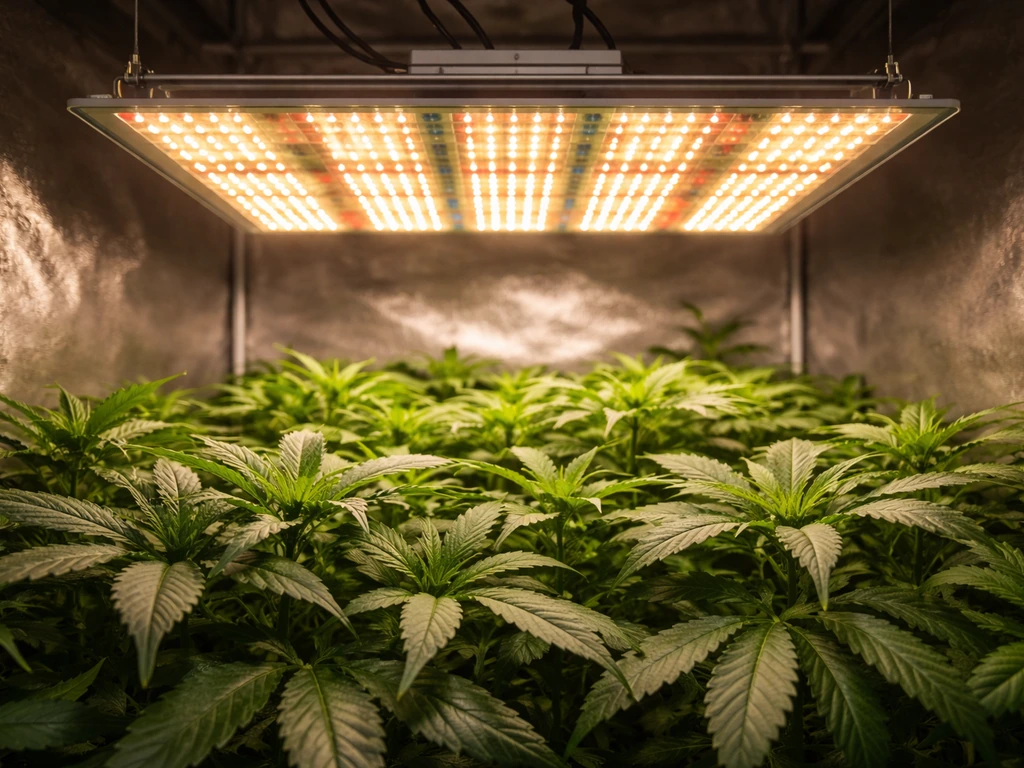
The best full spectrum LED grow light for your setup is the one that delivers the right PPFD at canopy level across your entire grow footprint, runs efficiently enough to keep electricity costs sane, and doesn't cook your plants with excess heat. That's it. Every other decision flows from those three things. Whether you're running a 2x2 tent for seedlings or a commercial 4x4 flowering space, the framework for choosing is the same. Let me walk you through it.
Best Full Spectrum LED Grow Lights 2026 Guide by Setup
Marcus Rutherford
2 Apr 2026
What 'full spectrum' actually means for LED grow lights
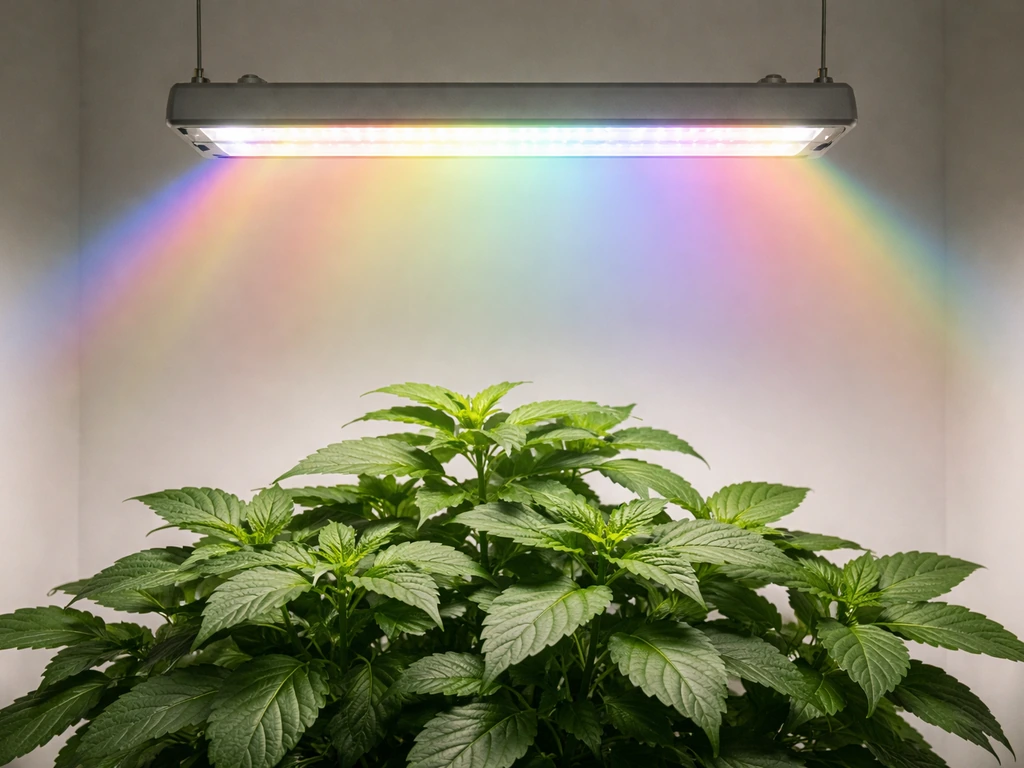
Marketing teams have stretched the phrase 'full spectrum' into something close to meaningless, so let's pin it down. In grow light context, full spectrum refers to a light source that covers the PAR range (photosynthetically active radiation), which runs from 400 to 700 nm, and ideally extends into the red-far-red region around 700 to 730 nm. That window covers the wavelengths chlorophyll A, chlorophyll B, and carotenoids actually absorb. Blue light (roughly 400 to 500 nm) drives compact vegetative growth. Red light (around 620 to 680 nm) is the engine for photosynthesis efficiency and flowering. Far-red (700 to 730 nm) influences the Emerson enhancement effect and photoperiod signaling.
Modern full spectrum white LEDs achieve this using high-CRI phosphor-converted chips (typically 3000K to 6500K) that produce a broad, continuous spectral curve rather than the narrow-peak blue-and-red 'blurple' output from older LEDs. The best fixtures combine high-CRI white diodes with dedicated red and sometimes far-red emitters to hit optimal ratios. When a manufacturer calls a light 'full spectrum' but only shows a blue spike and a red spike on their spec sheet with nothing between, that's not full spectrum, that's blurple with a rebrand. Ask for a full spectral power distribution (SPD) chart before buying.
One more thing worth knowing: the PAR range from 400 to 700 nm is exactly what calibrated quantum sensors like the Apogee MQ-500 are designed to measure. If a brand's PPFD claims come from a PAR meter measurement in that range, the number is meaningful. If they don't say how PPFD was measured, treat it skeptically.
How to choose the right light for your space
Coverage and wattage: match the fixture to the footprint
The single most common mistake growers make is buying a light rated for a larger space than the actual advertised coverage. A fixture listed as 'covers 4x4' at full power in flowering may only deliver adequate PPFD over a 3x3 area at that mounting height. Rule of thumb: for flowering, you want 35 to 50 true watts per square foot of actual draw (not 'equivalent' draw). A real 4x4 flowering space is 16 square feet, so you're targeting 560 to 800 watts of actual LED draw. For veg, you can drop to 20 to 30 watts per square foot. For seedlings, even less.
Bar-style fixtures (quantum boards spread across a frame) and single-panel quantum board lights dominate the current market for good reason: they spread photons more evenly across a wide footprint compared to older COB arrays, which concentrate intensity in the center and drop off sharply at the edges. If uniformity matters to you (and it should for multi-plant setups), look for fixtures where the manufacturer publishes a PPFD map showing edge-to-center ratios, not just a single peak number.
Mounting height changes everything
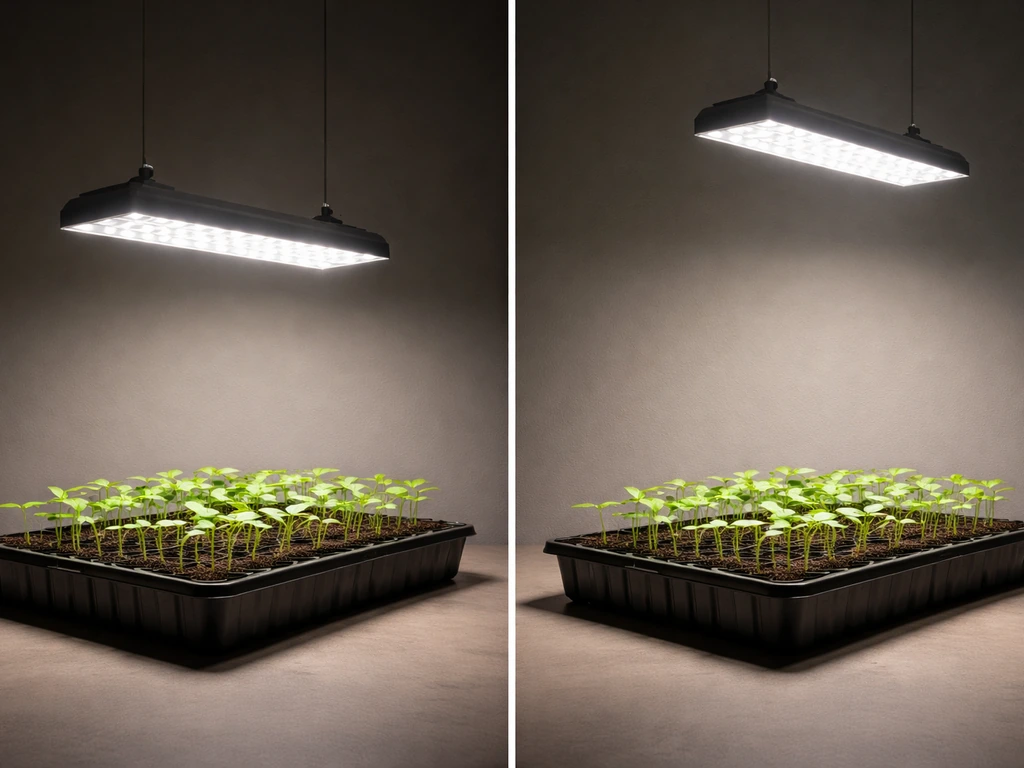
PPFD drops with the inverse square of distance. Drop a light from 24 inches to 12 inches and you roughly quadruple the intensity at the canopy. Most manufacturers publish PPFD maps at 18 to 24 inches for flowering and 24 to 36 inches for veg or seedling stages. If you're in a low-ceiling space or a 4-foot tent, make sure the fixture you're buying has a usable PPFD range at shorter mounting heights without bleaching the tops. Dimmable drivers are critical here because they let you reduce intensity while keeping the light closer for better coverage uniformity.
Seedling-focused full spectrum LED grow lights
Seedlings need light, but not a lot of it, and the wrong light at the wrong intensity is one of the fastest ways to stunt early growth. For seedlings, you're targeting a PPFD of roughly 100 to 300 µmol/m²/s at the canopy, far lower than the 600 to 900 µmol/m²/s you'd run for flowering. That low intensity requirement means a dedicated seedling light doesn't need to be powerful, but it does need to be full spectrum and dimmable.
DLI (daily light integral) is the most useful metric at this stage. DLI is the total number of photons accumulated over a full photoperiod, expressed in mol/m²/day. Seedlings generally perform well at a DLI of 6 to 12 mol/m²/day. blank" rel="noopener noreferrer">The relationship between PPFD and DLI is straightforward: multiply your PPFD (in µmol/m²/s) by the photoperiod in seconds and divide by one million to get your DLI. Virginia Tech's research on DLI for controlled environment agriculture shows you can hit a target DLI by adjusting either the intensity or the number of hours the light runs, which gives you real flexibility with a dimmable fixture.
For seedling-specific setups, compact panel lights or strip-style T5 LED replacements often make more sense than a full-power quantum board. You want even coverage at very low intensity across a propagation tray, not maximum photon output. Look for a light you can dim to 20 to 30% of max output, or mount high enough to hit that 100 to 300 PPFD target without cooking delicate leaves. A feature worth knowing about: full spectrum LED grow lights for UK growers often come with broader dimming ranges and 240V drivers that work well in propagation environments where precise control matters most.
Best picks by budget
Here's how I'd approach the market right now across three budget tiers. Prices have dropped significantly in the last two years, and the gap between 'cheap' and 'best overall' is smaller than it used to be, particularly for straightforward veg and early flower applications.
| Budget Tier | Target Spend (per fixture) | Best For | What to Expect | Trade-offs |
|---|---|---|---|---|
| Cheap / Entry | Under $100 | Seedlings, clones, small 2x2 veg spaces | Decent PPFD in the center, basic full spectrum white chips, simple on/off or basic dimming | Limited uniformity, minimal spec documentation, shorter lifespan drivers |
| Budget / Mid-Range | $100–$300 | 3x3 to 4x4 veg, light flowering, home hobbyist setups | Quantum board-style panels, LM301B or LM301H diodes, better driver quality (Meanwell or equivalent), published PPFD maps | May need two units for dense canopy flowering in larger spaces |
| Best Overall / Premium | $300–$700+ | 4x4 to 5x5 flowering, commercial runs, high-DLI applications | Bar-style quantum boards, Samsung LM301H EVO or similar top-bin diodes, 2.7–3.0+ µmol/J efficiency, UL 8800 listed, full spectral data provided | Higher upfront cost, though often lower cost-per-gram long term |
In the entry tier, you'll mostly find no-name or budget brand single-panel lights using white chips with minimal documentation. They work for seedlings and early veg if you keep expectations realistic. I wouldn't rely on them for flowering because PPFD uniformity across the edges is usually poor, and efficiency numbers are rarely published for good reason.
The mid-range tier is where the value story gets compelling. Lights using Samsung LM301B diodes paired with Meanwell drivers regularly deliver 2.3 to 2.5 µmol/J efficiency, which was a premium spec just four years ago. For a 3x3 or light-use 4x4 space, a single 240W to 320W fixture in this range is a strong choice. The key is finding a brand that actually publishes a PPFD map and efficiency figure rather than hiding behind 'equivalent wattage' marketing.
At the premium tier, you're paying for top-bin diodes (LM301H EVO, Osram SSL 660, or equivalent), better thermal management, and documented performance. The 2.7 to 3.0+ µmol/J efficiency range in this tier is real and meaningful for electricity-intensive grows. If you're running lights 18 hours a day for veg or 12 hours through a long flowering cycle, that efficiency delta adds up fast on your power bill.
Fixture vs grow light bulbs: which form factor fits your situation
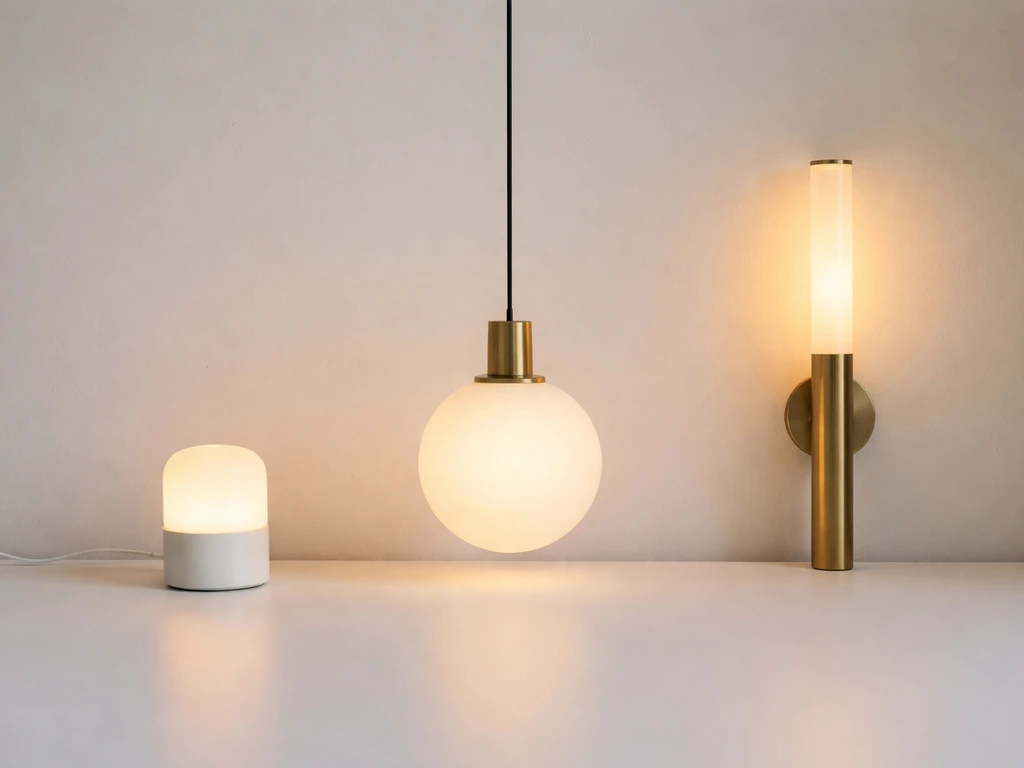
People searching 'full spectrum LED grow light bulbs' are usually thinking about E26 or E27 screw-base bulbs they can drop into an existing lamp socket or clamp light. These are a real product category and they have legitimate uses, but they're fundamentally different from dedicated grow fixtures in terms of performance.
Grow light bulbs (screw-base style) make sense in a few scenarios: supplementing natural light near a window, running a single houseplant or a small herb garden under a clamp light, or giving seedlings a boost in a low-commitment setup. They're inexpensive, easy to install, and don't require any mounting hardware. The downside is that most E26/E27 grow bulbs max out at 10 to 30 actual watts per bulb, which limits usable PPFD to a very small footprint directly underneath. Expect coverage of roughly 1 to 2 square feet per bulb at useful PPFD levels.
Dedicated grow fixtures (panel, bar, or COB style) are the right choice for anything beyond a casual houseplant. They're engineered to optimize thermal management, driver efficiency, and photon distribution across a defined footprint in a way a screw-base bulb simply cannot replicate. If you're growing in a tent, a dedicated fixture is not optional, it's the baseline. The difference in output per dollar spent at the fixture level is significant: a $150 panel fixture will outperform $150 worth of screw-base grow bulbs in almost every measurable way.
| Form Factor | Typical Wattage Range | Footprint Coverage | Best Use Case | Limitations |
|---|---|---|---|---|
| E26/E27 Grow Bulb | 5–30W per bulb | 1–2 sq ft per bulb | Houseplants, windowsill supplements, single seedling trays | Low PPFD, small coverage, not practical for tents |
| Single Panel / Quantum Board | 100–650W | 2x2 to 5x5 ft depending on wattage | Home tents, veg to flower, general-purpose grows | Larger panels can have center-heavy distribution |
| Bar-Style / Multi-Bar Array | 200–1000W+ | 4x4 to 8x8 ft and beyond | Flowering, commercial, high-uniformity canopy coverage | Higher cost, more complex mounting |
| COB Array | 200–500W | 3x3 to 5x5 ft | High-intensity spot coverage, deep canopy penetration | Less uniform than bar-style, more heat per point source |
The specs that actually matter when comparing lights
PPFD and coverage maps
PPFD (photosynthetic photon flux density) is measured in µmol/m²/s and tells you how many photons are hitting a square meter of canopy per second. It's the single most important number for evaluating a grow light's practical output. The problem is that manufacturers often cherry-pick their best single-point measurement (usually dead center under the fixture) rather than showing you the average across the entire footprint. Always look for a full PPFD map, a grid showing readings at multiple points across the coverage area. A good fixture should show less than 20 to 25% variation between the center and edge readings.
Efficiency (µmol/J)
Efficacy (sometimes written as efficiency) measures how many photons you get per joule of electricity consumed. The unit is µmol/J. Budget lights typically land between 1.8 and 2.2 µmol/J. Mid-range hits 2.3 to 2.6 µmol/J. Premium fixtures with top-bin diodes push 2.7 to 3.0+ µmol/J. Higher efficacy means lower electricity cost for the same photon output. For a 600W fixture running 12 hours a day for 60 flowering days, a 0.5 µmol/J efficacy difference can translate to meaningful savings across a growing season.
Spectrum and SPD chart
Ask for the spectral power distribution (SPD) chart. A genuine full spectrum light will show a broad continuous curve across the 400 to 700 nm PAR window, usually with a blue peak around 450 nm, a broad white band through 500 to 620 nm, and a strong red peak around 660 nm. Some premium fixtures add a far-red peak at 730 nm. If the SPD shows only two narrow spikes (blue and red) with nothing in between, it's not true full spectrum regardless of what the marketing says.
Safety certifications
UL 8800 is the safety standard developed specifically for horticultural lighting equipment. It covers the unique installation conditions that grow lights face, including high humidity, wet environments, and proximity to irrigation systems. A fixture that carries a UL 8800 listing has been independently tested and verified to meet those specific safety requirements. This matters more than people realize: cheap fixtures with non-certified drivers can fail in a humid grow tent environment in ways that create fire or shock hazards. For any permanent installation, prioritize UL 8800 listed or equivalent third-party certified fixtures.
Diode quality and driver brand
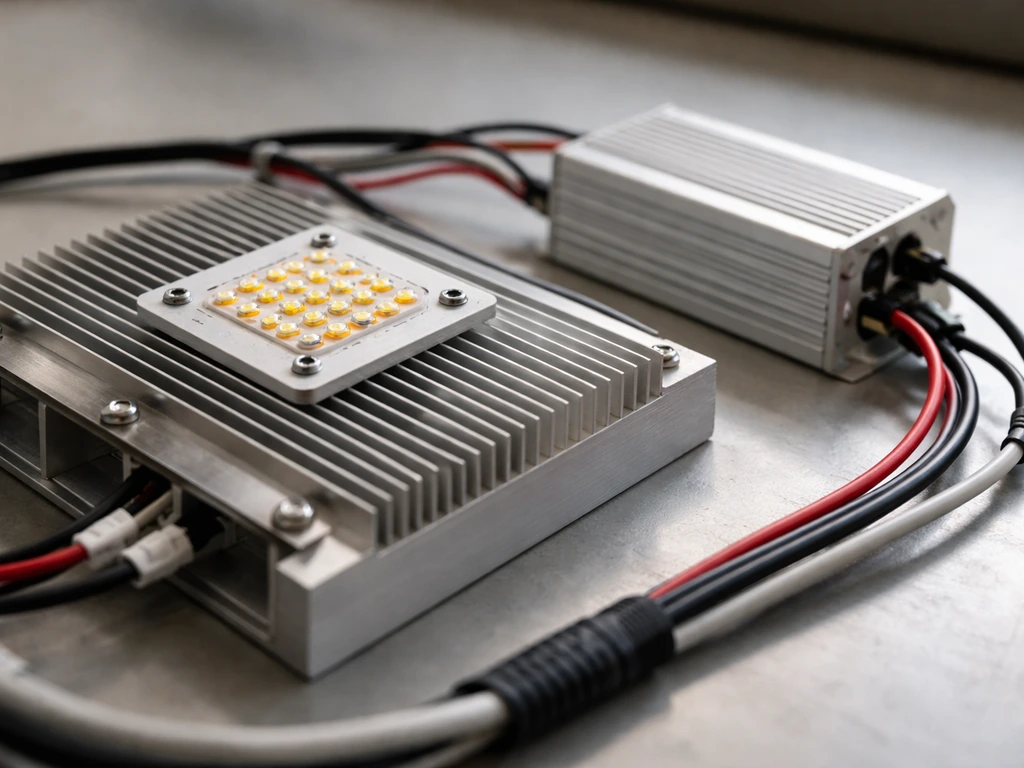
The LED diode and driver are the two components that determine both performance and lifespan. Samsung LM301B and LM301H are reliable benchmarks for white diodes. LM301H EVO is the current top-bin option from Samsung. For red supplemental diodes, Osram SSL 660 or Osram Olson SSL 730 are the reference-grade choices. On the driver side, Meanwell HLG and ELG series are the industry standard for reliability. MEAN WELL’s HLG-60H-B series supports 0, 10V dimming and multiple compatible “three in one” dimming input types (1, 10Vdc, 10V PWM, or resistance depending on configuration) 0–10V dimming and multiple input control types. If a manufacturer won't tell you what diodes and driver they're using, that's a red flag.
Your buying checklist and setup tips
Before you buy anything, run through this checklist. It takes five minutes and will save you from returning a light that doesn't fit your actual setup.
- Measure your grow space exactly. Width x length in feet gives you square footage. Know this number before you look at a single product listing.
- Decide your primary use: seedlings/clones only, veg only, full cycle veg-to-flower, or flowering only. Each stage has different PPFD targets.
- Set your wattage target: 20–30W per sq ft for veg, 35–50W per sq ft for dense flowering. Multiply by your square footage to get your target draw.
- Find a fixture with a published PPFD map at your mounting height, not just a peak center number.
- Confirm the efficiency rating in µmol/J is listed. Anything below 2.0 is outdated technology.
- Check the SPD chart for a genuine broad-spectrum output from 400–700 nm minimum.
- Verify diode brand (Samsung, Osram, or equivalent top-tier) and driver brand (Meanwell or equivalent).
- Look for UL 8800 listing or equivalent safety certification, especially for tent or commercial use.
- Confirm the fixture has a dimmable driver. This is non-negotiable for seedling stages and gives you flexibility for the full grow cycle.
- Calculate your DLI target using your PPFD and planned photoperiod hours. For seedlings, target 6–12 mol/m²/day. For flowering, 30–45 mol/m²/day depending on strain.
Once your light arrives, don't run it at full power on day one. Start seedlings at 20 to 30% power or mount the fixture 36 to 48 inches above the canopy and work down as plants establish. For transplants moving into veg, give them two to three days to acclimate before ramping intensity. Measure your actual PPFD at canopy level with a PAR meter if you're serious about dialing in results. A decent Apogee or Photone-calibrated sensor will tell you exactly what your plants are receiving, not what the spec sheet promises.
One practical setup note: heat management in enclosed tents is real. Even efficient fixtures put out some heat, and in a 4x4 tent with a 480W light, ambient temps can climb 10 to 15°F above room temperature without adequate exhaust. Size your inline fan for the tent volume and run it continuously during the photoperiod. This keeps both your plants and your driver (which degrades faster at high temps) running in their optimal range. A well-run setup with a mid-range fixture will outperform a poorly ventilated premium light every time.
FAQ
If a fixture has a great PPFD number in the center, how do I know the edges are usable for my plants?
Look for a PPFD map that reports multiple grid points across the stated footprint, then check the center-to-edge spread. A practical target is 20 to 25% variation or less, and if the manufacturer only shows one hotspot value, plan on lower density at the edges or reduce your effective coverage area.
Do I actually need far-red in a “best full spectrum led grow lights” choice for flowering?
Not always. Far-red (around 700 to 730 nm) can support photomorphogenic responses like the Emerson enhancement effect, but the benefit depends on your strain and target (compactness, stretch control, and flowering speed). If your goal is maximum photosynthesis per watt, prioritize strong PAR coverage and only pick far-red if the fixture includes it with documented ratios or SPD detail.
What should I do if my tent is small and the light has to be mounted higher than recommended?
Higher mounting drops PPFD quickly, so you have to compensate either by using a higher-output fixture or relying on dimming plus a verified PPFD map at your height. If the manufacturer only provides maps at 18 to 24 inches (flower) and you must run closer to 30+ inches, assume center performance will not translate to edge performance and confirm with a canopy PPFD measurement.
How can I tell whether the “full spectrum” claim is legit if they do not provide an SPD chart?
Ask for a full spectral power distribution or at least a breakdown of spectral components (white phosphor spectrum plus discrete red and far-red). If they refuse, or they only list color temperature and marketing phrases, treat it as a risk because some lights mimic blurple output while still calling themselves full spectrum. For planning purposes, you may end up overbuying or underdelivering the red and blue balance.
Is watts-per-square-foot the best way to compare lights, or does it lead me wrong?
It’s a starting rule, but it can mislead when brands report “equivalent” wattage or when cooling and dimming behavior differ. The better decision aid is PPFD at canopy level, plus uniformity, measured or mapped. Use watts-per-square-foot only after confirming the fixture’s actual draw, dimming range, and the published PPFD map for your mounting height.
Why does my plant look bleached even though the light is “dimmable”?
Bleaching often comes from mounting too low, running too high a duty cycle, or lack of uniformity where tops see more PPFD than you think. Dimming helps, but you still need to dial by measurement (PPFD at canopy) or by gradual intensity ramping. Also check whether the fixture has discrete driver modes that jump intensity in steps, which can make “fine” adjustments harder.
Can I skip PPFD measurements and rely on the app or manufacturer numbers?
You can, but you increase the odds of being off by a lot, especially with different mounting heights, reflectivity, and plant canopy density. Apps often estimate based on assumptions rather than your exact setup. If you are doing anything precise like seedling DLI targets, measuring PPFD at canopy is the quickest way to avoid underfeeding or overdriving young plants.
What’s the easiest way to translate PPFD settings into a daily light integral (DLI) for seedlings?
Use the relationship DLI (mol/m²/day) equals PPFD (µmol/m²/s) times photoperiod in seconds divided by one million. Then pick a target DLI range for your stage, for example 6 to 12 for seedlings, and adjust either intensity (via dimming) or runtime while keeping spectrum consistent.
When choosing the dimming range, should I care more about how low it goes or how smoothly it changes?
Both matter. For seedlings and clones you often need to run around 20 to 30% of maximum output to hit the 100 to 300 PPFD target. Smooth dimming makes it easier to dial without overshooting, while a light that only supports coarse driver steps can cause stress even if it is labeled dimmable.
Do UL 8800 listed fixtures always matter for a grow tent?
They matter most when conditions are humid, you are using enclosed tents, and you have permanent cabling near irrigation. Even if a fixture works initially, non-certified drivers can age faster under heat and moisture, raising failure and shock risk. If you are hard-mounting or using long photoperiods, prioritize UL 8800 or equivalent third-party certification.
What diode and driver info should I look for without getting lost in marketing?
Confirm both sides: the exact LED diode model (for example LM301B/LM301H EVO for white) and the driver family (for example Meanwell HLG/ELG series). If the brand won’t disclose either component, assume performance and longevity are less predictable. Also check whether they list driver current and voltage requirements, since mismatched electronics can limit safe dimming.
Are screw-base “full spectrum LED grow light bulbs” ever a good choice if I want the best full spectrum led grow lights for a tent?
Generally no for tents. Screw-base bulbs usually cap at low actual wattage and provide usable PPFD over roughly a tiny area directly under the bulb, so a tent needs multiple bulbs with gaps that create uneven canopies. They are better as supplements near windows or for small trays, but for a true tent, a dedicated fixture with documented PPFD mapping is the baseline.
How should I acclimate plants after switching to a stronger full spectrum fixture?
Ramp gradually instead of jumping to the target intensity on day one. For seedlings or sensitive transplants, start at around 20 to 30% output or mount higher, then work down over several days. If you are moving from veg to flowering intensity changes, give a short acclimation window and recheck canopy PPFD because canopy height and plant density quickly alter how much light actually reaches leaves.
Next Articles
Best Full Spectrum 1000W LED Grow Lights: Buyer Guide
Buy the best full spectrum 1000W LED grow light with spec-to-decision tips on PPFD, coverage, wattage, and tent fit.
Best 100W LED Grow Light: How to Choose the Right One
Choose the best 100W LED grow light with PPFD coverage, spectrum, efficiency, dimming, heat, and setup tips.
Best LED Grow Light to Replace 1000W HPS: Sizing Guide
Sizing and buying guide to replace a 1000W HPS with the right LED using PPFD, layout, mounting, and spectrum for yields.