LED grow lights are better than fluorescent in almost every measurable way for most growers today. That is the direct answer. But the longer answer matters because fluorescent setups still make sense in a few specific scenarios, and if you are running T5 HO fixtures for seedlings or cuttings, you may not need to swap anything out right now. This guide breaks down exactly where the differences show up in real grows, what the numbers actually mean, and which option fits your situation.
Fluorescent vs LED Grow Lights: Which to Choose Today
Marcus Rutherford
3 Apr 2026
What fluorescent and LED grow lights actually are
Fluorescent grow lights are not the same as the tubes in an office ceiling. Both use the same underlying technology, but the products sold for growing are optimized differently. Here is the quick breakdown of how each type works.
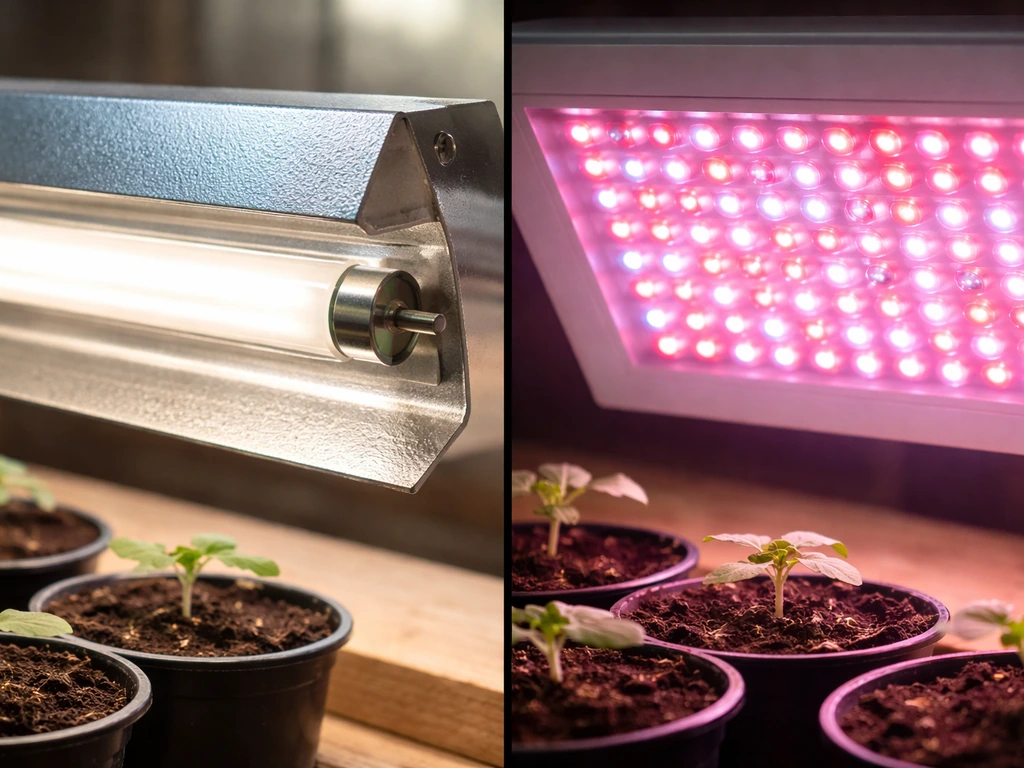
Fluorescent lamps produce light through an electric discharge inside a gas-filled tube. That discharge excites mercury vapor, which emits UV radiation, and then a phosphor coating on the inside of the tube converts that UV into visible light. The phosphor blend is what determines the color output. For growing, the three main formats are T5, T8, and T12 (the "T" number refers to tube diameter in eighths of an inch), and within those, T5 HO (High Output) is the most relevant because it delivers meaningfully more output than standard T5 or T8 lamps. A specific example: the LEDVANCE/SYLVANIA PENTRON 800 HO T5 lamp is rated at 80 W, which is nearly double the draw of a standard T5, and it is designed to hit peak lumen output around 95°F (35°C). All of these fluorescent systems require a ballast, which is the component that provides starting voltage and regulates current to keep the lamp stable. Compact fluorescent lamps (CFLs) follow the same discharge-and-phosphor principle in a smaller, screw-in form factor, and growers use them in lower-budget or space-constrained setups by selecting warm (2700K) or cool (6500K) color temperatures depending on the plant stage.
LED grow lights are purpose-built luminaires that use solid-state LED chips, a driver that converts AC power to regulated DC current, and optics or reflectors to shape the beam. There is no gas discharge, no mercury, and no phosphor conversion on the tube wall. The driver and optics design matters more than most buyers realize: driver quality affects flicker, thermal management, and how consistent output stays over time, while reflector or lens design determines how tightly or broadly light spreads across a canopy. When people use the term "grow light" as opposed to "fluorescent light," they are usually referring to purpose-built LED fixtures, though technically any light used to grow plants is a grow light. The terminology confusion comes from the fact that T5 HO fluorescent fixtures are legitimately sold and used as grow lights, and standard household CFLs have been used for growing for years.
The core differences that actually affect your plants
Spectrum and full-spectrum behavior
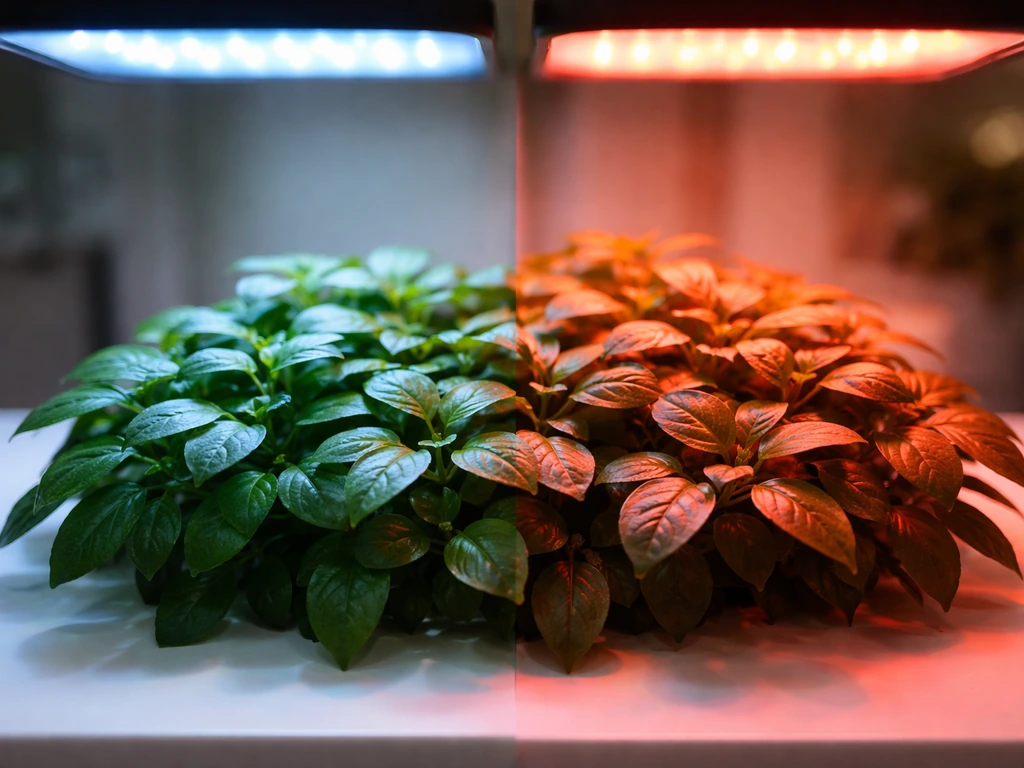
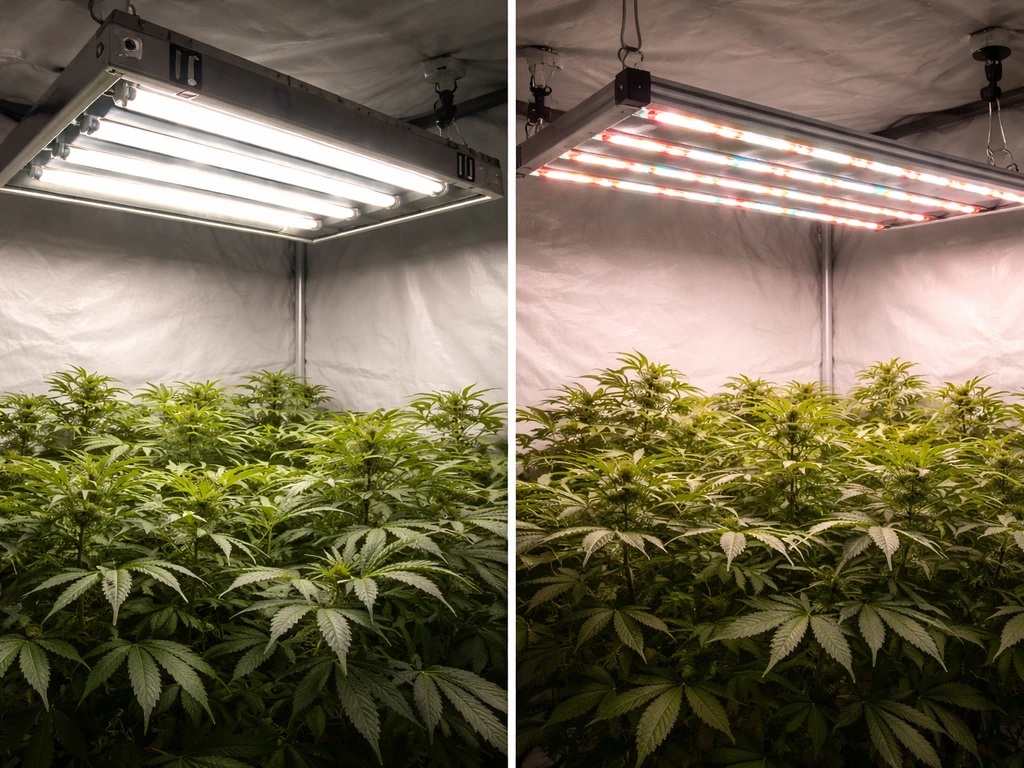
Plants use light in the 400 to 700 nm range (Photosynthetically Active Radiation, or PAR), with blue light (400 to 500 nm) driving vegetative growth and red light (600 to 700 nm) pushing flowering. Fluorescent lamps deliver spectrum based on their phosphor blend and color temperature. A 6500K T5 HO is strong in blue, useful for veg; a 3000K CFL leans warm and can supplement flowering. But fluorescent tubes cannot be meaningfully adjusted. You swap bulbs or mix fixtures if you want to shift the spectrum. LED grow lights, especially full-spectrum boards using white LEDs with added red diodes, can cover the entire PAR range in a single fixture, and many modern LEDs let you dial in the ratio of channels via dimming controls. Some include UV and far-red (700 to 800 nm) diodes that can improve resin production and speed up flowering, ranges that fluorescent lamps simply do not reach with standard phosphors.
PPFD, coverage, and canopy penetration
PPFD (Photosynthetic Photon Flux Density) is measured in micromoles per square meter per second (μmol/m²/s) and tells you how many photons are actually hitting the plant surface. Seedlings need roughly 100 to 300 μmol/m²/s, veg runs well at 400 to 600, and flowering plants benefit from 600 to 900 or more. A four-lamp T5 HO fixture (4 x 54 W = 216 W) covering a 2x4 foot footprint will deliver somewhere around 400 to 500 μmol/m²/s at 6 inches from the canopy, which is adequate for veg but falls short for dense flowering. Scaling that to a 4x4 tent requires two four-lamp fixtures, putting you at 430+ watts of fluorescent draw just to reach moderate veg-level PPFD. A single quality LED board designed for a 4x4 space at 200 to 250 W can hit 800 to 1000 μmol/m²/s across the same footprint. The efficiency gap here is significant. Fluorescent output also drops quickly with distance because the lamps are linear, diffuse sources with limited directionality. LEDs with focused optics maintain usable PPFD much further from the canopy, which also means better light penetration into a denser canopy.
Efficiency: PPE and what it means in practice
Photon Efficacy (PPE) measures how efficiently a fixture converts electrical watts into PAR photons, expressed in μmol/J. T5 HO fluorescent fixtures land around 1.0 to 1.4 μmol/J in practice. Modern mid-range LED grow lights hit 2.0 to 2.8 μmol/J, and premium fixtures push past 3.0 μmol/J. That gap means an LED delivering 600 μmol/m²/s might use half the watts a fluorescent setup needs to reach the same number. Over a 12-week cycle with lights running 18 hours a day, that difference adds up to real dollars and real heat load.
Heat, power draw, and what it costs to run each
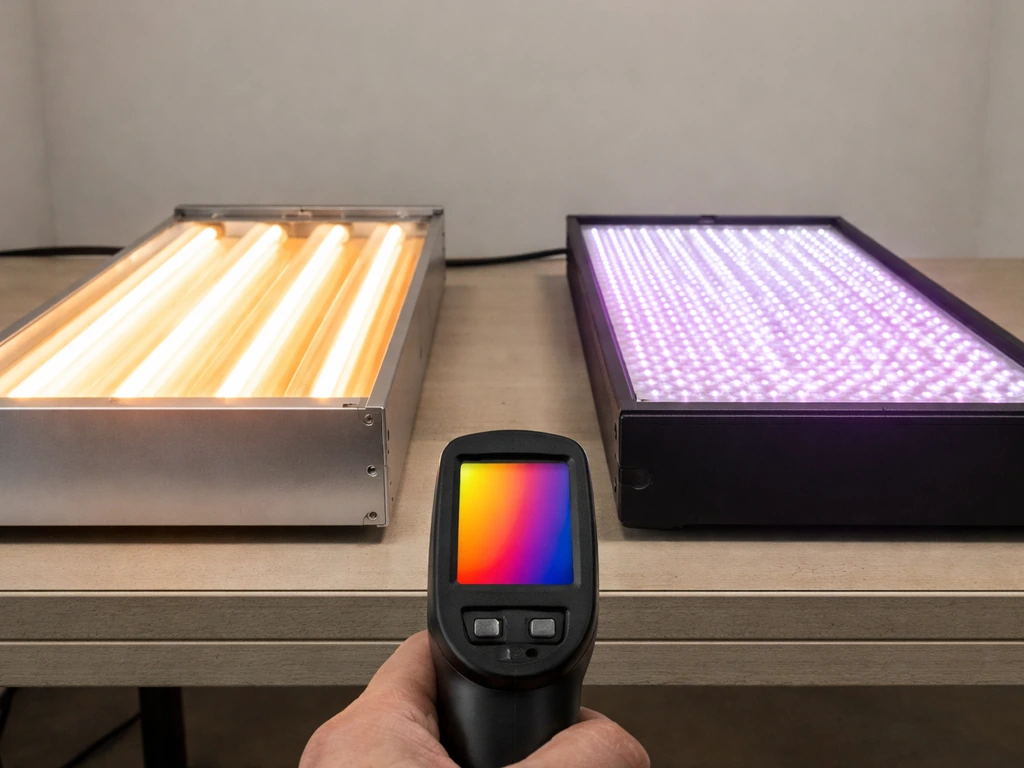
Fluorescent lamps convert a substantial portion of their input power into heat, and that heat comes off the lamp surface directly into the grow space. T5 HO fixtures run warm, which can be useful in a cold basement but is a liability in a summer tent grow. More importantly, heat at the lamp surface forces you to keep lights higher above the canopy, which further reduces the already-limited PPFD reaching the plants. LEDs concentrate waste heat on a heatsink, which can be managed with passive cooling or a small fan, keeping the fixture surface cooler and allowing closer placement to the canopy.
On operating costs, the math is straightforward. If you are running fluorescent fixtures at 430 W for 18 hours a day to cover a 4x4 tent through veg, that is about 7.7 kWh per day. At a national average of roughly $0.16 per kWh (2026 US average), that is about $1.23 per day or $37 per month. A quality LED covering the same space at 220 W draws 3.96 kWh per day, or about $0.63 per day and $19 per month. The $18/month savings pays off the cost difference between a T5 setup and a mid-range LED within 6 to 12 months depending on what you spend on each. Add in summer cooling costs from fluorescent heat load and the LED payback period shrinks further.
| Factor | T5 HO Fluorescent (4x4 coverage) | LED Grow Light (4x4 coverage) |
|---|---|---|
| Typical wattage needed | 400-450 W | 200-250 W |
| PPE (efficiency) | 1.0-1.4 μmol/J | 2.0-3.0+ μmol/J |
| PPFD at canopy (flowering) | 400-500 μmol/m²/s | 700-1000 μmol/m²/s |
| Monthly operating cost (est.) | ~$35-40 | ~$17-22 |
| Heat output | High (lamp surface) | Moderate (heatsink managed) |
| Full-spectrum / tunable | No (fixed phosphor) | Yes (most modern fixtures) |
| Dimming control | Limited (requires ballast support) | Yes (most fixtures) |
| Lifespan | 10,000-20,000 hours | 50,000+ hours |
Lifespan, maintenance, and what breaks over time
T5 HO lamps are rated for roughly 20,000 hours at best, but lumen output degrades long before the lamp stops working. A sustainability review in MDPI Sustainability notes that LED lighting system lifetime is often defined using L70/L80/L90, and that evaluation is based on IES LM-80 test data plus projection methods. Most fluorescent grow lamps lose 15 to 30 percent of their output by the time they hit the halfway point of their rated life. That means your plants are getting measurably less light by month 12 to 18 of use, even if the lamp still turns on. Factor in replacement costs (around $5 to $15 per T5 HO lamp, multiplied by the number of lamps in your fixture) and the time spent swapping tubes, and maintenance becomes a real ongoing cost. Standard CFLs have similar or shorter rated lives, often 8,000 to 15,000 hours, with the same lumen depreciation issue.
LED grow lights are rated for 50,000 hours or more, and quality fixtures hold output much better across their lifespan. A reputable LED board designed for a 4x4 or 5x5 space might see 10 to 20 percent lumen depreciation at 50,000 hours. There are no tubes to replace, no ballasts to fail, and no mercury-containing lamps to dispose of. When disposing of mercury-containing lamps, the US EPA notes that disposal and recycling requirements can differ depending on lamp type and the regulatory framework that applies. The upfront cost is higher, but you are essentially buying 5 to 10 years of lower-maintenance operation. The one thing that kills LEDs prematurely is heat: fixtures without adequate heatsinking or that are run in very hot environments will degrade faster, so thermal management in the fixture design matters.
Which one should you actually use? Recommendations by scenario
Here is where this gets practical. The right answer depends on what you are growing, at what scale, and what you have already invested.
- Seedlings and cuttings only: T5 HO fluorescent is still a legitimate choice here. Low PPFD requirements (100 to 300 μmol/m²/s) mean fluorescent fixtures are adequate, and the diffuse, even light spread is actually useful for trays of small plants. If you already have a T5 fixture, keep it for this stage. If you are buying new, a low-wattage LED panel is just as good and cheaper to run, but not dramatically better for seedlings.
- Vegetative growth in a small space (2x2 to 3x3): LED wins on efficiency and control. A 100 to 150 W LED panel in this footprint delivers better PPFD with more spectrum flexibility than equivalent fluorescent coverage. The cost gap is also smallest here, making the switch easy to justify.
- Full cycle growing in a 4x4 tent (veg through flower): LED is the clear winner. You need 600 to 900 μmol/m²/s for flowering, and hitting that with fluorescent requires stacking fixtures and wattage in ways that push heat and operating costs up fast. A single 200 to 250 W quality LED board designed for 4x4 coverage handles this cleanly. If you want to understand how specific tube-based options compare before fully committing to LED, the T8 vs LED grow light breakdown is worth reading before you buy.
- Commercial scale grows: Fluorescent is not a practical option at commercial scale. The wattage and fixture count required to hit commercial PPFD targets makes fluorescent economically unviable compared to LED. Operating cost, maintenance labor, and heat load all scale in the wrong direction.
- Tight budget, first grow, short-term setup: If you genuinely cannot stretch to a quality LED right now and you already have fluorescent hardware, use what you have for seedlings and veg, then upgrade before flowering. A cheap LED is not always the right move either; read up on whether a budget LED is actually worth it vs spending more before making that call.
How to compare fairly: specs to check and how to size a light
The specs that matter when shopping
When comparing any grow light, fluorescent or LED, these are the numbers you actually need. Lumens are not useful for plant lighting; they measure human-eye perception, not photosynthetic output. PPFD maps (measured at a stated distance, usually 18 to 24 inches) tell you how much PAR is hitting a defined area. PPE (μmol/J) tells you how efficiently the fixture converts watts to photons. Coverage area should be stated at a specific PPFD target, not just square footage. For LEDs, check whether the driver brand is mentioned (MeanWell is a common quality benchmark) and whether the fixture lists any dimming range. For fluorescent, the lamp wattage and HO designation matter more than brand claims.
Sizing for common tent setups
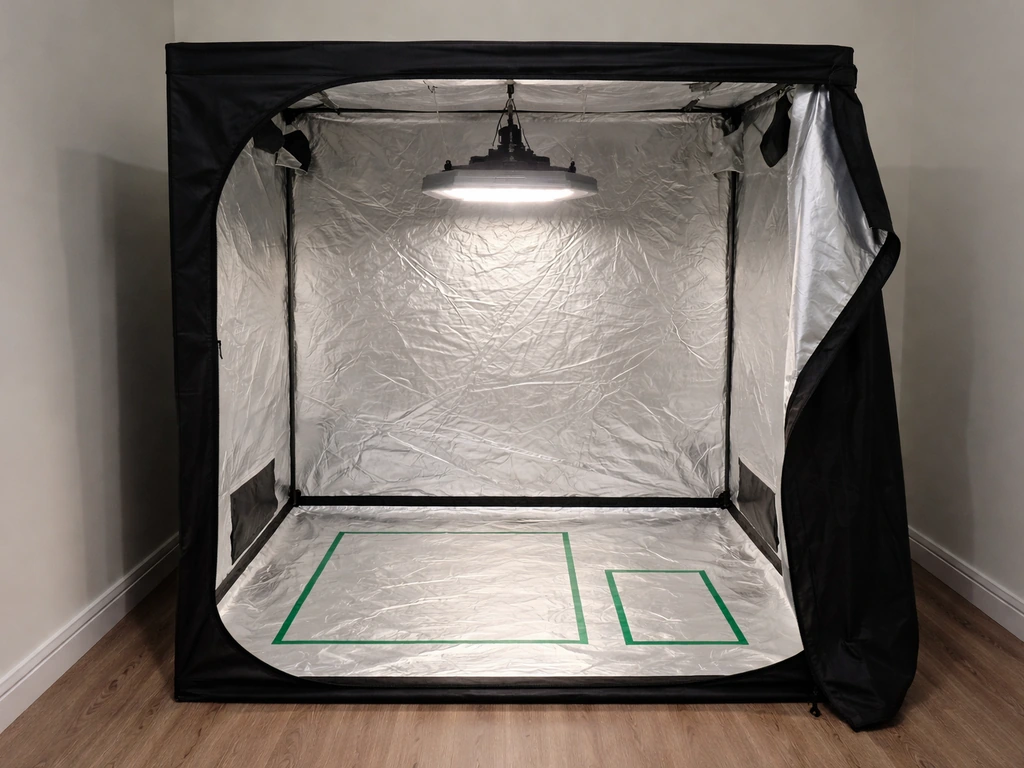
A rough rule for LED sizing: target 30 to 50 W of actual LED draw per square foot for flowering, and 20 to 30 W per square foot for veg. A 4x4 tent (16 sq ft) in flower needs 480 to 800 W of LED draw for serious results, though well-designed fixtures with high PPE can do it at the lower end of that range. A 3x3 (9 sq ft) needs 270 to 450 W. For seedlings, you can drop to 10 to 20 W per square foot. With fluorescent, the math is harder because efficacy is lower and you need to verify PPFD at canopy distance rather than trusting wattage alone. Two four-lamp T5 HO fixtures covering 4x4 gives you about 430 W but significantly less usable PPFD at flowering distances than a single mid-range LED.
Common buying mistakes to avoid
- Buying on wattage alone. A 1000 W blurple LED from a no-name brand often underperforms a 300 W quality white-LED board. Actual PPFD data at your canopy distance is what matters.
- Ignoring coverage area claims. "Covers 4x4" sometimes means the light barely hits 200 μmol/m²/s at the edges. Always look for PPFD maps or at minimum center and edge readings.
- Assuming any fluorescent tube is a grow light. Standard cool-white office T8s are not designed for plant spectrum and will underperform purpose-built grow lamps.
- Overlooking heat in the fixture selection. A high-wattage LED without proper heatsinking in a warm grow space will degrade faster and run less efficiently than rated.
- Not accounting for total cost of ownership. A cheaper fluorescent fixture that costs $40 more per month to run and needs lamp replacements every 18 months will cost more over three years than a quality LED at twice the upfront price.
The bottom line: if you are starting fresh today, buy a quality LED fixture sized for your tent and plant stage. If you have fluorescent hardware, use it for seedlings and cuttings where it genuinely competes, but plan to replace it before you hit the flowering stage in anything larger than a 2x3 space. The technology gap between modern LED and fluorescent is wide enough that it shows up in your harvest, your electricity bill, and how much time you spend managing your setup.
FAQ
How can I tell if an LED grow light will actually deliver the PPFD my plants need at my canopy height?
Look for a fixture that states PPFD or PAR at a defined distance and ideally includes a PPFD map (for example at 18 or 24 inches). If the listing only says lumens or “full spectrum,” it is not enough for sizing, because fluorescent and LED optics change how fast PPFD falls with height.
If LEDs are dimmable, can I buy a stronger fixture and just dial it down for veg and seedlings?
Yes, dimming can help prevent stress, but it should be used as a control, not a substitute for correct sizing. Start near the recommended PPFD for your stage, dim gradually if you see clawing or leaf curl, and confirm with an app, meter, or PPFD map rather than setting a random percentage.
When do T5 HO fluorescent fixtures still make sense instead of switching to LED right away?
T5 HO fluorescents can be a cost-effective stopgap for seedlings and clones in small spaces because they are relatively efficient for fluorescents and easy to run at close distances. However, you will usually reach a ceiling on flowering brightness in 3x3 or larger tents without multiple fixtures, so you should treat them as a transitional setup rather than a long-term flower solution.
What are common fluorescent failure points besides the tubes, like ballasts?
If your fluorescent system uses a ballast, confirm you are replacing or servicing the ballast when performance drops, not just the tubes. Ballast issues can cause dim output, flicker, or inconsistent start-up, which will ruin uniformity long before the lamps reach their labeled hour rating.
Why does canopy uniformity matter, even if my average PPFD looks right?
Many growers focus on total PPFD, but plant response depends on uniformity across the canopy. Two setups can have the same average PPFD, while one has hot spots and weak corners. Choose fixtures that report distribution (a PPFD map) or have good optical control, especially for 4x4 tents where coverage errors show up.
Can LED driver quality affect plant outcomes, not just electricity or comfort?
Yes, LED drivers can introduce flicker depending on design and dimming method. If you grow with cameras, do time-lapse, or notice unusual plant responses during dimming, prioritize listings that mention low flicker, and avoid overusing very low dimming percentages unless the driver is designed for it.
Which type is more likely to cause problems in a hot tent environment?
Heat management is different for LEDs than fluorescents. With LEDs, poor heatsinking or a stalled fan can shorten lifespan, while with fluorescents the lamp surface heat raises the whole tent temperature and can force you to keep lights further away. In hot climates or summer cycles, that difference can be the deciding factor.
How should I time fluorescent lamp replacements if I care about consistent flowering results?
Replace fluorescent tubes based on output decline, not on whether they still “turn on.” A practical approach is to schedule replacement before you start the flowering ramp, then verify results with a PPFD check if possible, especially if you are aiming for dense buds where lighting margins are tighter.
What is the safest way to compare lights when I do not have a PPFD meter?
If you cannot measure PPFD, you can still use a decision aid: treat wattage as a rough starting point only, and focus on verified coverage claims, stated dimming range, and efficiency (PPE) where available. LEDs with higher μmol/J typically give more usable light per watt, meaning you can maintain canopy distance without sacrificing output.
How do I avoid misleading claims about “coverage area” when shopping for fluorescent vs LED?
Watch for “coverage at target PPFD” and whether that target matches your plant stage. Some brands quote coverage for seedlings or low PPFD targets, then the usable intensity at flowering drops off quickly. For buying, ensure the stated coverage applies to the PPFD level you actually need.
Are CFLs ever a good middle ground for small grows, or are they usually too weak?
For CFLs used in very small setups, the biggest limitation is not spectrum choice, it is intensity and distance. CFL light falls off quickly and can be hard to distribute evenly across a canopy, so CFLs are usually best for a few plants or supplemental lighting rather than the main source for flowering.
What is the best way to transition from fluorescent for clones or seedlings to LED for flowering without stressing plants?
If you plan to keep fluorescent for seedlings and then switch for flowering, plan the re-mounting and timing so the transition does not coincide with a growth shock. For example, move seedlings to the next stage light on a consistent schedule, then adjust height and dimming to match veg PPFD before the flowering ramp.
Next Articles
Best Full Spectrum 1000W LED Grow Lights: Buyer Guide
Buy the best full spectrum 1000W LED grow light with spec-to-decision tips on PPFD, coverage, wattage, and tent fit.
Best 100W LED Grow Light: How to Choose the Right One
Choose the best 100W LED grow light with PPFD coverage, spectrum, efficiency, dimming, heat, and setup tips.
Best LED Grow Light to Replace 1000W HPS: Sizing Guide
Sizing and buying guide to replace a 1000W HPS with the right LED using PPFD, layout, mounting, and spectrum for yields.