The best CREE COB LED grow light for most home tent growers right now is a fixture built around the Cree CXB3590 COB, properly heatsinked, driven conservatively, and paired with a quality constant-current driver. That one sentence covers the core of it. Everything else in this guide is about helping you verify that a specific product actually delivers on that description, match coverage to your tent size, and avoid the flood of fixtures that slap "COB" in their name without backing it up.
Best CREE COB LED Grow Light: Reviews and Buying Guide
Marcus Rutherford
7 Apr 2026
What a COB LED grow light actually is (and what makes Cree special)
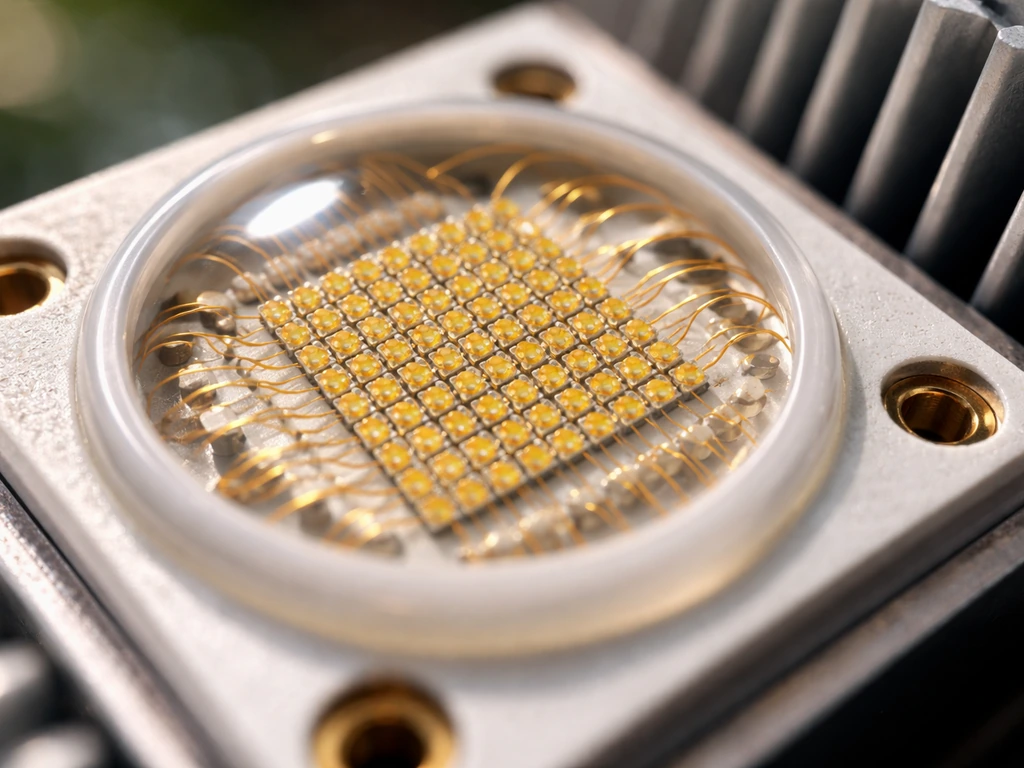
COB stands for chip-on-board. Instead of mounting individual LED dies across a wide board with spacing between them, a COB packages dozens or hundreds of LED dies directly onto a single substrate, then covers the whole cluster with a phosphor and epoxy lens. The result is a single, high-intensity point source rather than a grid of smaller emitters. That construction changes three things that matter to growers: the optics (you can use a secondary reflector or lens to concentrate or spread the beam more predictably), the thermal load (all that heat is concentrated in one spot, which demands serious heatsinking), and the spectral output (phosphor conversion produces a smoother, broader spectrum from a single package).
Cree's XLamp CXB3590 is the specific COB family that earned a near-legendary reputation in DIY and commercial grow circles. It's a square-format, high-flux chip-on-board device with a defined light-emitting surface and specific forward voltage and current ratings documented in Cree's own datasheet. The reason growers care about it: when driven correctly and kept cool, the CXB3590 is rated at L90 and L70 lifetimes both exceeding 61,000 hours under test conditions per Cree's LM-80 and TM-21 results.
That's not marketing copy, that's a published application note with specific drive current and case temperature parameters. The catch, and it's a big one, is that those lifetime numbers only hold when the fixture maintains proper thermal equilibrium at the package-to-heatsink interface. Cree specifies everything around case temperature (Tc) because junction temperature is what actually kills LEDs, and Tc is the measurable proxy.
COB vs other LED types: are they actually better?
The honest answer is: better at some things, worse at others. COB lights are not universally superior to quantum boards or bar-style LEDs, but they have specific advantages that matter depending on how you grow.
| Feature | COB LED | Quantum Board | Bar-Style LED |
|---|---|---|---|
| Light source | Single high-intensity point per COB | Many small SMD chips spread across board | SMD/mid-power chips along strips |
| Spectrum | Broad, phosphor-converted, smooth | Usually full-spectrum, tunable | Often tunable, narrow-band options common |
| Canopy penetration | Strong (high intensity at source) | Good but more diffuse | Good, wide spread |
| Heat management | Demanding — concentrated heat per COB | More distributed, easier passively | Distributed, usually manageable |
| Uniformity over large areas | Requires multiple COBs or reflectors | Excellent with proper spacing | Excellent |
| Dimming/control | Depends entirely on driver choice | Often built-in dimming standard | Often built-in dimming standard |
| DIY friendliness | High — modular per COB | Moderate | Moderate |
| Typical efficiency (2026) | Up to ~2.5–2.8 μmol/J quality builds | 2.6–3.0+ μmol/J top boards | 2.5–3.0+ μmol/J top bars |
| Upfront cost for equivalent PPFD | Moderate to high | Low to moderate | Moderate to high |
The biggest real-world difference growers notice is canopy penetration. Because a COB is a concentrated point source, it tends to punch light deeper into a dense canopy compared to a diffuse quantum board at the same average PPFD. That matters in late flower when your buds are stacked. The tradeoff is uniformity: a single COB or a small cluster of COBs will have hot spots directly below each emitter and dimmer zones at the edges.
Well-designed multi-COB fixtures address this with reflectors and calculated COB spacing, but cheap builds often skip that engineering. Quantum boards win on uniformity and are currently edging ahead on peak efficiency in top-tier commercial products, but a quality COB fixture driven conservatively is still an excellent choice and, depending on your setup, can outperform a budget quantum board in canopy penetration and longevity.
Full spectrum vs partial spectrum: what the phosphor actually gives you
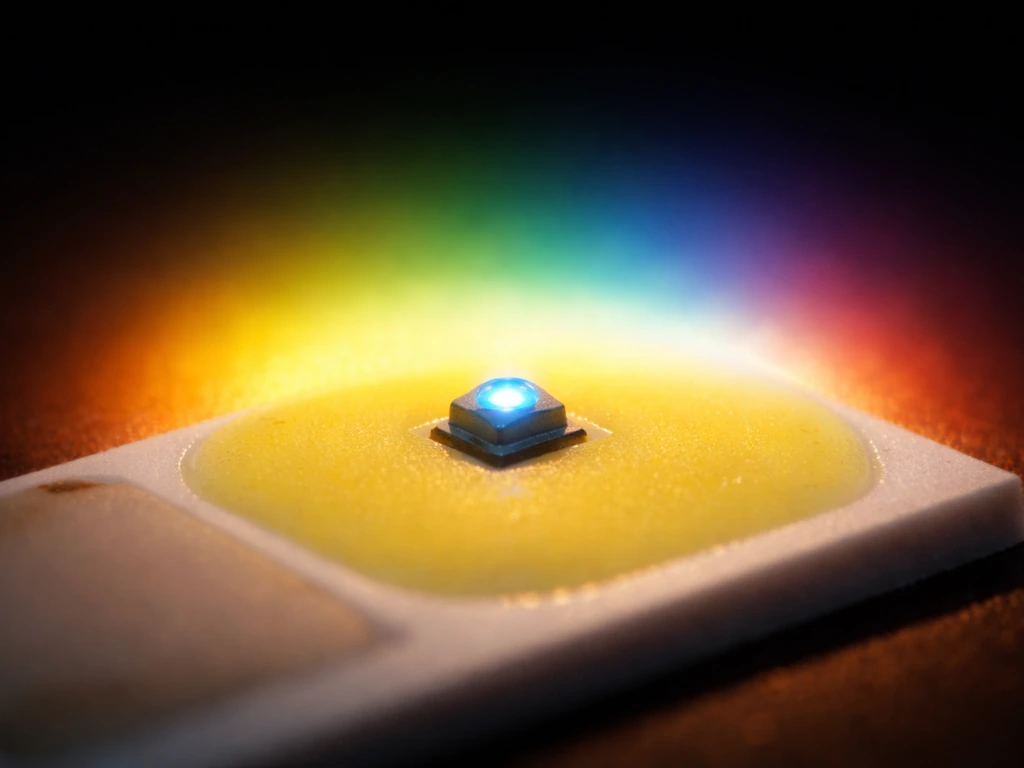
A true full-spectrum COB uses a blue LED chip under a broad-spectrum phosphor blend to produce output across the photosynthetically active radiation range (roughly 400–700 nm) with some output in far-red (700–750 nm). This is similar to how a single white LED works, and it's why COB-based fixtures look "white" rather than blurple. For cannabis and most fruiting crops, you want representation across blue (430–480 nm) for veg and red (620–680 nm) for flower, with a color temperature somewhere between 3000K–4000K covering both reasonably well.
The CXB3590 is available in different color bins. The 3500K version is probably the most popular for flowering and all-stage grows because it has a strong red component while retaining enough blue to run veg without issues. The 4000K version leans cooler and suits dedicated veg rooms. Some growers mix both. What you want to avoid is fixtures labeled "full spectrum" that are actually just a blend of narrow-band red and blue LEDs, which is a separate technology from phosphor-converted COBs and produces the classic blurple look. That's not inherently bad, but it's not what the COB format delivers.
The practical advice: check whether the fixture has a continuous spectral power distribution curve (not just a two-peak red/blue graph) and look for a color rendering index (CRI) rating of 80+ or a stated color temperature. Those two data points confirm you're getting genuine phosphor-converted full-spectrum output from the COB, not a misleadingly labeled mixed-LED product.
How to pick the right COB grow light for your space
Start with your target PPFD and coverage area
PPFD (photosynthetic photon flux density, measured in μmol/m²/s) at the canopy is the number that actually drives plant growth, not the fixture's wattage rating. Wattage is a proxy and a rough one. The practical formula growers use: average PPFD ≈ (fixture PPF output ÷ coverage area in m²) × system efficiency factor. For a quick sanity check, a 400W fixture producing 1000 μmol/s PPF covering a 4x4 (1.49 m²) gives you roughly 670 μmol/m²/s at canopy, which is mid-veg range. Adjust height to dial in the exact number.
For cannabis specifically: seedlings and cuttings are happy at 50–300 μmol/m²/s, veg runs best at 400–600 μmol/m²/s, and flowering wants 700–900 μmol/m²/s for most strains. Push past 900 without CO2 supplementation and you're likely hitting diminishing returns or light stress. Those targets shape everything about which fixture you buy and how you hang it.
Match wattage to tent size
A useful working rule for COB fixtures targeting full-flower PPFD: 200–250W actual draw for a 2x2, 400–550W for a 4x4. "Actual draw" means what the fixture pulls from the wall, not an "equivalent" or "peak" marketing number. Always ask for or measure the actual wattage.
- 2x2 tent (0.37 m²): 150–250W actual draw, targeting 700–900 μmol/m²/s flower PPFD
- 3x3 tent (0.84 m²): 300–400W actual draw
- 4x4 tent (1.49 m²): 400–600W actual draw
- 5x5 tent (2.32 m²): 600–800W actual draw
- 4x8 tent (2.97 m²): two independent fixtures recommended over one large unit
Evaluate the driver, not just the COB
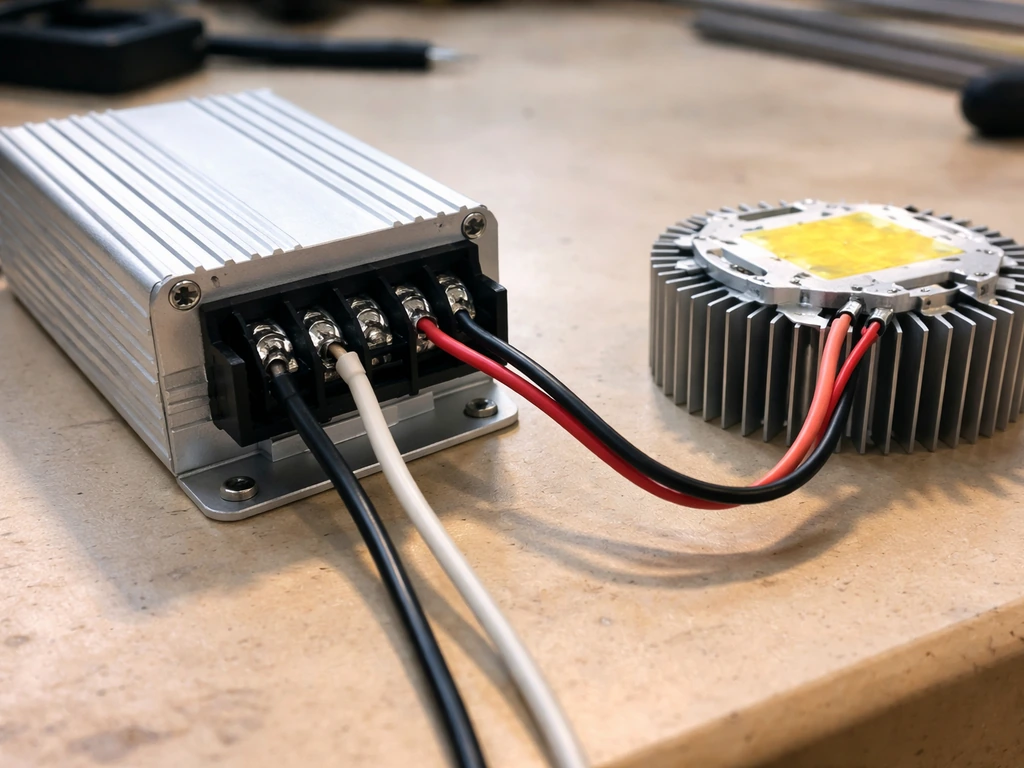
The driver is half the equation. A CXB3590 COB run on a cheap, poorly regulated driver that swings current and creates thermal spikes will underperform and fail early. Quality fixtures use Meanwell HLG-series or equivalent constant-current drivers. These are dimmable (0–10V or PWM), run efficiently, and are rated for 50,000+ hours themselves. The MEAN WELL HLG-120H specification sheet lists dimming input options including PWM and analog dimming for the HLG-120H series dimmable (0–10V or PWM). If a fixture listing doesn't name the driver brand, that's worth questioning directly before you buy.
Heatsink and thermal design: non-negotiable
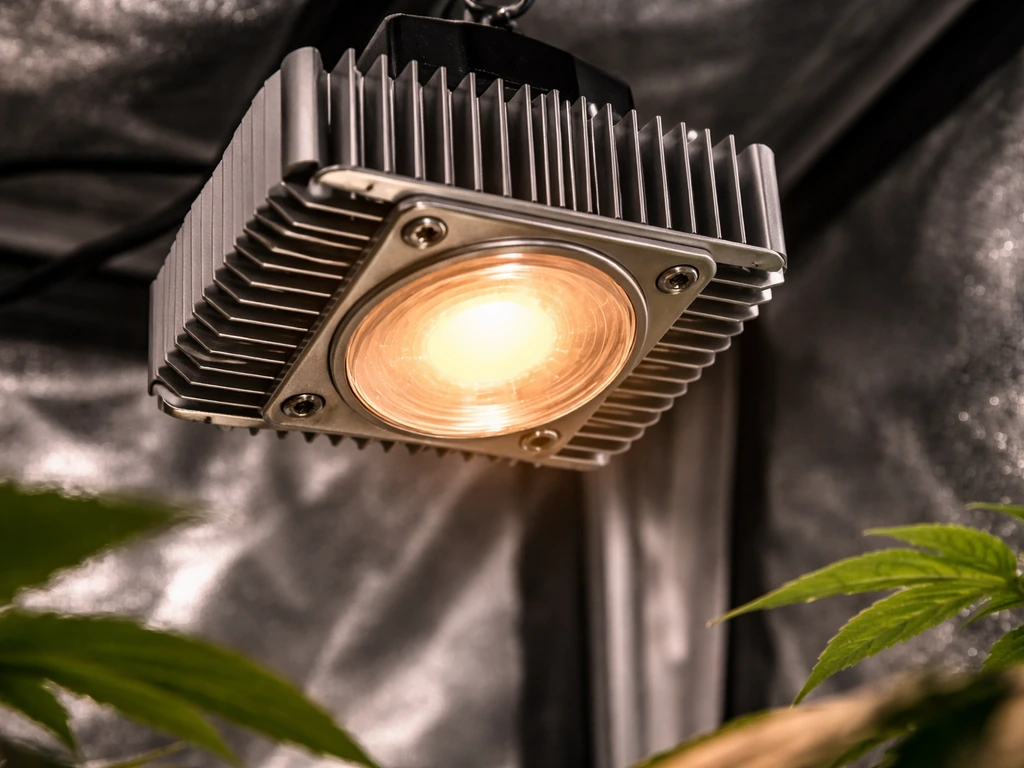
Because COB heat is concentrated, the heatsink mass matters more than it does in a quantum board. A quality passive heatsink for a single CXB3590 driven at 50W is large, often a finned aluminum extrusion rated for at least that wattage in free-air convection. Some fixtures use active cooling (fans), which works but adds noise and a potential failure point. If you see a COB fixture with a tiny, thin heatsink, walk away. The CXB3590's maximum allowable drive current is explicitly tied to maintaining Tc within spec, and that only happens with adequate heatsink area and airflow.
Best CREE COB LED grow lights: picks by use case
I'll be direct: the "best" list here is structured around verifiable criteria, not sponsorships. Each pick needs to show actual Cree COB usage, a named quality driver, documented PPFD data, and reasonable warranty terms. The market shifts, so treat these as frameworks with current examples.
Best for 2x2 to 3x3 home tent: single or dual CXB3590 builds
For a 2x2 to 3x3 space, a DIY or kit build using one or two CXB3590 COBs (3500K, CD Bin) on a large passive heatsink with a Meanwell HLG-120H-C1400 driver is genuinely hard to beat. Driven at 1400mA per COB, you're pulling about 100–110W per COB at the wall, which is a conservative and efficient operating point. Two of them in a 2x4 or 3x3 give you clean, even coverage and excellent longevity.
The COBs themselves are widely available from authorized distributors. If you prefer a pre-built route, look for commercial fixtures that explicitly state "Cree CXB3590" in their spec sheets (not just "COB LED") and list a Meanwell driver. Vendors like Timber Grow Lights and Cobshop have historically offered exactly this.
Best for 4x4 flowering: four-COB Cree fixture
A four-CXB3590 build or pre-built fixture covering a 4x4 is the sweet spot for home cannabis growers wanting serious flower results. Driven at 1400–2100mA per COB depending on heatsink capability, a four-COB setup pulls 400–450W actual and can deliver 700–900 μmol/m²/s across most of a 4x4 canopy with proper reflectors. The Growers Choice ROI-E720 and similar fixtures have used Cree or equivalent high-quality COBs in this format.
On Growace’s product page for the ROI-E720, the listing includes output and operating figures such as total output (1870, 1924 µmol/s) and wattage draw (740, 800W), along with an approximate system efficacy (~2. 6 µmol/J) total output (1870–1924 µmol/s) and wattage draw (740–800W). Verify by asking the vendor for the PPFD test methodology, not just the number.
Best full-spectrum COB LED for veg and seedlings
For a dedicated veg room or seedling stage, a 4000K CXB3590 COB (or 3500K run at reduced intensity via dimming) is ideal. The cooler color temperature shifts more output toward blue wavelengths, which drives compact, bushy vegetative growth. A single 4000K CXB3590 on a conservative driver covers a 2x2 veg area comfortably at the 400–600 μmol/m²/s target. If you're running a mixed veg/flower tent and want one light to do both, stick with 3500K and use the dimmer during early stages.
Best budget-accessible entry point
If the full DIY route feels like too much, a few commercial COB lights in the $150–$300 range use genuine high-quality COBs in simpler single or dual configurations. The key is not assuming "COB" in the name means Cree. Some budget fixtures use generic Chinese COB modules that are fine but shouldn't be compared to CXB3590 longevity specs. For hobbyists who want a simpler screw-in or socket-based solution, it's worth reading up on the best screw-in LED grow light options as a lower-complexity alternative before committing to a full COB fixture setup.
Best COB grow light for weed: practical cannabis setup guidance
Cannabis is the use case that drove most of the DIY COB movement, and for good reason. The plant responds well to the high-intensity, penetrating output of a COB point source, especially in the last four to six weeks of flower when dense bud sites need light to reach below the top canopy. Here's a practical staging guide for a 4x4 soil grow:
- Seedling stage (weeks 1–2): Dim the fixture to 20–30% output, hang 24–30 inches above canopy, target 100–200 μmol/m²/s. Cree CXB3590 COBs dim smoothly via the 0–10V input on a Meanwell driver, so this is straightforward.
- Early veg (weeks 3–5): Ramp to 40–50% power, lower to 20–24 inches, targeting 400–500 μmol/m²/s. Watch for leaf curl or bleaching as a sign you're too close or too bright.
- Late veg / pre-flower (weeks 6–8): 60–70% power, 18–22 inches, 500–650 μmol/m²/s. This is where COB penetration starts showing its value in plant structure.
- Early flower (weeks 1–3 of 12/12): Push to 80–90% power, 16–20 inches, 650–800 μmol/m²/s.
- Peak flower (weeks 4–8): Full power if thermals allow, 14–18 inches, 800–900 μmol/m²/s. Monitor canopy temperature, keep it under 82°F (28°C).
- Late flower / flush (final 2 weeks): Some growers reduce back to 70–80% to reduce heat stress during ripening. Not universally necessary, but useful in hot environments.
Heat management is especially critical for cannabis because terpene expression and final density are sensitive to ambient and radiant heat. A four-COB fixture pulling 400W in a 4x4 tent will raise tent temperature significantly without good exhaust airflow. Size your inline fan for at least 2x the tent volume per minute, and consider running the light during nighttime hours if ambient temps are high. The COB's concentrated heat output is manageable with good ventilation, but it requires more attention than a distributed quantum board setup.
One thing worth noting for cannabis growers comparing form factors: the COB vs quantum board debate is real and ongoing in the community. For a single-light 4x4 flower tent, either can deliver great results. The difference shows up in how you manage it. Also, if you're growing in a setup that uses standard lamp sockets for other fixtures, a quick look at E27 LED grow light options can help you understand where COB fixtures fit relative to simpler socket-based alternatives, especially when you're mixing fixture types across a multi-tent setup.
COB grow light review checklist: what to verify before you buy
Here's the actual checklist I run through when evaluating any COB grow light claim. Use this before you spend money.
- Verify the COB brand and model: Does the spec sheet name "Cree CXB3590" specifically? Generic "COB LED" without a chip manufacturer name is a red flag. Ask the vendor directly if it's not in the listing.
- Check actual wall draw vs rated wattage: Plug into a Kill-A-Watt or similar meter on arrival. If a "400W" fixture pulls 220W, your PPFD will be way below what the marketing chart shows.
- Demand PPFD data with test methodology: A PPFD map is useful only if the test distance, sensor calibration, and measurement grid are stated. Cree's own LM-80 results come with specific test conditions for exactly this reason. Any vendor PPFD claim without test conditions is marketing, not data.
- Confirm the driver brand and model number: Meanwell HLG series is the gold standard. Inventronics and Sosen are also acceptable. No-name drivers should disqualify a fixture from serious consideration.
- Evaluate heatsink mass and design: Adequate finned aluminum heatsink for passive cooling, or active cooling with a quality fan. A thin stamped-metal back plate on a high-power COB is insufficient.
- Check dimming capability: 0–10V analog dimming via the driver is standard for quality builds. PWM dimming is also fine. No dimming capability on a COB fixture is a significant limitation for multi-stage grows.
- Read the warranty terms carefully: A quality COB light should carry a minimum 3-year warranty. Some top-tier brands offer 5 years. Short warranties (under 2 years) on expensive fixtures suggest the manufacturer isn't confident in their thermal design.
- Look for thermal protection: Over-temperature shutoff is a meaningful safety feature on COB fixtures. It means the driver or COB thermal management will reduce current before damage occurs, protecting your investment.
- Cross-check claimed efficiency: Divide the stated PPF (μmol/s) by the actual wall draw (watts). Numbers above 2.5 μmol/J are good for COB fixtures. Claims above 3.0 μmol/J from a COB-based fixture warrant extra scrutiny unless backed by third-party testing.
One last practical note on longevity: the 61,000-hour L70 lifetime figure from Cree's TM-21 projections for the CXB3590 assumes the fixture maintains proper Tc during operation. That's roughly 17 years at 10 hours per day. In practice, fixtures in hot grow tents with poor airflow will see elevated case temperatures, and every 10°C rise in junction temperature roughly halves semiconductor lifetime. Buying a quality fixture is step one. Running it in a well-ventilated tent and not pushing it to maximum current in a hot environment is step two. Both matter equally.
FAQ
How do I confirm the real wattage of a best CREE COB LED grow light before buying?
“Actual draw” is what the wall meter reads during steady operation, not the marketing wattage or an assumed equivalent. If the listing does not provide input power at a stated dimming level (for example, 50 percent and 100 percent), assume the PPFD estimate may be inflated and plan to verify with a Kill A Watt style meter before relying on coverage claims.
Can I safely run a CXB3590-based COB light at reduced power for seedlings and then crank it for flower?
Yes, if the driver supports it. For most COB setups, dimming changes both PPFD and thermal stress, but it does not automatically prevent overheating if heatsinking is undersized. Use dimming for staging (veg to flower), then still confirm case temperature stays within spec by ensuring the heatsink is sized for the maximum drive current you will use.
What’s the difference between a true full-spectrum phosphor-converted COB and a “full spectrum” blurple-style mix?
Not always. Many fixtures use a single phosphor conversion, but that does not guarantee far-red content or a continuous spectral distribution. If you see only “red plus blue” claims under a “full spectrum” label, ask for a spectrum or SPD plot, and confirm whether the product actually uses phosphor-converted white/CXB packages rather than mixing narrow-band LEDs.
Will dimming a COB light change plant results, and what should I check about the dimmer/driver?
Try to match dimming range and controls to your environment. If the fixture is only dimmable by crude analog means, or uses PWM without proper smoothing, you may see more canopy fluctuation at low output. Look for documented 0–10V dimming support (and confirm it is compatible with your controller), or plan to keep it above low dim levels for consistent PPFD.
How can I verify uniform coverage with a COB light, since hotspots are more common?
A key method is PPFD mapping, not trusting a single center reading. With COBs, the point source creates a sharper intensity gradient, so test at canopy height at multiple points across the footprint (center, corners, and midpoints). If you cannot map it yourself, request test methodology including measurement distance, sensor model, and whether reflectors were used.
Can I run a best CREE COB LED grow light on a smart plug, timer, or external controller?
In most cases, yes, but it depends on the driver and wiring. Constant-current drivers can dim and stabilize output, but if the driver is not designed for that range or the wiring is poor, you can get flicker or unstable output. Check for a published minimum dim level and confirm the driver supports the dimming control type you plan to use.
When does having multiple CXB3590 COBs help, and what spacing or reflector design should I look for?
“COB spacing” matters for uniformity more than total wattage alone. For a multi-COB fixture, evenly spaced emitters plus proper reflector geometry reduce edge roll-off. If a product shows a single small reflector or no mention of reflector design, assume coverage uniformity will be weaker at the perimeter.
Is active cooling (fans) always worse than passive heatsinks for COB grow lights?
Watch for the heatsink type relative to your tent conditions. Passive cooling can be excellent, but it assumes stable ambient temperatures and adequate airflow. If your grow area routinely runs hot or humid, prioritize a larger fin area or consider controlled intake and exhaust, because active fans add noise and create another wear-based failure point.
What warranty details matter most for COB longevity claims like L70 or L90?
Look for an explicit warranty term and a clear returns policy, but also check what they cover. Some brands warranty the fixture electronics but not thermals, while others treat thermal failure as user error. Since COB lifetime depends on maintaining correct case temperature, choose a warranty that does not quietly exclude overheating scenarios caused by undersized heatsinks.
How do I avoid light stress if I’m adjusting hanging height and photoperiod with a COB?
Yes, because plant response is driven by intensity and duration, and photoperiod is not the same thing as PPFD. For example, a COB that hits 800 μmol/m²/s for a few hours can stress similarly to a longer day at 700 μmol/m²/s. Calibrate height to hit your target daily plan, then keep photoperiod consistent for the growth stage.
Do the cannabis PPFD targets change if I use CO2, and what’s the common mistake?
Yes, you may not need the same intensity targets if you run CO2. The article notes diminishing returns beyond 900 μmol/m²/s for most setups without CO2, but even with CO2, overshooting can cause leaf tip burn or slowed transpiration if VPD and irrigation are off. Use stage-appropriate PPFD targets, then adjust CO2 gradually while also monitoring humidity and temperature.
What are the most common reasons people end up with underperforming results from the best CREE COB LED grow light?
One big mistake is assuming a “4x4” label matches your actual hang height and reflectors. Another is using fixture wattage alone to estimate PPFD, without verifying system efficiency and output distribution. Always tie the fixture’s expected PPFD to your canopy height, reflector use, and measured coverage across the whole space.
Next Articles
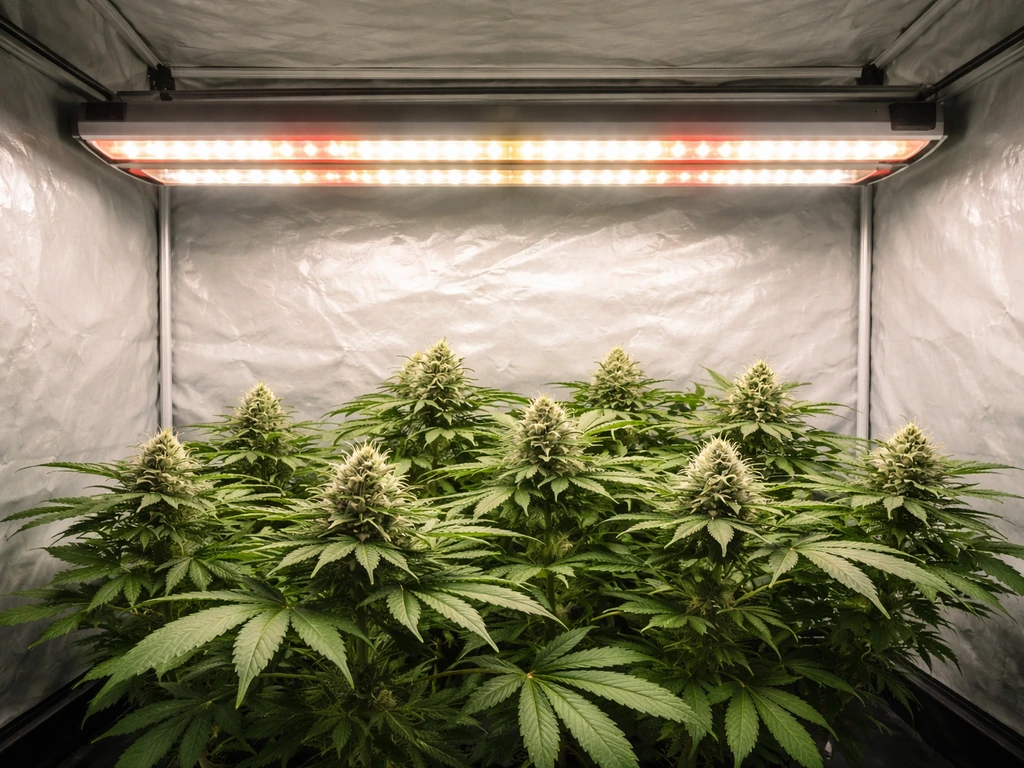
Best Full Spectrum 1000W LED Grow Lights: Buyer Guide
Buy the best full spectrum 1000W LED grow light with spec-to-decision tips on PPFD, coverage, wattage, and tent fit.
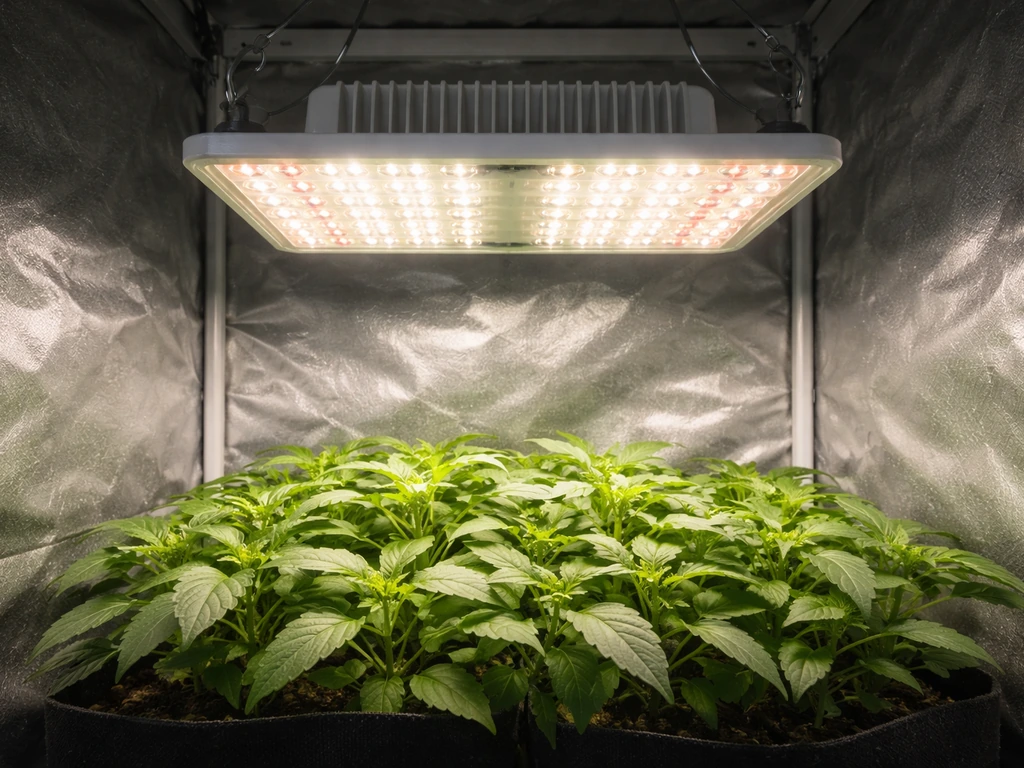
Best 100W LED Grow Light: How to Choose the Right One
Choose the best 100W LED grow light with PPFD coverage, spectrum, efficiency, dimming, heat, and setup tips.
Best LED Grow Light to Replace 1000W HPS: Sizing Guide
Sizing and buying guide to replace a 1000W HPS with the right LED using PPFD, layout, mounting, and spectrum for yields.