
A good 100W LED grow light is one of the most practical purchases you can make for a small grow. It covers a 2x2 ft space well, handles a 3x3 ft space in a pinch for veg, draws real power close to what it advertises, and costs far less to run than any HID equivalent. But the 100W category is also one of the most crowded and most misleading. You'll find fixtures ranging from genuinely efficient quantum boards hitting 2.4–2.5 µmol/J to cheap UFO panels that can barely push useful PPFD past the center of the canopy. This guide cuts through that noise and gives you a direct path to picking the right one.
Best 100W LED Grow Light: How to Choose the Right One
Marcus Rutherford
21 Apr 2026
What a 100W LED can actually do for your grow
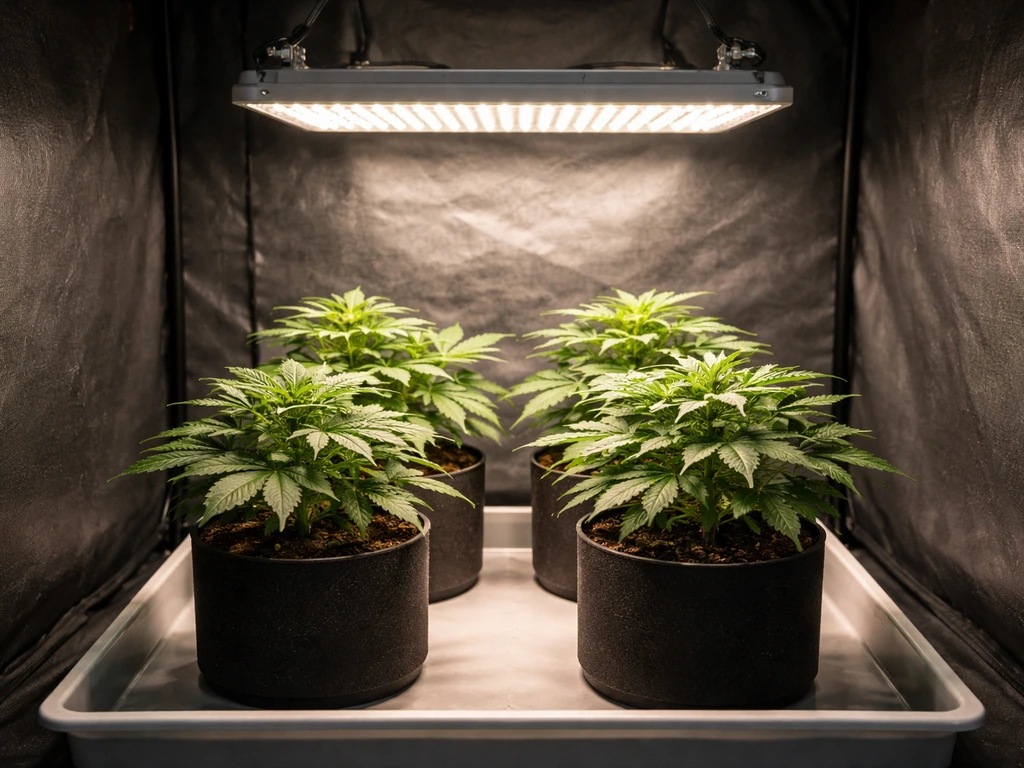
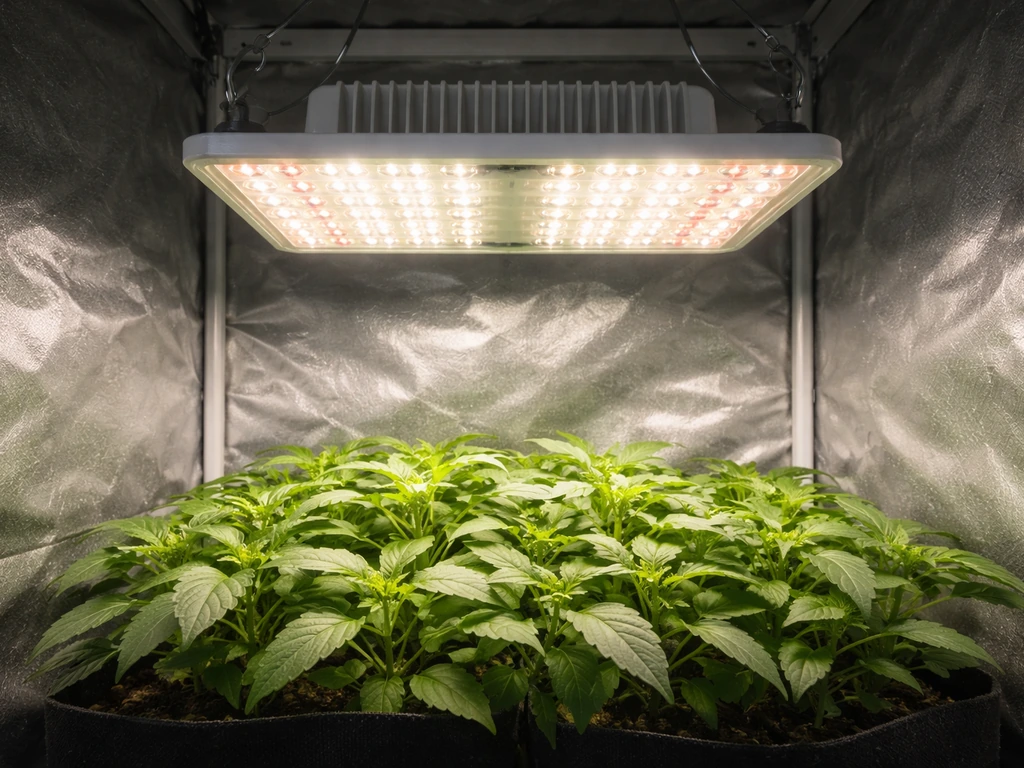
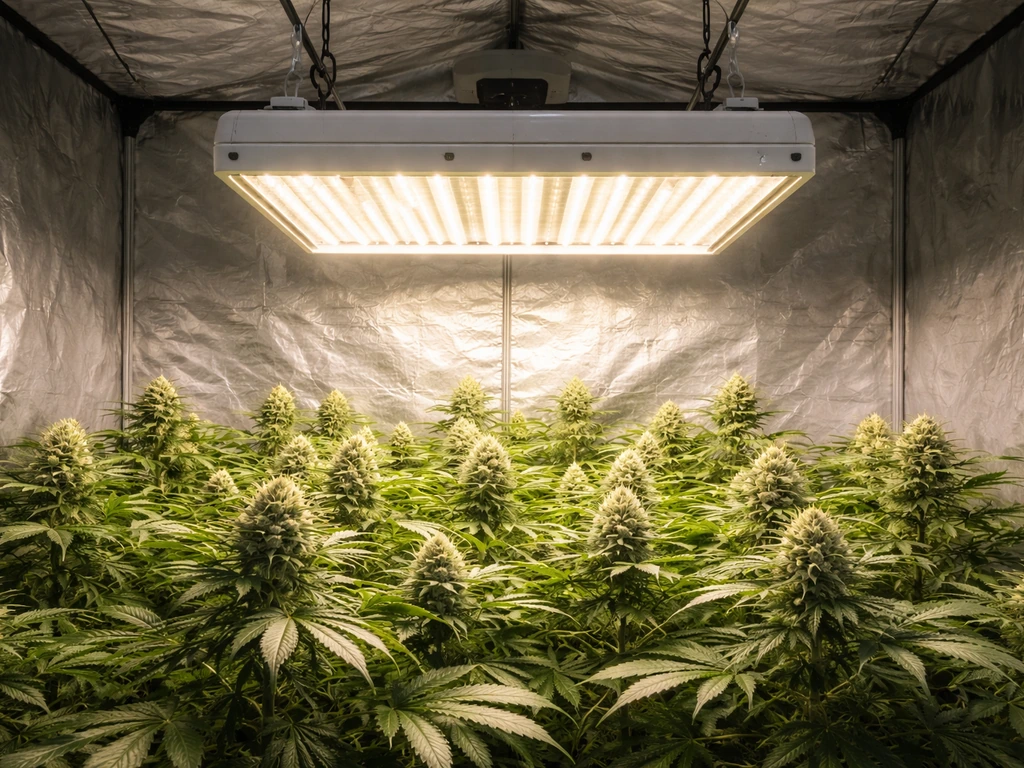
The honest answer is that a well-built 100W LED is ideal for a 2x2 ft (roughly 0.37 m²) flowering space or a 3x3 ft veg area. At 18 inches of hanging height, a quality fixture in this class delivers roughly 500–900+ µmol/m²/s across that footprint, with a higher center hotspot and lower edge readings. To put real numbers on it: Spider Farmer's SF1000D PPFD map shows 527–1349 µmol/m²/s at 18 inches and 650–1669 µmol/m²/s at 12 inches over a 4x4 ft mapped area, though the effective flowering sweet spot at useful uniformity is closer to 2x2 ft. CulTiuana's CT-100 claims 1050 µmol/m²/s at 12 inches centered, with a 2.45 µmol/J efficacy rating, which is in the same competitive tier.
For plant stages, 100W is most reliable as a full-cycle light for one to two plants in a 2x2, or as a dedicated veg light covering a 3x3. If you're growing a single autoflower or a couple of small photoperiod plants from seed to harvest, 100W is genuinely sufficient. If you're thinking about four or more full-size plants in a 4x4 tent through flowering, you're in the territory covered by higher-wattage options. There's no shame in acknowledging the scale limit early rather than halfway through a grow.
The specs that actually matter when comparing models
Wattage labels on grow lights are marketing, not physics. The number that tells you how much light you're actually getting per watt of electricity is efficacy, measured in µmol/J (micromoles of photons per joule of energy). For 100W-class lights today (2025–2026), a competitive efficacy is 2.4–2.6 µmol/J. The SF1000D lands at 2.5 µmol/J per its published spec sheet. If a product doesn't list this number, ask the seller or move on.
PPFD (photosynthetic photon flux density) tells you how intense the light is at a specific point and height, in µmol/m²/s. The most useful product specs show a PPFD map or distribution, not just a single peak center number. A center reading of 1200 µmol/m²/s sounds great until you realize the edges of your 2x2 canopy are getting 300. Also confirm the test distance: some manufacturers publish PPFD at 12 inches (30 cm), others at 24 inches (60 cm). Comparing a 12-inch number to a 24-inch number is like comparing apples to something that isn't fruit.
PPF (photosynthetic photon flux) is the total light output of the fixture in µmol/s, independent of distance. A fixture with a higher PPF will deliver more total photons regardless of how you mount it. True power draw matters too: plug a watt meter into any light you buy and verify it's actually drawing what the label says. Some "100W" lights pull 80W, some pull 110W. Your electricity cost and your heat load both depend on the real number, not the marketing number.
Finally, look for whether PPFD and efficacy claims are tied to a recognized test standard. The DLC (DesignLights Consortium) horticultural testing protocol references ANSI/IES LM-79 methodology. If a manufacturer cites LM-79-based testing for their PPFD and efficacy figures, that's a meaningful credibility signal. If the numbers appear without any testing reference, treat them as directional estimates rather than guarantees.
Coverage area and mounting height: matching the light to your space
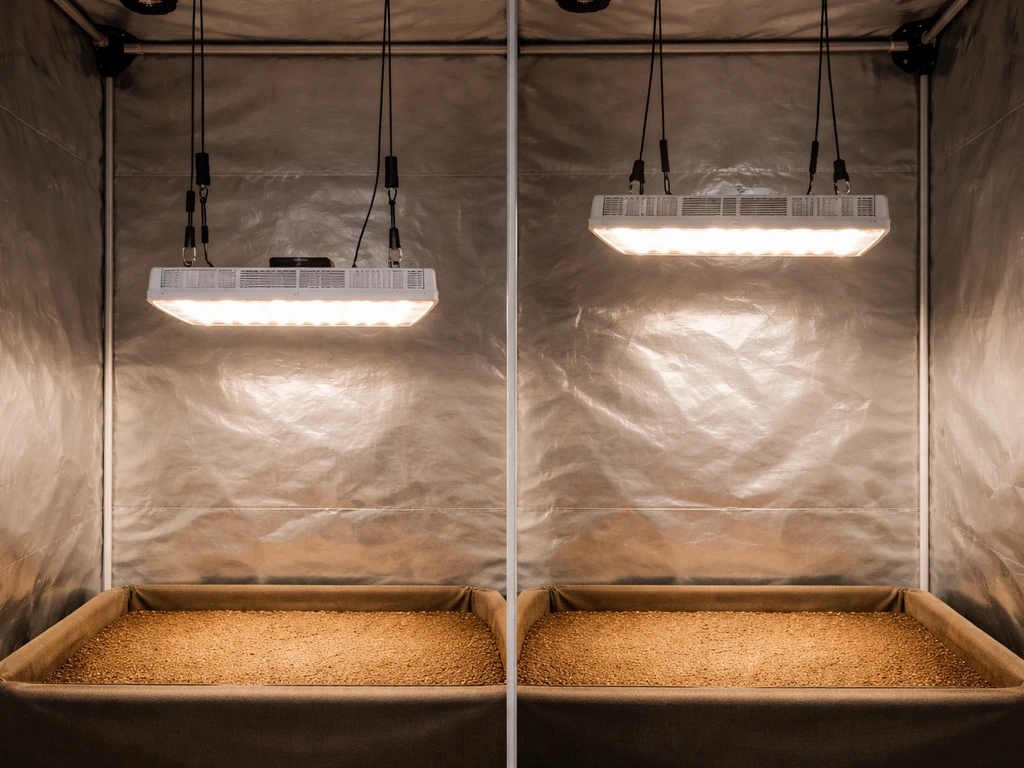
The relationship between mounting height and PPFD is not linear. Dropping from 24 inches to 12 inches doesn't double your light intensity, it roughly quadruples the center reading while compressing coverage area. For practical tent growing, use stage-based mounting heights as your starting point, then fine-tune with PPFD measurements if you have a meter.
| Growth Stage | Recommended Height | Target PPFD (µmol/m²/s) | Effective Coverage |
|---|---|---|---|
| Seedling / Clone | 24–30 inches (60–75 cm) | 100–300 | Up to 3x3 ft |
| Vegetative | 18–24 inches (45–60 cm) | 300–600 | 2x2 to 3x3 ft |
| Flowering | 12–18 inches (30–45 cm) | 600–900+ | 2x2 ft (ideal) |
| CO2-supplemented flower | 12–16 inches (30–40 cm) | 900–1200 | 2x2 ft (center-heavy) |
These ranges come from the same kind of stage-based guidance you'll find in manufacturer manuals like Spider Farmer's SF series documentation. At 18 inches over a 2x2 canopy, you're targeting consistent vegetative to early-flower PPFD across most of the canopy. Drop to 12 inches for late flower if your plants are handling the intensity without light stress. If you see leaf bleaching or cupping, raise the light before anything else.
One practical note on bar-style versus panel-style lights and coverage uniformity: bar lights (linear form factor) typically deliver better edge-to-center uniformity across a rectangular footprint than a single-point UFO or compact quantum board. If your tent is a rectangle and edge uniformity matters to you, this is worth factoring into your choice.
Full-spectrum vs veg-focused: what your plants actually need
"Full spectrum" has become a marketing phrase that can mean almost anything. At a minimum, a genuinely full-spectrum 100W light should include broad white phosphor LEDs (which cover the 400–700 nm range), supplemental deep red at 660 nm to push flowering, and ideally far-red at 730 nm and some UV/violet around 395 nm. Far-red is not a gimmick: it triggers the Emerson enhancement effect, which measurably increases photosynthetic efficiency and can speed up flowering transitions. UV at ~395 nm stimulates secondary metabolite production, which matters for resin-heavy crops.
A practical example of what this looks like in a product: the Hellion Variable Spectrum III uses a combination of LM301H diodes, OSRAM 660 nm red, OSRAM 730 nm far-red, and Seoul 395 nm UV components across separate VEG and BLOOM channels. The VEG channel is full-spectrum rich in blue, while the BLOOM channel adds far-red content for flowering response. This kind of multi-channel design lets you tune the spectrum to the growth stage, not just the intensity.
For most growers at the 100W scale, a single-board full-spectrum light with 3000K or 3500K warm white plus 660 nm red diodes is a solid all-around choice for full-cycle grows. If you're running a dedicated veg space or propagation station, a 5000K or 6500K-biased board gives more blue content for compact, bushy growth. If flowering quality is your priority and you want the most out of a small grow, look for something that at minimum includes 660 nm red supplementation, and consider far-red if budget allows.
Form factor and build quality: panel, bar, or COB?
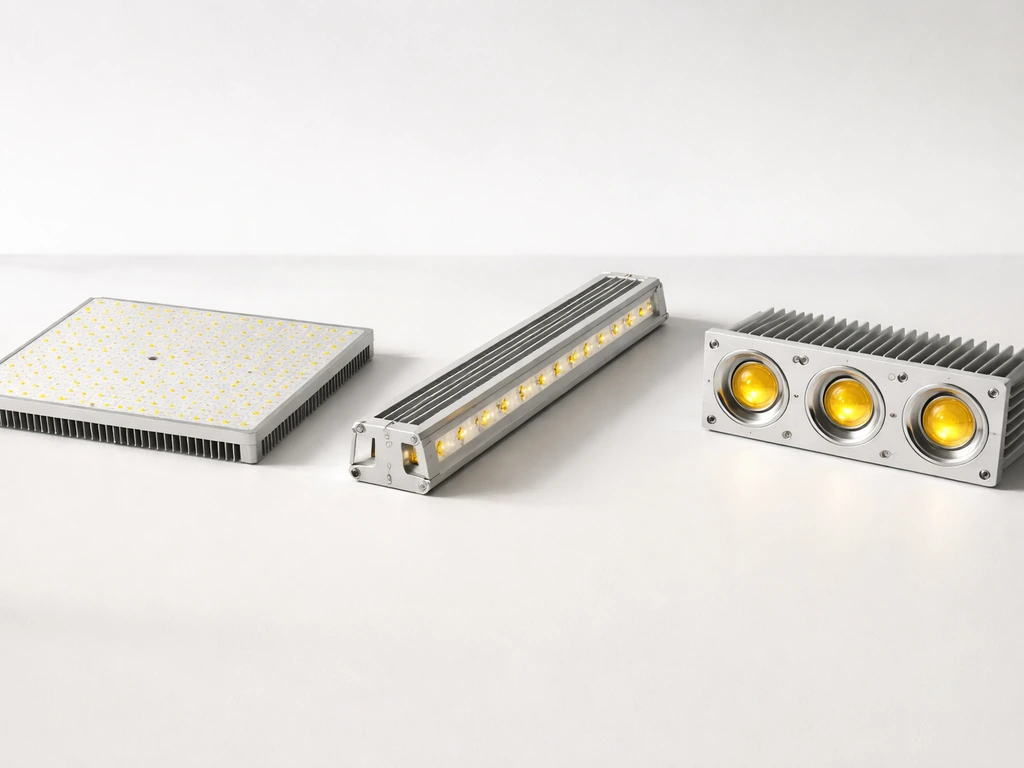
At 100W, you're mostly choosing between three form factors: quantum board panels (flat, square or rectangular boards with many small SMD LEDs), bar/linear lights (one or more elongated strips), and UFO/COB units (compact, higher-intensity single-point sources). Each has real tradeoffs.
| Form Factor | Coverage Uniformity | Heat Management | Dimming/Control | Best For |
|---|---|---|---|---|
| Quantum Board Panel | Good center, moderate edges | Passive heatsink, runs warm but manageable | Usually built-in knob or 0–10V | 2x2 full-cycle, small tent all-in-one |
| Bar / Linear | Best uniformity across footprint | Excellent, heat spread across length | 0–10V, external dimmer often needed | Rectangular spaces, veg rooms, multi-bar rigs |
| UFO / COB | Poor edge uniformity, high center hotspot | Requires active fan or large heatsink | Often fixed or basic dimming | Supplemental lighting, cloning, propagation |
Driver quality is the most underrated spec in this category. A fixture running a Meanwell driver (or equivalent commercial-grade unit) will last significantly longer than one running a no-name driver, and driver failures are the most common way a grow light dies before the diodes do. Look for brand-name driver mentions in the spec sheet, not just the word "quality" in the product description. The Optic LED Slim 100 Gen2, for example, explicitly references a Meanwell driver in its warranty terms alongside 10–100% dimming and a 10-year warranty, which is a concrete spec you can hold the manufacturer to.
Dimming matters more than most beginners expect. Being able to run a 100W light at 50% during seedling stage, then ramp up to 100% in late flower, means you're not burning seedlings and you're getting full intensity when plants can use it. Look for 0–10V dimming (common on bar lights) or a built-in rotary dimmer. One catch with 0–10V on bar lights: the Kingrowlight S-series, for example, supports 0–10V dimming but doesn't include the external dimmer in the box. Confirm what's in the package before you buy.
IP rating is worth checking if your grow space gets humid or you clean with water mist. IP65 (like on the Kingrowlight S-series lens section and the Optic LED Slim 100 Gen2) means the light resists water jets and won't be damaged by condensation or accidental splashing. It's a nice-to-have for tent growing and a genuine need if you're in a greenhouse or humid propagation room.
How to pick the best 100W model: a practical checklist
When you're looking at product pages, run through this list before you buy. Any fixture that can't answer most of these questions cleanly is a light you should skip.
- True input wattage: Does the spec sheet list actual power draw (watts from the wall), not just a marketing equivalency? Look for "actual power" or "input power" labeled explicitly.
- Efficacy in µmol/J: Is it 2.3 µmol/J or higher? Anything below 2.0 µmol/J in 2025–2026 is behind the curve.
- PPFD map or distribution: Does the manufacturer show PPFD at multiple points across a defined footprint, not just a single center peak? At what height was it measured?
- Spectrum breakdown: Does it include 660 nm red at minimum? Is far-red (730 nm) or UV (395 nm) listed if you want channel control or flowering optimization?
- Driver brand and dimming range: Is a named driver (Meanwell or equivalent) referenced? What is the dimming range and method (rotary, 0–10V, app)?
- Warranty length and what it covers: A 3-year minimum is reasonable; 5–10 years on bar lights from established brands is a genuine differentiator. Check whether the driver is covered separately.
- IP rating: If your environment is humid, confirm IP65 on the housing or at least the lens.
- Test methodology: Is there any reference to LM-79 or DLC listing for the PPFD/efficacy data? Not required, but a strong credibility signal.
- Form factor fit: Does the shape of the fixture match the shape of your tent footprint? A square panel in a long rectangular tent wastes coverage.
Setup tips, safety basics, and when to size up or down
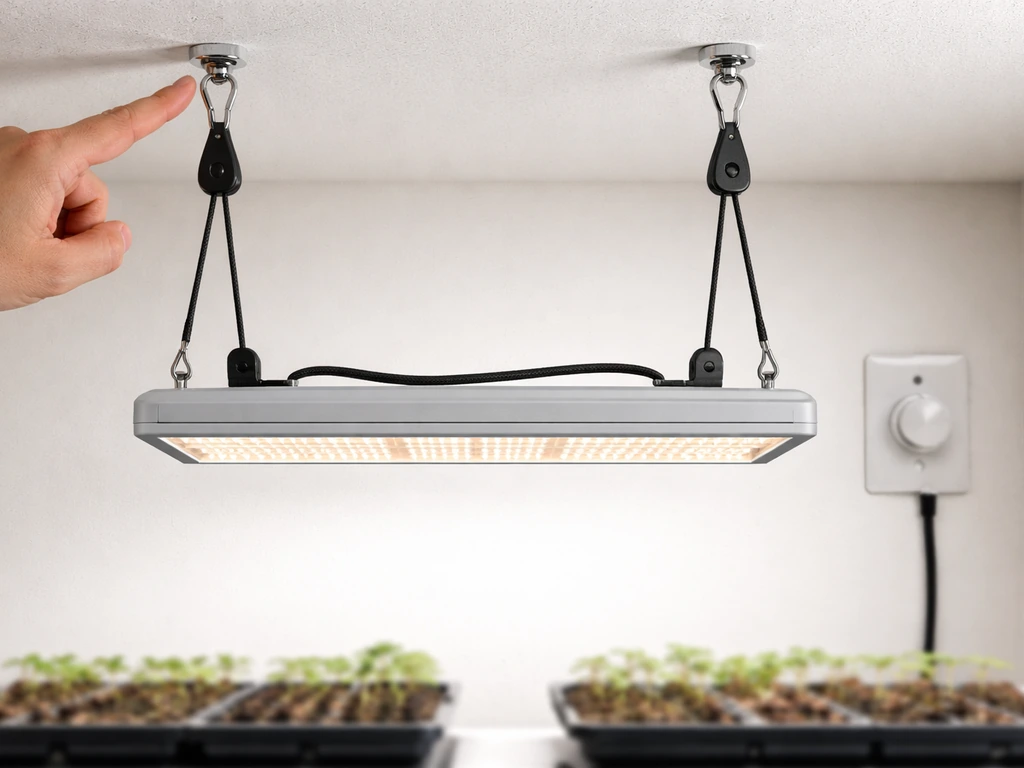
Installation and safety
Hang the light before putting plants underneath it. Confirm it's level and that the hanging hardware (ratchet straps or cable hangers) is rated for at least twice the fixture weight. Most 100W LEDs weigh 2–5 kg, which is well within standard tent bar capacity, but check your specific tent's stated weight limit anyway. Route the power cable so it can't contact water and isn't under tension. Use a properly rated extension cord if you need one, not a generic household strip.
For dimming: start seedlings at 25–40% power at 24–30 inches. Increase gradually over the first two weeks. Jumping to full power too early causes stress and slows early root development. For a 100W light at full power in a sealed or semi-sealed 2x2 tent, expect to add 50–80W of equivalent heat load to the space. You'll need some air exchange to manage that, even if it's just a small inline fan with passive intake.
When 100W is the right choice
- One to two plants in a 2x2 ft tent, full cycle including flower
- Three to four plants in a 3x3 ft tent for vegetative growth only
- Dedicated propagation or clone station covering 2–4 sq ft
- Supplemental side lighting in a larger setup
- Micro-grows or stealth enclosures where heat is a constraint
When to size up (or down)
If you're filling a 3x3 or 4x4 tent for full-cycle flowering with multiple plants, a 100W light will underperform at canopy edges and you'll see it in yield. That's the territory where stepping up to 200–400W options makes a real difference. On the flip side, if you're running a clone tray, a propagation dome, or a small herb garden with modest light requirements, 100W is already overkill and a 40–60W option saves money and heat.
There's also a broader 1000W LED category worth understanding if you're scaling to larger commercial or multi-light home setups, where the economics and fixture architecture shift considerably. If you're also looking at the best led grow lights 1000w, make sure you compare real PPFD coverage, dimming options, and documented test data at your mounting height.
If you're also shopping for the best 1000 watt led grow light, make sure you compare PPFD coverage, dimming options, and documented test data at your mounting height. If you are currently running a 1000W HPS, use the same PPFD coverage, dimming, and test-height checks to find the best LED alternative for a comparable canopy best led grow light to replace 1000w hps.
If you are shopping for the best full spectrum 1000w led grow lights, compare PPFD coverage, dimming options, and the testing height so you know what will actually reach your canopy best led grow lights 1000w. If you're comparing the best 1000W LED grow lights, the same ideas about PPFD maps, dimming, and tested efficacy still matter, but coverage and heat management become the deciding factors.
The bottom line: a 100W LED at 2.4+ µmol/J efficacy, with a full-spectrum board including 660 nm red, a quality driver, and honest PPFD data, is genuinely excellent for what it is. Don't expect it to fill a 4x4 for flower. Do expect it to outperform every HID option at its actual scale, use a fraction of the electricity, and last longer than most of the equipment around it.
FAQ
How many plants can the best 100W LED grow light realistically cover in a 2x2 tent?
If you are using a 100W LED as a full-cycle light, plan for one to two plants in a 2x2 canopy. If you run three or more plants in that same footprint, you will usually see edge under-lighting during flowering even when the center PPFD looks fine, which can translate into slower bud development on the perimeter.
What signs mean my 100W LED is mounted too low or too intense?
Use your thermometer and a simple grow-room rule of thumb: if leaf tips start to taco, bleaching appears, or plants lift and “cup” under strong intensity, raise the light immediately. Also, if your exhaust has to run constantly to keep the tent stable, you may be overshooting both intensity and heat for that setup.
Can I compare two best 100W LED grow light options by their PPFD peak numbers?
Yes, but only if the seller provides PPFD maps at the height you will use. Many “peak PPFD” numbers are measured differently, so a 12 inch spec on one product can correspond to a much higher or lower real canopy intensity on another. The safest approach is to compare PPFD distributions (uniformity), not center maxima.
Is built-in dimming on a 100W LED grow light worth it, and what should I confirm?
A dimmer can help, but choose dimming that changes output without causing driver instability. If the light supports 0 to 10V dimming, confirm whether the external controller is included, and verify the usable dimming range. If the unit only “claims dimming” without stating the control method, treat it as unreliable for seedling ramp schedules.
Which color temperature and red supplementation combination works best for full-cycle growing with a 100W LED?
Warm white (3000K to 3500K) plus dedicated 660 nm red is usually enough for full-cycle use in the 100W class. If you want tighter vegetative growth for compact plants, favor a higher blue bias (5000K to 6500K) and keep red supplementation appropriate for the flowering phase you are running.
What should I verify to avoid misleading “full spectrum” claims on a 100W grow light?
Don’t just look for “full spectrum” text. Confirm the fixture includes specific wavelengths (for example, 660 nm, and ideally far-red around 730 nm if you can afford it). If UV is advertised, check that it is a defined emitter around ~395 nm rather than a vague “UV” claim, because those details usually reflect whether the spectrum is truly useful.
What happens if I have to mount my 100W LED higher than recommended?
Most 100W lights are not designed to be used at extremely high mounting heights without recalculating uniformity. If you need to mount above your planned distance due to tent clearance, verify coverage at that specific height and consider whether you will need a second light or a higher-watt option for even flowering.
What should I do if a 100W LED grow light listing does not provide µmol/J or testing methodology?
If the product does not publish an efficacy value (µmol/J) or a test standard reference, it is harder to judge long-term real output. In that case, your decision should rely more heavily on documented PPFD at your height, plus credible driver and warranty details. If neither PPFD maps nor efficacy/testing references are provided, it is usually safer to skip.
Are brand-name drivers (like Meanwell) enough to judge how long a 100W grow light will last?
A Meanwell or equivalent commercial driver is a reliability upgrade, but it still depends on real warranty coverage and thermal design. Look for a clear warranty term and service process, and ensure the driver is not hidden behind marketing-only “quality” language. If the warranty is short, treat the driver brand as a partial, not complete, solution.
Can I safely use a 100W LED grow light in a humid tent or near misting?
Yes, but plan airflow like it matters for humidity as much as for heat. Even with an IP65 lens, condensation can form on surfaces and corrode wiring over time. Use a small intake and exhaust strategy, and avoid letting water droplets repeatedly hit the fixture housing or power connections.
Next Articles
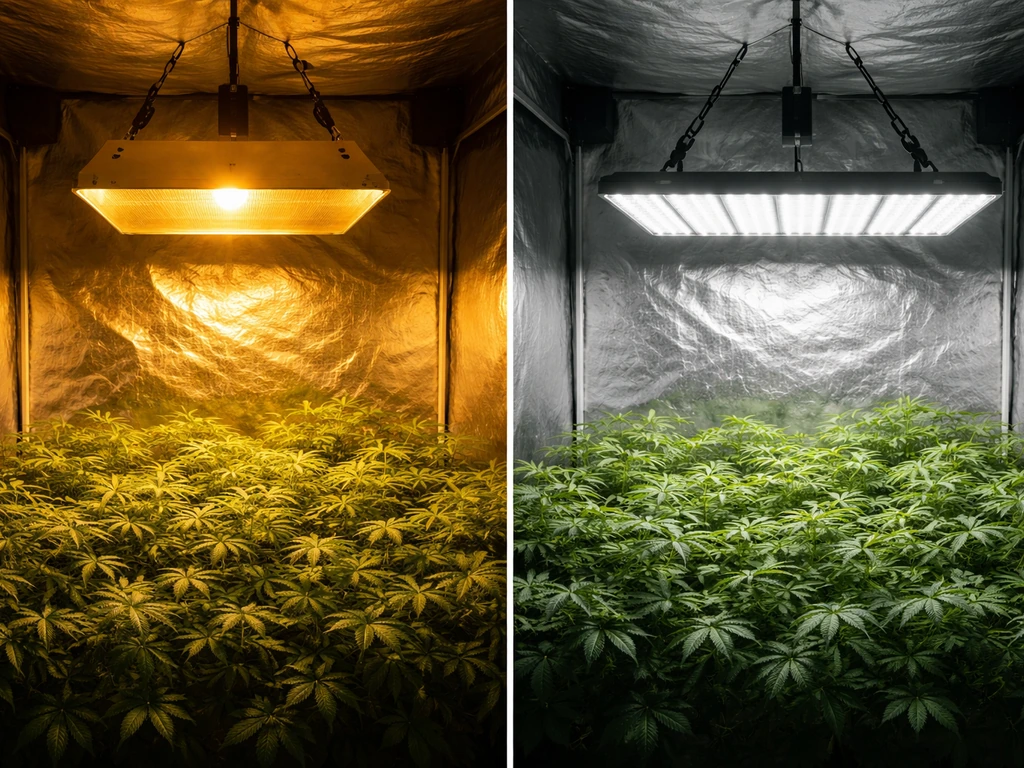
Best LED Grow Light to Replace 1000W HPS: Sizing Guide
Sizing and buying guide to replace a 1000W HPS with the right LED using PPFD, layout, mounting, and spectrum for yields.
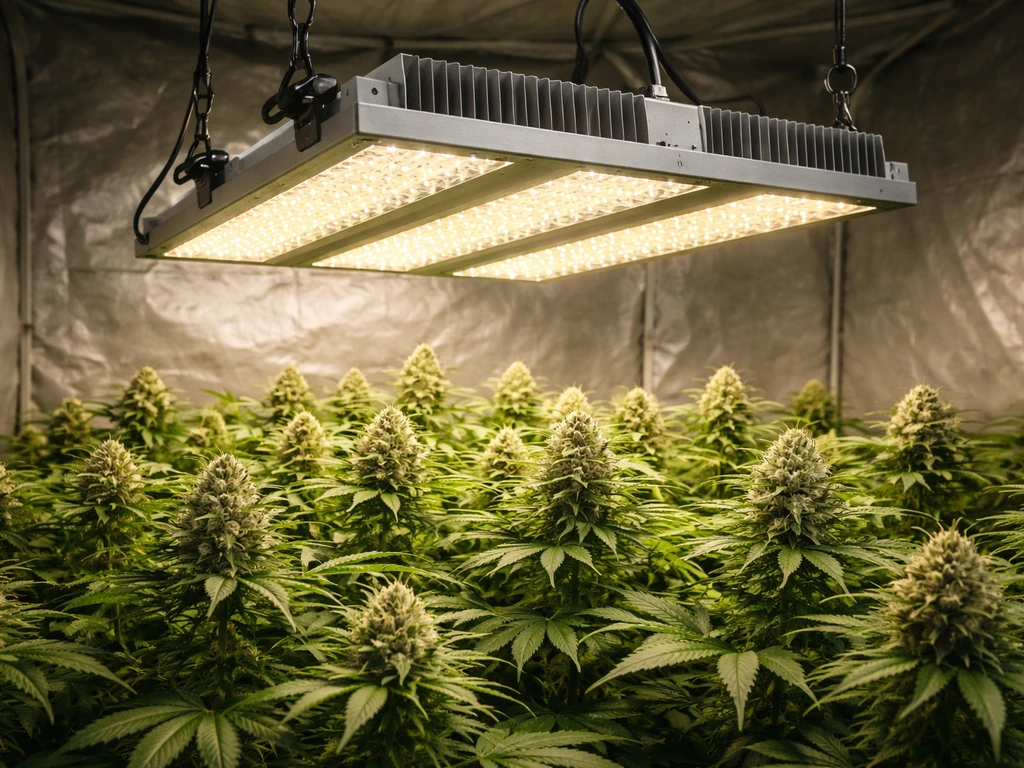
Best LED Grow Lights 1000W: Buying Guide, Coverage, Costs
Buying guide to choose the best 1000W LED grow lights: real watt draw, coverage, spectrum, mounting, and running costs.
Best 1000 Watt LED Grow Light Guide: Coverage, PPFD, Setup
Choose the best 1000W LED grow light with PPFD, true coverage, setup height, and buying tips for your tent size