
The best 1000W LED grow light for your setup is whichever fixture delivers the right PPFD (photosynthetic photon flux density) uniformly across your canopy at the lowest running cost, not the one with the biggest number on the box. That distinction matters because "1000W" is one of the most abused labels in grow lighting. Some fixtures that carry it draw 1000 true watts from the wall. Others draw 200W and are simply named after the HPS bulb they supposedly replace. If you are shopping by wattage label alone, you are going to get burned.
Best LED Grow Lights 1000W: Buying Guide, Coverage, Costs
Marcus Rutherford
11 Apr 2026
What "1000W LED" actually means (and what it doesn't)
The metric that actually tells you how useful a grow light is has nothing to do with the label wattage. It starts with PPF (photosynthetic photon flux, measured in µmol/s), which is the total number of photons the fixture emits per second in the PAR range. PPFD (µmol/m²/s) is how dense those photons are at a given point on your canopy. Efficacy, expressed as µmol/J, tells you how many photons you get per watt of electricity consumed. A light with 2.7 µmol/J is meaningfully more efficient than one at 2.0 µmol/J, and that gap adds up fast in your electricity bill and in how much light actually reaches your plants. Understanding what separates high-efficacy LED grow lights from budget options starts with getting comfortable with these three numbers.
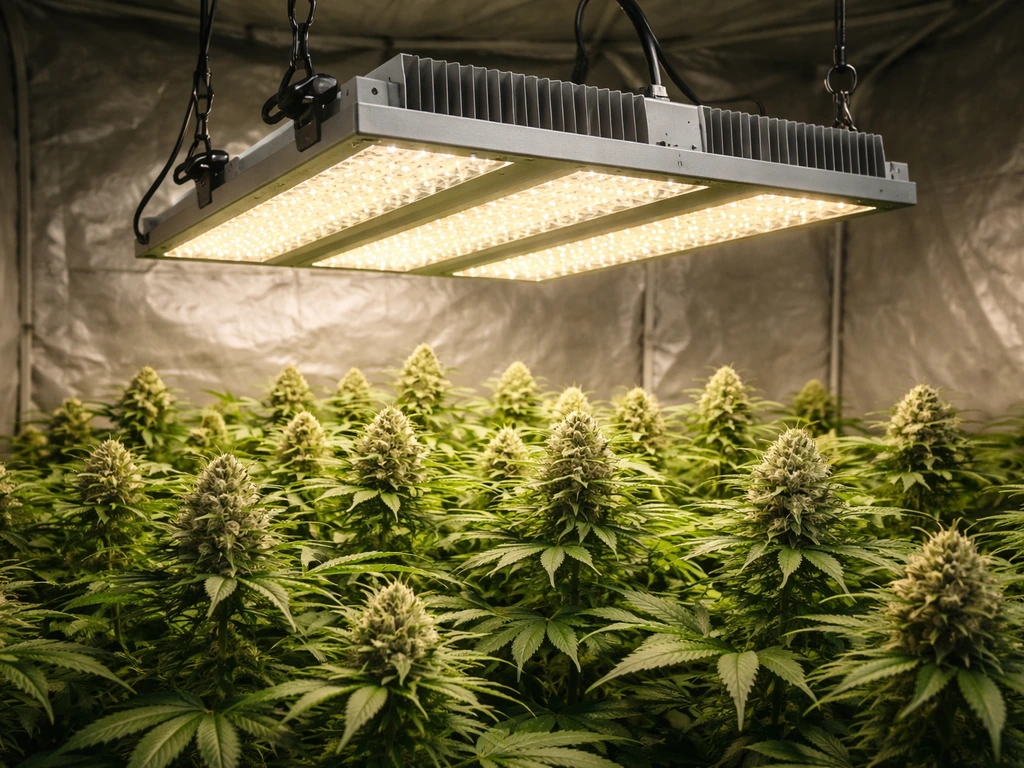
Here is the trap most buyers fall into: a "1000W" light that only draws 200W from the wall is not covering the same area as a true 1000W draw fixture, even if both carry the same label. Reputable manufacturers publish a PPFD map, measured at a defined hang height in a defined space (often a 4x5 or 5x5 tent with reflective walls). That map is the only honest way to compare coverage claims across models. If a brand does not publish one, that alone tells you something. The full breakdown of 1000W-class lights ranked by real-world performance goes deep on this if you want to compare specific models side by side.
To put some real numbers on it: a well-engineered true 1000W-class fixture should produce around 2700 µmol/s PPF and hit efficacy at or above 2.7 µmol/J. The Atlantic Grow 1000W spec sheet, for example, lists PPE 2.7 µmol/J and PPF 2700 µmol/s. HLG's Greenhouse Pro FS series pushes 2.85 µmol/J. If a "1000W" light you are looking at does not publish PPF or efficacy, skip it.
Matching the light to your grow space
Tent size is where coverage decisions get practical. A true 1000W-class fixture is generally sized for a 4x4 to 5x5 footprint in flowering, where you want sustained PPFD in the 800 to 1000+ µmol/m²/s range at canopy. For vegetative growth, target PPFD is lower (400 to 600 µmol/m²/s), which means you can either dim the fixture or push it to cover a slightly larger area. Spider Farmer positions the G1000W explicitly for a 5x5 tent, and that is a reasonable real-world benchmark for a quality fixture in that watt class.
Mounting height has a dramatic effect on both PPFD intensity and uniformity. The PerfectPar 1000W PPFD map was measured at 1 foot (30.5 cm) hang height in a 4x5 reflective tent. Raise the light and intensity drops; lower it and you risk hot spots at center. A good rule: use the manufacturer's PPFD map as your starting point, match their hang height and tent conditions as closely as possible, then fine-tune from there. Most quality 1000W-class fixtures work best between 18 and 30 inches above canopy for flower, with veg typically pushed to 24 to 36 inches.
Reflective walls matter more than most growers realize. Mylar or white poly walls in a closed tent can recycle 20 to 30% of photons that would otherwise be lost. The PPFD maps that brands publish almost always assume reflective enclosures. If you are running an open room or a black tent, expect real-world numbers to fall noticeably below the published map. Canopy uniformity is also a function of fixture geometry, which is why bar-style lights and quantum boards behave differently over the same footprint.
Spectrum and performance across grow stages
Full-spectrum LEDs cover the full PAR range (roughly 400 to 700 nm) with some mixing of red, blue, green, and often far-red and UV. These are the workhorses for growers running a single fixture through veg and flower without swapping anything out. A quality full-spectrum 1000W LED handles seedlings, veg, and late-stage flower all at once, just by adjusting intensity via dimming or hang height.
Some 1000W-class models go further and offer switchable or adjustable spectra by growth stage. The Medic Grow Neo-780/1000, for example, offers smart adjustable spectrum with distinct veg and flower modes and claims PPE up to 2.8 µmol/J. This kind of stage-switching is genuinely useful if you are dialing in different crops or running a perpetual harvest with staggered stages. The catch is that you need to check the actual watt draw at each mode. Some dual-spectrum lights list PPE around 0.9 µmol/J at one of their operating points, which is a dramatic efficiency drop and a red flag worth understanding before you buy.
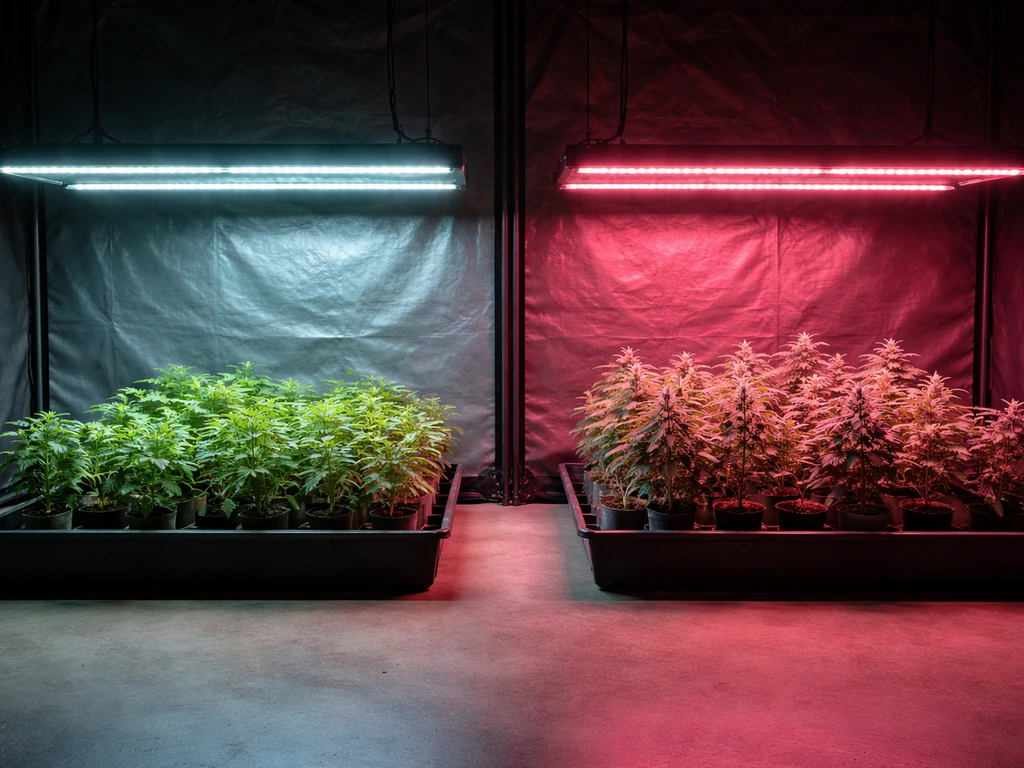
Canopy penetration is the other piece of the spectrum conversation. Blue-heavy light (400 to 500 nm) is absorbed quickly at the top of the canopy and does not reach lower leaves well. Red (620 to 700 nm) and far-red (700 to 750 nm) penetrate deeper. For tall, dense plants in late flower, a spectrum weighted toward red/far-red improves lower bud development. For seedlings and early veg on short plants, blue-heavy is fine and actually preferred for compact internodal spacing. Full-spectrum designs handle this reasonably well across stages, but if you are optimizing for heavy flowering, check that the fixture is not blue-dominant.
Bar-style vs quantum board vs COB: which form factor wins?
These three form factors dominate the 1000W-class market right now, and each has genuine strengths. Here is how they actually compare across the specs that matter.
| Form Factor | Uniformity | Canopy Penetration | Typical Efficacy | Heat Management | Best For |
|---|---|---|---|---|---|
| Bar-style (multi-bar) | Excellent (wide, even spread) | Good (distributed emitters) | 2.7–2.8 µmol/J | Low heat per bar; easy passive dissipation | 5x5 flower, commercial rows, uniform canopies |
| Quantum Board (QBoard) | Very good (wide panel) | Moderate (shallow depth) | 2.5–2.85 µmol/J | Moderate; heatsink needed | 4x4 to 5x5, veg/flower single-fixture setups |
| COB (chip-on-board) | Lower (point sources) | Good center, weaker edges | 2.0–2.5 µmol/J (older designs) | Higher; active cooling often needed | Smaller footprints, DIY builds, supplemental lighting |
Bar-style fixtures like the Kingrowlight Foldable LED Grow Light Plus (10 x 100W bars, PPF 2800 µmol/s, PPE 2.8 µmol/J) offer exceptional uniformity because the light source is distributed across the entire footprint rather than concentrated in a single point or panel. This makes hot spots almost a non-issue and is why commercial growers have largely moved to bar-style designs. Quantum boards are the most popular choice for home tent growers: they hit 2.5 to 2.85 µmol/J from quality suppliers, they are compact, and they are simple to hang and adjust. COB designs, as noted in some horticultural LED literature, were often "not specifically designed for horticultural use" and can struggle to match the efficacy and uniformity of modern diode arrays. That said, well-built COB fixtures still have a place in supplemental lighting or smaller spaces.
For most tent growers running a 4x4 or 5x5, a quality quantum board or bar-style fixture in the true 1000W-class is the right call. The top-performing 1000 watt LED grow lights reviewed in detail cover specific model recommendations across both form factors if you want to get into individual fixture performance.
Reputable model traits to look for
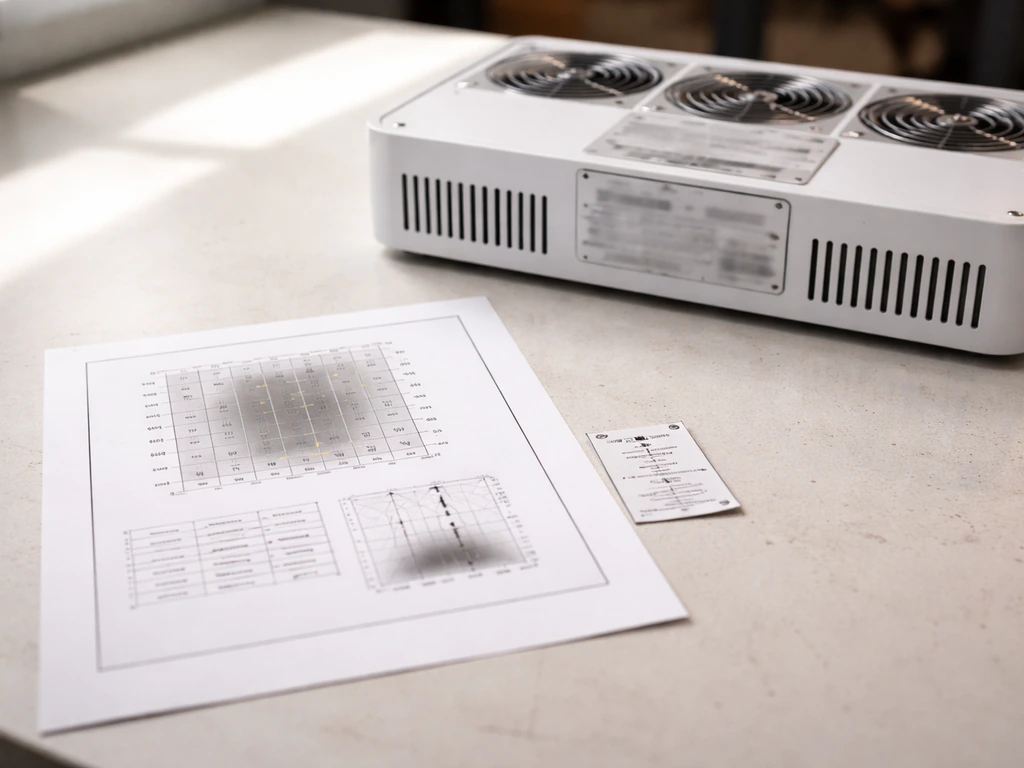
- Published PPFD map with defined hang height and reflective tent conditions
- PPF and PPE (efficacy) listed on the spec sheet, not just label wattage
- Efficacy at or above 2.7 µmol/J for 2026 production-ready fixtures
- Full 0 to 100% PWM dimming (not just a few preset modes)
- Quality driver brand (Meanwell or equivalent; check warranty terms)
- Safety certification: CSA C22.2#250.0, UL 8800, or DLC qualification
- At least a 3-year warranty; 5-year is the benchmark for premium brands
Setup, installation, and what you need to run one properly
A true 1000W draw fixture pulling full power needs to be on a dedicated 15-amp circuit minimum, and ideally a 20-amp circuit if you are also running fans and controllers on the same line. At 120V, 1000W is about 8.3 amps, which leaves headroom on a 15-amp breaker but gets tight once you add inline fans and controllers. At 240V, the amperage halves and cord runs are more efficient. Check the fixture's driver spec for input voltage range and always use the rated driver voltage.
Heat output from a 1000W draw fixture is significant. Unlike HPS where the heat is radiated directly downward into the canopy, LED heat is generated at the driver and heatsink and needs to be exhausted from the tent. A 4-inch inline fan is the bare minimum for a 4x4 tent; for a 5x5, run a 6-inch at a minimum. If your driver is external (many bar-style and quantum board designs offer this), you can route the driver outside the tent entirely, which makes thermal management inside the tent much easier. Ambient room temperature matters: LEDs drop in efficiency and lifespan when operating above 77°F (25°C). Keep your grow room cool if you want to protect your investment.
For dimming, the best fixtures offer 0 to 100% PWM control, not just a switch between two modes. The UPLUX 240 Quantum Board is a good example: it specifies full 0 to 100% PWM dimming, which lets you ramp output precisely for seedlings, dial back to 60% for early veg, and push to 100% for peak flower. App-controlled fixtures like the Spider Farmer G1000W, with WiFi and Bluetooth dimming, take this further by letting you build daily schedules without manually touching the fixture. That flexibility is worth paying for if you are growing multiple strains or cycling through stages in the same tent.
Hanging and leveling matters more than most guides admit. An unlevel fixture over a square tent creates a PPFD gradient across the canopy, with one corner significantly under-lit. Use a digital level on the fixture frame during installation, and confirm with a PAR meter (or a PAR meter app as a rough check) after hanging. Adjust hang height until the lowest reading across your canopy footprint is near your target PPFD, not just the center. That workflow, sometimes called "PPFD-first hanging," is the fastest way to dial in coverage.
Running costs and what you should actually expect to yield
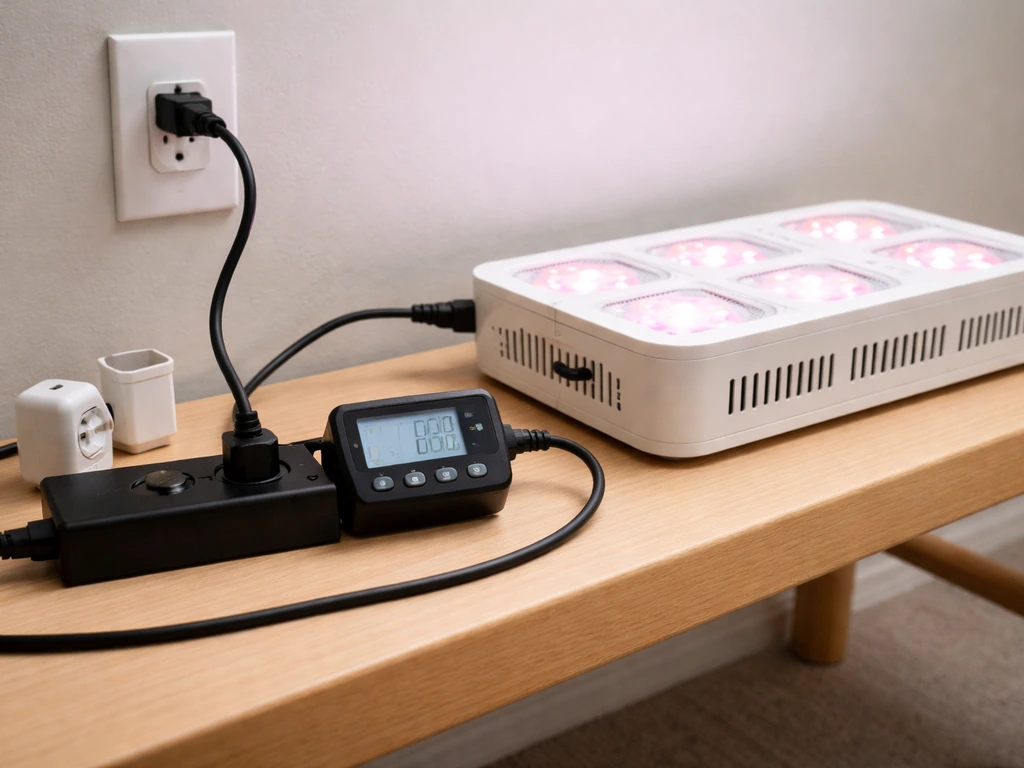
The math on running costs is straightforward once you know your fixture's true watt draw and efficacy. A fixture drawing 1000W running 12 hours a day consumes 12 kWh per day. At the U.S. average of roughly $0.16/kWh (2026 rate), that is about $1.92 per day or around $57 per month per fixture. A high-efficacy fixture at 2.8 µmol/J delivers 2800 µmol/s of photons at that draw. A lower-efficacy fixture at 2.0 µmol/J delivers only 2000 µmol/s for the same electricity cost. You are paying for photons, and efficacy is what determines how many you get per dollar. Understanding how a top LED compares to a 1000W HPS replacement makes this cost difference even clearer, since HPS typically runs at 1.0 to 1.5 µmol/J and generates far more waste heat.
Yield expectations depend on PPFD, spectrum quality, CO2 levels, and growing technique more than the fixture label. With a true 1000W-class fixture hitting 800 to 1000 µmol/m²/s uniformly across a 5x5 canopy in ambient CO2, experienced growers using well-managed photoperiod crops regularly pull 1.5 to 2 grams per watt of actual draw. At elevated CO2 (1000 to 1500 ppm), some growers push beyond 2 g/W. Budget for the fixture, not just the label: a 1000W draw fixture at $800 to $1200 from a reputable brand will outperform three $200 "1000W-labeled" lights drawing 200W each, both in yield and in electricity cost per gram.
DLI (daily light integral) is the other number worth tracking. It combines PPFD, photoperiod hours, and tells you total photon dose per day in mol/m²/day. Veg crops typically target 20 to 40 mol/m²/day; flowering plants push 40 to 65 mol/m²/day under 12/12. A good fixture at 900 µmol/m²/s running 12 hours delivers about 38.9 mol/m²/day, which sits right at the lower end of an aggressive flower target. Dial it up to 1100 µmol/m²/s and you hit 47.5 mol/m²/day, solidly in the flowering performance range. Smaller-format LED options use the same DLI math at lower intensity targets, which is useful context if you are scaling a multi-tent operation with different watt classes.
Common mistakes that cost growers time and money
Trusting the label wattage
This is the most common and most expensive mistake. A "1000W" fixture drawing 200W genuinely cannot light a 5x5 tent for flowering. Do not buy based on label wattage. Buy based on PPF, PPFD map, and efficacy. If those numbers are not published, the brand is hiding something.
Ignoring hot spots and uniformity
A light hung too low or too close to the canopy in a tent creates a bright center and dim edges. Plants at the edges stretch toward the light (etiolation), while center plants can show bleaching or light stress. The fix is simple: raise the fixture, verify with a PAR meter across at least five points (center, four corners), and adjust until the lowest reading meets your PPFD target. This is exactly what a quality PPFD map is designed to help you replicate.
Wrong spectrum for the stage
Running a heavy red-spectrum flower light on seedlings produces leggy, pale growth. Running a blue-heavy veg spectrum through late flower suppresses bud development. Full-spectrum fixtures solve this for most growers. If you are using a stage-specific fixture, confirm the spectrum and switch modes appropriately. Some budget dual-spectrum lights claim stage-switching but use poor-quality diodes that shift color temperature unpredictably. Stick to brands that publish spectral power distribution (SPD) charts alongside their PPFD data.
Under-lighting large spaces
A single true 1000W-class fixture will cover a 5x5 for flowering. Trying to stretch it to a 6x6 or larger is a recipe for edge deficiencies and disappointing yields. If you are running a larger footprint, run multiple fixtures and ensure PPFD maps overlap evenly. The best full-spectrum 1000W LED options include multi-fixture layout guidance for exactly this scenario.
Skipping driver and certification checks
Cheap drivers fail early, and failure in a sealed grow tent can mean fire risk or total crop loss. Look for UL 8800, CSA C22.2#250.0, or DLC qualification on the fixture. HLG's certification to CSA C22.2#250.0 is the kind of third-party verification that separates serious brands from rebranded imports. Some vendors also tie longer warranties to DLC qualification status, so certification has a direct impact on support terms. When comparing fixture warranties across the market, that 3 to 5-year window is where quality brands separate themselves from the competition.
Not using dimming strategically
Running a 1000W fixture at full power for seedlings will burn them. Most quality 1000W-class fixtures are genuinely most useful when dimmed to 40 to 60% for early stages and ramped up gradually. A fixture with full 0 to 100% PWM dimming lets you do this precisely. One without it forces you to raise the light awkwardly or live with intensity mismatches. If the fixture you are considering only has a single on/off or two preset modes, it is a significant operational limitation that will affect every grow cycle you run.
FAQ
How can I tell whether a “best led grow lights 1000w” is a true 1000W draw light or just relabeled marketing wattage?
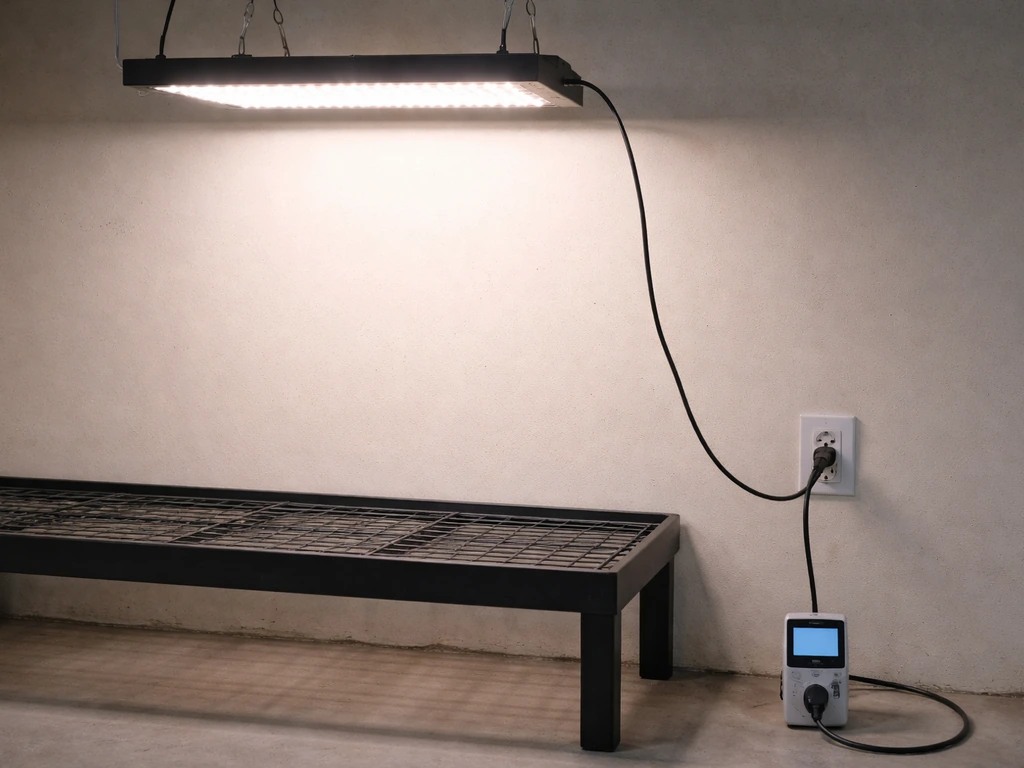
If the fixture is truly 1000W-class, it should publish both PPF (µmol/s) and efficacy (µmol/J) for its rated operating point, plus a PPFD map at a stated hang height and footprint. If any of those are missing, treat the “1000W” label as marketing and verify the actual draw from the wall (watt meter) instead of trusting the nameplate.
What DLI number should I aim for with a 1000W LED, and how do I calculate it for my exact schedule?
DLI is most useful when you match it to your crop stage and photoperiod plan. If your target is 12/12 flower, use the manufacturer’s PPFD map or measured PPFD at canopy and then calculate mol/m²/day, but adjust for your actual dimming level and measured hang height (because DLI changes linearly with PPFD).
When tuning a 1000W LED in a tent, should I aim for the center PPFD or the average/lowest value?
Use the lowest PPFD value across the canopy, not the center. The practical reason is that yields and plant health are constrained by under-lit areas first. A quick workflow is, hang at the manufacturer’s map height, measure center and four corners, then adjust height until the lowest reading is near your target PPFD.
If a light is “switchable spectrum” for veg and flower, can it be less efficient in one of the modes?
It can be, especially if you switch modes or use stage-specific presets with different power levels. Confirm watt draw for veg and flower modes, then compare published efficacy for each mode. If a fixture’s veg mode and flower mode have very different µmol/J but the same “1000W” label, that is a sign to prioritize the numbers, not the branding.
Can I stretch a true 1000W-class LED to a 6x6 tent, or should I stay with 4x4 to 5x5?
For flowering in a standard 5x5, you generally do better with one fixture sized for that footprint than trying to force a 6x6 coverage. If you must go wider, plan a multi-fixture layout and aim for even overlap using PPFD maps, otherwise edge plants will run lower DLI and often stretch.
How much do reflective walls (vs black or open room conditions) change the real coverage of a 1000W LED?
Yes, and it is usually the single biggest reason real results disappoint published claims. PPFD maps assume reflective walls and a defined tent setup. If you run a black tent or open room, you can lose a noticeable fraction of effective light, so raise the light carefully and re-measure PPFD on corners to avoid an overcorrection.
Where does heat come from on 1000W LED grow lights, and how should I manage it for longevity?
Check driver placement and ventilation strategy. If the driver is external and you can keep it cooler, tent ambient temperature matters less inside the tent. If the driver is inside and the tent runs above typical comfort temperatures, expect reduced efficiency and shorter lifespan over time, so prioritize exhaust sizing and consistent airflow.
Why is dimming important for seedlings and early veg, and what should I watch for?
Yes, and the risk is highest when you cannot dim. For seedlings, many growers run 40 to 60% output and ramp slowly, using PWM dimming so you do not have harsh step changes. If the fixture is only on/off or has two presets, you may end up compensating with hang height, which often creates a bigger PPFD gradient across the canopy.
What safety and compatibility checks should I do before powering a 1000W LED from my outlet?
Look for third-party safety and performance qualifications and then verify the exact driver input specs (voltage range) on the fixture or driver label. A quality fixture may have acceptable certifications but still be misconfigured if you plug the driver into the wrong rated voltage or use an incompatible extension/adapter.
Does certification really affect warranty and support, or is it only a safety checkbox?
If warranty terms are similar, certification can still matter because it often tracks manufacturer commitment and support logistics. If a brand ties longer coverage or easier support to a specific qualification status, that becomes a decision factor when you compare two “similar” 1000W-class options.
If two 1000W LEDs have similar PPFD in the center, which one is likely to yield more for flowering?
Not precisely, because plant response depends on uniformity, spectrum balance, and your environment. But if you need a rule of thumb for buying: target a true 1000W-class fixture that can deliver your flowering PPFD at the canopy with even coverage. Then refine with PAR meter readings and DLI, since spectrum and CO2 can change achievable grams per watt.
When using multiple 1000W LEDs, how do I avoid over-lighting one zone and under-lighting another?
It usually is not. If you are already using multiple 1000W fixtures for a larger area, the key is even overlap and avoiding hotspots or dead zones. Overlapping PPFD maps and measuring after installation matters more than simply adding wattage, because uniformity affects light stress and stretching.
Next Articles
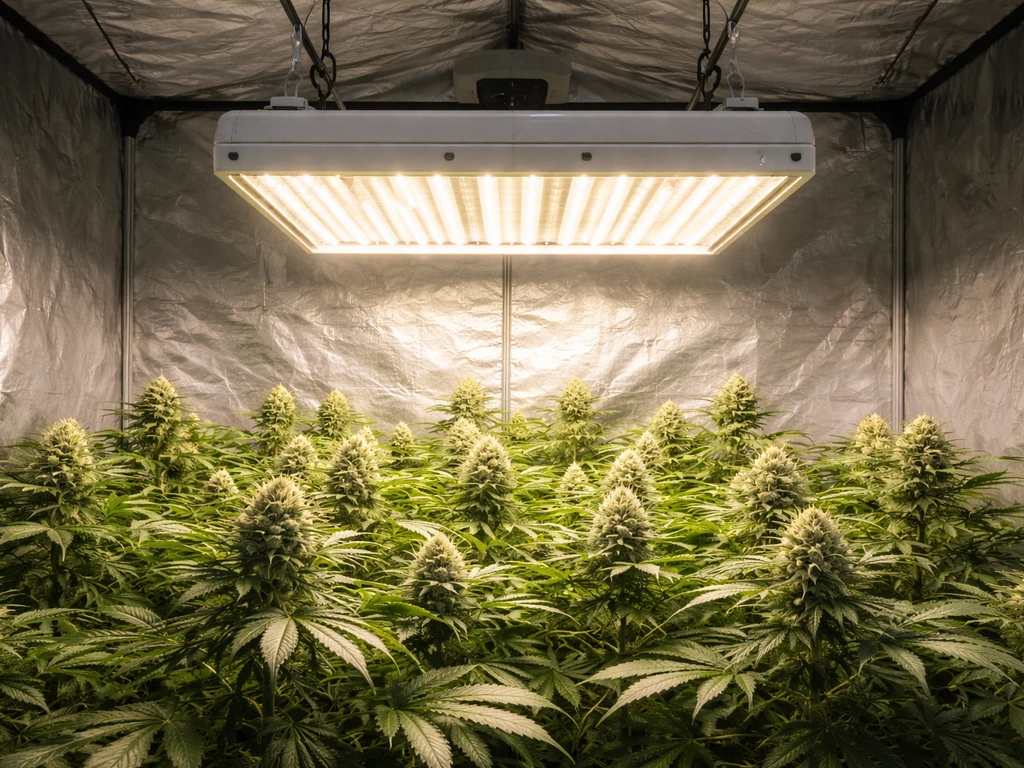
Best 1000 Watt LED Grow Light Guide: Coverage, PPFD, Setup
Choose the best 1000W LED grow light with PPFD, true coverage, setup height, and buying tips for your tent size
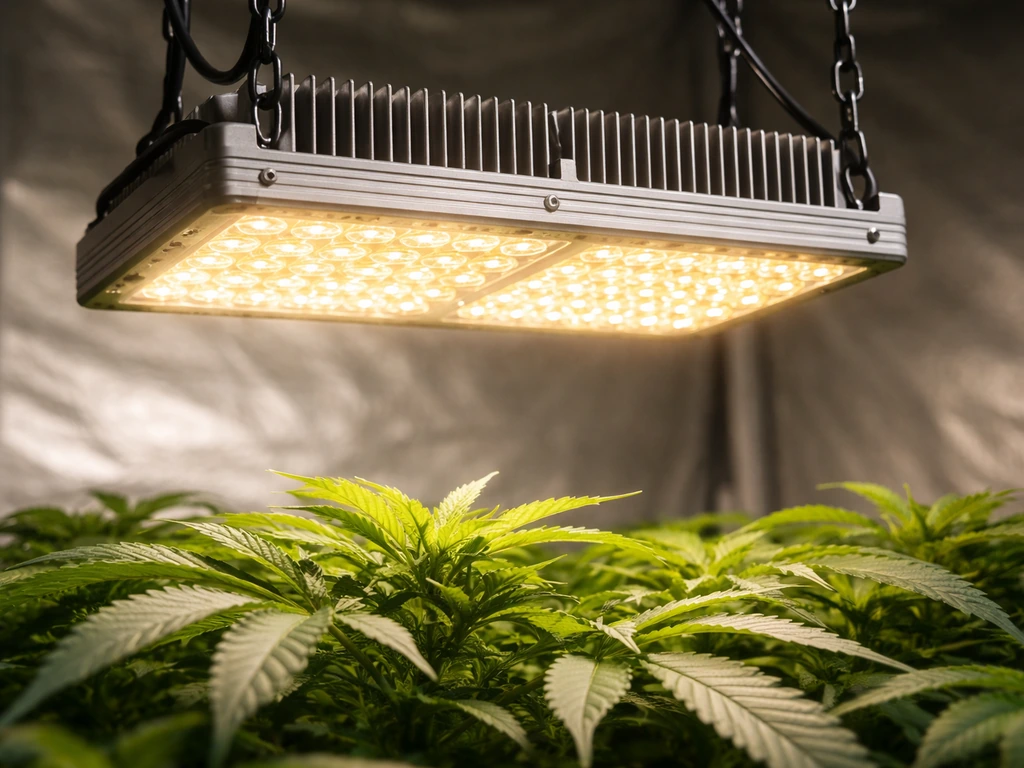
Best 1000W LED Grow Lights: How to Choose the Right One
Guide to picking the best 1000W LED grow light by real draw, coverage, PPFD, spectrum, efficiency, and safe setup
Top Shelf LED Grow Lights: Buyer Guide and Specs Checklist
Choose top shelf LED grow lights fast with a spec checklist for coverage, PPF, dimming, heat, and setup planning.