
If you're running a 1000W HPS and thinking about switching to LED, you don't need the 'LED equivalent of 1000W.' You need an LED fixture that delivers the right PPFD at canopy level across your specific footprint. Those are two very different things, and the distinction is where most growers go wrong. Done right, a quality LED pulling 500 to 650 watts at the wall can match or beat what your HPS is doing, with less heat, lower electricity costs, and better spectrum control. Here's how to make that translation accurately and choose the right light for your setup.
Best LED Grow Light to Replace 1000W HPS: Sizing Guide
Marcus Rutherford
20 Apr 2026
How to translate 1000W HPS into an LED target
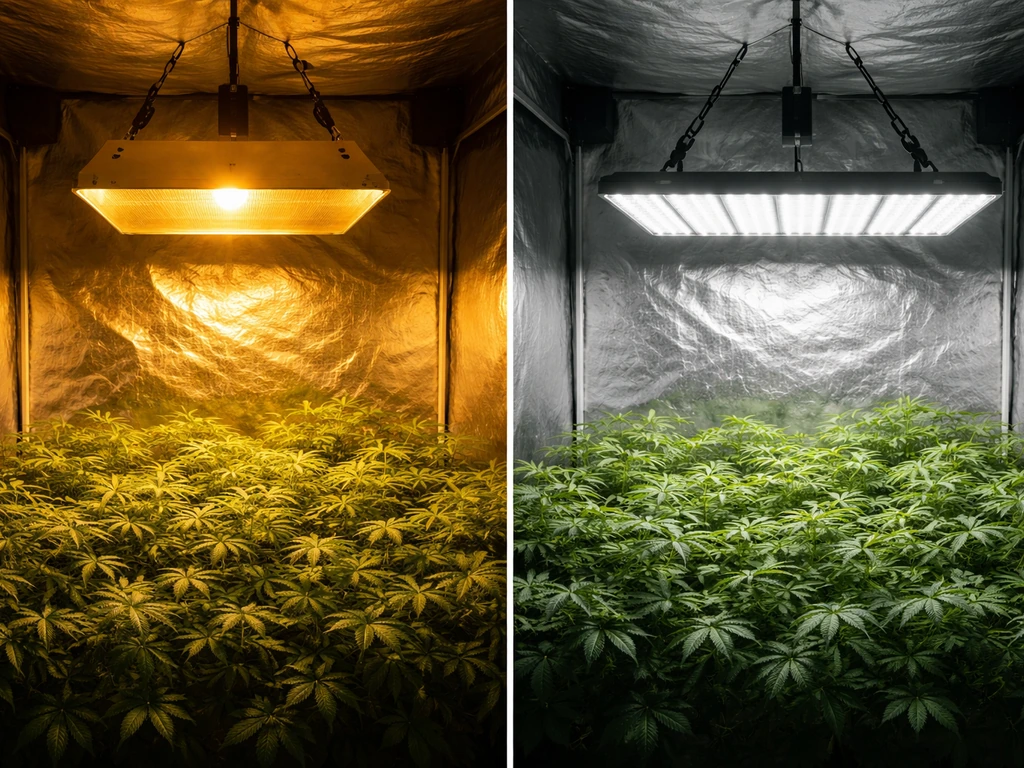
A 1000W HPS running at full power typically delivers around 900 to 1000 µmol/m²/s at canopy level over a 4x4 to 5x5 footprint, depending on reflector quality and mount height. That's your real benchmark, not wattage. The metric you want to match is PPFD (photosynthetic photon flux density), measured in µmol/m²/s at the canopy surface. Chasing a wattage number instead of a PPFD target is the single most common mistake growers make when switching to LED.
From PPFD you can calculate DLI (daily light integral), which tells you the total photon dose your plants receive per day. The formula is straightforward: DLI = PPFD × 0.0036 × hours of light per day. So a canopy sitting at 900 µmol/m²/s under an 18-hour veg cycle gets a DLI of roughly 58 mol/m²/day, which is aggressive but appropriate for high-demand crops. In flower under a 12-hour cycle at 900 µmol/m²/s, you're looking at about 39 mol/m²/day, which sits in the sweet spot for most cannabis and other high-light crops. Your LED target should hit those same DLI values, which means matching the PPFD of your HPS, not its wattage.
The practical PPFD targets to aim for are 800 to 1000 µmol/m²/s for bloom and 400 to 600 µmol/m²/s for veg. A high-quality LED rated for a 4x4 to 5x5 footprint should hit 900+ µmol/m²/s averaged across the canopy when measured at the recommended hang height. If a fixture's spec sheet doesn't include a PPFD map or canopy-level measurements at a stated distance, treat that omission as a red flag. Any reputable manufacturer will publish that data.
Coverage area: what footprint does a 1000W HPS actually serve?
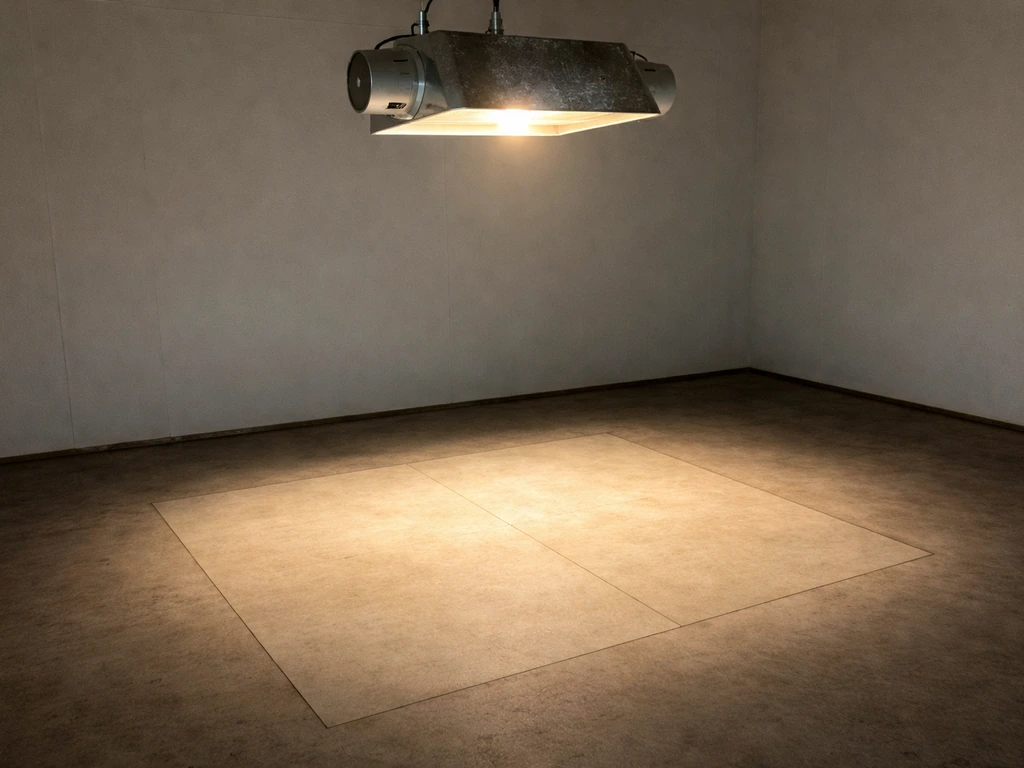
A 1000W HPS with a good air-cooled reflector covers a true flowering footprint of about 4x4 feet with high intensity, and can stretch to 5x5 with some falloff at the edges. Your LED replacement needs to match that coverage at adequate PPFD, not just fill the space with dim light. When you see LED fixtures marketed as covering '5x5' or even '6x6,' double-check the PPFD map. Coverage claims often reflect a lower-intensity threshold (like 400 µmol/m²/s), which is fine for veg but not for flower. Match the coverage claim to a flowering-level PPFD, and you'll find the real number is usually closer to 4x4 or 4.5x4.5 for a single quality fixture.
Choosing the right LED type and spectrum for your grow
Not all LEDs are built the same, and the form factor matters more than most buyers realize. The three main types you'll encounter for a 1000W HPS replacement are quantum board fixtures, bar-style fixtures, and high-output COB or chip-on-board designs. Each has real trade-offs.
| Type | Light Distribution | Heat Management | Best For | Typical Real Draw |
|---|---|---|---|---|
| Quantum Board | Wide, soft, uniform | Passive or low-noise active | Low canopy, even coverage | 400–650W |
| Bar-Style (LED Strips) | Very uniform, wide angle | Excellent passive spread | Large canopy, commercial rows | 500–700W |
| COB / High-Output | Intense, center-heavy | Requires active cooling | Deep canopy penetration | 400–600W |
Quantum boards and bar-style fixtures dominate the current market for good reason. They spread light more evenly across the canopy, run cooler per watt than COB designs, and are generally easier to dial in at the right mount height. Bar-style fixtures in particular are excellent for 4x4 and larger spaces because the multiple bars distribute PPFD more uniformly than a single central source, which is a genuine advantage over the point-source nature of HPS.
Full-cycle vs bloom-focused spectrum: which do you actually need?
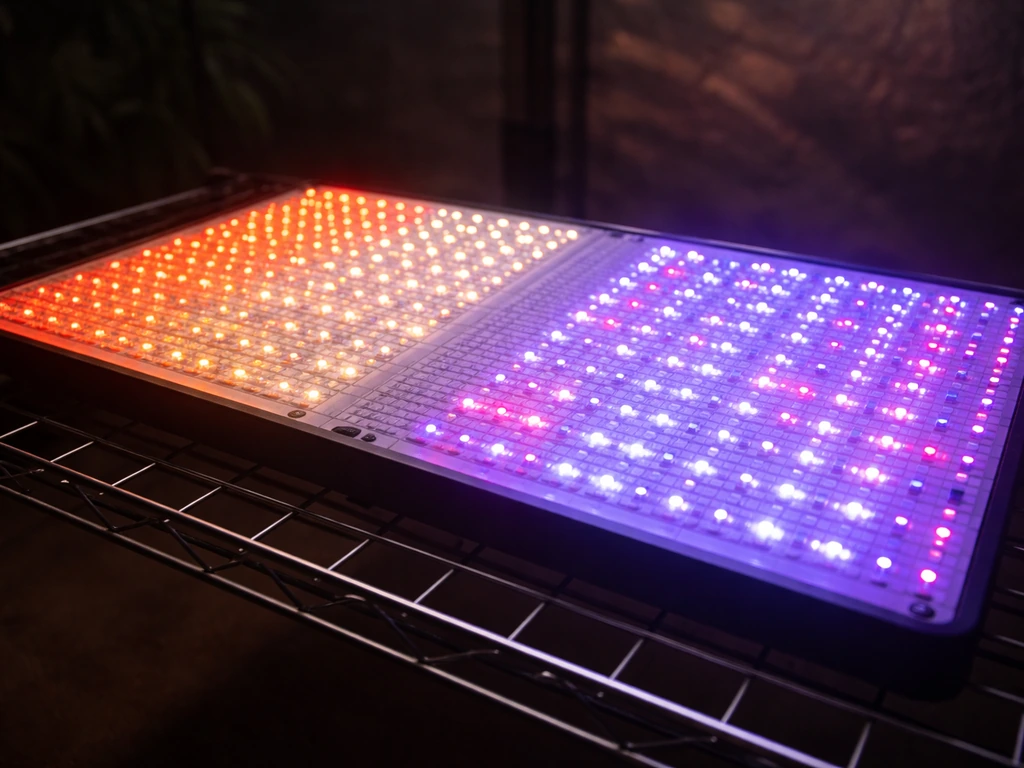
A standard 1000W HPS runs a heavy red and yellow spectrum that's optimized for flowering but thin on blue. Most modern full-spectrum LEDs cover 380 to 780nm and include a meaningful blue component (typically 440 to 470nm), which makes them genuinely full-cycle capable. You don't need a separate veg light. If you're running a single-tent setup or a two-tent system with the same fixture type, go full-spectrum and use dimming to manage intensity by growth stage.
Bloom-focused or 'red-heavy' LED spectrums do still show up, often marketed as closer HPS replacements. They can deliver strong flower results, but they underperform during veg and early stretch, and they limit your flexibility if your grow evolves. Unless you're running a dedicated flowering room where plants come in already vegged out, a full-spectrum fixture is the smarter long-term buy.
UV and IR add-ons are worth considering if you're buying a premium fixture, but they aren't a deciding factor for most growers. UV (280 to 400nm) has documented effects on terpene and resin development when applied during late flower. IR (700 to 780nm) promotes the Emerson enhancement effect and can accelerate flowering slightly. Several quality fixtures now include both in a fixed ratio, which is fine. Adjustable UV/IR channels add cost and complexity without major practical benefit for most home growers.
Fixture wattage and layout planning
A single high-quality LED fixture drawing 500 to 650W at the wall can replace a 1000W HPS in a 4x4 tent. In a 5x5, you'll want to either push toward 650W with a fixture that's specifically designed for that footprint, or use two fixtures in the 300 to 350W range that you can position for better uniformity. Two lights almost always beat one for canopy evenness in a 5x5 or larger space, because you eliminate the center-heavy intensity drop-off that any single fixture produces.
For a 4x8 grow room (a common two-plant commercial or hobbyist setup), plan on two fixtures, each covering a 4x4 half. Running two independently dimmable fixtures also gives you staging flexibility, letting you run one side in flower while the other is in veg, or staggering harvests.
| Footprint | Recommended LED Draw | Single or Multiple Fixtures | Target Avg. PPFD (Flower) |
|---|---|---|---|
| 3x3 | 250–350W | Single | 800–900 µmol/m²/s |
| 4x4 | 500–600W | Single or two smaller | 900–1000 µmol/m²/s |
| 5x5 | 600–700W | Single large or two | 850–950 µmol/m²/s |
| 4x8 | 900–1100W total | Two fixtures | 900–1000 µmol/m²/s |
One thing to verify before you buy: your circuit capacity. A 1000W HPS with ballast actually draws closer to 1050 to 1100W from the wall. A 600W LED is obviously lighter on the circuit, but if you're adding multiple fixtures or running other equipment on the same 15A circuit, check your total draw. Quality LED drivers run at 0.95+ power factor, so the math is clean, but it's still math worth doing before you flip the breaker.
Reflectors and bare-board designs
Most modern LED fixtures don't use reflectors the way HPS setups do. The LED chips and secondary optics handle beam angle natively. Bar-style fixtures typically use a 120-degree lens that spreads light evenly across the canopy. If you're used to swapping reflectors on your HPS to tune coverage, know that LED doesn't work the same way. The geometry is built into the fixture. What you control instead is mount height and, to a lesser extent, tent reflection (white walls or Mylar still matter for bouncing lateral light back onto the canopy).
Mount height, dimming, and airflow: dialing in your LED like a pro
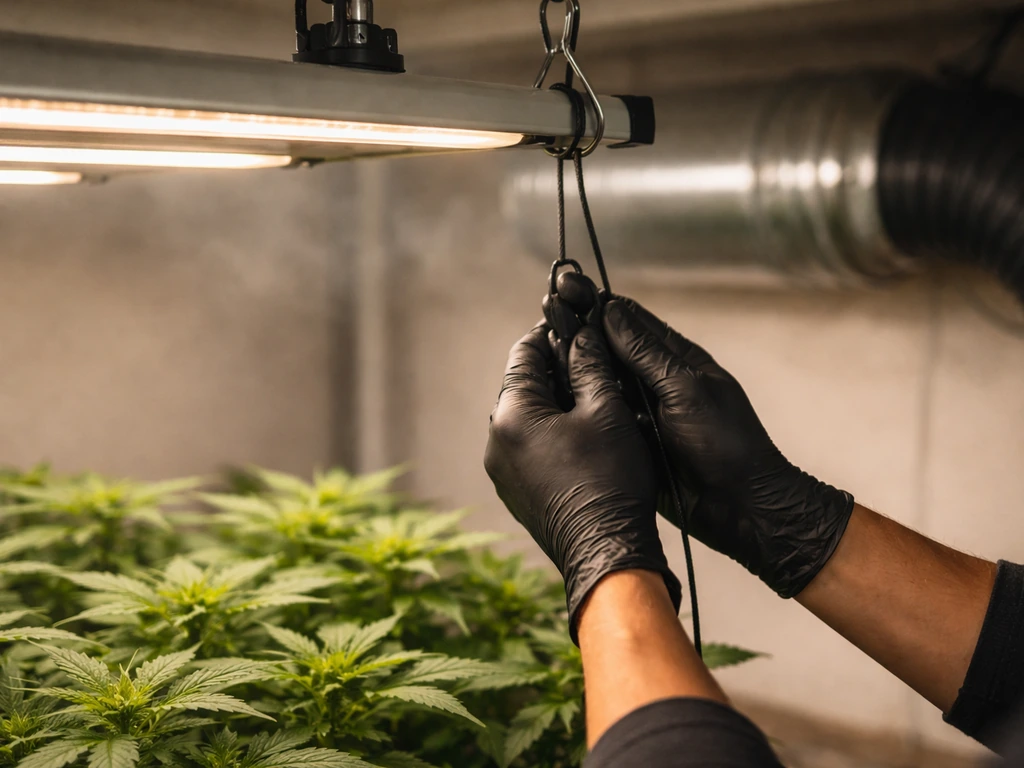
HPS growers are used to a fixed mount height and not much room to adjust intensity short of swapping bulbs. LED gives you real flexibility, and using it correctly makes a material difference in results. The two tools are mount height and the dimmer knob, and they work together.
For most bar-style and quantum board fixtures at 500 to 650W, the recommended flowering height is 18 to 24 inches above the canopy. Closer than 16 inches risks light bleaching on the tops, especially with high-efficiency diodes that pack more photons per watt. Farther than 30 inches and you start losing PPFD at canopy faster than you'd expect: blank" rel="noopener noreferrer">intensity drops with the inverse square law, so moving from 18 to 36 inches cuts intensity to roughly 25% of what you had at 18 inches. Hang height is not a small variable.
Dimming is your best friend during the first two weeks of a crop and during transitions. Start new transplants at 40 to 50% power and ramp up over 7 to 10 days. In late veg, you should be at 70 to 80%. Push to full power only once the canopy is established in flower. Running at full intensity from day one doesn't accelerate growth. It stresses young root systems and wastes electricity.
Airflow with LED is meaningfully different from HPS. A 1000W HPS dumps roughly 3400 BTU/hour of radiant heat into your grow space. A 600W LED produces about half that, but it still produces heat. The difference is that LED heat comes from the driver and the fixture housing, not from radiant IR below the fixture. Your canopy temperature won't be driven up by radiant heat the same way, but your ambient room temperature still needs management. Keep your exhaust fan sizing appropriate for the room, don't over-reduce it just because you switched to LED, and ensure your driver isn't recirculating hot air back across the canopy if it's mounted inside the tent.
How to verify and troubleshoot your setup
The only way to know if your LED is actually delivering what the spec sheet promises is to measure it. A quality quantum PAR sensor like the Apogee SQ-500 or SQ-520 will give you accurate PPFD readings with around 5% measurement uncertainty across LED, HPS, and other sources. Do not use a lux meter or a smartphone app for this. Lux meters are calibrated for human vision, not plant photosynthesis, and the conversion factor from lux to PPFD varies significantly by light source spectrum. For LED, those conversions are unreliable enough to send you in the wrong direction.
To map your canopy, take PPFD readings at a 1-foot grid across the entire canopy surface at your intended hang height. A 4x4 footprint gives you 16 measurement points. Record the max, min, and average. A good fixture should show a max-to-min spread of no more than 30 to 40% across the footprint, meaning if your center reads 1000 µmol/m²/s, your corners should be 600+ for acceptable uniformity. Anything below 50% of center at the edges indicates either wrong mount height, a fixture that's undersized for that footprint, or a design with poor lateral distribution.
Hot spots are more common than growers expect, especially with COB-style fixtures or bar lights that are spaced too far apart. If you see bleaching, upward-curling leaves, or nutrient lockout symptoms specifically on the tops near center, check your center PPFD first before blaming your feeding program. Dropping the dimmer to 80% and raising the fixture 4 inches will often fix it without rehanging anything.
Common sizing errors when switching from HPS to LED include buying a fixture rated for the same wattage (a '1000W LED' that draws 200W from the wall), trusting coverage claims without a PPFD map, and mounting too high to compensate for heat fears. LED doesn't burn plants from radiant heat at normal distances the way HPS can. If you're hanging your LED fixture at 36 inches because you're nervous about heat, you're leaving a significant amount of your PAR output on the floor.
What to actually look for when shopping
The specs that matter when comparing LED fixtures for a 1000W HPS replacement come down to four things: real watt draw, photon efficacy, published PPFD maps, and driver quality. If you want help narrowing down the best 1000 watt led grow light options, focus on real-world performance specs rather than marketing numbers real watt draw. A good place to start is comparing the best led grow lights 1000w options based on real watt draw and canopy-level PPFD results, not marketing claims. Everything else is secondary. In the same way you compare specs for a 1000W HPS replacement, you can also use this as a quick check for the best 100w led grow light choices.
- Real watt draw at the wall: The number that matters for your electrical bill and circuit planning. Look for it in the spec sheet, not the marketing headline. '1000W LED' often means 200 to 250W actual draw, which is nowhere near enough for a 4x4 flower tent.
- Photon efficacy (µmol/J): This is your efficiency metric. Top-tier current fixtures hit 2.7 to 3.0+ µmol/J. Solid mid-range sits at 2.3 to 2.6 µmol/J. Anything under 2.0 is not competitive in 2026 and you're leaving real energy savings on the table.
- Published PPFD maps: A manufacturer that won't publish canopy-level PPFD data at a stated distance and power level is hiding something. Third-party tested maps are even better. Look for testing tied to real electrical input conditions, not optimistic projections.
- Driver quality and dimming: Meanwell HLG-series drivers are the current industry benchmark for reliability and clean dimming. 0-10V dimming compatibility is useful if you want to run a light controller. Cheaper fixtures often use unbranded drivers that fail within 12 to 18 months under continuous grow-room conditions.
- Warranty and heat management: A genuine 5-year warranty signals manufacturer confidence in thermal design. Passive cooling with aluminum heatsinks is quieter and more reliable than fans. Active cooling (fans on the fixture) is fine but adds a failure point over time.
- LM-79 test data or DLC listing: Fixtures with IES LM-79 photometric test reports or DesignLights Consortium (DLC) listings have been independently validated for efficacy and electrical performance. This is the clearest signal that the published numbers reflect reality.
On the topic of budget vs. premium: the gap has genuinely narrowed. In 2026, there are solid fixtures from Chinese manufacturers using Samsung LM301H or Osram diodes with Meanwell drivers that perform within 10 to 15% of premium-tier brands at 40 to 50% of the price. The trade-off is usually build quality, warranty support, and customer service if something goes wrong. For a one-light home setup, the budget-to-mid range is absolutely worth considering. For a commercial build where downtime costs money, the premium tier earns its price.
If you're comparing fixtures marketed as 1000W LED replacements, look at the best 1000w led grow lights category more broadly, keeping in mind that those listings include everything from serious commercial fixtures to underpowered budget options that misuse the '1000W' label. Similarly, full-spectrum 1000W LED options specifically optimized for complete grow cycles are worth evaluating separately if spectrum flexibility is a priority for your setup. If you’re comparing options, prioritize full-spectrum fixtures that can hit the canopy-level PPFD targets across your full grow cycle full-spectrum 10000w led grow lights.
What to expect from the switch: real outcomes vs. HPS
If you do this correctly, choosing a fixture with the right real watt draw, hanging it at the right height, and dialing in intensity through the grow cycle, you should expect to match your HPS yields and often beat them slightly. The performance gains from LED aren't primarily from more photons. They come from better canopy temperature control, more uniform PPFD distribution (especially with bar-style fixtures versus HPS's center-heavy output), and the ability to run your lights through a whole grow cycle without a mid-grow bulb change affecting spectrum.
The electricity savings are real and significant. Replacing a 1000W HPS (drawing 1050 to 1100W with ballast) with a 550 to 600W LED fixture that delivers equivalent canopy PPFD cuts your lighting energy use by roughly 45 to 50%. Over a 12/12 flower cycle running 90 days, that's around 270 kWh saved per cycle at 12 hours per day, which adds up quickly at current electricity rates.
Heat load reduction is the other practical win. Less radiant heat means lower HVAC costs, less evaporative stress on plants, and more stable VPD management. Growers who switch from HPS to a quality LED often report easier climate control as one of the first things they notice, before they even assess yield differences.
Where LED can underperform HPS is in deep canopy penetration for tall plants in late flower. HPS still has an advantage in delivering high-intensity photons to lower bud sites in very tall canopies (over 36 inches). If you're running a scrog or keeping canopy height under 24 inches, this is not a factor. If you run tall plants with a lot of vertical structure, a COB-style LED or a higher-wattage bar fixture will outperform a standard quantum board in this specific scenario.
The bottom line: a 500 to 650W LED with 2.5+ µmol/J efficacy, a published PPFD map showing 900+ µmol/m²/s at canopy in a 4x4 footprint, and a quality driver will replace your 1000W HPS competently. Measure your canopy with a real PAR sensor, hang it at the manufacturer's recommended height, and ramp it up gradually. If you want the best 100w led grow light, use the same PPFD and canopy-height method to confirm the fixture can actually hit your targets across the whole footprint 500 to 650W. You'll spend less on electricity, run a cooler room, and very likely hit the same or better yields within one or two grow cycles of dialing it in.
FAQ
What if a product says “1000W HPS replacement,” but it doesn’t list PPFD at canopy level?
Use the fixture’s published PPFD (or PPFD map) at a specified hang height. If the only numbers you see are coverage claims and “1000W replacement,” it is usually underpowered for flowering intensity, even if the watt draw sounds high.
Should I trust the manufacturer’s PPFD map, or verify once I mount the light?
Measure PPFD at your intended mounting distance after installation, because hang height and tent geometry change results. Then set your dimmer using those readings, not the manufacturer’s ideal scenario, especially if your tent walls are dark or your reflective surfaces are worn.
Will a higher-watt LED always replace a 1000W HPS better than a lower-watt option?
Not necessarily. If you can hit your target DLI via dimming and the fixture maintains uniform PPFD across the canopy, a lower-watt LED can outperform a higher-watt one that is less efficient or more center-peaked. Prioritize average PPFD uniformity over raw watt draw.
What should I do if my tops are bleaching or showing light stress after switching to LED?
If your plant tops show bleaching or stress near the center, reduce power and adjust height first. A common fix is to drop to about 80% and raise by 3 to 5 inches, then re-check PPFD at the canopy so you are not guessing based on symptoms alone.
My LED seems strong in the middle and dim on the edges, how do I fix canopy uniformity?
Add more fixtures or reduce spacing before you assume you can “dimmer your way out.” Uniformity problems come from lateral distribution, so if the corners are far below the center, two lights (or better placement) is often the real remedy.
Can I use one LED light for both veg and flower without changing fixtures or spectrum?
Yes, but only if you are controlling intensity. Full-cycle performance depends on keeping PPFD high enough during bloom while also ramping gradually in early growth to avoid stalling. A proper full-spectrum LED plus dimming is usually more flexible than a red-heavy unit.
Can I use a smartphone app or a lux meter to set my PPFD targets?
Avoid it. Lux meters and most phone apps are calibrated to human brightness, not photon flux, and they can lead you to set intensity too low or too high. For sizing decisions, use a real PPFD sensor (PAR sensor) and measure at canopy level.
How do I compare two lights if their PPFD numbers are measured at different distances or footprints?
Check how the fixture is specified: some brands rate “room output” or at a nominal height. For your decision, look for averaged canopy PPFD and the hang height used in the test, and compare that directly to your footprint target.
Does tent airflow and where the driver sits inside the tent affect LED performance?
Consider driver temperature and airflow path. If your driver is mounted inside the tent and heat builds up around it, efficiency can drop and output may not match spec. Ensure the driver area has clear airflow and is not trapped against hot tent walls.
When would a quantum board be a poor choice compared with COB for replacing a 1000W HPS?
For typical setups under about 24 to 30 inches of canopy height, the guidance in the article is usually sufficient. If you run very tall plants or an extended canopy that exceeds that range, you may need a COB-style design or a higher-output bar with better lower-site penetration.
How do I calculate whether my 15A circuit can handle the LED upgrade?
Yes, especially on shared circuits. Total draw includes everything on that circuit, and some LED drivers can vary slightly under load. If you are close to the limit, add up all devices running at once (fans, dehumidifier, heaters) and verify breaker margin.
What is a safe dimming ramp when switching from HPS to LED in the middle of a grow?
Plan the dimming schedule by starting low and ramping based on plant response, not by running full power immediately. In transitions, keep the ramp over about a week and confirm with PPFD readings so you do not overshoot target DLI.
How many PPFD measurement points do I need, and where should I place them for best accuracy?
For many bar and quantum board fixtures, a 1-foot grid is a practical start, but the key is measuring at your actual hang height and across the canopy where buds will form. If you suspect a hotspot, add extra points near the corners and near the centerline.
Should I use two fixtures instead of one for a 5x5 if I want flowering-level PPFD?
Usually yes for flowering-stage uniformity. If you are trying to cover 5x5 at 900+ averaged PPFD, one fixture often cannot keep the corners up without using excessive intensity and creating center hotspots. Two fixtures also let you stagger harvests and adjust one side independently.
Next Articles
Best LED Grow Lights 1000W: Buying Guide, Coverage, Costs
Buying guide to choose the best 1000W LED grow lights: real watt draw, coverage, spectrum, mounting, and running costs.
Best 1000 Watt LED Grow Light Guide: Coverage, PPFD, Setup
Choose the best 1000W LED grow light with PPFD, true coverage, setup height, and buying tips for your tent size
Best 1000W LED Grow Lights: How to Choose the Right One
Guide to picking the best 1000W LED grow light by real draw, coverage, PPFD, spectrum, efficiency, and safe setup