
If you want a direct answer: a well-built 500W-class LED grow light is the sweet spot for a 4x4 tent running flowering crops, and it's the wattage range I'd recommend to most hobby growers who've outgrown a 200-300W bar light but don't need to light a 5x5 or larger space. The catch is that "500 watt" is one of the most inconsistently used labels in grow lighting, so before you spend $300 to $600 on a fixture, you need to understand what that number actually means.
Best 500 Watt LED Grow Light: Buyer Guide and Setup Tips
Marcus Rutherford
6 Apr 2026
What "500 watt" really means for grow lights
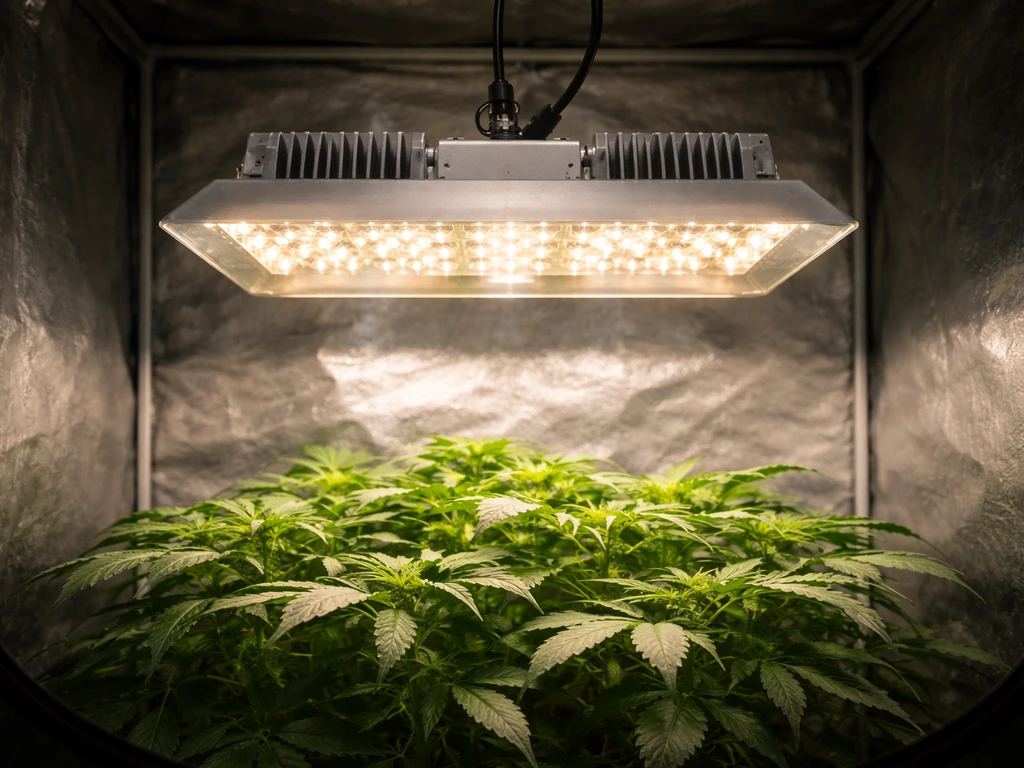
The wattage number on a grow light box almost never tells the full story. There are two different wattages you'll encounter: the "equivalent" or marketing wattage, and the actual wall draw. A light sold as "500W" might pull anywhere from 400W to 530W from your outlet depending on the brand. The ViparSpectra KS5000, for example, is marketed as a 500W fixture, but independent testing clocked its actual wall draw at 488W. Spider Farmer's SE5000 is similarly grouped in the 500W class but is rated at 480W of actual consumption. Neither number is dishonest exactly, but neither is what the marketing headline implies either.
Why does this matter? Because actual wall draw is what determines your electricity bill, your heat load, and the real photon output your plants receive. When comparing fixtures, always look for the actual power draw (sometimes listed as "true power" or "wall power") rather than the headline wattage. A fixture pulling 480W with a photon efficacy of 2.7 µmol/J will outperform a 520W fixture rated at 2.1 µmol/J, both in light output and in heat generated per watt.
Efficacy, measured in micromoles of photons per joule (µmol/J), is the single most useful number on a spec sheet. Entry-level 500W-class fixtures from a few years ago hovered around 1.8 to 2.1 µmol/J. Today's better options are pushing 2.7 to 2.9 µmol/J. The KS5000 sits at 2.40 µmol/J (ViparSpectra's stated Usable PPE), which is competitive but not class-leading. If you see anything below 2.0 µmol/J in 2026, skip it.
How to choose the best 500W LED: the specs that matter
Shopping for a grow light without understanding the core specs is like buying a car by looking at the paint color. Here's what to actually check before buying.
PPFD and coverage map
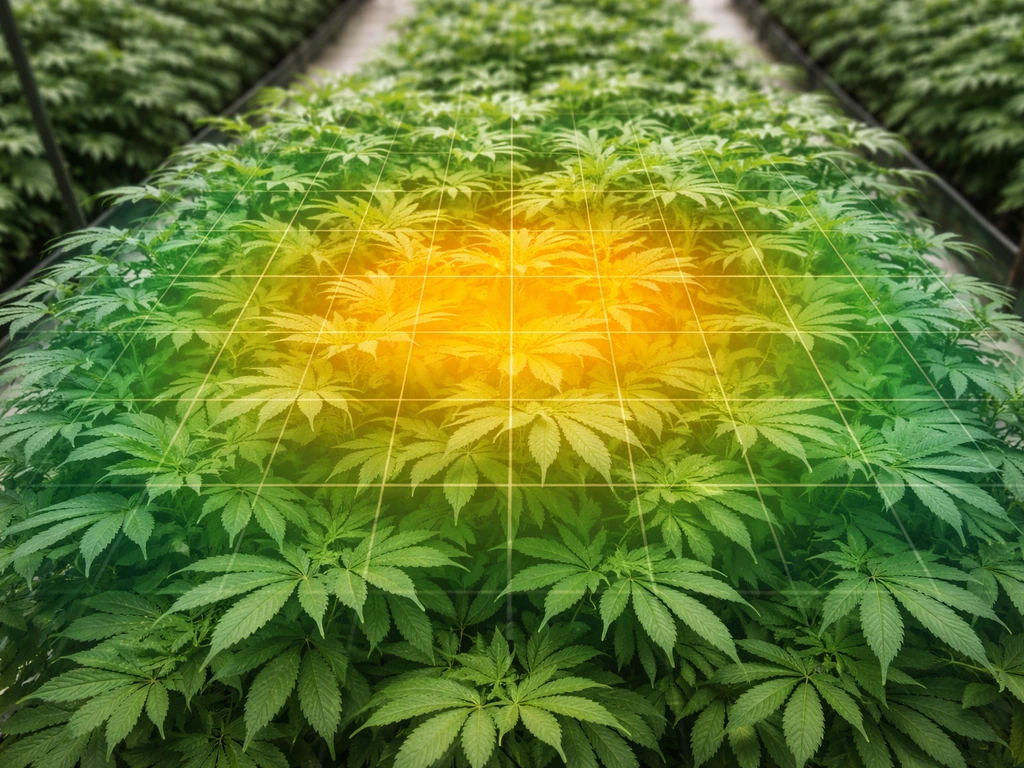
PPFD (photosynthetic photon flux density) is the number of photons hitting a square meter of canopy per second, expressed in µmol/m²/s. This is the most direct measure of how much usable light your plants are getting. For flowering crops, you want a PPFD of roughly 600 to 900 µmol/m²/s across the canopy at your target hanging height. A legitimate 500W fixture should be able to deliver that across a 4x4 footprint (16 sq ft). The KS5000, in third-party testing, hit a maximum PPFD of around 1,000 µmol/m²/s at just 28 cm (about 11 inches) above the sensor, which means you have real headroom to dial back intensity or raise the fixture to spread coverage.
Always ask for a PPFD map, not just a single center reading. Some brands publish a 5x5 grid showing readings at multiple points across the footprint. If the edges are half the value of the center, the "coverage" claim is misleading. A good fixture at a well-chosen hanging height should show no more than a 20 to 25% drop from center to edge across your intended footprint.
Efficacy and driver quality
As mentioned above, target at least 2.4 µmol/J efficacy. Beyond the LEDs themselves, the driver is the most failure-prone component in any LED fixture. Meanwell drivers (specifically the HLG and ELG series) are the industry gold standard for a reason: they run cooler, tolerate voltage fluctuations better, and have a documented lifespan of 50,000+ hours. If a fixture doesn't specify the driver brand or uses a generic "self-developed" driver with no third-party certification, that's a yellow flag.
Dimming and control
Dimming is not a luxury feature at the 500W price point, it's essential. You'll want to dim to 30 to 50% for seedlings and early veg, then ramp up for late veg and flower. Look for 0 to 100% continuous dimming, ideally with RJ14 daisy-chain capability so you can link multiple fixtures to one controller. Some higher-end options also offer independent dimming of UV or IR channels, which is useful if you're dialing in specific spectrum ratios for different stages.
Certification and safety ratings
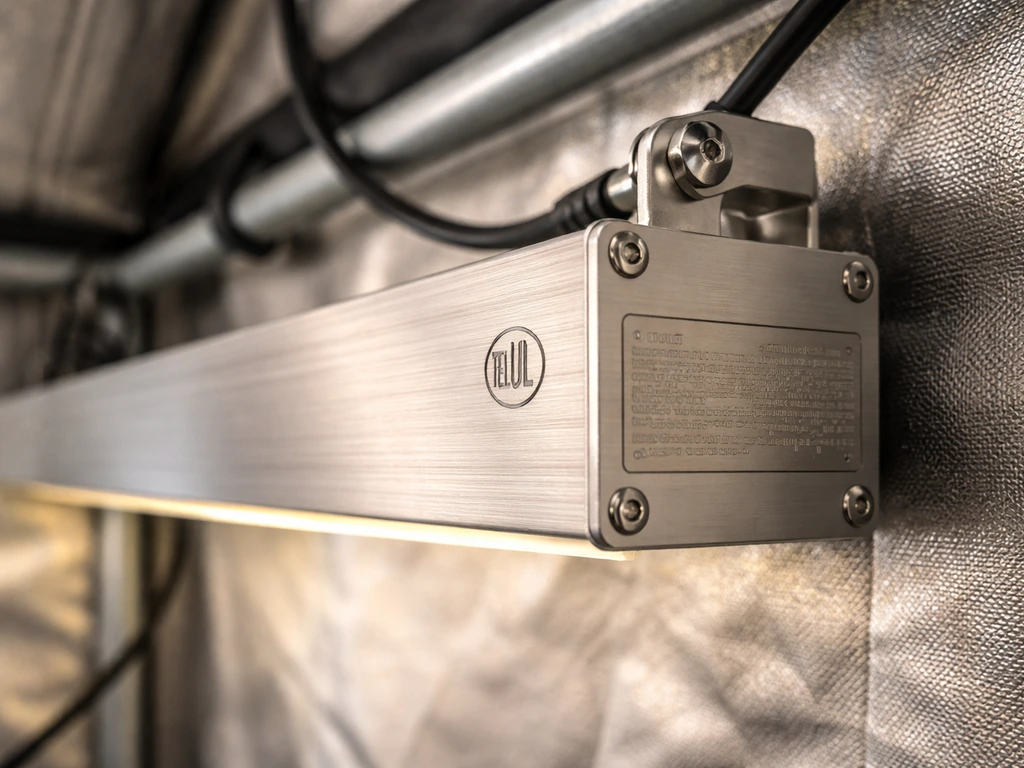
For any fixture you're running in an enclosed grow tent, ETL or UL listing is the minimum I'd accept. These certifications mean the fixture has been tested by a recognized third-party lab for electrical safety. DLC (DesignLights Consortium) listing is a bonus and is increasingly required for commercial rebate programs. DLC also publishes horticultural technical requirements used to support blank" rel="noopener noreferrer">DLC qualifying LED listings for rebate and commercial programs. Without ETL or UL, you're running an untested fixture in a space that typically has high humidity, enclosed air, and sometimes CO2 supplementation. That's a fire hazard worth taking seriously.
Top use-cases and ideal footprint coverage
A 500W-class LED is built for the 4x4 tent. That's the primary use-case and where these fixtures perform best. At the right hanging height (more on that below), a quality 500W fixture will deliver flowering-level PPFD uniformly across all 16 square feet of a 4x4. For vegetative growth in a 4x4, you're often running these at 50 to 60% power, which is efficient and keeps temps manageable.
You can push a strong 500W fixture into a 5x5 for vegetative growth, but for flowering in a 5x5 you'll be light-starved at the edges. Conversely, running a 500W in a 3x3 for flower will give you more than enough PPFD, which means you'll spend most of your grow dimmed way down or hanging the light very high, neither of which is ideal. For a 3x3 space, a 400 watt LED grow light is usually a better fit and a more cost-effective choice.
For hobbyists who are just starting out and working with a smaller footprint, it's also worth knowing that 300 watt LED grow lights cover a 2x4 or 3x3 tent very well and are significantly cheaper to run. Don't overbuy wattage for your space.
| Grow Space | Recommended Stage | Target PPFD | Notes |
|---|---|---|---|
| 3x3 (9 sq ft) | Veg only | 400–600 µmol/m²/s | 500W is overkill for flower here; dim heavily or choose a 300–400W fixture |
| 4x4 (16 sq ft) | Veg + Flower | 600–900 µmol/m²/s | Ideal footprint for a 500W-class light |
| 4x8 (32 sq ft) | Veg only | 400–600 µmol/m²/s | Two 500W fixtures recommended for flowering |
| 5x5 (25 sq ft) | Veg | 400–600 µmol/m²/s | Marginal for flower; consider 600W+ for flowering in this space |
Spectrum and performance for veg vs flower
Most modern 500W LED fixtures ship with a broad "full-spectrum" output covering roughly 380nm to 780nm, which works across all growth stages without swapping out lights. That's a genuine improvement over the purple blurple lights of 10 years ago. The question now is how the spectrum is weighted, and whether you have any control over it.
For vegetative growth, plants respond best to blue-heavy light in the 400 to 500nm range. Blues promote compact, bushy growth, tighter internodal spacing, and thicker leaf structure. For flowering, red wavelengths in the 620 to 680nm range drive photosynthesis most efficiently, while far-red (700 to 740nm) can accelerate flowering transitions and increase yield density through the Emerson effect. A fixture that claims a single spectrum for "all stages" is making a reasonable compromise, not an outright lie. But if you want to optimize, look for fixtures with independent veg/bloom channels or controllable spectrum ratios.
Color temperature is also relevant when you're comparing specific diodes. If you're evaluating fixtures by their LED chip specs, 6500K LED grow lights lean blue-heavy and are better suited for vegetative phases, while warmer 3000K diodes prioritize red output for flowering. The best all-stage fixtures mix multiple diode temperatures plus dedicated red and far-red diodes rather than relying on a single bin.
One thing to watch: some budget 500W fixtures inflate their red/far-red output to hit impressive-sounding PPFD numbers, because red photons are "cheaper" to produce and show up well in PAR meters. The fix is to look for ePAR measurements (which include far-red from 400 to 750nm) and to check that the spectrum graph shows a meaningful blue peak, not just a red-heavy spike.
Setup, mounting height, and troubleshooting for maximum PPFD
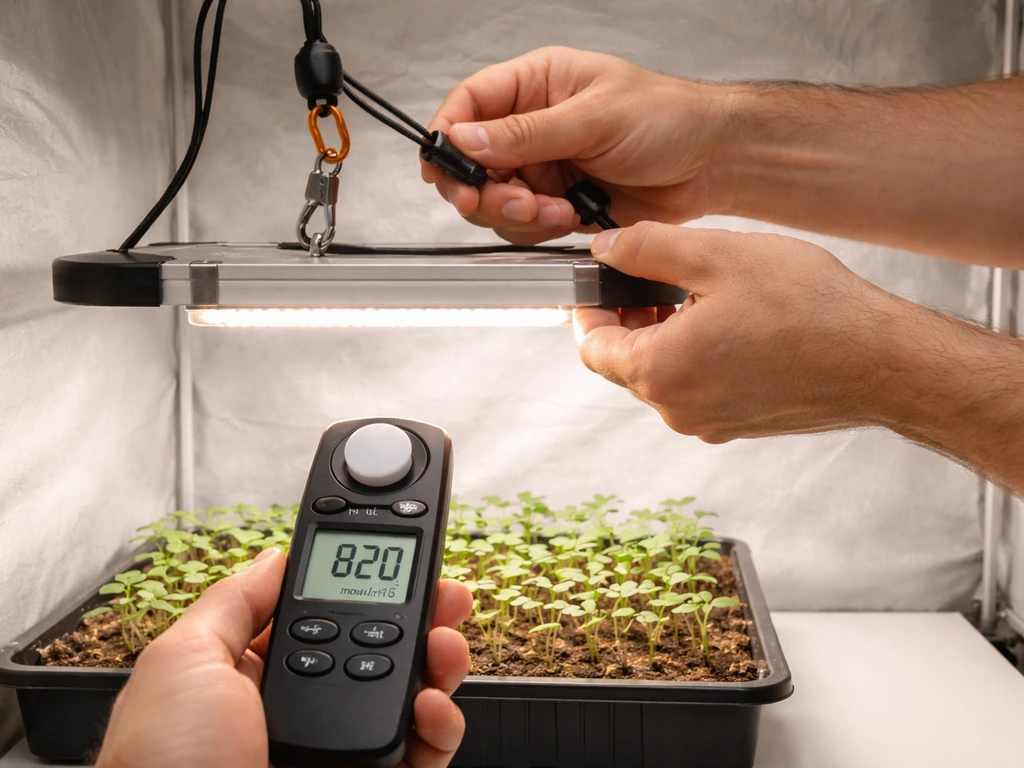
Mounting height is the single most adjustable variable you have after buying a fixture, and it has an enormous effect on your actual PPFD. Lower the light and PPFD increases (but hotspots and bleaching become a risk). Raise it and PPFD drops across the whole canopy but coverage becomes more uniform. For most 500W bar-style fixtures over a 4x4, a hanging height of 16 to 24 inches above the canopy is the practical working range. The KS5000's published data suggests 16 inches delivers solid even coverage across a 4x4. Third-party testing showed the 28 cm (11 inch) height yielding peak PPFD around 1,000 µmol/m²/s, which is at the top of what most crops need for flower.
During seedling stage, raise the fixture to 24 to 36 inches and dim to 30 to 40%. For early veg, move to 24 to 30 inches at 50 to 60%. For late veg and early flower, drop to 18 to 24 inches at 75 to 100%. For peak flower, 16 to 20 inches at full power is typical, but verify with a PAR meter rather than guessing.
If you're seeing uneven growth, bleached tops, or stunted plants at the edges, those are PPFD distribution problems. Uneven canopy growth usually means your edges are underpowered: try lowering the light slightly and verify with a PAR meter at 9 different points across your 4x4 grid. Bleached tops with healthy edges means the center PPFD is too high: raise the fixture or dim it. Plants stretching toward the light means PPFD is too low overall, so lower the fixture or increase intensity.
One underrated setup tip: train your canopy flat (SCROG or LST) before you dial in your final light height. A lumpy canopy with a 12-inch height difference between the lowest and highest bud sites will never have uniform PPFD no matter how you adjust the fixture.
Safety, heat, and reliability considerations
A 500W fixture running 12 hours per day is pulling significant power. At the US average of around $0.16/kWh (though this varies widely by region), a 488W fixture running a 12/12 flowering schedule costs roughly $340 per year in electricity alone. That's not a reason not to buy, but it's a reason to choose an efficient fixture rather than a cheap one, because the efficiency gap between a 2.1 µmol/J and a 2.7 µmol/J fixture compounds over 3 to 5 years of use.
On heat: modern quantum board LED fixtures at 500W run considerably cooler than HPS equivalents, but they still generate meaningful heat. A 488W fixture is dissipating roughly 400 to 450 watts of heat into your grow space (the rest leaves as photons). In a 4x4 tent, that's enough to raise ambient temperature by 8 to 15 degrees Fahrenheit over room temp, depending on airflow and insulation. Budget for at least 4-inch inline fan extraction with a carbon filter, and size your fan to exchange your tent air volume at least once per minute.
Passive aluminum heatsinks on quantum board fixtures are more reliable than active cooling fans over the long term, because there are no mechanical parts to fail. Look for fixtures with thick aluminum heatsinks and good thermal contact between the PCB and the heatsink. Boards that run uncomfortably hot to the touch (above 60°C at the heatsink) will have reduced LED lifespan.
For electrical safety in an enclosed tent with irrigation, always: use a GFCI outlet or GFCI breaker, keep drivers outside the tent where possible (many fixtures allow this via a remote driver mount), and never run wiring through standing water. If a fixture isn't ETL or UL listed, the risk profile changes significantly in a wet environment.
Value vs other wattages: when 500W is the right (or wrong) buy
The 500W class occupies a specific value sweet spot, but it's not always the right answer. Here's how I think about the wattage decision relative to your space and budget.
If your space is a 4x4 and you're growing flowering crops through a full cycle, 500W is correct. You'll have enough PPFD to hit 800 to 900 µmol/m²/s at the canopy without stressing your plants, and you won't be leaving yield on the table the way you would with a 300W unit. For growers looking at options slightly above this range, the best 600 watt LED grow lights are worth evaluating if you're considering a 5x5 space or want extra headroom for high-light crops like tomatoes and peppers.
If you're UK-based and shopping in that market, the options and pricing shift enough that checking out the best 600W LED grow lights available in the UK is a worthwhile comparison exercise, since that wattage tier is more widely stocked from UK distributors with faster shipping and local warranty support.
On the other end, if you're working in a smaller space or have a limited budget, 300W LED grow lights are genuinely capable fixtures for a 2x4 or small 3x3 tent and cost significantly less to purchase and operate. Don't buy more watts than your space needs.
If you're scaling to a serious commercial or semi-commercial setup and a 4x4 is just one of many tents, the math often changes in favor of fewer, larger fixtures. A single 1500W LED grow light covering a 4x8 can be more efficient per square foot than four 500W units, with lower per-fixture cost and fewer power circuits to manage.
| Wattage Class | Ideal Footprint (Flower) | Estimated Cost Range | Best For |
|---|---|---|---|
| 300W | 2x4 or 3x3 | $150–$300 | Small tents, beginners, supplemental lighting |
| 400W | 3x3 to 3x4 | $200–$350 | Compact grow spaces, efficient single-plant setups |
| 500W | 4x4 | $280–$600 | Standard hobby grow tent, one full flowering cycle |
| 600W | 4x5 to 5x5 | $350–$700 | Larger tents, high-light crops, extra headroom |
| 1500W | 4x8 or larger | $600–$1200+ | Commercial or multi-plant production runs |
How to shortlist and verify before you buy
Here's the practical process I'd follow if I were buying a 500W-class fixture today. First, confirm the actual wall draw (not the marketing wattage) and divide the manufacturer's stated PPF output (in µmol/s) by that wattage to get efficacy. If the brand won't publish PPF, that's a red flag. Second, find a published PPFD map at 18 to 24 inches for a 4x4 footprint.
Third, confirm ETL or UL listing. ManualsLib hosts the [ViparSpectra KS5000 user instructions](https://www. manualslib. com/manual/3136341/Vipar-Spectra-Ks5000.
html), including the manual version/date and product diode information that can support setup and safety references. Fourth, check the driver brand. Fifth, verify dimming range and control compatibility if you plan to use a grow controller. Sixth, check the warranty: anything less than 3 years on a $400+ fixture is a sign the brand isn't confident in the product.
If independent test data is available from a third-party site (grow forums, university extension programs, or dedicated review sites), prioritize that over manufacturer specs. Brands consistently publish best-case PPFD numbers from ideal test conditions. Real-world mounts in reflective tents with real canopy heights will differ, sometimes substantially.
Finally: buy a PAR meter or rent one after your fixture arrives. A $30 to $50 apogee-style smartphone meter attachment is enough to verify your actual PPFD at canopy level. If your light isn't hitting the expected numbers, you can adjust height, increase power, or return the fixture while you're still in the return window. Don't run a full grow cycle on guesswork when a basic measurement takes 10 minutes.
FAQ
Can I use a “500W” light for a 4x4 if I’m only running it at half power during veg? Then will it still be even enough?
Yes, but only if you can reproduce the same hanging height and coverage. If you plan to dim low for veg, confirm the PPFD map at your intended percentage (for example 50% output) because some fixtures keep hotspots at the center even when dimmed.
Will a best 500 watt led grow light work with a grow controller, and what dimming signals should I look for?
If the driver supports remote dimming or has an RJ14 daisy-chain port, a grow controller can work well. If the fixture uses proprietary dimming inputs or only supports on-off control, you may lose fine control over spectrum channels or continuity, so verify compatibility before buying the controller.
What’s the safest way to confirm that a 500W light’s dimming is truly usable for seedlings and early veg?
Look for both a listed dimming range (0 to 100% continuous) and the mechanism used (dimmer module, potentiometer, or controller input). If it only claims “dimmable” but does not specify the range or whether it flickers, you can see uneven growth and stress, especially on seedlings.
If the light hits peak PPFD at about 11 inches, is mounting it that low always a good idea for flower?
At 16 inches you can get very high PPFD, which helps yield, but the risk is center bleaching and canopy hotspots if your canopy is uneven. This is why the practical fix is to confirm PPFD uniformity with a PAR meter or to keep a small buffer, for example staying slightly higher than the minimum and compensating with dimming.
My plants are uneven even after I set the hanging height. What should I troubleshoot first, light or canopy shape?
A good rule is to treat the lowest and highest bud sites separately. If your canopy has a large height difference, the brightest tops will absorb more than intended, causing stress. Flat training first, then re-check the top height to set the final hanging distance.
What do bleached tops with healthy edges usually indicate, and what adjustment order should I follow?
If you see bleached tops, raise the fixture or reduce power, but also verify your edge PPFD is not too low. Uniformity issues often look like “edge is fine but center burns,” which usually means the center-to-edge drop is bigger than the spec implies for your actual hanging height.
How do I avoid electrical problems when using a 500W LED grow light in a humid, enclosed tent?
Confirm that the driver is rated for your incoming voltage and that the fixture uses an appropriate cable and strain relief for constant outdoor-style tent humidity. Many problems are actually condensation and corrosion at connectors, so check for a sealed driver compartment and warranty terms that cover electrical parts.
If a fixture says “full spectrum for all stages,” how can I tell whether it’s actually adjustable enough for veg and flower?
Yes. Some fixtures use a full-spectrum marketing label but rely on spectrum balance you cannot change. If you want better stage optimization, look for independent veg/bloom channels or separate red and far-red control rather than only having a single dimmer.
What should I do if a 500 watt led grow light listing does not provide PPF or ePAR data?
If the brand does not publish PPF (total photons per second) or ePAR/effective spectrum data, you lose the ability to compare efficacy fairly. A missing PPF is a practical buying red flag because you cannot calculate µmol/J from wall draw, and you may end up overpaying for marketing PPFD.
How should I size my exhaust fan and carbon filter for a 4x4 with a 500W-class LED?
Heat management still matters even with quantum board designs. Use your tent’s exhaust fan sizing based on air exchange (at least about once per minute as a baseline), then re-check temps after a week because filter loading and duct length can reduce airflow.
Is a PAR meter necessary, and how should I interpret results from a low-cost meter or phone attachment?
Use the measurement method rather than the number alone. A smartphone attachment can be misleading if you are not using a calibration profile for the same sensor type and spectrum, so treat it as a trend tool. If your readings are far from the claimed PPFD map, verify setup details (height, dimming level, and canopy position) before you return the fixture.
If my measured PPFD is lower than expected, what’s the best step-by-step way to correct it?
Move gradually and watch plant response. If you are using a PAR meter, adjust in small steps (for example 10 to 20% power changes) so you can tell whether the canopy is limited by light versus environment. Sudden changes can also trigger stress, which can be mistaken for light problems.
Next Articles
Best 6500K LED Grow Light: How to Choose and Optimize
Choose the best 6500K LED grow light using real PPFD, coverage, spectrum strategy, setup, and claim checks.
Best 400 Watt LED Grow Light: Top Picks and Buying Guide
Top 400W LED grow lights picked by PPF, spectrum, coverage, drivers, dimming, and heat with setup tips and checklist.
Best 600 Watt LED Grow Light: Buyer Guide and Setup Tips
Compare the best 600W LED grow lights by true power, PPFD coverage, spectra, dimming, and setup height for your tent.