The short answer: for indoor strawberry fruiting, you need a full-spectrum LED that can push 200–400 µmol·m⁻²·s⁻¹ of PPFD at canopy height, with a spectrum that includes red (around 660 nm), blue (around 450 nm), and ideally some far-red (700–740 nm) for flowering support. A 100W–200W quality LED fixture covers a 2x2 to 3x3 ft area at fruiting intensity, while a 400W–600W bar-style light is the right range for a 4x4 ft canopy. Everything else in this guide is about making sure you pick the right light for your specific setup, run it correctly, and actually verify it's doing what the spec sheet claims.
Best LED Grow Lights for Strawberries: Buy Guide
Marcus Rutherford
7 Apr 2026
What strawberry plants actually need from your LEDs
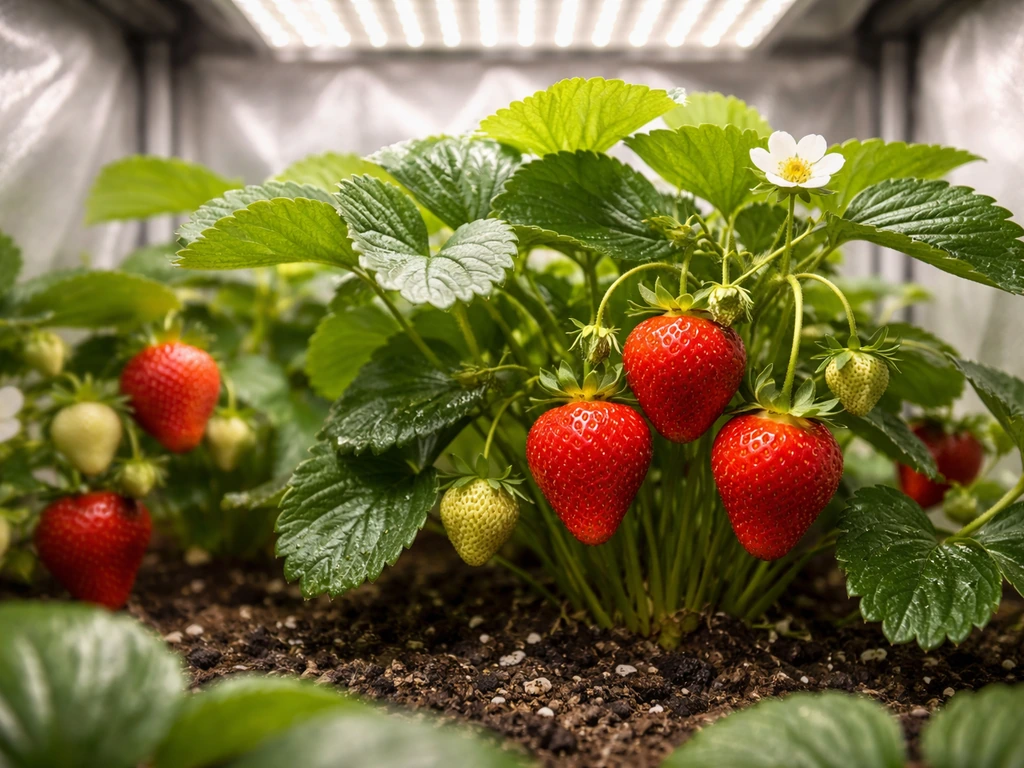
Strawberries are a low-to-moderate light crop compared to tomatoes or cannabis, but they're more spectrum-sensitive than most growers realize. For photosynthesis and fruit development, a PPFD of roughly 200 µmol·m⁻²·s⁻¹ at canopy level is a practical working target for indoor systems. Research targeting high-yield controlled environments often shoots for that ~200 µmol·m⁻²·s⁻¹ mark across the whole coverage area. On the higher end, some commercial greenhouse systems and Samsung's horticulture documentation reference photon flux density targets in the 800–1,200 µmol·m⁻²·s⁻¹ range for intensive production scenarios. For a home grower, 200–400 µmol·m⁻²·s⁻¹ is a realistic and productive sweet spot.
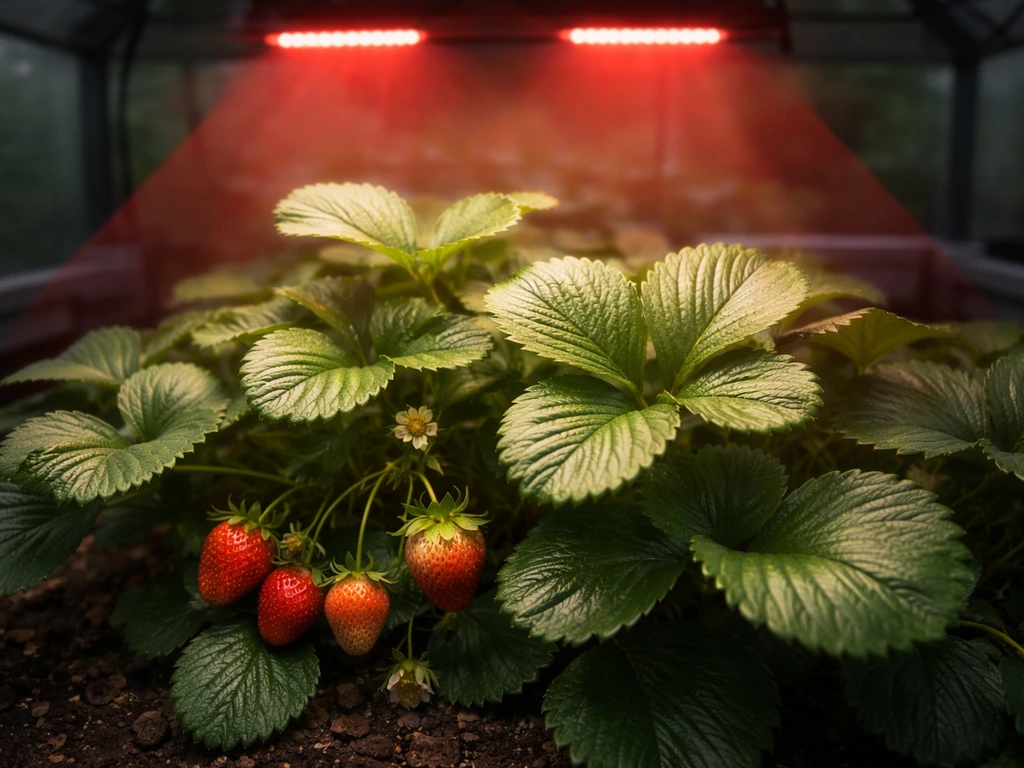
Spectrum matters more than most fixture marketing lets on. Red (around 660 nm) drives photosynthesis and has a direct impact on fruit yield. Studies on supplemental red LED lighting show measurable increases in strawberry productivity and fruit quality parameters compared to white-only light. Blue light (430–470 nm) is essential for healthy vegetative structure and prevents excessive stretching.
The more interesting variable is far-red (700–740 nm): research into far-red radiation shows it can directly regulate days to flower in strawberries, and combining far-red with photoperiod treatments is one of the more promising strategies for enhancing floral development in controlled environments.
In an ASHS Hortech study on far-red timing in strawberries, supplemental far-red light with a peak around 730 nm is used to influence flower induction and flowering outcomes [combining far-red with photoperiod treatments is one of the more promising strategies for enhancing floral development in controlled environments. ](https://journals. ashs. org/horttech/downloadpdf/view/journals/horttech/35/3/article-p370.
pdf). This is why a true full-spectrum fixture with some far-red content outperforms a basic red/blue "blurple" for fruiting crops.
Daily Light Integral (DLI) is the most useful single number for planning your light setup. DLI is the total photon dose your plants receive in a day, calculated as PPFD multiplied by photoperiod hours. For indoor strawberries, targeting a DLI in the range of 12–17 mol·m⁻²·d⁻¹ is a reasonable goal, achievable with 200 µmol·m⁻²·s⁻¹ over a 16-hour day. OSU's controlled environment research flags that above roughly 30 mol·m⁻²·d⁻¹, strawberry plants can show stress and may need shading, so don't assume more is always better. The goal of supplemental or primary LED lighting is always to hit that minimum DLI target, not to maximize raw intensity.
Photoperiod control is also a real tool, not just a timer convenience. Strawberry flowering response is phytochrome-mediated, which means the length of the dark period matters directly to flower initiation. Long-day conditions (16 hours light, 8 hours dark) generally promote flowering in day-neutral and everbearing varieties. For short-day varieties, you can actually use night interruption (NI) lighting: a 3–4 hour burst of low-intensity light around midnight (as low as 2–3 µmol·m⁻²·s⁻¹, roughly 20 footcandles) is enough to break the dark period and induce a long-day response, without running your main lights all night. OSU's photoperiodic lighting guidance specifically outlines 4–6 hour daylength extension or 3–4 hour night interruption as the two practical approaches.
Sizing your LED to your grow area
The most common sizing mistake is trusting the "coverage area" number on the box. Manufacturers often list maximum coverage, which is the area where the light delivers any usable photons, not the area where it delivers fruiting-level PPFD. For strawberries, use the flowering/fruiting coverage spec if it's listed, or plan on roughly 30–40W of actual power draw (not "equivalent" wattage) per square foot of canopy. Here's a practical sizing table:
| Grow Area | Actual Wattage Needed | Target PPFD at Canopy | Recommended Form Factor |
|---|---|---|---|
| 2x2 ft (4 sq ft) | 100–150W | 200–350 µmol·m⁻²·s⁻¹ | Compact panel or single bar |
| 3x3 ft (9 sq ft) | 200–300W | 200–350 µmol·m⁻²·s⁻¹ | Mid-size panel or 2-bar array |
| 4x4 ft (16 sq ft) | 350–500W | 200–400 µmol·m⁻²·s⁻¹ | Bar-style fixture or multi-bar array |
| 4x8 ft (32 sq ft) | 600–900W | 200–400 µmol·m⁻²·s⁻¹ | Two bar fixtures or multi-bar array |
| Large/commercial | Scale per sq ft at 30–40W/sq ft | 200–1200 µmol·m⁻²·s⁻¹ | Commercial toplighting or multi-fixture array |
For a standard 4x4 tent, a 400–480W bar-style fixture from a reputable brand is the right call. Bar lights win for strawberries specifically because their spread-out design gives you more uniform PPFD across a horizontal canopy compared to a single-point panel. Uniformity matters because uneven light creates uneven ripening. If you're in a smaller 2x2 or 3x3 space, a compact panel works fine and costs less, but consider whether LED grow light strips arranged across the canopy might give you better coverage uniformity than a single overhead puck.
Best LED grow light picks for strawberries by setup and budget
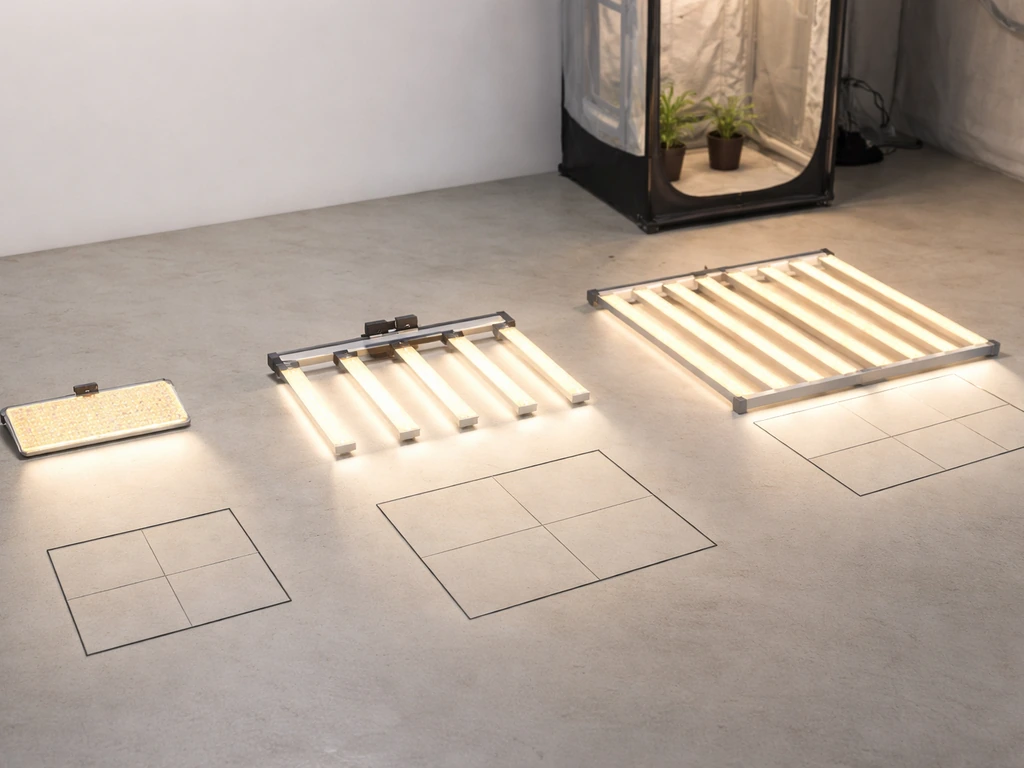
Rather than recommending one light, here's how I'd approach different scenarios. The specific fixtures I mention have published PPFD maps or independent test data, which is the minimum bar for recommending anything.
Small setup (2x2 to 3x3): budget to mid-range
For a 2x2 or 3x3 tent with 4–9 strawberry plants, look at fixtures in the 100–240W actual draw range. The ViparSpectra KS3000 is a reasonable mid-range choice in this category. Its user instructions include a detailed PPFD map with tested mounting heights at 12 in (30 cm) and 24 in (60 cm), which lets you verify what you're actually getting at canopy height before you hang it.
At 24 in, it delivers enough intensity for strawberry fruiting over a 3x3 footprint with the dimmer backed off slightly. It's not the most efficient fixture in watts-per-µmol, but the PPFD map transparency makes it easier to trust. If you want to stretch into a slightly larger footprint without upgrading the fixture, dimming capability helps here, and dimmable LED grow lights are particularly useful for acclimating young strawberry transplants that can't handle full intensity immediately.
Mid-size setup (4x4): best bang for the money
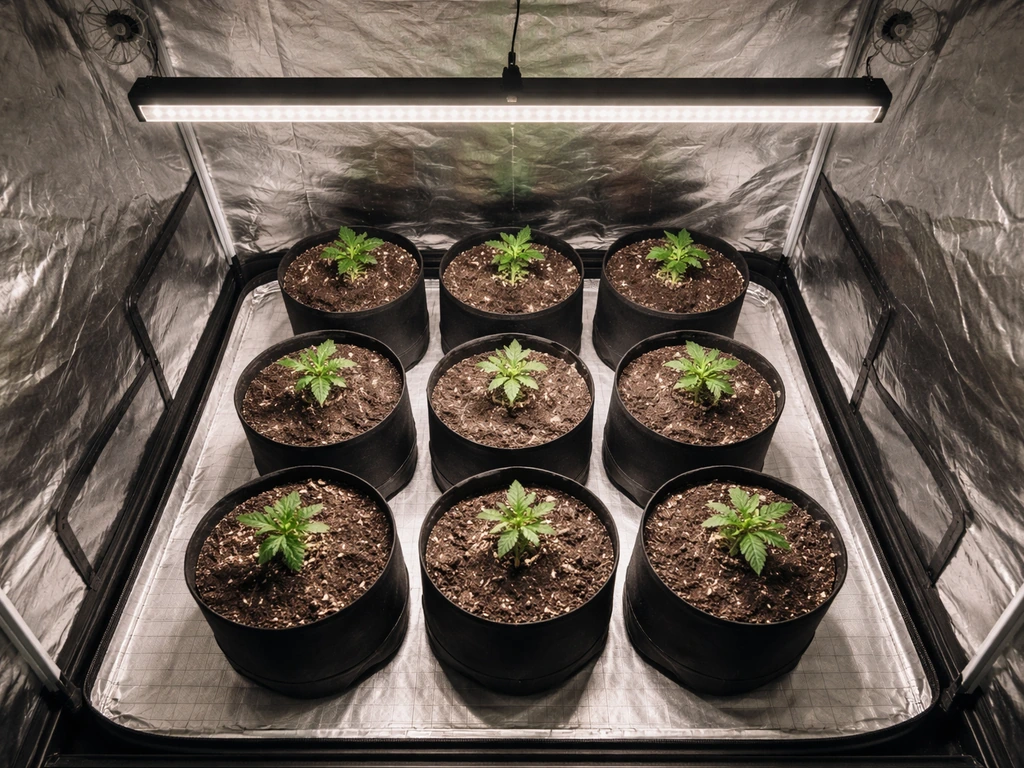
The 4x4 footprint is the sweet spot where bar-style fixtures really pull ahead of panels. The Mars Hydro FC-E series (around 400–480W) and similar bar fixtures deliver significantly more uniform canopy coverage than a single-point quantum board over the same area.
An independent review of the Mars Hydro FC-8000 (an 800W version of the same family) reported average PPFD measurements around 793 µmol·m⁻²·s⁻¹ in the tester's setup, though that review also notes clearly that conditions like CO2 enrichment and hanging height change real-world outputs considerably. For strawberries in a 4x4 at 200–350 µmol·m⁻²·s⁻¹ targets, a 400W bar fixture run at 60–70% power gives you plenty of headroom and keeps heat manageable.
If you're serious about chasing the highest possible yield from your LED setup, a bar fixture with dimming and controller support is the right starting point.
Larger or commercial setups
For multi-tier racks, grow rooms beyond 4x4, or anyone scaling toward production, commercial fixtures with proper dimming and control systems are the right tool. Grow Light Science's PROGROW 2400 is built specifically for these scenarios: it's designed to deliver around 1,500 µmol·m⁻²·s⁻¹ when arranged as an array of multiple units, and the PROGROW controller can manage up to 50 fixtures simultaneously for uniform dimming across an entire room.
Grow Light Science states the PROGROW 2400 can deliver very high PPFD levels (about 1,500 µmol·m⁻²·s⁻¹) when arranged as an array of multiple units, and the PROGROW controller can manage up to 50 fixtures for uniform dimming across a room PROGROW 2400 can deliver about 1,500 µmol·m⁻²·s⁻¹ in an array. That level of control lets you dial in exactly the PPFD target your strawberry canopy needs across every tier.
On the greenhouse and commercial end, Philips GreenPower LED toplighting systems have been used specifically in strawberry production, with documented far-red capable configurations. Signify's far-red LED toplighting approach has been trialed in strawberry cultivation with positive results, though adding far-red does reduce overall system efficiency slightly. For most home growers, these are overkill, but if you're building out a larger strawberry operation and want to understand how to scale, these are the reference-class fixtures.
If you want to add far-red without replacing your whole fixture
If your current LED is already covering the PPFD target but you want to experiment with far-red enhancement for flowering, adding a supplemental LED grow light with far-red output is a lower-cost way to test the effect before committing to a full fixture upgrade. Dedicated far-red supplemental bars exist in the 20–40W range and can be hung alongside your main fixture during the photoperiod extension window.
Mounting, height, photoperiod, and acclimation
Hanging height controls PPFD at canopy level more than almost any other factor after wattage. A typical bar fixture at 18–24 in above the canopy delivers fruiting-range PPFD for strawberries. Lowering to 12 in increases intensity significantly but also reduces coverage uniformity and raises the risk of light stress on outer leaves if the canopy isn't perfectly flat. Start at 24 in and use your PPFD meter (or the fixture's published map) to confirm you're in the 200–350 µmol·m⁻²·s⁻¹ range. Adjust down only if you're reading significantly below target.
For photoperiod, 16 hours on / 8 hours off is the standard recommendation for day-neutral and everbearing varieties indoors, since it mimics long-day summer conditions that promote continuous flowering. Research comparing 16-hour versus 12-hour LED photoperiod schedules showed clear yield advantages for the longer photoperiod in controlled environment strawberry trials. If you're growing short-day varieties specifically (which is unusual for indoor setups but not unheard of), the night interruption approach works: set a secondary timer to run low-intensity light for 3–4 hours centered around midnight. Even at just 2–3 µmol·m⁻²·s⁻¹, this is enough to break the dark period and trigger a long-day response.
Acclimation is non-negotiable for young plants or any time you move strawberries from lower-light conditions. Start new plants at 50% of your target PPFD for the first 5–7 days, then ramp up over another week. This prevents photooxidative stress, which shows up as whitish or bleached patches on young leaves, especially on new transplants. If your fixture has a dimmer, this is straightforward. If it doesn't, raise the hanging height by 12–18 in above the normal position for the first week.
Reading specs honestly: what actually matters vs. marketing
LED grow light marketing is full of inflated numbers, and strawberry growers are as exposed to this as anyone. Here's what to actually check before buying:
- Actual power draw (watts): The number on the wall meter when the light is running at full power. Ignore "equivalent wattage" or "replaces X HID watts" claims entirely.
- Published PPFD map: Any reputable fixture should have a PPFD map tested at a specific hanging height and coverage area. No map = no way to verify claims. Check whether the map was generated at the manufacturer's lab or by an independent tester.
- Efficacy (µmol/J): This is how many photons you get per joule of electricity. Anything above 2.0 µmol/J is genuinely efficient. Budget lights often fall in the 1.5–1.8 range. Commercial fixtures hit 2.5–3.0 µmol/J.
- Spectrum chart: Ask for a spectral power distribution (SPD) chart, not just "full spectrum" text. You want to see peaks in red (660 nm) and blue (450 nm) and ideally some far-red energy above 700 nm.
- Coverage area rating: Distinguish between vegetative coverage (lower PPFD, larger area) and flowering/fruiting coverage (higher PPFD, smaller area). Always use the fruiting coverage number for strawberry planning.
- Uniformity: Bar lights generally produce more uniform PPFD maps than single-point panels over the same area. Uniformity above 80% across your canopy footprint is a good target.
One specific caution: don't use lux meters or lux/footcandle conversions to estimate PPFD for LED lights. OSU's controlled environment research explicitly warns that spectral differences between LED fixtures and the calibration assumptions in lux meters make these conversions unreliable for plant-useful photon estimates. You need a PAR meter (quantum sensor) for real verification. Apogee and Licor make accurate handheld options in the $200–$400 range. If that's too much, many grow communities have shared or rental programs for members. If you're curious whether LEDs are worth the investment at all before diving in deep, a basic rundown of whether LED grow lights are actually effective can help ground expectations before spec-hunting.
Also be aware that independent reviews sometimes tell a different story than manufacturer specs. An independent test of the Mars Hydro FC-8000, for example, showed real-world PPFD measurements around 793 µmol·m⁻²·s⁻¹ at the tested conditions, with notes that CO2 and other environmental factors affect the numbers versus what's shown on a spec sheet. This is why third-party test data always trumps manufacturer PPFD maps when you can find it. For an overview of how different lights stack up across community reviews, community grow light discussions can surface real-world patterns that lab specs miss.
Troubleshooting poor flowering and low yields
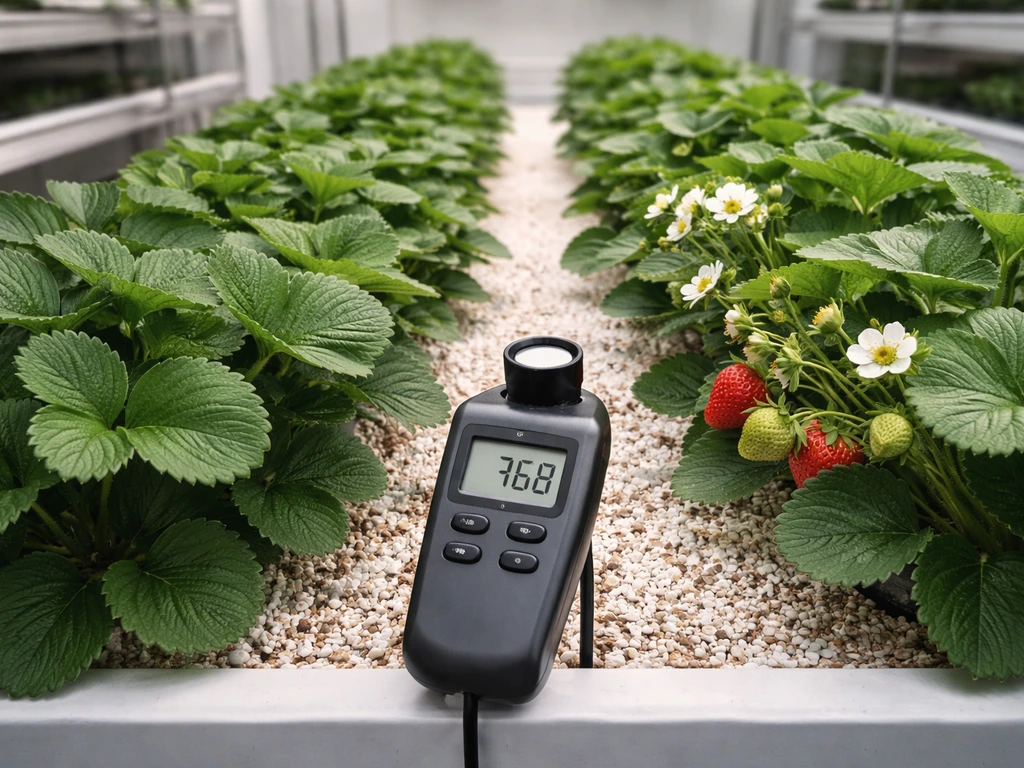
If your strawberries are growing green and lush but not flowering or fruiting well, run through this checklist before changing anything else:
- Verify your actual PPFD at canopy height with a PAR meter. Lush vegetative growth with no flowers is often a low-light problem in disguise. If you're reading below 150 µmol·m⁻²·s⁻¹, lower your fixture or increase power.
- Check your DLI math. Multiply your PPFD reading by your photoperiod hours and divide by 1,000,000 (to convert from µmol to mol). If you're below 10 mol·m⁻²·d⁻¹, you're likely light-limited for fruiting.
- Confirm your photoperiod timer. 16 hours on is the safe standard for day-neutral and everbearing types. A timer that's drifted to 14 or 13 hours can suppress flowering.
- Look at your spectrum. If you're running an older blurple fixture with no far-red and minimal white output, consider adding a supplemental far-red bar or upgrading to a true full-spectrum fixture. Spectrum changes in controlled experiments have shown measurable differences in fruit quality and flowering timing across strawberry cultivars.
- Check for light stress if flowering stalled after you increased intensity. Bleached patches on new leaves, curling edges, or stalled growth after a light change point to too much PPFD too quickly. Dim back to 70% and give the plants a week to recover.
- Evaluate temperature at canopy. LED fixtures should run cooler than HID, but compact fixtures can raise canopy temperature by 3–5°F in a small tent. If canopy temps exceed 80°F consistently, it will suppress fruit set even with perfect light.
- For persistent flowering problems, consider trying a 3-hour night interruption with very low intensity (2–3 µmol·m⁻²·s⁻¹) rather than adjusting your main photoperiod. This can tip stubborn plants into flowering without changing your primary light schedule.
One thing worth noting: different strawberry cultivars respond differently to light spectrum and photoperiod. The research comparing four cultivars under different LED supplemental spectra found that the effects on fruit quality and growth varied meaningfully by cultivar, not just by light treatment. If you've dialed in the light parameters and still see inconsistent results, the cultivar itself may be the variable. Day-neutral varieties like Albion, Seascape, or San Andreas are the most forgiving for consistent indoor fruiting under LED control.
The bottom line is straightforward: get a full-spectrum LED with published PPFD data, size it to your footprint using actual wattage rather than marketing claims, run 16 hours on for day-neutral varieties, verify intensity with a real PAR meter, and acclimate new plants gradually. That combination covers the overwhelming majority of indoor strawberry fruiting problems before you ever need to dive into far-red supplementation or advanced photoperiod manipulation.
FAQ
Can I start strawberries under the same LED I’ll use for fruiting, or do I need a weaker setup?
Yes, but only if you can actually deliver the same PPFD at canopy height. Full-spectrum LEDs can be dimmed, and dimming is often the easiest way to prevent overshooting DLI when plants are small or when you are testing coverage. If your fixture lacks a dimmer, a higher hanging height can reduce PPFD, but it usually makes coverage less even across the canopy.
How uniform does PPFD need to be for the best led grow lights for strawberries?
For indoor strawberries, you typically want PPFD targets that are stable across the full canopy, not just the brightest spot. A good rule is to aim for your target (about 200 to 350 µmol·m⁻²·s⁻¹) and keep low spots within roughly 20 to 30 percent of that value. If the fixture only reaches target PPFD in the center, you may see uneven flowering and patchy ripening even when the overall light “seems bright.”
Where and how often should I measure PPFD for my strawberry canopy? Should I trust the map on the box?
You should measure at canopy level and in the same position your plants will occupy, because fixture output drops fast with distance and spreads unevenly. If you’re using published PPFD maps, confirm the mounting height matches the map exactly (including if you use hanging chains or a different bracket). Recheck after you change any variables like height, dimmer setting, or reflector placement.
If I only have a lux meter, can I still set up my light schedule correctly for strawberries?
Lux meters are not dependable for LED grow lights because the device calibration assumes a generic light spectrum that LEDs do not match. They can still be used for rough consistency checks (for example, making sure “more light” means more light after you adjust a dimmer), but they should not be used to calculate PPFD or DLI. For real plant-useful numbers, use a PAR quantum sensor.
What happens if my LEDs deliver too much light, and how do I fix it?
If you overshoot DLI, strawberries often show stress as leaf bleaching, scorched tips, or slowed flowering, especially on the outer leaves where PPFD can be highest. Rather than reducing photoperiod immediately, try lowering PPFD by dimming (preferred) or raising the fixture slightly, then observe for a few days. Also check airflow and leaf temperature, since heat stress can mimic or worsen light stress.
Can I add far-red to improve flowering, and will it interfere with the PPFD/DLI targets I’m already hitting?
Yes, but timing matters. Far-red delivered during the flowering decision window may help regulate photoperiod responses, while adding far-red all day can reduce overall luminous efficacy and can complicate your light budgeting. If you want to experiment, add a supplemental far-red bar only during part of the photoperiod (or during photoperiod extension) and keep your main PPFD target consistent so you can attribute changes to far-red rather than to higher intensity.
Do I need to measure each level in a multi-tier rack, or can I rely on the fixture’s published footprint?
It can, even if PPFD is in-range. If your plants are in a stacked rack, light spill from upper tiers and reflections from the walls can raise or redistribute photon dose in ways the fixture map does not reflect. In multi-tier setups, measure at each tier and consider separating fixtures by row or using dimming zones to keep each canopy on target.
Will timer settings or power outages affect strawberry flowering under LED lighting?
Generally, yes, because flowering depends on the dark period, not just total daily photons. If you switch timers or have frequent power interruptions, you can accidentally break the dark window and alter flowering response, especially for short-day behavior or night interruption strategies. Use a reliable timer, and avoid manual on/off changes during the dark period.
If my light settings are correct but my strawberries won’t fruit consistently, could it be the cultivar?
Yes, cultivar differences can show up as “light I dialed in, but results vary.” Day-neutral varieties are usually easier to get consistent fruiting indoors. If you have inconsistent results after you verify PPFD and DLI, the next variable to check is whether the cultivar matches your intended photoperiod approach (for example, day-neutral versus short-day behavior).
How do I set DLI when I’m using both a main full-spectrum LED and a far-red supplemental bar?
If you’re using a supplemental far-red bar, keep the main fixture’s PPFD and DLI on target and treat far-red as an add-on variable. Use your PAR meter to ensure the total photon dose (from all LEDs) still lands in the 12 to 17 mol·m⁻²·d⁻¹ DLI range you’re targeting. Because far-red can change perceived brightness without reliably indicating photon dose, verify with quantum measurements rather than visual cues.
Next Articles
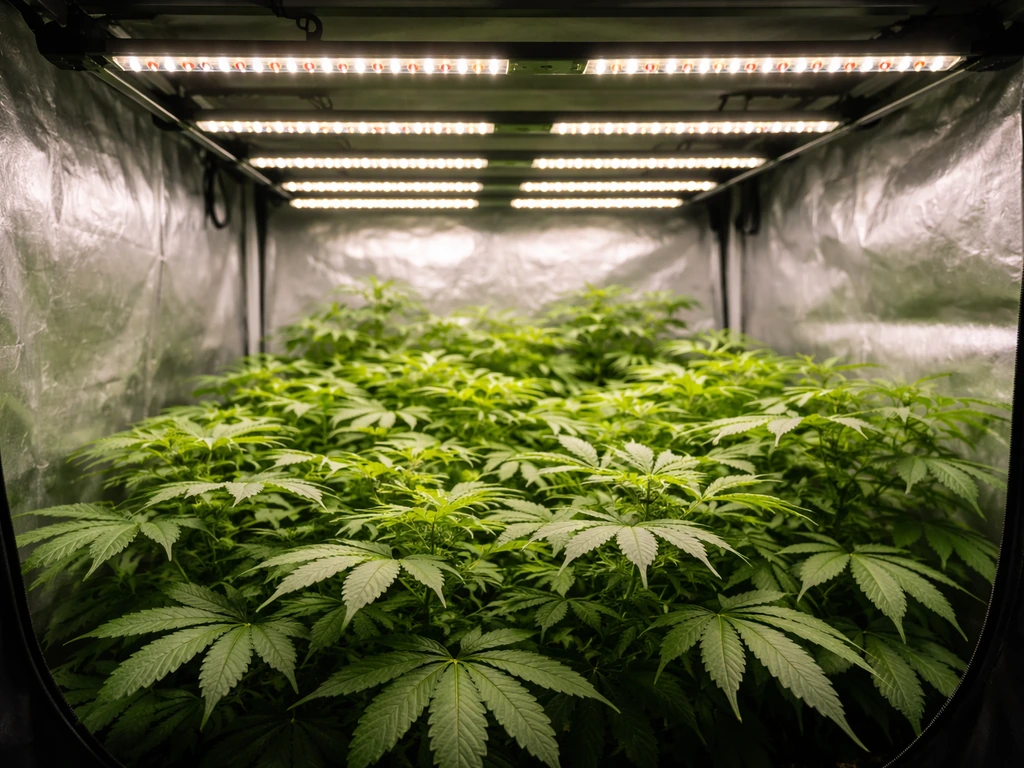
Best LED Grow Light Strips: Buyer’s Guide for Full Spectrum
Buyer guide to the best LED grow light strips, with full spectrum checks, sizing, setup, safety, and setup tips.
Are LED Grow Lights Good? Honest Verdict and How to Choose
Real verdict on LED grow lights: when they’re worth it, key specs to check, and how to choose for your tent and plants.
Best Full Spectrum 1000W LED Grow Lights: Buyer Guide
Buy the best full spectrum 1000W LED grow light with spec-to-decision tips on PPFD, coverage, wattage, and tent fit.