The short answer: most quality LED grow lights today use one of three LED technologies, SMD-based quantum boards (often built around Samsung LM301B or LM301H diodes), COB (chip-on-board) arrays, or older-style blurple SMD strips. Of those, quantum boards running full-spectrum white LEDs plus targeted deep-red diodes dominate the current market, and for good reason. They hit the best balance of efficiency, coverage, and spectrum quality for most home growers. The rest of this guide breaks down exactly what you'll encounter when shopping, how to tell them apart, and how to match the right LED type to your actual grow setup.
What LEDs to Use for Grow Lights: A Practical Guide
Marcus Rutherford
12 Apr 2026
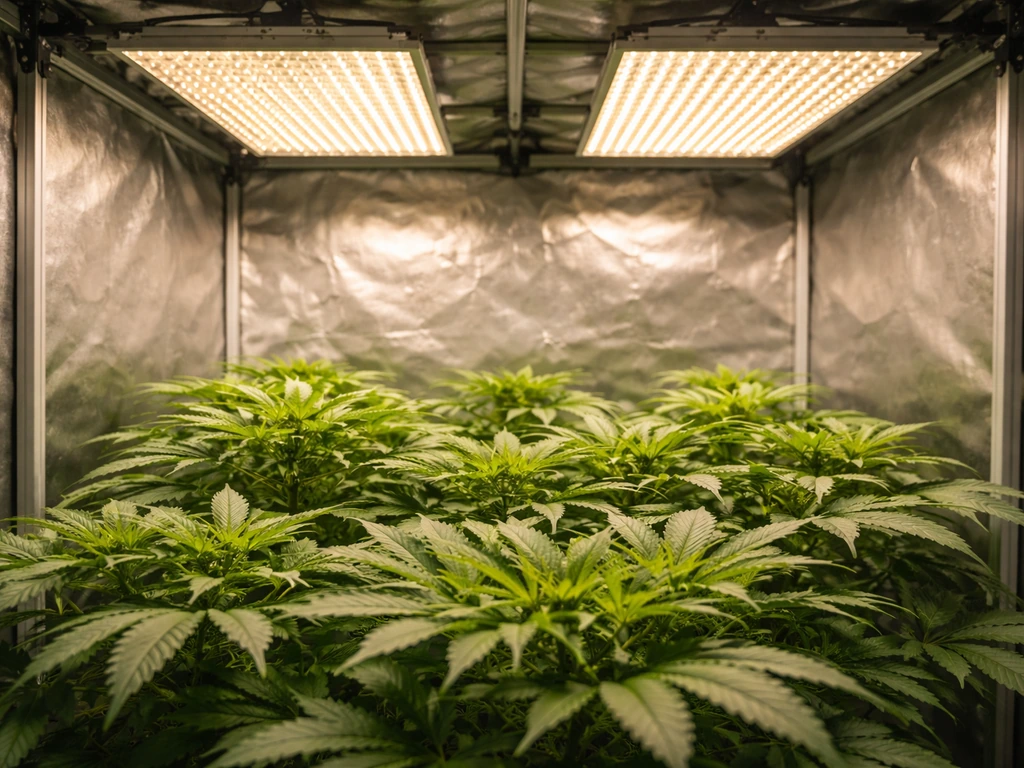
The LED types you'll actually find in grow lights
Walking into the grow light market cold is confusing because the same word, LED, gets applied to very different underlying technologies. Here's what's actually out there.
SMD diodes on quantum boards
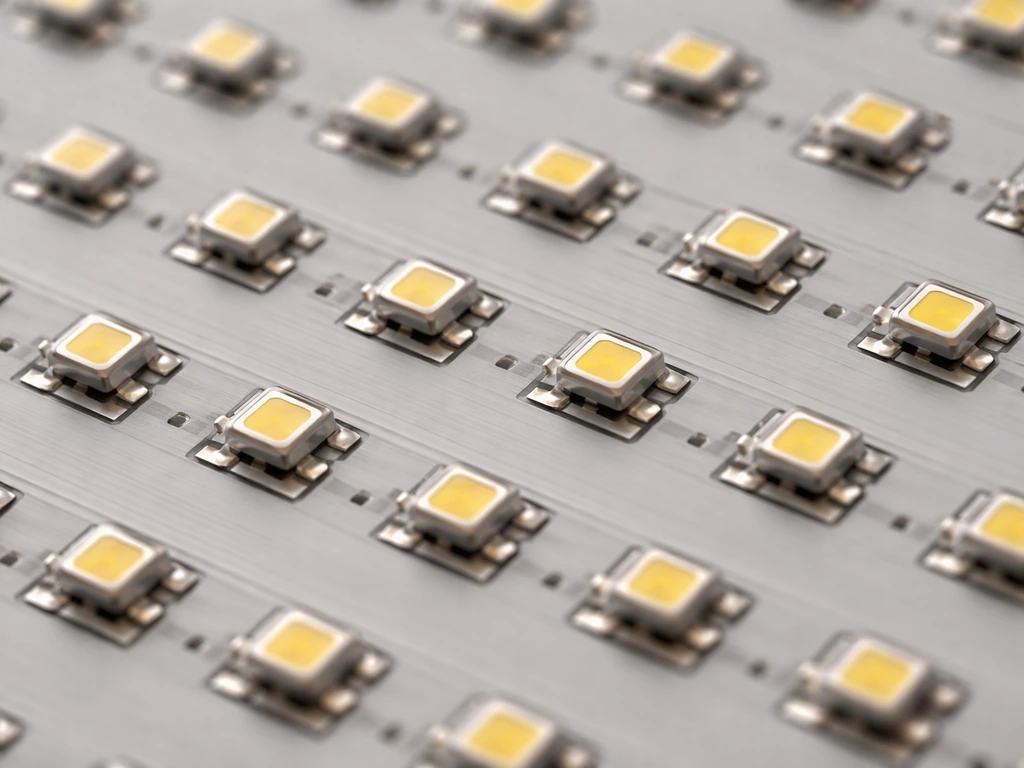
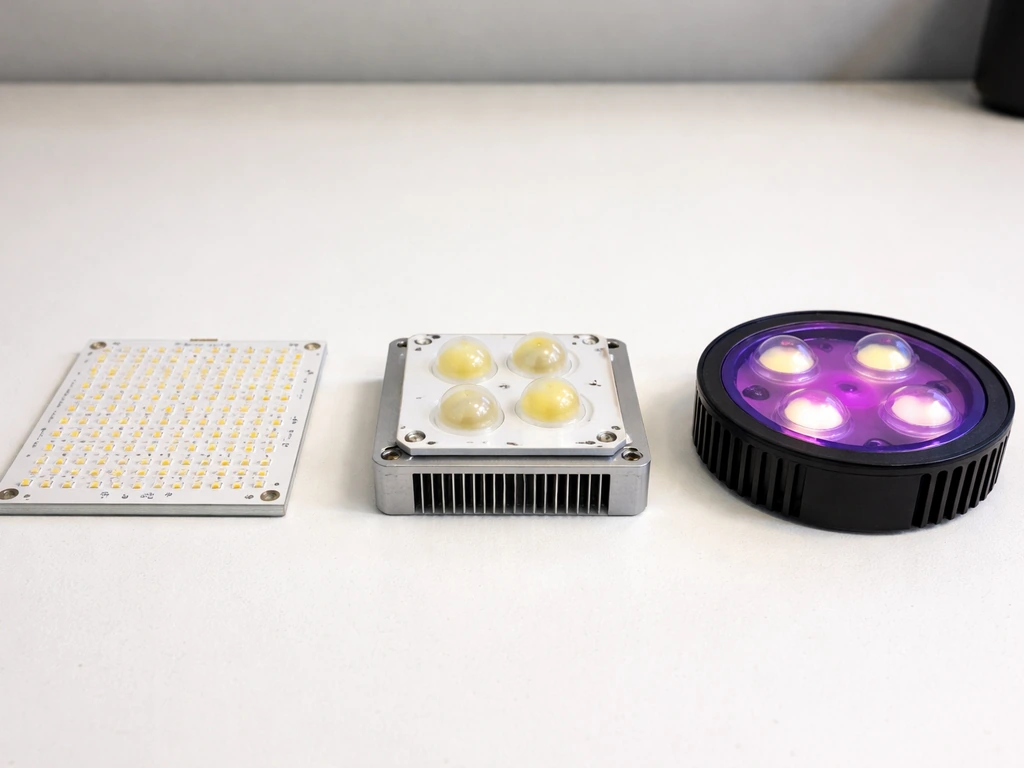
SMD stands for surface-mount device. These are pre-packaged LED chips mounted onto a PCB in a grid pattern. Because they're spread across a wide board, they behave like an array of many point sources, which gives you even light distribution and low heat per diode. Samsung's LM301B and LM301H are the most referenced SMD diodes in grow lighting right now, they show up in everything from budget panels to premium builds.
A typical setup pairs these white full-spectrum diodes with additional 660nm deep-red LEDs to boost flowering performance. The MEIJIU 240W quantum board, for example, does exactly this: custom full-spectrum high-efficiency white Quantum Boards using Samsung LM301H plus 660nm deep-red supplemental diodes. That pairing has become the de facto standard for serious growers.
COB (chip-on-board) LEDs
COB packaging is a different animal. Instead of pre-packaging individual chips, COB places bare LED chips directly onto the PCB and skips the traditional packaging step entirely. This produces a single, high-density light source rather than a grid of small ones. COBs can pack a lot of power into a small area, which is why they're popular for supplemental lighting, smaller coverage zones, or builds where you want intense directional light. The downside is concentrated heat, that high-density footprint means thermal management matters more with COBs than with spread-out SMD boards. They also typically need secondary optics (reflectors or lenses) to shape the beam, whereas a quantum board's broad spread handles most grows without additional optics.
Blurple SMD arrays
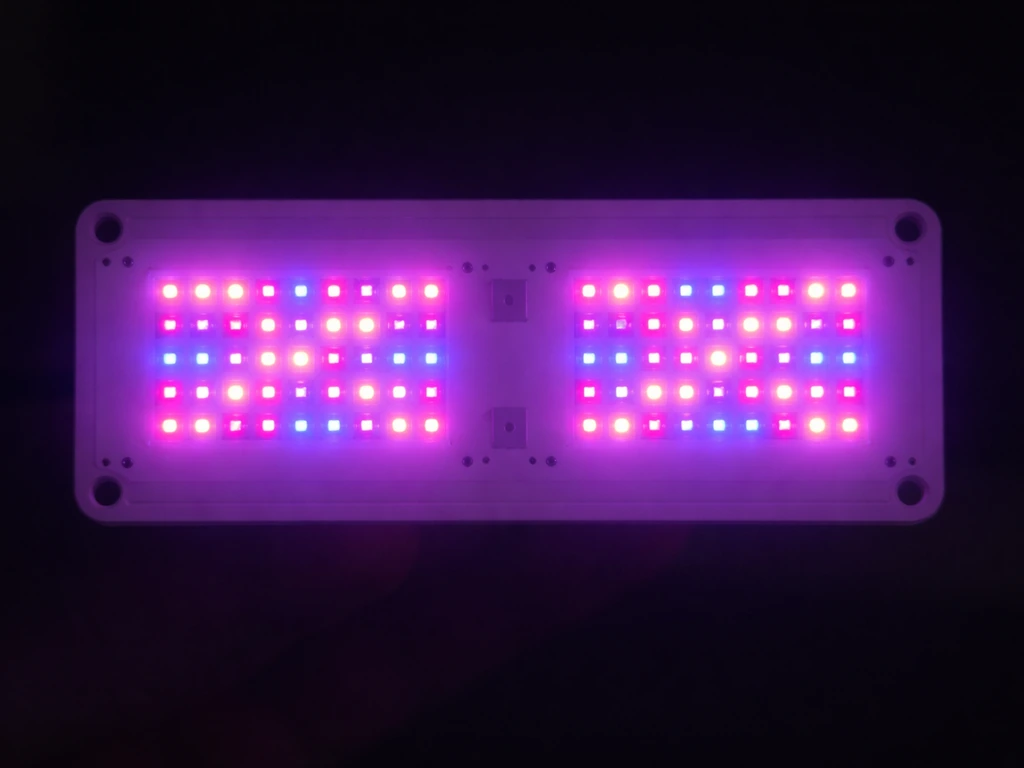
Blurple lights are the older generation: arrays of discrete red (typically 630nm or 660nm) and blue (typically 440nm or 450nm) LEDs that produce that purple-pink glow. They were everywhere five years ago and are still sold cheaply today. They're not useless, red and blue do hit photosynthesis peaks, but their efficiency and coverage uniformity lag behind modern full-spectrum designs. If you see a light with a blurple glow and a watt rating that seems too good (claiming 1000W from a 100W draw), that's usually this technology. Skip them unless your budget is extremely tight and your expectations are low.
Which LED option fits your grow
Full-spectrum quantum boards cover the overwhelming majority of grow scenarios well, from seedling through harvest. But "full-spectrum" is a label that gets slapped on a lot of products that don't necessarily deliver even spectral coverage across the board. The term technically just means the light covers the visible spectrum range, but the distribution can be heavily weighted toward certain wavelengths. Don't buy based on the label alone; ask for or look up the actual spectral chart. A light that shows a strong spike at 450nm and 660nm with weak output everywhere else is not performing like true broad-spectrum sunlight, regardless of how it's marketed.
For a 4x4 tent running photoperiod plants through a full veg-to-flower cycle, a quantum board in the 200–320W actual draw range (not claimed equivalent wattage) with Samsung LM301H or similar high-bin diodes is the practical go-to. The Lightmyleaf 120W panel using Samsung LM301B/LM301H is a reasonable option for a 3x3 or a low-plant-count veg setup where you don't need maximum intensity at canopy. Scale up for a 4x4 or 5x5. For larger tents, 5x5 and beyond, you're better off running multiple mid-wattage boards than one large fixture, both for coverage uniformity and for redundancy.
COBs make sense in two scenarios: you're doing a small, intensive grow in a 2x2 or smaller space, or you're building a custom supplemental lighting setup where you need targeted intensity at specific canopy points. They're also worth considering if you already have a spread-out quantum board setup and want to boost a specific zone. For most beginners or anyone running a standard tent, COBs are more work than they're worth, the thermal management and optics complexity add friction without a clear benefit over a well-designed quantum board.
If you're growing strains that are particularly light-hungry or that thrive under specific spectral conditions, picking the right technology matters more. choosing strains optimized for LED growing can make a bigger difference than swapping between similar quantum board models, especially for growers who are already running decent fixtures.
How to choose spectrum and efficiency for real results
Efficiency is measured in micromoles of photons per joule (µmol/J). Samsung’s LM301H EVO datasheet lists PPF in µmol/s and PPF/W in µmol/J across CCT bins with min/max values µmol/J (photons per joule) efficiency. A good quantum board in 2025–2026 should hit at least 2.5 µmol/J, with top-tier fixtures reaching 2.8–3.0 µmol/J. Anything below 2.0 µmol/J is outdated technology at this point, you're paying for electricity without equivalent photon output. When a vendor gives you a watt rating but no µmol/J figure, that's a red flag.
On spectrum: the dominant grow-light approach right now is broad white-spectrum LEDs (which simulate daylight with a mix of wavelengths across the 400–700nm range) supplemented with extra 660nm deep red to push flowering. This works because chlorophyll A and B have absorption peaks around 430nm and 680nm, but plants also use the full PAR range (400–700nm) and benefit from far-red (700–800nm) for the Emerson effect. Getting the balance right between blue and red output affects not just yield but plant morphology, too much blue keeps internodes tight (good for veg, limiting for stretch in early flower), while heavy red shifts encourage elongation and bud development. For a deeper look at dialing in that ratio, understanding the best red-to-blue ratio for your LED grow light is worth reading before you finalize a spectrum choice.
Lifecycle specs matter too, and most buyers ignore them. Look for L70 or L90 ratings rather than generic "50,000 hour" claims. L70 means the light retains 70% of its original output at the stated hour mark, that's the industry standard threshold. A light claiming 50,000 hours but without specifying whether that's L70 or L50 might be degrading to half its original output well before you'd expect it. Quality vendors will provide this data; if they don't have it, factor that into your risk assessment.
Form factor and heat, what actually breaks your light
The biggest failure point in LED grow lights isn't the diodes, it's the driver. Specifically, it's the electrolytic capacitors inside the driver. Capacitor life degrades sharply as operating temperature rises. A capacitor rated for 2,000 hours at 85°C might last 16,000+ hours at 65°C, but if it's sitting in a driver mounted directly to a hot fixture running in a warm grow tent, that temperature buffer disappears fast. Lights that use a remote driver, where the driver is physically separated from the heat-generating diode board, run cooler and last longer. This is a practical thing to look for when buying: is the driver integrated or external?
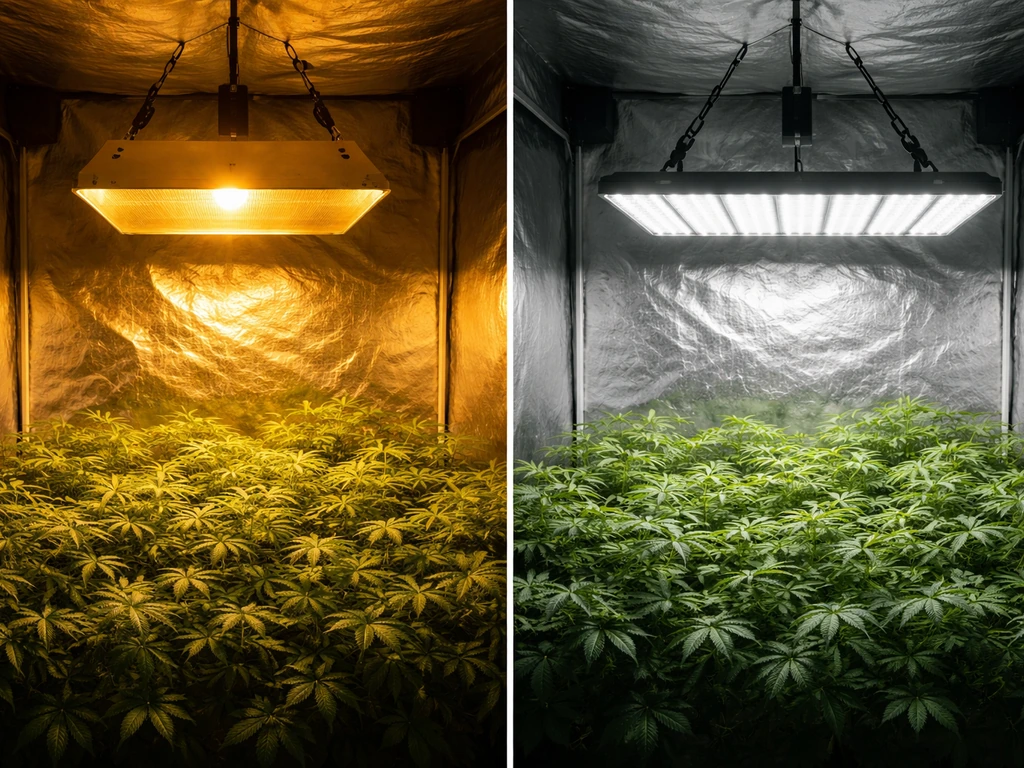
Quantum boards dissipate heat across a large aluminum heatsink, which keeps diode junction temperatures low even without active cooling (fans). This passive thermal management is one of the real practical advantages of the form factor for grow tents, where you're already managing ambient temperature. COBs generate more concentrated heat and often need active cooling or larger heatsinks, which adds noise, complexity, and more components that can fail.
Hanging height interacts directly with form factor too. A wide quantum board at 18–24 inches above canopy gives excellent uniformity. A COB at the same height creates hot spots. Getting this right for your specific fixture is covered in detail in the guide on finding the best hanging height for LED grow lights, which is worth checking once you've narrowed down your fixture choice.
One thing people overlook when setting up a new LED system: eye protection. Modern full-spectrum LEDs at grow intensities, especially ones with deep-red supplemental diodes, are hard on your eyes during extended inspections. It's worth pairing any serious setup with the right glasses designed for LED grow light environments to protect your vision while still being able to accurately assess plant health under the light.
Comparing the main LED types side by side
| LED Type | Best Use Case | Efficiency Range | Heat Management | Typical Cost | Spectrum Flexibility |
|---|---|---|---|---|---|
| SMD Quantum Board (LM301H etc.) | 4x4 tents, full cycle veg to flower | 2.5–3.0 µmol/J | Passive heatsink, low heat per diode | Mid to premium | High (white + supplemental red/far-red) |
| COB Array | Small intense grows, supplemental lighting | 1.8–2.5 µmol/J | Active or large passive cooling needed | Mid to high | Moderate (fixed spectrum per COB) |
| Blurple SMD Strip | Very tight budgets, basic veg only | 1.0–1.8 µmol/J | Passive, but runs warm per chip | Budget | Low (red + blue only) |
For most growers reading this today: quantum boards win. COBs are a niche tool. Blurple is legacy tech you should avoid unless cost is the absolute ceiling. If you're comparing two quantum board fixtures, the differentiator is efficiency (µmol/J), diode quality (Samsung LM301H is the benchmark), driver quality (external/remote is better), and L70 lifespan data. Samsung’s horticulture technical brochure for the LM301H includes performance data fields such as PPF and PPF/W (µmol/J) and labels efficacy for horticultural applications efficiency (µmol/J).
Your practical buying checklist
Before you spend money, run through these checks. They'll save you from the most common mistakes.
- Confirm actual power draw (not "equivalent" wattage) — a 240W actual draw fixture for a 4x4 is a reasonable baseline; 320W gives headroom for high-light strains.
- Check the efficiency rating in µmol/J — anything below 2.3 µmol/J is not worth buying new in 2026.
- Identify the diode type — Samsung LM301H, Osram, or Epistar are known quantities; generic "high-efficiency LED" with no part number is a warning sign.
- Look for L70 or L90 lifespan data — if the vendor only says "50,000 hours" with no degradation qualifier, ask specifically what percentage output is retained at that point.
- Check driver placement — external/remote drivers run cooler and last longer; integrated drivers in hot enclosures are a reliability risk.
- Verify the spectral chart exists — not just a marketing image, but an actual SPD (spectral power distribution) chart showing output across wavelengths.
- Make sure the fixture covers your space at the recommended PPFD — aim for 600–900 µmol/m²/s at canopy for most flowering plants, with the ability to dim down for seedlings and veg.
- Budget for nutrients to match your light output — higher-intensity LEDs can drive faster growth that depletes nutrients faster, and pairing the right nutrients with your LED grow setup keeps you from undercutting the investment you made in the fixture.
The LED grow light market has matured a lot. The core technology in a $150 quantum board and a $400 quantum board is often closer than the price gap suggests, the difference usually comes down to driver quality, build finish, and warranty support. Focus on the specs above, ignore the marketing language around "full-spectrum" without data to back it up, and you'll end up with a fixture that actually grows plants well.
FAQ
How can I tell if a grow light’s watt claim is real or just “equivalent” marketing?
Look for the actual draw (watts from the wall) plus efficiency (µmol/J). If a listing only gives a “replacement HPS” or “equivalent” watt number, treat it as marketing and confirm by checking the fixture’s real-input wattage and µmol/J spec.
What should I use for coverage uniformity, quantum boards or COBs?
Choose based on the target tent area and your canopy coverage, then verify uniformity with layout math. A COB can concentrate light, so it needs more careful spacing and often secondary optics, while quantum boards are easier to center and spread evenly without creating hotspots.
If a light is “full spectrum,” what specific proof should I look for beyond the label?
Buy based on photon efficiency and spectral distribution, not just color. If you can find a PAR or spectral chart, compare how evenly the fixture fills the 400 to 700 nm range and confirm it actually has meaningful output beyond just blue and deep red spikes.
What does it mean if a manufacturer does not provide L70 or L90 lifespan ratings?
If you cannot find an L70 or L90 rating with test conditions, assume earlier degradation risk. A missing lifecycle spec often correlates with uncertain driver and thermal design, so prioritize remote driver builds and heatsink quality when you shop.
Does the red-to-blue ratio affect veg and early flower differently on LED quantum boards?
For photoperiod grows, you generally want enough intensity for canopy without overshooting, then tune morphology with spectrum balance. If you use too much blue for early flower, plants can stay overly compact, so aim for a balanced white plus deep red approach rather than an extremely blue-heavy design.
How do I evaluate driver quality when shopping online (especially capacitor heat concerns)?
Measure the driver placement and heat management in real terms. Remote drivers usually run cooler because the capacitor is not inside a hot enclosure, so look for documented driver separation, wiring length, and whether the board still has adequate heatsinking.
Are all “Samsung LM301” quantum boards equally good, or can they differ significantly?
Many “quantum board” products are mixed, with some using different white LED bins or different deep red counts. If performance matters, compare µmol/J and spectral output, and confirm the diode model is actually specified for the white diodes, not just listed in marketing.
When is a COB actually worth it for a beginner, not just a niche option?
Yes, if you have a small space and want targeted intensity, a COB can be a practical tool. The decision edge is whether you need spot boosting, not whether COB is “stronger,” because you will spend more time managing hanging height, hotspots, and airflow.
How should I set hanging height differently for COBs versus quantum boards?
Plan your hanging height using the light’s beam spread and your uniformity goal. If you raise a COB too high you may lose useful intensity, and if you lower it too much you risk canopy scorching from hotspots, while quantum boards are usually more forgiving.
What’s the best way to improve results in larger tents without buying one massive panel?
Instead of chasing one “perfect” fixture, many growers improve results by using multiple boards for evenness and redundancy. This reduces the chance that one hot zone or one dim section drives uneven growth across the canopy.
Do I really need LED grow light glasses if the light is not extremely bright to me?
Match eye protection to your real usage pattern. If you will inspect plants at full intensity for long periods, use dedicated LED grow eyewear designed to filter high brightness, because even brief staring can hurt, and repeated checking adds up.
What’s a quick checklist I can use to compare two quantum board options before buying?
A common next step is to shortlist fixtures, then create a comparison table with three items: actual input wattage, µmol/J, and a spectral chart or PAR data if available. If two lights are close in efficiency, pick the one with remote driver and clear L70 or L90 data.
Next Articles
Best Full Spectrum 1000W LED Grow Lights: Buyer Guide
Buy the best full spectrum 1000W LED grow light with spec-to-decision tips on PPFD, coverage, wattage, and tent fit.
Best 100W LED Grow Light: How to Choose the Right One
Choose the best 100W LED grow light with PPFD coverage, spectrum, efficiency, dimming, heat, and setup tips.
Best LED Grow Light to Replace 1000W HPS: Sizing Guide
Sizing and buying guide to replace a 1000W HPS with the right LED using PPFD, layout, mounting, and spectrum for yields.