
If you think your LED grow light might be one of the worst on the market, here's the short answer: it probably is one of the worst if it uses vague wattage claims, ships without real PPF or PPFD data, runs hot enough to warm your tent noticeably, or simply isn't producing the yields you expected after a full grow cycle. The good news is that diagnosing a bad light and replacing it with something genuinely better doesn't require a PhD in photonics. You just need to know which numbers actually matter and which ones are pure marketing noise.
Worst LED Grow Lights: How to Spot Bad Lights Fast
Marcus Rutherford
13 Apr 2026
What 'Worst' Actually Means for a Grow Light
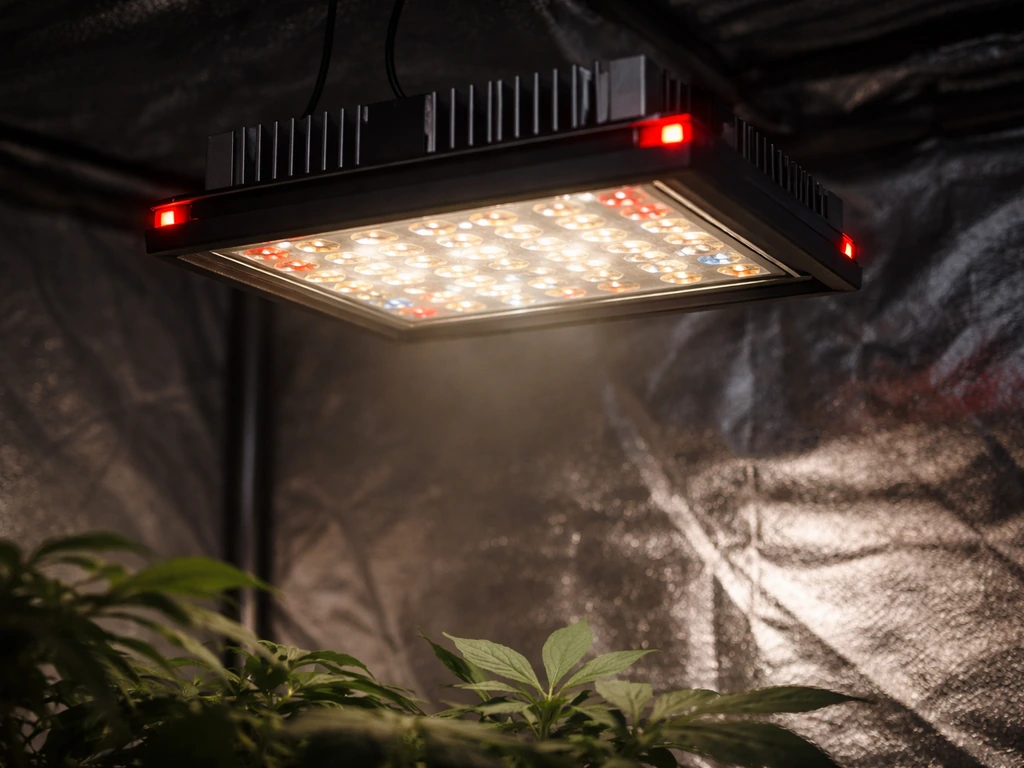
When growers call a light 'the worst,' they usually mean one of a handful of concrete failure modes. The most common is misleading wattage. A fixture labeled '1000W' often draws only 100 to 200 actual watts from the wall, because that '1000W' figure is a marketing comparison to an old HID bulb, not a real power draw number. That kind of 'equivalent wattage' language is a red flag in any product listing, and it directly causes underdelivery of photon output across your canopy.
Beyond wattage fraud, a light can be 'worst' for any of these reasons: dim output that never hits even the minimum PPFD threshold for vegetative growth, wrong spectrum (too blue for flowering, too red for seedlings, or a spikey narrow band instead of a broad usable range), uneven coverage that creates bright hotspots in the center and dim edges, excessive heat from poor thermal management, unreliable drivers or fans that fail mid-cycle, and unsafe electrical design that puts you and your space at risk. A light can also be a great fixture in the wrong application: a bar light sized for a 2x4 is a terrible choice for a 5x5, not because it's defective, but because it's mismatched.
Diagnosing Poor LED Performance in Your Setup
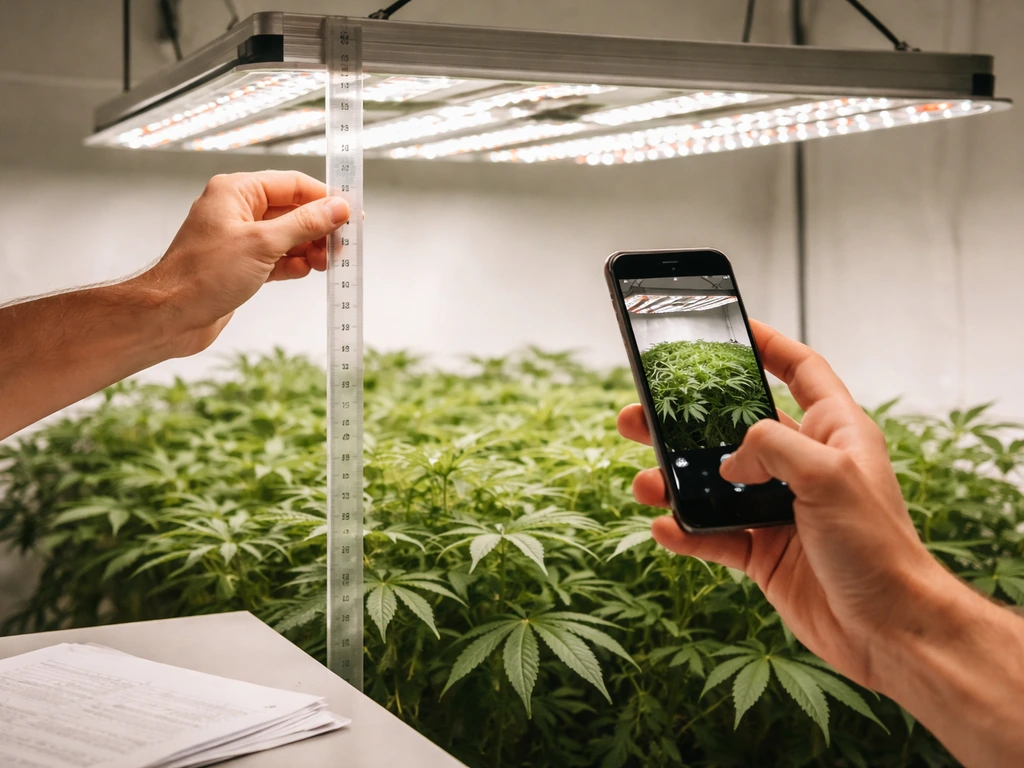
You don't need a PAR meter to start diagnosing a bad light, though one helps. Start with the obvious: pull up the manufacturer's spec sheet and look for actual PPF (photosynthetic photon flux, measured in µmol/s) and PPFD (photosynthetic photon flux density, measured in µmol/m²/s) at specific mounting heights. If neither number exists on the spec sheet, that's your first red flag. A credible fixture will list PPF and PAR efficacy (µmol/J) explicitly, and you should be comparing fixtures on those exact fields.
Next, check your mounting height against the manufacturer's PPFD map. Most reputable brands publish a PPFD grid showing intensity across a canopy area at a stated height (say 18 inches or 24 inches). If you're mounting the light at a different height, your actual PPFD will be lower than the chart shows. Keep in mind that PPFD maps are often measured in ideal, empty-room conditions, which means real canopy PPFD in a tent with walls and plants will vary. This is why plants in the center thrive while edges struggle: coverage isn't as uniform as the map implies.
If you want a rough verification without a dedicated PAR meter, be careful with phone-based PPFD apps. Community experience consistently shows these apps produce significant measurement errors compared to calibrated Apogee or Li-Cor meters, so treat phone readings as a ballpark at best. A better no-meter check is to look at your plants: pale, stretchy stems under a light running at full power at the correct height signal insufficient PPFD. Leaf curl or bleaching near the center and healthy growth at the edges signals a hotspot from mounting too close.
Also check your dimmer. Some fixtures deliver claimed PPFD only at 100% power, but many growers run dimmers at 50 to 75% and wonder why their results don't match the spec sheet. If you're running a dimmer below full power intentionally (for seedlings or early veg), that's fine, but calibrate your expectations: PPFD output is roughly linear with power draw on quality LED drivers, so 60% power means roughly 60% of the listed PPFD.
Red Flags in Specs: Wattage, PAR, Efficacy, Spectrum, and Coverage
Learning to read a spec sheet critically is the single fastest way to filter out the worst lights before you buy. Here are the specific numbers and claims to scrutinize.
Wattage claims
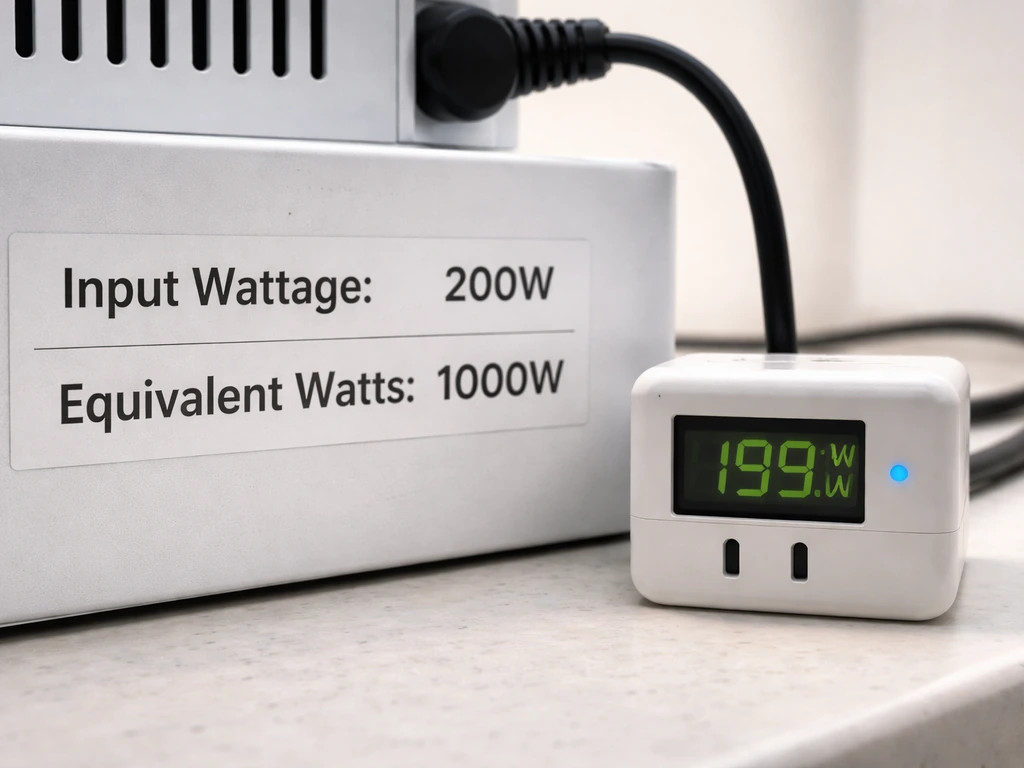
Always look for actual wall draw in watts, not 'equivalent' watts. A legitimate spec sheet will list input wattage (the real electrical consumption) separately from any comparative figure. If you see only 'replaces 1000W HPS' with no real wattage stated, walk away. The actual draw tells you how much electricity you're paying for and, combined with PPF, tells you how efficient the fixture is.
PPF and efficacy
PAR efficacy (µmol/J) is the key efficiency metric. A genuinely good LED fixture in 2026 should hit at least 2.5 µmol/J, with top-tier fixtures from established brands reaching 2.7 to 3.0 µmol/J or higher. A credible commercial fixture, for example, might show 1,716 to 1,820 µmol/s PPF at 2.60 µmol/J, listed explicitly on the spec sheet. If the spec sheet doesn't include both PPF and efficacy, treat the product's claimed output as unverified.
PPFD and coverage claims
Be extremely skeptical of any light claiming it covers a 10x10 space without a full PPFD map at a real mounting height. Coverage claims without PPFD proof are the most common performance lie in budget LED listings. Reasonable coverage for a single bar or panel fixture is typically a 4x4 to 5x5 footprint at adequate PPFD (above 400 µmol/m²/s for veg, above 600 for flower). A light claiming a 10x10 coverage area is almost certainly describing the outer edge of very dim fringe light, not usable photon density.
Spectrum
A vague spectrum chart showing only a few colored spikes (common in cheap blurple lights) is a warning sign. Modern full-spectrum LEDs use broadband white phosphor chips (often Samsung LM301H or similar) with targeted red supplementation, producing a spectrum that looks similar to sunlight on a spectral graph. This matters because plants use the full 400 to 700 nm range for photosynthesis. A light that's heavy in one narrow band may hit decent total µmol/s on paper but deliver those photons in wavelengths your plants use less efficiently at certain growth stages.
Uniformity
Uniformity is a design quality indicator that cheap lights frequently ignore. Good fixtures use optimized LED spacing, optics, and beam angles to spread light evenly. Some well-designed bar arrays claim uniformity figures around 90% or better across the coverage footprint, meaning the lowest PPFD point in the grid is within 10% of the highest. A light with a tight central hotspot and dim edges has poor uniformity, which directly causes uneven growth and wasted canopy space.
Matching Your Light to Your Tent, Plant Stage, and Canopy Height
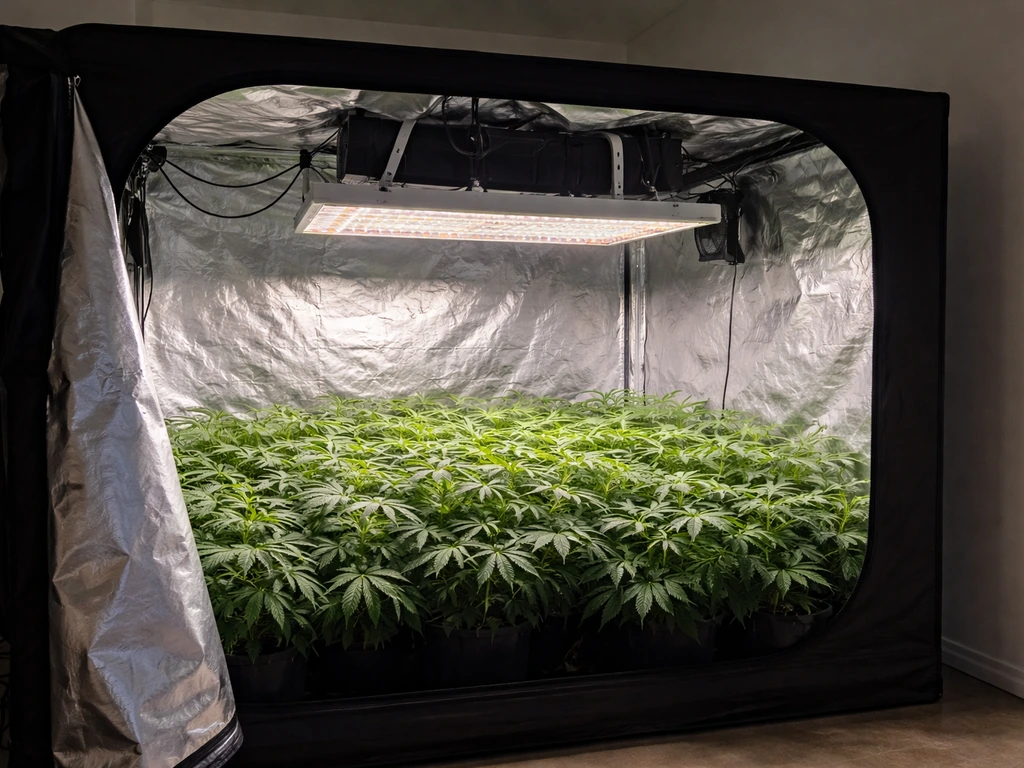
A mismatch between the light and the grow scenario is one of the most common reasons a technically functional fixture still produces 'worst' results. Getting this right means thinking about three things together: the footprint, the plant stage, and the mounting height.
For PPFD targets, research-backed ranges give you a practical sanity check. Oklahoma State University Extension recommends a PPFD of 400 to 800 µmol/m²/s as a general growth range, and extension-level PPFD guidance for flowering and fruiting suggests going up to 400 to 1,200 µmol/m²/s depending on the plant. For a typical cannabis or tomato grow, seedlings and clones want 100 to 300 µmol/m²/s, vegetative growth wants 400 to 600 µmol/m²/s, and flowering wants 600 to 900 µmol/m²/s or higher for light-hungry strains.
You can tie all of this together using daily light integral (DLI), which is calculated as: DLI = (PPFD × 3,600 × operating hours) / 1,000,000. If your light delivers 600 µmol/m²/s and runs for 18 hours, your DLI is (600 × 3,600 × 18) / 1,000,000 = 38.9 mol/m²/day, which is appropriate for heavy-feeding flowering plants. This framework lets you adjust either intensity or photoperiod to hit your target rather than guessing.
| Grow Space | Minimum Fixture Size (Real Watts) | Target PPFD (Flower) | Recommended Mounting Height |
|---|---|---|---|
| 2x4 tent | 200-250W | 600-800 µmol/m²/s | 18-24 inches |
| 4x4 tent | 400-480W | 600-900 µmol/m²/s | 18-24 inches |
| 5x5 tent | 600-650W | 600-900 µmol/m²/s | 18-24 inches |
| 4x8 tent | 800-1000W | 600-900 µmol/m²/s | 18-24 inches |
| 10x10 commercial | 2000W+ | 600-1000 µmol/m²/s | 24-36 inches |
LED placement also involves spacing between fixtures when you're running multiple units. Simply clustering two lights in the center of a large space creates overlapping hotspots while leaving edges dim. Spreading fixtures evenly across the canopy and matching spacing to the manufacturer's PPFD overlap data is how you get consistent intensity across the whole footprint. If you're running a single fixture in a 4x4, center it and confirm that the PPFD at the corners is above your target threshold, not just the center point.
If you're growing something that has specific light requirements, like a small, slow-growing plant on a windowsill or under a compact fixture, be honest about what you actually need. LED grow lights for bonsai, for example, operate in a completely different PPFD and coverage range than a flowering cannabis tent, so a bonsai-appropriate fixture would look terrible in a 4x4 even though it's perfectly suited for its actual purpose.
Heat, Power Draw, Reliability, and Safety Checks
Heat is both a performance issue and a safety issue. A well-designed LED runs its diodes at controlled temperatures using passive heatsinks, heat pipes, or active fans. When a budget fixture runs hot to the touch on the heatsink (above 60°C or so at the board), it's shortening the lifespan of its diodes and drivers significantly. Elevated ambient temps in your tent also push up VPD and stress your plants. If your light is noticeably warming the air in a well-ventilated tent, its thermal management is inadequate.
On the electrical side, check actual wall draw with a Kill-A-Watt or similar plug-in meter. Compare the measured draw to the spec sheet's stated wattage. If a light claims 480W real draw but only pulls 200W, you're getting less than half the promised output. Conversely, if a 'budget 200W' light actually pulls 240W with no thermal headroom designed in, its components are running outside their rated range.
Safety certification is a hard filter that many growers overlook. The relevant standard for horticultural lighting in North America is blank" rel="noopener noreferrer">ANSI/CAN/UL 8800, which covers electrical safety, fire risk, and photobiological effects (UV/blue light exposure to eyes and skin during normal use). The Illuminating Engineering Society notes that Risk Group 3 horticultural lights, those producing the highest photobiological hazard, are not eligible for safety listing under this framework. Lights that carry UL 8800 listing or appear on the blank" rel="noopener noreferrer">DesignLights Consortium (DLC) horticultural Qualified Products List have passed independent third-party testing. Lights that don't carry any recognized certification and are priced suspiciously low should be treated as a genuine fire and safety risk, not just a performance gamble.
Warranty and driver quality are reliability proxies when you can't inspect the internals. Meanwell, Inventronics, and similar tier-one driver brands are a good sign. A one-year warranty on an LED fixture is marginal; three to five years is the standard for quality gear. If the brand has no verifiable customer service contact, no replacement parts program, and no warranty documentation beyond a slip of paper in the box, factor that into your total cost of ownership.
What a Actually Good LED Looks Like, and How to Upgrade
When you're ready to replace a bad light, here are the minimum evidence standards to require before buying. First, the spec sheet must include real input wattage, PPF in µmol/s, and PAR efficacy in µmol/J. Second, there must be a published PPFD map at a stated mounting height for your target footprint. Third, the fixture should carry a recognized safety certification (UL 8800, ETL, or DLC listing). Fourth, the spectrum should be broad and continuous in the 400 to 700 nm range, not a handful of narrow spikes. Fifth, the warranty should be at least three years with documented support.
For efficacy, aim for 2.5 µmol/J as a minimum in 2026. Fixtures using Samsung LM301H, LM301B, or equivalent Osram diodes with quality drivers routinely hit 2.7 µmol/J and above. The best Samsung LED grow lights demonstrate why diode quality matters so much: the same driver and heatsink design produces meaningfully different output depending on which bins are used.
For incremental upgrades, you don't always have to replace everything at once. If you have one underperforming fixture in a 4x4, adding a second bar light at the edges can fix coverage gaps without a full teardown. Raise the main light to reduce hotspots at the center and let the supplemental fixture fill in the perimeter. This kind of staggered upgrade path works well when budget is a constraint, as long as you're tracking PPFD across the whole footprint rather than just eyeballing the center.
If you're not sure where to start with the replacement selection process, working through a structured buying decision helps more than browsing random listings. A resource that walks you through which LED grow light to buy based on your specific space and goals is a better starting point than sorting by price on a marketplace. And if you're in Canada, note that safety certification requirements and available products differ slightly, so checking the best LED grow light options in Canada will give you region-specific guidance on certifications and locally available brands.
Your Next Steps After Identifying a Bad Light
Here's a practical checklist to work through right now if you suspect your current light is underperforming.
- Pull the spec sheet and verify real input wattage, PPF (µmol/s), and PAR efficacy (µmol/J). If any of these are missing, the light's performance is unverified.
- Check the PPFD map at your actual mounting height and confirm the corner readings (not just the center peak) are above your target for the current plant stage.
- Measure actual wall draw with a plug-in meter. Compare it to the stated wattage. A significant gap means you're getting less photon output than claimed.
- Check your dimmer setting. If it's below 100%, expect proportionally lower PPFD than the spec sheet shows.
- Feel the heatsink 30 minutes into a run. Warm is fine; hot enough to hurt suggests thermal management issues.
- Verify safety certification. Look for UL 8800, ETL, or DLC horticultural QPL listing. No listing on a cheap fixture is a concrete safety concern.
- If the light fails two or more of these checks, start shopping for a replacement using the minimum spec thresholds above: 2.5+ µmol/J efficacy, published PPFD map, three-year warranty minimum, and recognized safety certification.
The worst LED grow lights share a pattern: they hide behind vague numbers, skip third-party testing, and count on growers not knowing what to look for. Once you know the difference between real watts and equivalent watts, and between a verified PPFD map and a coverage claim pulled from thin air, the bad options become obvious fast. A genuinely good replacement fixture will pay for itself in one or two grow cycles through better yields and lower energy waste.
FAQ
My worst led grow light doesn’t feel hot. Can it still be a bad light?
Not necessarily. If a light runs cool but still underdelivers, the more likely issues are low PPF, poor uniformity, or incorrect spectrum balance. Use the wall-watt measurement to confirm real input power, then cross-check that the spec sheet provides both PPF and efficacy, not just marketing “coverage” claims.
What if the center looks fine, but my yields are still terrible?
Yes, and it’s common. A fixture can hit the target center PPFD but still produce weak yields because the corners and edges fall below your plant’s minimum threshold. When you verify, check multiple points at the same mounting height, especially near corners, not only the center spot.
How do I know my worst led grow light’s dimmer isn’t the problem?
Check whether the light is driven by a genuine dimmer mode that the manufacturer characterizes, or by a simple “lower power” setting with unknown output. If the brand does not publish PPFD maps at each dim level, treat dimmed performance as uncertain, even if output appears to be roughly proportional on paper.
Can PPFD maps still be misleading even if they exist on the spec sheet?
Look for “PPFD map at X height” language that matches your actual mounting height, and confirm the map includes your footprint dimensions. If the map height differs, apply caution because LED intensity often drops nonlinearly with distance depending on optics.
Are phone PPFD apps ever accurate enough to judge the worst led grow lights?
Phone apps can be off because they rely on camera sensors and generic calibrations that do not match PAR measurement physics. If you use one anyway, validate it once with a known reference light or by correlating with a professional meter reading if you have access.
My plants bleach near the center. Does that mean the light is “too weak” or “too strong”?
If you see bleaching near the hottest area only after increasing intensity or photoperiod, your issue could be overdriving those regions, not overall fixture weakness. Reduce power slightly, raise the light, and confirm uniformity, because hotspot management fixes more problems than chasing a new spectrum.
Are silent, fanless LED grow lights automatically better than the worst led grow lights?
Some “silent” fixtures use fanless or passive designs, but they still must have a thermal pathway that keeps diode and driver temperatures within spec. If the heatsink is warm but not documented, prioritize evidence like driver brand, warranty length, and safety certification over comfort-based assumptions.
How should I compare two lights if one lists only “equivalent wattage”?
Be careful with “equivalent watts” claims. The decision aid is simple: compare measured plug wattage to the listed input wattage, then compute expected efficiency using PPF and µmol/J if available. If PPF is missing, don’t infer performance from power alone, because low quality drivers can underdeliver photons for the same watts.
What reliability warning signs matter beyond wattage and PPFD?
Reputable brands publish both safety listing information and a warranty that is supported by real customer contact. A short warranty, no spare parts path, or unclear service address is a practical red flag, even if the light has decent-looking spec numbers.
Can I use DLI to fix a bad light purchase I already made?
The most useful target is DLI for your crop stage, but you need at least approximate PPFD and a realistic operating schedule. If your PPFD is wrong because of height mismatch or poor uniformity, the DLI calculation will mislead you, so confirm canopy readings at multiple points before dialing photoperiod or intensity.
How do I troubleshoot fixture spacing when I’m running multiple lights?
Spacing between multiple fixtures should be planned so overlap raises the low points rather than stacking hotspots. Start from the manufacturer’s overlap guidance if provided, otherwise map PPFD across the whole canopy after installation, then adjust spacing, not just height.
What warranty details should I read carefully to avoid the worst led grow lights later?
Look at the warranty terms for exclusions, and whether the company offers driver replacement or parts service. If only the diodes are covered, or if failures caused by “power fluctuations” shift blame onto the buyer, factor that into the real cost of ownership.
Is it better to chase maximum PPFD or better uniformity?
Some lights list a high PPFD number at the center but have low efficiency or poor uniformity, resulting in weak edge growth. If you’re choosing between higher center PPFD and better grid uniformity, prioritize uniformity for most plant types because it reduces stress from microclimate variation.
Next Articles
Which LED Grow Light to Buy: Coverage, Spectrum, Wattage Guide
Guide to choose the right LED grow light by tent size, spectrum, wattage, PPFD coverage, and budget to buy today
Best Full Spectrum 1000W LED Grow Lights: Buyer Guide
Buy the best full spectrum 1000W LED grow light with spec-to-decision tips on PPFD, coverage, wattage, and tent fit.
Best 100W LED Grow Light: How to Choose the Right One
Choose the best 100W LED grow light with PPFD coverage, spectrum, efficiency, dimming, heat, and setup tips.