
When growers search for "High Times best LED grow lights," they're really asking one thing: which LED grow light is actually worth buying right now, verified by people who have tested them seriously rather than just listed specs from a press kit? The answer depends heavily on your grow space, your target PPFD at canopy level, and how much you care about efficiency versus upfront price. This guide cuts through the noise and gives you a real framework to choose, plus a shortlist of top picks organized by grow scenario so you can match light to space without guessing.
High Times Best LED Grow Lights: How to Choose 2026
Marcus Rutherford
9 Apr 2026
What 'best' actually means in a real grow (and what High Times-style picks optimize for)
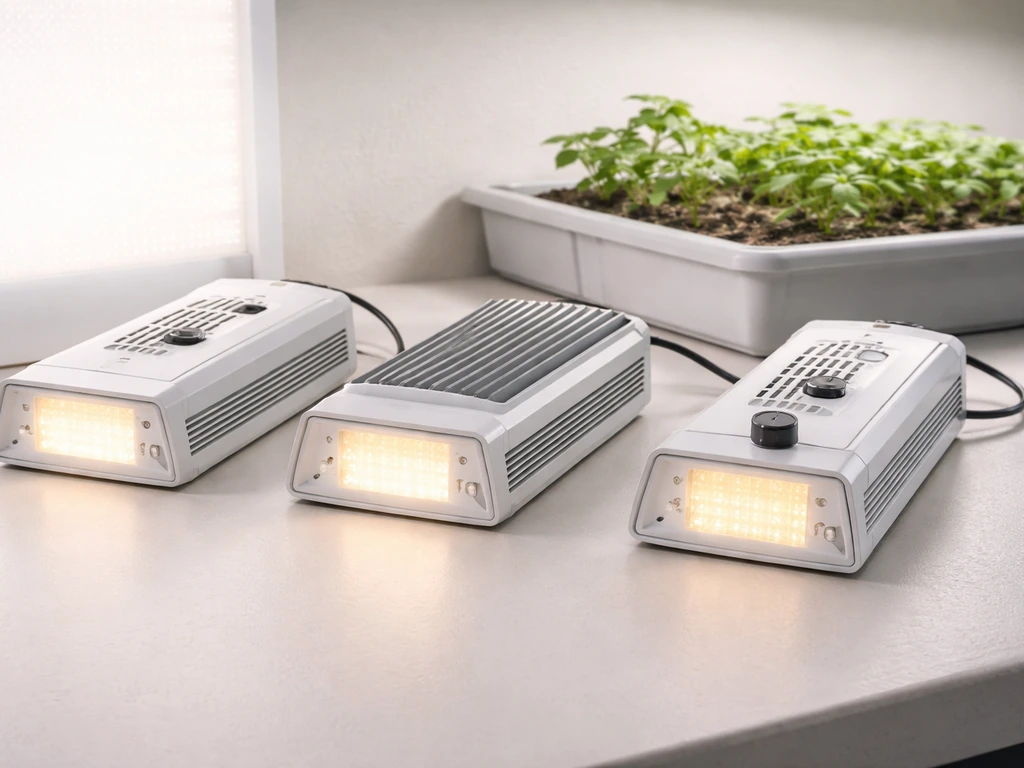
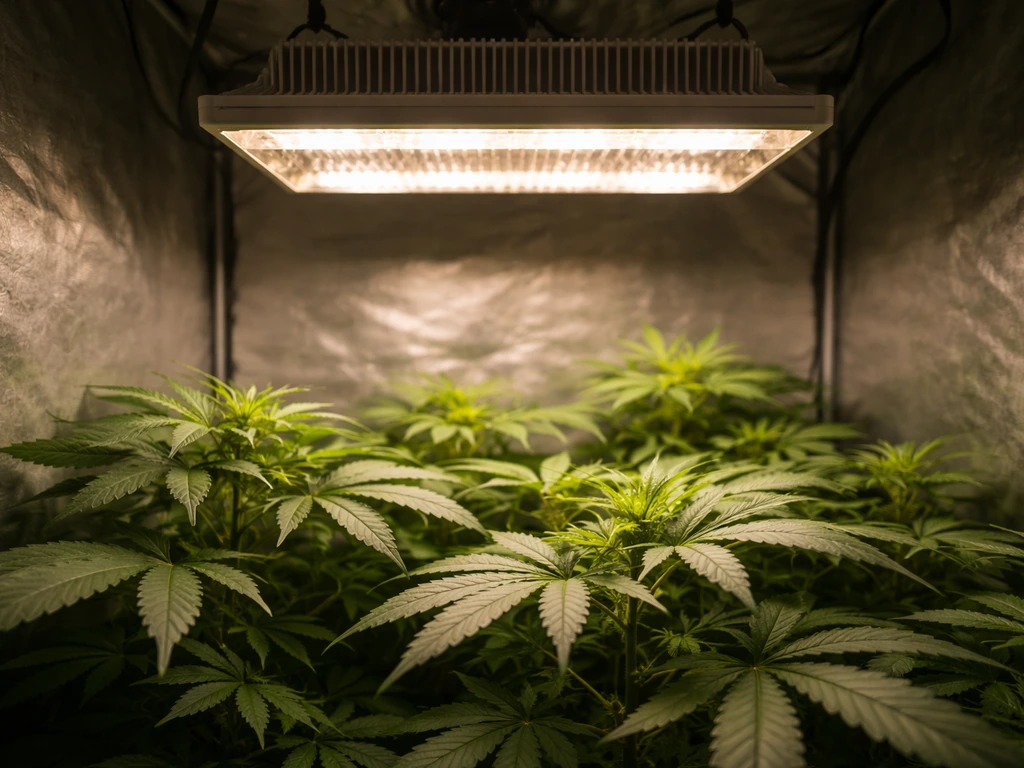
High Times LED grow light recommendations tend to optimize for peak PPFD output, reported yield per watt, and name-brand credibility. Their reviews have highlighted fixtures like the Mars Hydro FC-6500, noting its average PPFD running roughly 30% higher than comparable fixtures and a reported maximum yield up to about 2.5 grams per watt. Those are impressive headline numbers, but they don't automatically mean it's the right light for your 3x3 tent or your budget. What publication-style "best" picks usually skip: how uniformly the light covers the canopy, what the PPFD looks like at the edges versus the center, how the fixture handles heat in a sealed tent, and whether the spectrum is actually tuned for the stage your plants are in. A light that posts a massive peak PPFD in a 4x4 PAR map can still underperform if you're running it in a 2x2 at the wrong height. Real "best" means the right photon output, at the right uniformity, for the right footprint, at a price that makes sense for your setup.
One thing High Times does get right is calling out PPFD as the metric that actually matters for plant growth, not lumens. Lumens measure light the human eye perceives. White LEDs can look blindingly bright and score high in lumens while delivering lower PPFD to your canopy than a purpose-built horticultural fixture. PPFD (micromoles per square meter per second, or µmol/m²/s) tells you how many photons are landing on your canopy per second, which is what drives photosynthesis. That's the number you should be building your purchasing decision around.
Coverage footprint, PPFD targets, and matching light to your tent
Before you look at a single product listing, you need two numbers: your canopy area in square meters and your target PPFD for the current growth stage. Manufacturers publish PAR maps showing PPFD across a grid of measurement points at a specified hanging height, and that map tells you whether a given fixture actually covers your footprint at usable intensity. The catch, as Black Dog LED points out, is that PPFD comparisons are only valid when lights are hung at the same height and measured with the same method. If one brand tests at 18 inches and another at 24 inches, the numbers aren't comparable at all.
For target PPFD by stage, here are the ranges backed by horticultural lighting research: propagation runs 100 to 250 µmol/m²/s, vegetative growth runs 300 to 450 µmol/m²/s, and flowering needs 700 to 1,200 µmol/m²/s. You can translate any of these into a daily light integral using the DLI formula: DLI (mol/m²/day) = 0.0036 × PPFD × light hours per day. FYTech Systems’ DLI guide confirms the same conversion form: DLI equals PPFD multiplied by photoperiod (hours) and 0.0036 DLI = 0.0036 × PPFD × light hours per day. For example, a 12-hour flowering photoperiod at 900 µmol/m²/s gives you a DLI of roughly 39 mol/m²/day, which sits in the productive range for most cannabis cultivars. This formula is genuinely useful for planning because it lets you dial back intensity and compensate with a longer photoperiod if your fixture can't hit peak PPFD uniformly across the whole canopy.
Coverage footprint is where a lot of growers get burned. A 600-watt fixture marketed for a 4x4 might only hit adequate PPFD in the center two square feet if uniformity is poor. Uniformity is defined practically as average PPFD divided by maximum PPFD across the measured area. A ratio closer to 1.0 means the light is spread evenly. A fixture like the Treegers GL650W+ publishes a uniformity ratio of 0.62 on its performance data sheet, which is on the lower side and means the edges of the canopy are getting significantly less light than the center. When you're comparing fixtures, always look for the published PAR map and calculate or note the uniformity ratio. A fixture with lower peak PPFD but a ratio above 0.75 will often outperform a flashier option with a brighter center and dim corners.
| Grow Space | Canopy Area (sq ft) | Target PPFD (Flower) | Estimated Wattage Needed |
|---|---|---|---|
| 2x2 tent | 4 sq ft | 700–900 µmol/m²/s | 100–150W |
| 3x3 tent | 9 sq ft | 700–1,000 µmol/m²/s | 200–300W |
| 4x4 tent | 16 sq ft | 800–1,100 µmol/m²/s | 400–650W |
| 5x5 tent | 25 sq ft | 900–1,200 µmol/m²/s | 650–1,000W |
| 4x8 / commercial row | 32 sq ft | 900–1,200 µmol/m²/s | 1,000–1,600W |
Full-spectrum strategy: what your plants actually need at each stage
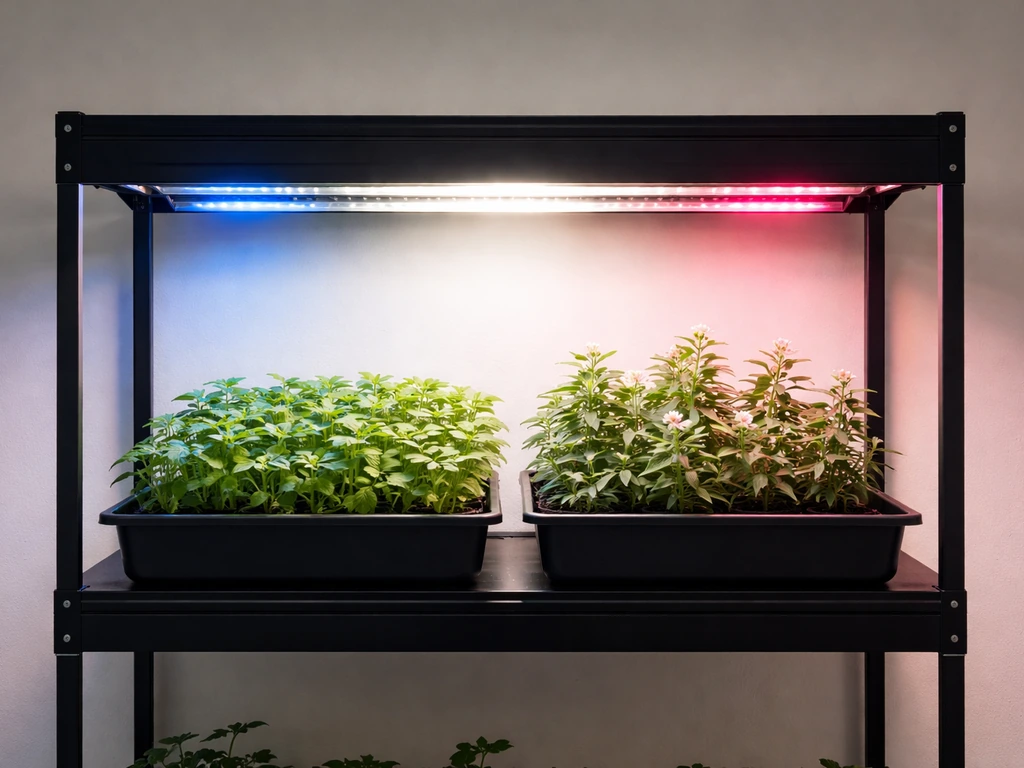
"Full spectrum" has become a marketing phrase that means almost nothing without specifics. What it should mean is a spectral output that covers the photosynthetically active radiation range (roughly 400 to 700 nm) with enough blue (400 to 500 nm), red (600 to 700 nm), and often some far-red (700 to 800 nm) to support the plant through every stage. But the ratio of those bands matters, and it changes depending on what you're trying to accomplish.
During vegetative growth, a higher ratio of blue light is beneficial. Blue photons promote compact, bushy growth and help suppress the stretching response triggered by a high red-to-far-red ratio. Research confirms that moderately high blue photon flux density attenuates the red-to-far-red extension growth response, meaning you get stockier plants with better internodal spacing. For veg, a spectrum with solid blue output (sometimes called "4000K" or "5000K" color temperature in white LEDs, or a dedicated blue channel in multi-band fixtures) is what you want.
During flowering, the calculus shifts. Far-red light plays a direct role in photoperiodic flowering induction and gene expression tied to flower development. A 2025 Scientific Reports study found that modifying the LED red-to-far-red ratio in cannabis directly manipulates the expression of flowering-related genes through photoperiodic mechanisms. In the Scientific Reports study on medicinal cannabis, the DLI-related methods used PAR-component measurements and far-red at 735 nm with LightScout Quantum Meter and a LightScout Red/Far Red Meter A 2025 Scientific Reports study found that modifying the LED red-to-far-red ratio in cannabis directly manipulates the expression of flowering-related genes through photoperiodic mechanisms.. In practical terms, this means a fixture with far-red output (730 nm is the common target) can speed up flower initiation and potentially improve bud development. Many modern bar-style fixtures include a dedicated far-red channel or end-of-day far-red supplementation as a feature. If you're growing photoperiod cannabis, this is genuinely worth paying for, not just a spec sheet checkbox.
The bottom line on spectrum: for a single fixture covering veg and flower, a broad white spectrum with supplemental far-red is your best all-around option. If you're running a dedicated veg space and a separate flower room, optimize each. Veg lights can be tuned toward blue-heavy 4000K to 5000K output; flower fixtures should lean red-heavy with far-red included. Lights that let you toggle or dim individual spectrum channels give you the most flexibility, though they cost more.
Bar lights vs panels vs quantum boards: what form factor to choose
The three main form factors you'll encounter are quantum board panels (a single flat board covered in diodes), multi-bar fixtures (LEDs spread across multiple arms or bars), and traditional chip-on-board (COB) panels. Each has real tradeoffs, and the right choice depends on your tent size and how much you care about uniformity versus simplicity.
Quantum boards like the HLG line are compact, run cool relative to their output, and are easy to hang in a tent. The HLG 250 Veg Pro is designed with a rectangular spread to improve light distribution and is recommended at about 12 inches from the canopy for that improved spread. Quantum boards are excellent for 2x2 to 3x3 spaces and dedicated veg rooms. Their limitation is uniformity at scale: as you push past 4x4 footprints with a single panel, the center-to-edge PPFD drop becomes more noticeable.
Multi-bar fixtures solve the uniformity problem by spreading LEDs across a wider physical area. Fixtures like the Mars Hydro FC-E6500 use this approach, and independent testing confirms the bar layout helps push usable PPFD across the full canopy footprint. A reflector-style design like the Mars Hydro RP1000 takes a different approach, using a reflector to redirect photons and widen effective coverage for more even PPFD distribution. Bar lights do have one downside: they tend to be physically larger and can be harder to fit into shorter tents where you're running limited vertical space.
On heat and airflow, LED fixtures run far cooler than HPS, but heat management still matters. Passively cooled quantum boards are nearly silent and low-maintenance. Bar-style fixtures at high wattage may include small fans that add noise and represent a potential long-term failure point. Always check whether the driver is built-in or external: an external driver lets you mount it outside the tent, keeping both heat and noise out of your growing environment. For sealed grow rooms, the driver placement decision alone can make a meaningful difference in ambient temperature.
Top LED grow light picks by grow scenario
Small tents (2x2 to 3x3): HLG 65 V2 / HLG 200-series
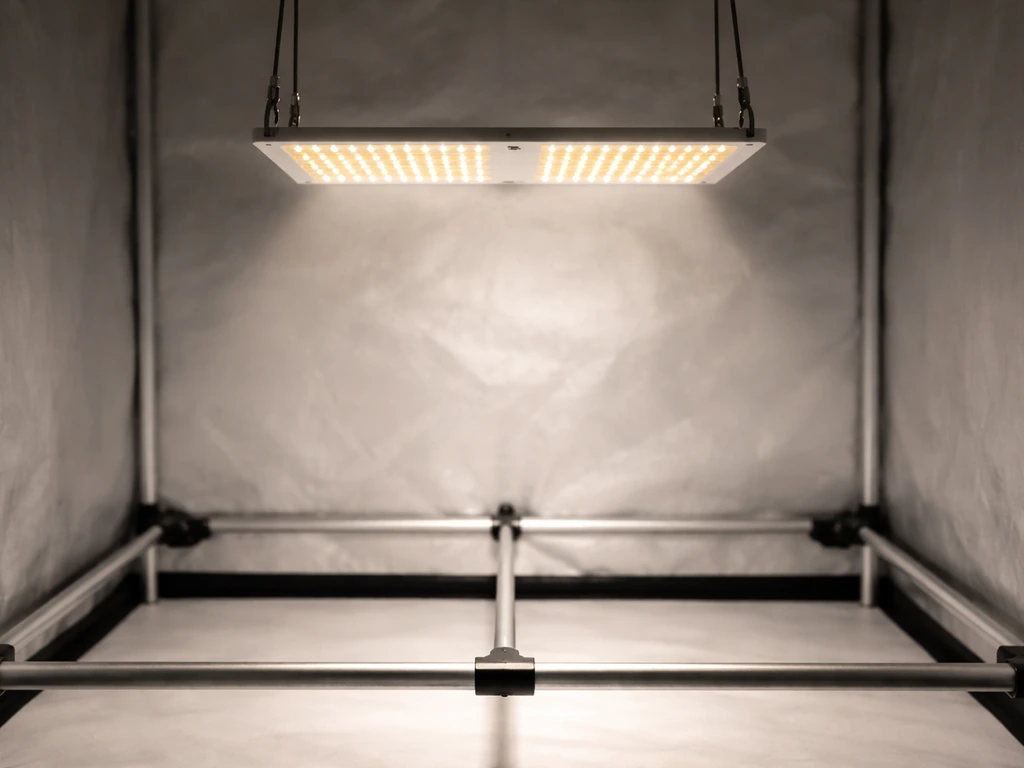
For a 2x2 veg or small flower setup, a compact quantum board in the 65 to 100 watt range covers the footprint without overpowering it. The HLG 65 V2 is a clean example: it's a quantum board pulling around 65 watts, running efficient white-spectrum diodes, and backed by a 3-year manufacturer's warranty. It won't flower a 3x3 to its full potential, but for propagation, veg, or a compact one-plant setup it's hard to beat at the price point. For a 3x3 flower space, step up to the HLG 200 or 225 range to hit the PPFD targets you need without burning money on excess wattage.
4x4 medium tent: Mars Hydro FC-6500 EVO / HLG 650R
The 4x4 is the most common home grow footprint and the most competitive product category. The Mars Hydro FC6500 EVO has published PAR maps tested in a 4x4 grow area showing solid PPFD distribution, and the FC-6500 (the platform it's built on) has been reviewed favorably by High Times for its output-to-watt ratio. Independent testing of the FC-E6500 variant showed maximum PPFD around 1,000 µmol/m²/s at 30 cm hanging height, which is right in the productive flowering range. The HLG 650R is the premium competitor here: better build quality, external driver option, and the HLG 750 Diablo-level warranty coverage (the HLG Diablo line carries a 5-year warranty covering the LED board, drivers, and all electrical components). If budget is your primary constraint, the Mars Hydro wins on value. If you want a fixture built to run for five or more years with less worry, HLG is worth the premium.
High-output and value picks (5x5 and up)
At 5x5 and larger, you're either running multiple fixtures or stepping up to a high-output single unit above 800 watts. Multi-bar fixtures dominate this category because their physical spread matches large footprints better than single panels. Budget-conscious growers looking at this tier should evaluate quantum board options built around LM301H EVO diodes: some third-party quantum boards advertise efficiency around 3.1 µmol/J with a claimed 50,000-hour lifespan and a 3-year warranty, which competes seriously with brand-name options at a fraction of the cost. The tradeoff is that warranty service on budget boards can be difficult to actually use. For commercial or semi-commercial grows where downtime is expensive, stick with brands that have real US-based customer support.
Price, efficiency, controls, and lifespan: how to compare without getting fooled
The most abused spec in LED marketing is wattage. "600 watt" can mean the fixture actually draws 600 watts from the wall, or it can mean a historical HPS-equivalent claim with real draw closer to 300 watts. Always look for actual wall-draw wattage, not "equivalent" wattage. After that, efficiency is your next filter: a fixture rated at 2.7 µmol/J or higher is competitive for 2026; anything above 3.0 µmol/J is genuinely excellent. Below 2.0 µmol/J, you're leaving money on your electricity bill every month. GrowersHouse advises evaluating fixtures using PPFD, efficacy in µmol/J, and PAR maps as the three key real-world metrics rather than wattage alone, which is exactly the right framework.
Dimming and control features matter more than most beginners expect. A 0 to 10V dimming input lets you connect a controller and automate intensity ramping across the day or growth stage. Some fixtures include a built-in dial; others require an external controller. If you're growing multiple strains or running different stages in the same room, dimming gives you the flexibility to dial back intensity without changing hang height. RJ45-linked daisy-chain control (where multiple fixtures sync from one controller) is a feature worth paying for once you're running three or more lights.
On lifespan, most quality LED fixtures are rated for 50,000 hours at full output before L70 (the point where output drops to 70% of original). At 18 hours per day, that's around 7.6 years before meaningful degradation. Warranty coverage is the real-world proxy for manufacturer confidence: a 5-year warranty like that offered on the HLG Diablo line is a strong signal. A 1-year warranty on a budget fixture is a signal that the manufacturer isn't betting on long-term reliability. When comparing warranties, check whether coverage includes the driver and LEDs separately or as a complete luminaire, since drivers are the most common failure point.
If you want to verify manufacturer PPFD claims yourself rather than just trust the spec sheet, you need a PAR meter with cosine correction. Apogee's SQ-500 is the standard reference tool: it covers 389 to 692 nm spectral response, has directional cosine response within 5% at 75° zenith angle, measures up to 4,000 µmol/m²/s, and carries a 4-year warranty. The SQ-520 USB version adds datalogging via ApogeeConnect software, which is useful if you want to map a full grid of measurement points across your canopy rather than just spot-checking the center. Cosine correction matters because photons arriving at an angle contribute less to plant photosynthesis than those arriving perpendicular to the leaf surface, and a non-corrected meter will overstate PPFD under certain fixture geometries.
Quick buying checklist and how to size your light today
Run through this checklist before you finalize any purchase. It takes about ten minutes and will save you from the most common LED buying mistakes.
- Measure your actual canopy area in square meters (length × width in meters). This is your coverage target.
- Decide your primary growth stage: propagation (100–250 µmol/m²/s), veg (300–450 µmol/m²/s), or flower (700–1,200 µmol/m²/s).
- Find the fixture's PAR map at a specified hanging height. Check that the PPFD at the edges of your canopy footprint (not just the center) meets your stage target.
- Calculate or note the uniformity ratio from the PAR map (average PPFD divided by maximum PPFD). Aim for 0.70 or higher.
- Confirm actual wall-draw wattage (not equivalent wattage) and calculate efficacy: if the manufacturer lists µmol/J, look for 2.7 or above.
- Check dimming: does it support 0–10V, a built-in dial, or daisy-chain control? Make sure it matches how you plan to manage your grow.
- Verify the warranty duration and what it covers (LEDs, driver, full luminaire). Five years covering the full fixture is the benchmark to beat.
- Confirm hanging height compatibility with your tent's interior height. A bar fixture requiring 24 inches of clearance won't work well in a 60-inch tent running tall plants.
- If you want to validate claims yourself, plan a canopy-level PPFD measurement using a cosine-corrected PAR meter at the same hanging height the manufacturer used in their published map.
To size your light right now: take your canopy area in square feet, multiply by your target PPFD in µmol/m²/s, and divide by the fixture's efficacy in µmol/J, then multiply by 1,000,000 and divide by the area to get a rough wattage estimate. Or use the simpler rule of thumb: budget 30 to 40 watts of actual draw per square foot of canopy for high-intensity flower, 15 to 20 watts per square foot for veg. A 4x4 (16 sq ft) flowering space needs roughly 480 to 640 watts of real draw from an efficient modern fixture. Match that to a fixture with a published PAR map showing coverage of your footprint, efficiency above 2.7 µmol/J, and a warranty you can actually use, and you've made a sound buying decision regardless of which publication's "best" list you started from.
FAQ
How do I choose high times best led grow lights if my ceiling height makes the “recommended hanging distance” impossible?
Use the fixture’s PAR map at the closest practical height (or the height it was tested at) and verify edge coverage, not just center PPFD. If you must raise or lower the light beyond the test condition, plan to adjust output with dimming or change fixture count, because the footprint uniformity can drop quickly when the hang height changes.
What’s the safest way to compare two lights that report PPFD differently?
Make sure the PPFD is reported with the same hanging height, the same measurement grid approach, and a meter that uses cosine correction (or otherwise states comparable methodology). If one brand only gives a single “max PPFD” number, treat it as incomplete and rely on the full PAR map and implied uniformity for decision-making.
Do “white” LED grow lights still work if the spectrum is not stage-specific?
They can, especially for veg or as a single-fixture setup, but you should look for supplemental far-red support if you are optimizing flowering performance. If your fixture cannot provide far-red (or lets you toggle it), you may get slower or less consistent flowering induction than a design that explicitly includes a far-red channel.
How much dimming should I use, and will dimming reduce lifespan or efficiency?
Dimming mainly changes how hard the driver runs, which usually lets you dial in target PPFD without changing hang height. Efficiency can dip slightly at very low outputs, and lifespan depends on thermal conditions, so avoid fully enclosing a fixture in a way that traps heat when running at high power or high ambient temperatures.
Is it better to buy one high-output light for a 4x4, or multiple smaller lights for better coverage?
If your budget allows, multiple smaller fixtures can improve uniformity because you reduce center-to-edge falloff and can stagger or overlap light fields. For a single-light purchase, prioritize a strong PAR uniformity ratio and confirm the edges meet your target PPFD, not just the peak number.
What happens if my uniformity ratio is low, for example around 0.6?
Expect weaker growth at the canopy edges, uneven flowering, and more plant-to-plant variability, especially with plants spread across the full footprint. A low ratio often means you should either reduce the canopy area (fit fewer plants under the “effective zone”), raise intensity carefully, or use additional fixtures to even out the map.
How do I calculate DLI correctly if my photoperiod includes lights-off time and I dim the fixture?
Use the PPFD value at the actual dimmed setting and multiply by the real daily light hours, then convert using DLI = 0.0036 × PPFD × hours. If dimming changes during the day, calculate DLI in segments (high intensity hours and low intensity hours) and add them together for the total daily exposure.
Should I base my purchase on efficacy (µmol/J) or on overall PPFD coverage?
Use both, but let PPFD coverage and uniformity decide first. High efficacy helps reduce electricity cost, yet a fixture can still underperform if it does not maintain usable PPFD at the edges of your canopy. A practical rule is, pick lights that meet your PPFD and uniformity targets, then compare efficacy to choose the most cost-effective option.
What wall-draw wattage should I look for on product listings to avoid “equivalent wattage” traps?
Prefer a listing that clearly states the actual input power (from the wall) and confirm it matches the driver specs. If the marketing emphasizes HPS-equivalent claims without a direct wall-draw number, treat it as a warning sign and do not size your electricity cost or heat expectations based on that equivalent figure.
Does the rated “50,000 hours” mean the light will still produce enough PPFD after several years?
It refers to an L70 point, meaning output drops to about 70% under controlled conditions. Real performance can be influenced by airflow, driver temperature, and how often you run at maximum power. If you need consistent high flower PPFD, prioritize better warranty terms for the driver and LED board and plan for periodic intensity adjustments.
Do I need a PAR meter, or can I trust manufacturer PAR maps?
You can start with manufacturer PAR maps if you confirm the hanging height and methodology, but a PAR meter becomes valuable if you have a non-standard setup (odd tent dimensions, different reflector use, custom plant height). If you measure yourself, use a meter with cosine correction and map multiple points across your canopy, not just one spot near the center.
Which warranty details matter most for high times best led grow lights?
Confirm whether the warranty covers the driver separately, and whether LED and driver coverage are listed as parts or as a complete luminaire. If warranty length is long but driver coverage is unclear, you may end up paying for the most common failure item, especially in sealed tents where driver heat runs higher.
How do I decide between quantum boards, multi-bar fixtures, and COB when optimizing for my tent?
Quantum boards are compact and often efficient, but footprint uniformity can worsen as you scale up to larger areas. Multi-bar fixtures usually handle coverage better on larger footprints, but they can be physically larger and noisier if they rely on fans. COB panels vary by design, so for any COB option, check how the PAR map looks at the edges and whether the thermal setup is suited to your airflow conditions.
Next Articles
Best Full Spectrum 1000W LED Grow Lights: Buyer Guide
Buy the best full spectrum 1000W LED grow light with spec-to-decision tips on PPFD, coverage, wattage, and tent fit.
Best 100W LED Grow Light: How to Choose the Right One
Choose the best 100W LED grow light with PPFD coverage, spectrum, efficiency, dimming, heat, and setup tips.
Best LED Grow Light to Replace 1000W HPS: Sizing Guide
Sizing and buying guide to replace a 1000W HPS with the right LED using PPFD, layout, mounting, and spectrum for yields.