
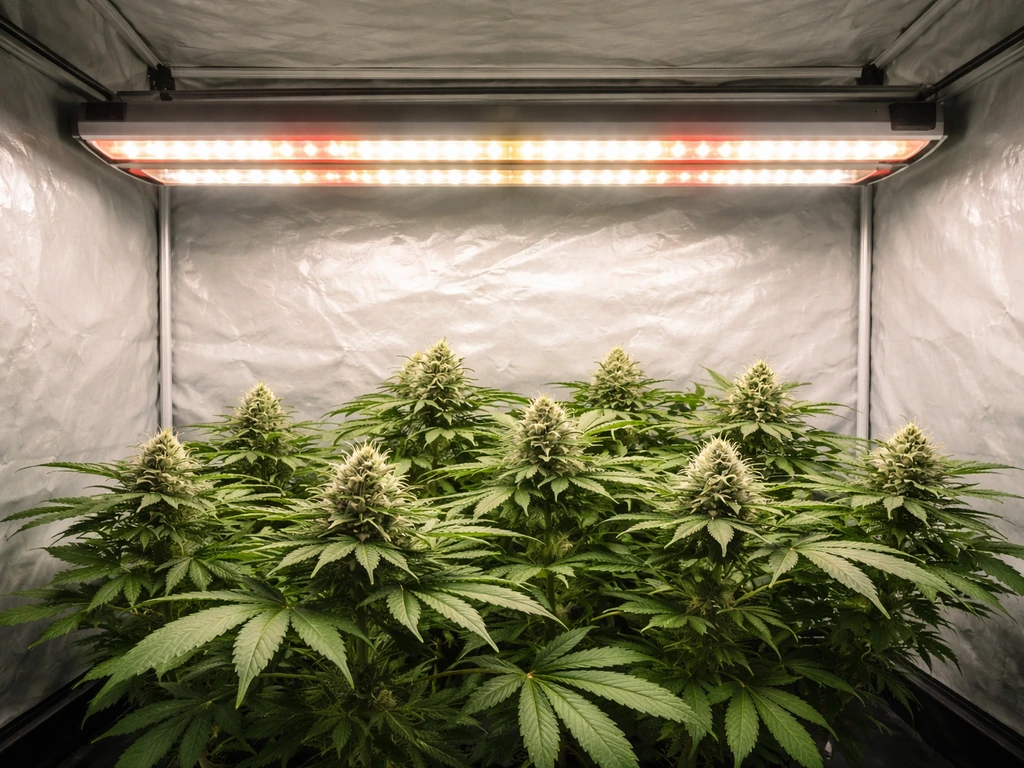
The best LED grow tent kit for your setup is the one matched to your actual tent footprint, your target PPFD, and whether you're running veg-only or a full flower cycle, not just the one with the biggest number on the box. If you're shopping in the UK specifically, you also need to think about plug compatibility, energy tariffs, and which brands actually ship reliably to British addresses. This guide cuts through all of it: specs that matter, size-matched recommendations, a UK buying angle, and a hands-on checklist so you can order with confidence today.
Best LED Grow Tent Kit UK Guide for Picking the Right Setup
Marcus Rutherford
9 Apr 2026
How to match a kit to your tent size
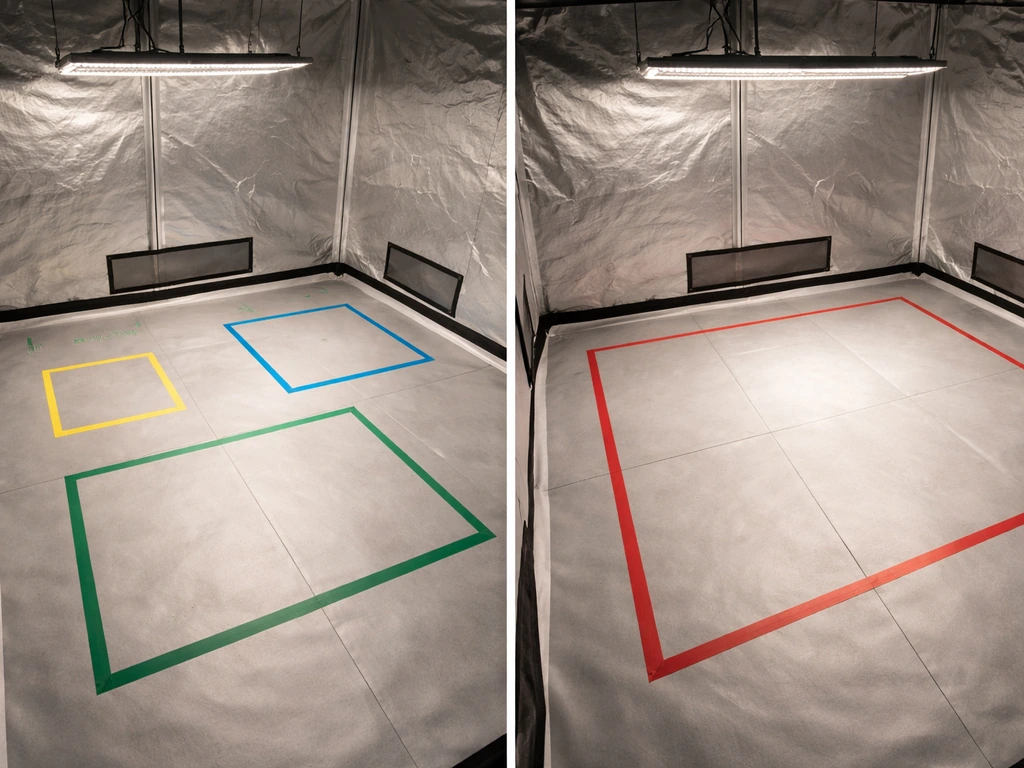
Start with your tent's floor dimensions, not the wattage on a light's label. A 60x60cm (2x2ft) tent, a 80x80cm, a 1.2x1.2m (4x4ft), and a 1.5x1.5m (5x5ft) all need radically different amounts of delivered light, and a fixture advertised as covering '4x4' by one brand might only really fill a 3x3 at flowering PPFD. The rule of thumb from Oklahoma State University Extension is roughly 25W of actual LED draw per square foot as a minimum baseline for productive growth, that's about 270W per square metre. Use that as a sanity check, not a ceiling.
Beyond raw wattage, coverage evenness matters enormously. If you're running multiple fixtures in one tent, plan for 10–20% overlap between their coverage zones to eliminate low-light corners and hotspots. A single bar-style or quantum board fixture centred over a small tent is usually cleaner than two offset panels with a dead band down the middle. For tents up to 1.2x1.2m, one well-chosen fixture is almost always the better call.
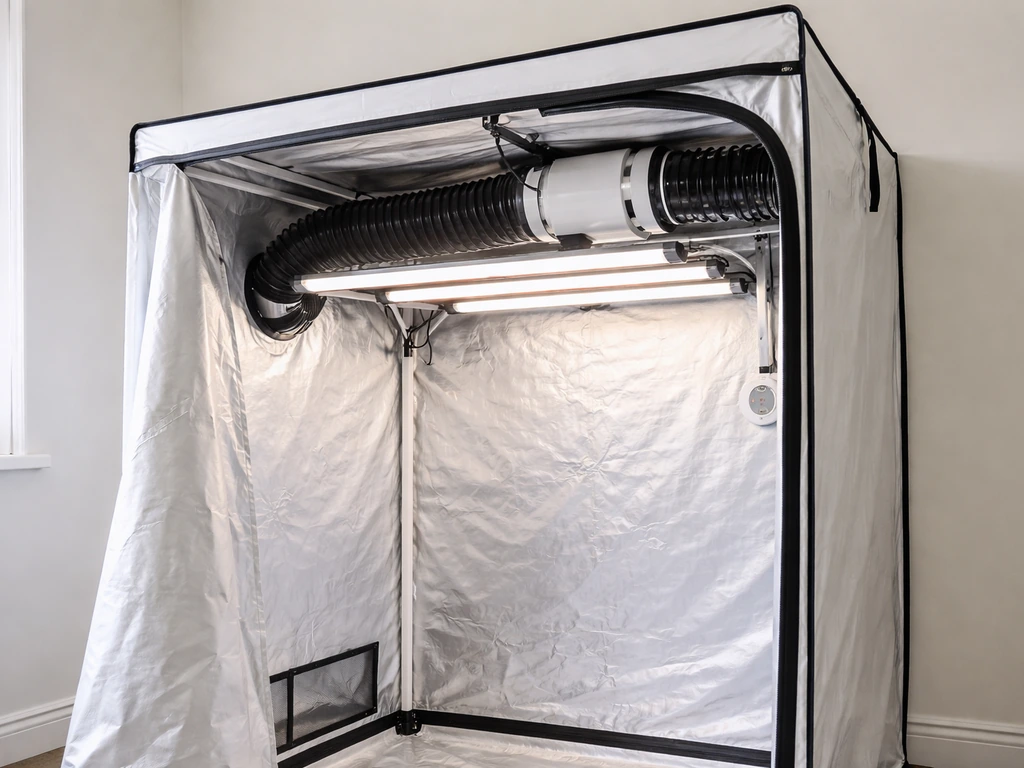
Tent kits bundle the light with the tent shell, extraction fan, carbon filter, ducting, and hangers. The value is real, buying those parts separately often costs 20–30% more, but the bundled light is frequently the weakest component. Always check whether you can swap or upgrade just the light. The best kit sellers let you mix and match; the worst lock you into a mediocre light at a 'bundle price.'
LED light specs that actually matter
Wattage: draw watts, not 'equivalent' watts
Ignore any figure described as 'HPS equivalent' or 'max output equivalent.' The only number that tells you what you're actually paying for on your electricity bill is the wall draw in watts. A fixture pulling 240W from the wall is a 240W light. Full stop. Many budget LEDs still advertise inflated wattage based on the theoretical maximum of their diodes, not what they actually consume. Check the product spec sheet or the energy label, if a UK seller can't provide that, move on.
PPFD and coverage maps
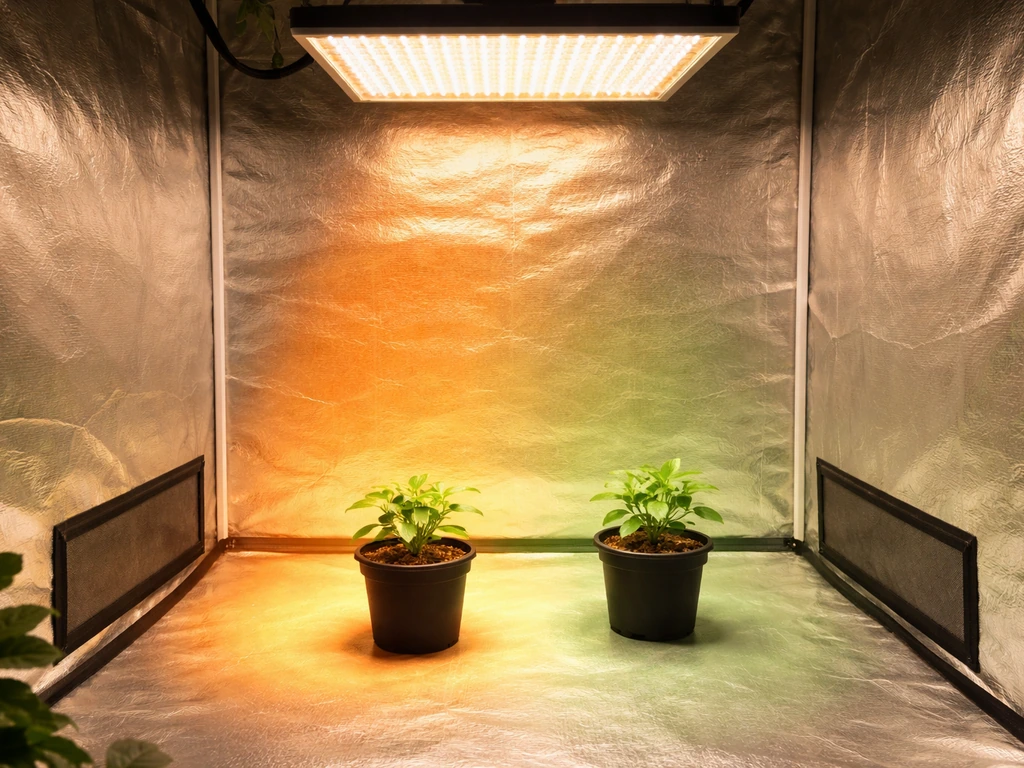
PPFD (photosynthetic photon flux density, measured in μmol/m²/s) is the number you care about most for yield. For vegetative growth, aim for 400–600 μmol/m²/s. For flowering, you want 600–900 μmol/m²/s, and pushing toward 1,000+ is achievable with CO2 supplementation. A reputable manufacturer will provide a coverage map showing PPFD at multiple hanging heights, usually 18 inches and 24 inches. If a brand only gives you a single peak number with no map, that peak is almost certainly taken at the centre of the beam at the closest possible hang distance, which tells you nothing about edge coverage.
Spectrum: full-cycle vs purpose-built
Most quality LED kits today ship with a full-spectrum white light (typically 3000K–4000K phosphor-converted diodes with added deep red 660nm peaks). This works well across the entire grow cycle without swapping lights. Purpose-built veg lights lean toward blue-heavy spectra (5000K–6500K) for compact growth, while bloom-tuned lights punch up the red (630–660nm) and sometimes far-red (720–740nm) to trigger flowering responses and dense bud development. Unless you're running a dedicated mother/clone room, a quality full-spectrum quantum board is the practical choice for a tent kit, you get one light, one set of hangers, and one dimmer for the whole grow.
Dimming, control, and driver quality
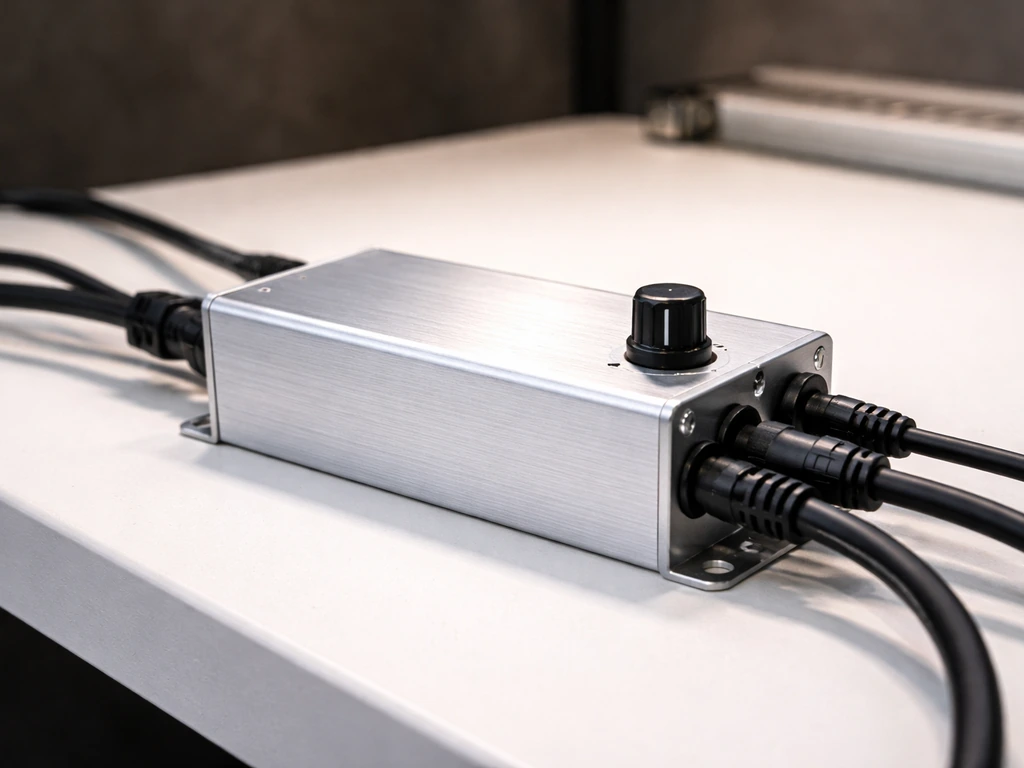
A dimmable driver (look for Mean Well HLG or ELG series, or comparable quality-tier drivers from Inventronics or TDK-Lambda) is non-negotiable in a decent kit. Dimming lets you run lower intensity during seedling and early veg stages without stressing young plants, then ramp up to full power in late flower. Some premium kits add app-based scheduling and sunrise/sunset dimming curves, which are nice but not essential. What is essential: the driver runs cool, it's rated for continuous duty, and it's properly certified (CE marking for UK use).
Best kits by grow scenario
Rather than listing product names that change with stock levels, here's how to evaluate a kit for each common tent footprint. Pair these benchmarks with current availability from UK stockists.
| Tent Size | Target Draw Watts | Target Flower PPFD | Ideal Kit Type | Budget Range (UK £) |
|---|---|---|---|---|
| 60x60cm (2x2ft) | 100–150W | 600–800 μmol/m²/s | Single quantum board, full-spectrum | £150–£280 complete kit |
| 80x80cm | 150–200W | 600–900 μmol/m²/s | Single QB or bar, dimmable | £200–£350 complete kit |
| 1.0x1.0m | 200–250W | 700–900 μmol/m²/s | Single large QB or 2-bar LED | £250–£420 complete kit |
| 1.2x1.2m (4x4ft) | 300–400W | 800–1000 μmol/m²/s | Single 300–400W bar or dual QB | £350–£600 complete kit |
| 1.5x1.5m (5x5ft) | 500–600W | 800–1000 μmol/m²/s | Full-power bar array or 2x QB | £550–£900 complete kit |
Small tents (60x60cm to 80x80cm): budget-conscious but capable
This is where hobbyist kits shine, and where the most budget noise exists. For a 60x60cm tent, a 100–120W quantum board running Samsung LM301B or LM301H diodes will hit your PPFD targets easily. A good LED for a small grow tent doesn't need to be expensive; it needs to be efficient (look for 2.5–2.8 μmol/J efficacy) and dimmable. Complete kits at this size from brands like Mars Hydro, AC Infinity, and Spider Farmer regularly come in at £150–£280 including tent, fan, and filter.
Mid-size tents (1.2x1.2m): the most popular footprint
The 1.2x1.2m (4x4ft equivalent) is the most common serious hobbyist tent size in the UK, and it's where kit quality really diverges. You need a genuine 300–400W draw fixture. Bar-style LEDs (like the Gavita Pro 1700e LED or Spider Farmer SE series) distribute light more evenly across a square footprint than a single central quantum board at this size. Check that the included fan is rated for at least 200m³/h extraction, undersized fans in 4x4-sized kits are the most common complaint you'll see in UK growing forums.
Larger footprints (1.5x1.5m and beyond)
At 1.5x1.5m and above, you're looking at a dedicated 5x5 LED grow light setup, and single-fixture kits start to compromise coverage evenness. Two matched 250–300W bars spaced correctly will outperform one 600W centre-mounted fixture at the canopy edges. At this scale you're also moving into semi-commercial territory, think carefully about your electricity contract, heat management, and whether your circuit can handle the continuous load. For anything bigger than a 5x5, look at dedicated LED lights for a 10x10 grow tent and purpose-built commercial kits rather than standard hobby bundles.
UK-specific buying: brands, availability, and energy costs
UK growers have a few structural advantages and a few headaches compared to US buyers. The advantages: VAT is included in listed prices (no surprise at checkout), CE certification is enforced, and there are several solid UK-based distributors (Ecotechnics, Cultiv8, Plant Magic, and the UK arms of Mars Hydro and Spider Farmer all ship fast). The headaches: some US-market kits ship with NEMA plugs, not UK BS 1363 plugs, and the power supplies may be rated for 110V only, always confirm the driver is 100–240V universal input before ordering.
UK electricity is currently averaging around 24–25p per kWh on a standard tariff (as of early 2026, post-price-cap adjustments). For GB-average Energy Price Cap unit rates and standing charges by period, Ofgem publishes the official figures by quarter Ofgem publishes the official GB-average unit rate and standing charge for the Energy Price Cap by period. A 300W LED running 18 hours/day in veg costs roughly £1.30/day or about £39/month. In 12/12 flower at the same wattage, that drops to about £0.87/day or £26/month. Running a complete tent kit with fan and carbon filter adds another 40–80W continuously, so budget an extra £0.35–0.70/day on top. Those numbers are meaningful over a 10–12 week grow cycle, and they're one good reason to pay more upfront for a high-efficacy LED (2.7+ μmol/J) rather than a cheap 2.0 μmol/J fixture.
For UK price benchmarks: a complete entry-level 60x60cm kit (tent, 100W LED, 4-inch fan, filter) runs £130–£180. A mid-range 1.2x1.2m kit with a quality 300W bar LED, 6-inch fan, and decent carbon filter runs £380–£550. Premium kits with app-controlled LEDs, EC fans, and dual-layer filters push £600–£900 for the same footprint. Don't assume the premium bundle's light is always worth the jump, sometimes you're paying for the fan and controller, not the photons.
Setup, installation, and safe operation
Hanging height and first light adjustment
Most quantum boards and bar LEDs should start at 24–30 inches above the canopy at seedling stage, stepping down to 18–24 inches in veg and 12–18 inches in peak flower, but check your specific fixture's PPFD map first, because a high-output 600W bar at 12 inches will bleach a canopy that a 200W board handles fine at the same distance. Start high, dim down, then gradually lower and increase intensity over the first two weeks. Your plants will tell you if you've gone too fast: upward-cupping leaves and bleached tips mean too much, excessive stretching means too little.
Airflow and cooling
LEDs run far cooler than HPS, but they're not zero-heat. A 300W LED in a sealed 1.2x1.2m tent will still raise ambient temperature 4–6°C above room temperature. Your extraction fan needs to cycle the tent's air volume at least once per minute, for a 1.2x1.2x2.0m tent (roughly 2.9m³), that means a fan rated for at least 175m³/h, but realistically go to 200–250m³/h to account for filter restriction. Run a small oscillating clip fan inside the tent for stem strengthening and to prevent humid dead zones under the canopy. LED drivers mounted outside the tent (many modern fixtures support this) can shave another 1–2°C off internal temps.
Electrical safety in a UK home
UK standard household circuits are 13A fused, which means a single ring main socket can safely handle about 3,000W. A 300W LED, 60W fan, and 60W of other equipment is well within that, but if you're running a larger tent with 600W+ of LEDs plus fans, humidifiers, and timers, put the total load on a dedicated circuit installed by a qualified electrician. Use RCD-protected sockets (or a plug-in RCD adapter, available at most UK DIY retailers for under £15) whenever you're combining electricity and water in any grow space. Never run extension leads under rugs or through doors, and use quality-rated IEC or Schuko to UK converter cables rather than cheap unbranded adapters.
Real-world performance and where kits commonly fail
Hotspots and uneven coverage
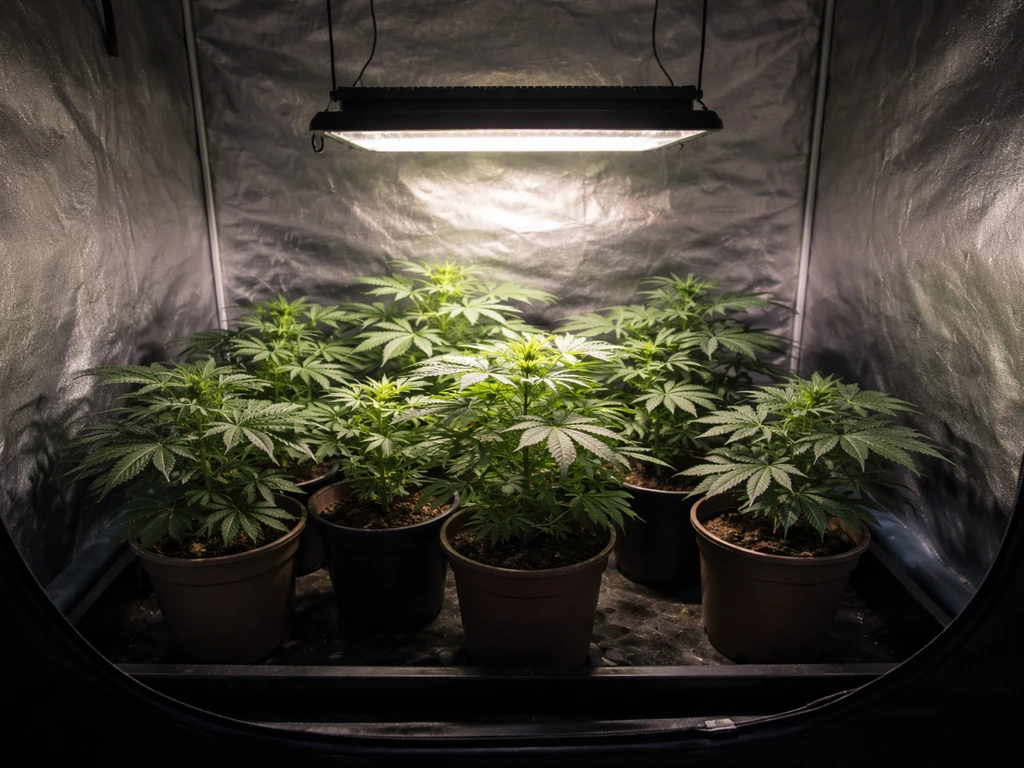
The single most common performance complaint with tent kits is hot centres and dim corners. It's almost always caused by hanging the light too low, using a fixture with too narrow a beam angle, or choosing a kit whose stated coverage area is measured at a threshold PPFD that's way below what you need for flowering. Fix it by raising the fixture, checking the coverage map at your actual target PPFD (not at whatever minimum value makes the coverage look biggest on the spec sheet), and using reflective mylar or white-coated tent walls to bounce edge light back toward the canopy.
Under-lighting and plant stretch
Stretch in the first two weeks of flower is normal, expect plants to double in height during the stretch phase. Excessive stretch throughout flower, weak secondary branches, and airy buds are signs of under-lighting, usually because the advertised wattage was way over the actual wall draw, or because the fixture simply wasn't rated for the footprint you're using it in. If you're seeing these symptoms, raise your intensity (dim up gradually over several days) before moving the light closer, rapid proximity changes shock plants more than a slower intensity increase.
Driver and diode failure patterns
Budget LED kits most often fail at the driver, not the diodes themselves. Cheap drivers run hot, have poor power factor correction, and often fail within 12–18 months of daily use. Quality drivers (Mean Well HLG series being the industry benchmark) carry 5-year warranties and routinely outlast the fixtures they're paired with. If you buy a budget kit, check whether the driver is user-replaceable, it often is, and a £30–£50 Mean Well driver swap can resurrect a dead fixture. Diode failure is usually localised (you'll see a dark spot or section), is covered under warranty by reputable brands, and rarely kills the whole fixture.
Your buying checklist and how to compare kits

Before you commit to any LED grow tent kit, run through this checklist. It takes five minutes and will save you from the most common buying mistakes.
- Confirm the fixture's actual wall draw in watts (not 'equivalent' or 'max diode' wattage).
- Check the PPFD coverage map at your tent's footprint size and your target hanging height — not just the peak centre number.
- Verify the driver brand and whether it's user-replaceable; look for CE certification and a minimum 3-year warranty.
- Confirm the spectrum: full-cycle white LED for one-light grows, or separate veg/bloom outputs if you're running dedicated rooms.
- Check that the included fan matches your tent volume (tent m³ × 60 = minimum m³/h fan rating, then add 30% for filter restriction).
- Confirm UK plug compatibility (BS 1363) and that the driver accepts 220–240V input.
- Calculate your running cost: draw watts × hours per day × £0.245 per kWh = daily cost; multiply by your grow cycle length.
- Look for an upgrade path — can you replace just the light, add a second bar, or upgrade the fan without replacing the whole kit?
- Check UK stockist reviews specifically for shipping speed and returns handling, not just the product itself.
- For tents 1.2x1.2m and above, verify that the tent's roof bar rating can handle the light's hanging weight (quality LEDs can be 5–12kg).
When comparing two kits at similar price points, the tiebreakers in order are: efficacy (μmol/J, higher is better), driver quality and warranty length, coverage map evenness, and then brand reputation for UK after-sales support. Don't let bundled extras like smart timers or pH pens swing you toward a kit with a worse light, you can buy a timer for £10, but you can't easily fix a low-efficacy LED that's already bolted to your tent's crossbar.
The bottom line: a good LED grow tent kit in the UK means a dimmable, full-spectrum light pulling genuine watts at 2.5+ μmol/J efficacy, paired with an appropriately sized extraction system, in a reflective tent that matches your plant count and canopy footprint. Spend the majority of your budget on the light and the fan, the tent shell itself is rarely where a kit fails.
FAQ
If a kit’s coverage spec says it fits 4x4, how do I verify it will actually reach my flowering PPFD at the edges?
Ask for a PPFD coverage map that includes at least two hanging heights and shows a contour, not just a single peak number. Then compare your target flowering PPFD, for example 700–900 μmol/m²/s, against the lowest contour on the map. If the brand only states “covers X by Y” without a map at your intended height, assume the real usable area is smaller, especially near corners.
Should I run my LED at full power all the time to keep things simple?
Usually not. Start at lower intensity for the first 7–14 days after transplant, then ramp gradually. Full power immediately increases stress risk, and you also lose efficiency because plants do not convert higher intensity into proportionally higher yield indefinitely. If your driver is dimmable, use steady, incremental increases rather than frequent on off changes.
What extraction fan rating should I use if I have a carbon filter and duct bends?
Do not size the fan by “tent volume equals X m³/h” alone, because filters and ducting add static pressure. Use the filter’s and duct’s diameter compatibility, then add a realistic margin, roughly 10–30% over the minimum fan you calculated. If possible, confirm the kit’s fan curve at the expected duct length so you do not end up with weak negative pressure.
Are universal drivers really universal in the UK, and what should I check before ordering?
Check the input range printed on the driver, not just the listing headline. Look for explicit “100–240V, 50/60Hz” (or equivalent) and a model number you can match to the manufacturer spec sheet. If the kit is advertised for 110V systems or lacks a clear input range, treat it as a wiring and reliability risk.
How can I confirm the kit is safe for UK electrics if it uses a UK plug?
Verify the plug type is BS 1363 and that the driver and fan are CE marked. Then check whether the power brick or driver is intended for UK indoor use and has thermal protection. If you are in a grow space with humidity, prefer kits where the electrical components mount outside the tent where possible, and avoid unbranded extension leads.
What’s the best approach to avoid hot centers and dim corners besides “raise the light”?
First, confirm the beam angle and whether the fixture is meant for square coverage or narrow coverage. Next, check whether you are using the recommended hanging height range from the PPFD map, not a generic distance. If you still see a center peak, use two fixtures with overlap (about 10–20%) or rotate the fixture plan so hotspots fall between plant positions, not directly under key canopy areas.
Do I need to upgrade only the light if the rest of the kit is cheaper?
Often yes. Tent, ducting, and basic extraction can be adequate, but the light and driver usually determine performance and longevity. Before upgrading, check if the light is hard-mounted to the tent structure in a way that prevents swapping, and confirm the kit has a compatible hanging system and wiring length. If the kit locks you into a specific light model, it can be cheaper to replace the entire fixture assembly.
How do I decide between a single quantum board setup and multiple bars in a bigger tent?
In small tents, one correctly-sized fixture usually gives better evenness. In 1.5x1.5m and larger footprints, multiple bars spaced to cover overlap generally reduces edge drop-off. If you only have a single center-mounted unit, prioritize a fixture with a verified square coverage map for your target PPFD and confirm it does not assume a low threshold at the perimeter.
What should I do if my plants are stretching in early flower, but the tent is already at maximum intensity?
Re-check whether the “maximum intensity” you can set corresponds to the driver’s real dimming range, and verify you are using the correct hanging height. If the light is already very close, you may need a higher wattage or a broader fixture rather than just lowering the distance. Also confirm light schedule timing is consistent, because short or interrupted photoperiods can compound stretch.
How do I estimate the true electricity cost for LED tent kits on UK tariffs?
Use wall draw, not advertised LED power. If a kit is labeled 300W draw, multiply by hours per day and then by your pence per kWh, converting units carefully (for example, 0.24–0.25 per kWh). Remember to add the extraction and controller load, and include the carbon filter and fan running during the entire photoperiod for the best planning accuracy.
If my kit’s driver fails, can I replace it without replacing the whole fixture?
Only some kits are designed for user-serviceable drivers. Check whether the fixture uses an external driver box, a detachable driver connection, and whether the replacement driver voltage and current match the LED board requirements. If you see a non-standard driver model number or sealed electronics, plan on returning the kit or buying the exact driver through the brand or distributor.
Do reflective tent walls always improve light at the edges?
They help, but placement matters. Ensure the reflective surface is intact and not covered by dust, torn seams, or excessive condensation residue. Also consider airflow, because very reflective foil can increase humidity in corners if extraction is weak. If you already have good PPFD from the map but see localized dim spots, that can be a fixture placement or beam angle issue rather than reflection.
Next Articles
Best LED for Small Grow Tent: How to Choose Right Light
Pick the best LED for a small grow tent by matching coverage, spectrum, wattage, and hanging height to your crop and PPF
Best 5x5 LED Grow Light: Buying Guide and Top Picks
Find the best 5x5 LED grow light with specs on PPFD coverage, spectrum, wattage, dimming, efficiency, and setup tips.
Best Full Spectrum 1000W LED Grow Lights: Buyer Guide
Buy the best full spectrum 1000W LED grow light with spec-to-decision tips on PPFD, coverage, wattage, and tent fit.