The best E27 LED grow light for your setup depends on three things: how much canopy you're covering, what growth stage you're targeting, and whether you're running one bulb or a bank of them. E27 grow bulbs are genuinely useful for small spaces, seedling trays, low-budget builds, and supplemental lighting, but they're frequently oversold. This guide cuts through the marketing noise and gives you a real framework for choosing, sizing, and installing E27 grow lights that actually deliver.
Best E27 LED Grow Light: Buying Guide for Real Canopy Coverage
Marcus Rutherford
10 Apr 2026
What an E27 LED grow light actually is
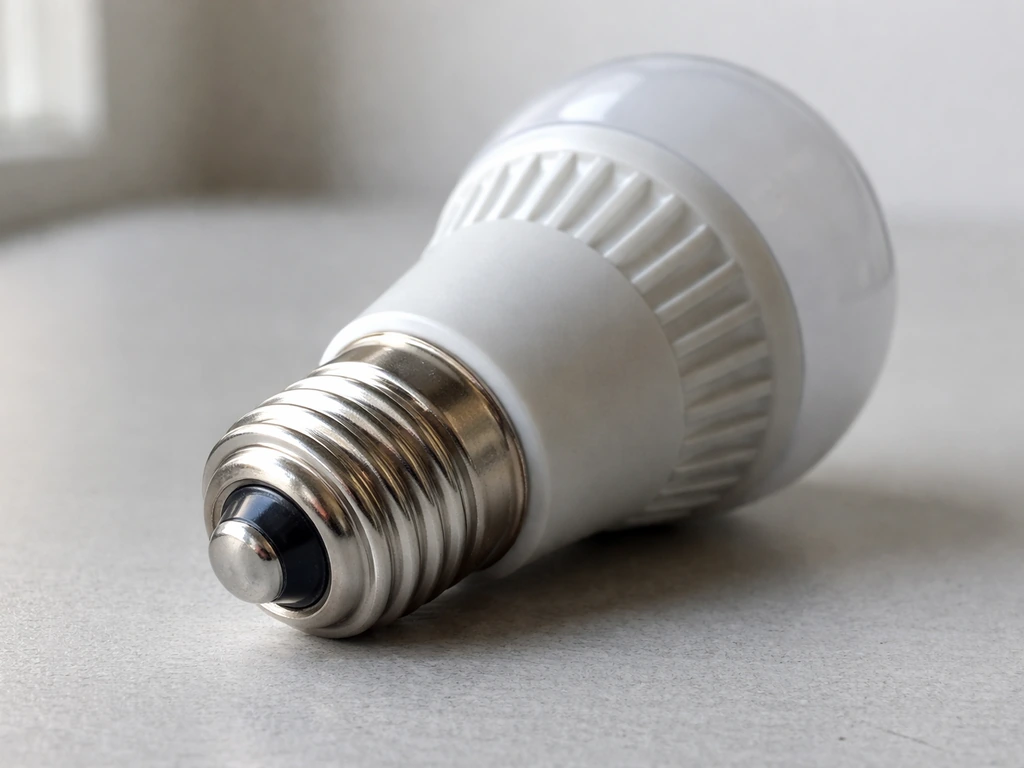
E27 refers to the screw-base format of the bulb, not anything special about its grow performance. The "E" stands for Edison screw, and the number 27 refers to the 27mm diameter of the threaded base. It's the standard large Edison screw fitting used across many common household and commercial fixtures. The competing formats you'll see in grow light listings are GU10 (a twist-and-lock bi-pin base, common in directional spotlights) and B22 (the bayonet/pin style common in the UK), and neither is interchangeable with an E27 socket. If your fixture or lamp holder has a screw socket in that size, you're in E27 territory.
Some E27 grow bulbs come in a standard A-shape, but a growing number are now sold in reflector formats like PAR30, with listed beam angles around 130 degrees that shape how the light spreads across your canopy. That distinction matters for coverage calculations. A wide-angle reflector bulb distributes light more evenly across a horizontal surface; a narrow one concentrates output, which gives you better PPFD directly underneath but falls off fast toward the edges. For most small grow setups, wide-angle E27 grow bulbs are the more practical choice.
Where does this format fit in the wider grow light market? It's not a replacement for a dedicated quantum board or COB panel if you're running a 4x4 tent at full flower. But E27 grow bulbs are well-suited for propagation stations, herb shelves, cabinet grows under 2 square feet per bulb, seedling racks, and as spectrum supplementation alongside a main fixture. If you want to explore the broader screw-in format category, the best screw in led grow light options cover a wider range of base types and wattages beyond just E27.
How to judge "best" for your grow
Spectrum, intensity, and coverage are the three pillars. Get all three right for your specific stage and space, and the bulb will perform. Miss any one, and no amount of wattage will save your grow.
Spectrum: full-spectrum vs. red/blue-focused
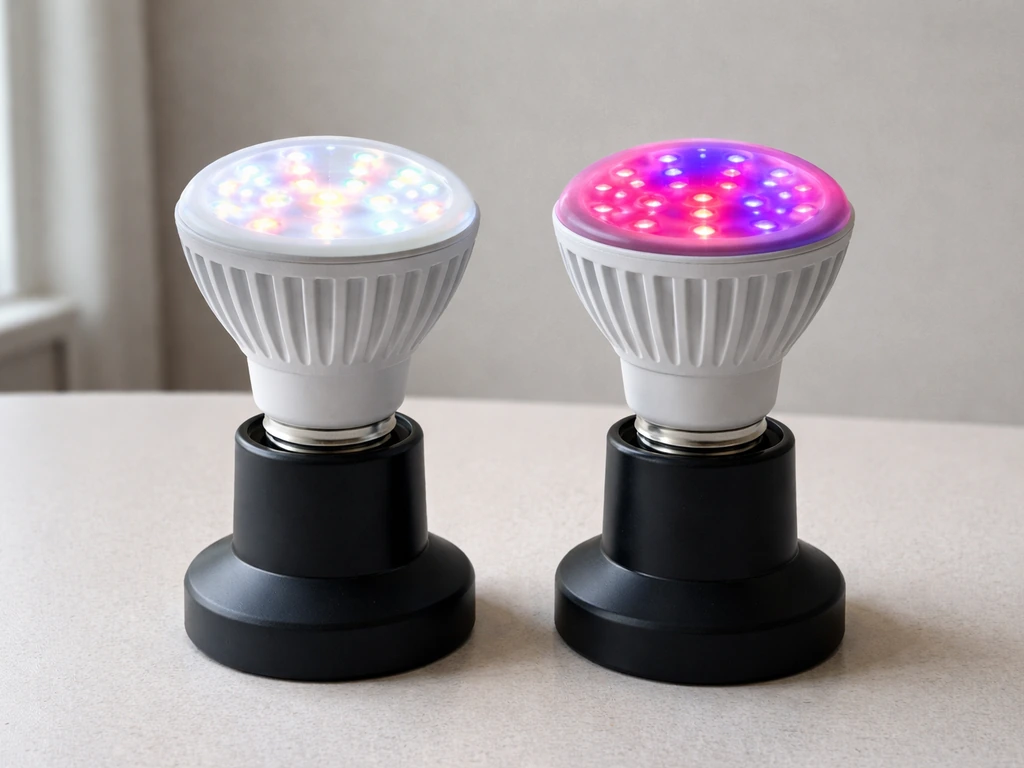
The core wavelength bands you need to understand are: blue around 400 to 500 nm (peak around 450 nm), red around 600 to 700 nm (peak around 660 nm), and far-red at approximately 730 nm. The 660 nm red band has strong photosynthetic action and drives vegetative growth and photosynthesis efficiently. The 730 nm far-red band works on a different level: it influences phytochrome conversion, specifically converting the active Pfr form back to Pr, which is the mechanism that signals flowering in photoperiod-sensitive plants. If you're growing fruiting or flowering crops, a bulb that includes 730 nm far-red isn't a nice-to-have; it's a meaningful tool for initiating bloom.
Full-spectrum E27 grow bulbs include a continuous white-light output that mimics natural sunlight more closely, incorporating green and yellow wavelengths that pure red/blue (blurple) bulbs skip. For seedlings and veg, either can work. For bloom, full-spectrum with added far-red is the better pick. Pure red/blue bulbs can look impressive in terms of par output per watt at low cost, but they often lack the far-red that triggers flowering in sensitive strains. Don't let a purple glow convince you you're getting what your plants actually need.
Intensity and coverage: what "coverage area" claims really mean
Most E27 grow bulb listings overstate coverage area. A single 12W to 15W E27 bulb realistically delivers useful PPFD (above 200 µmol/m²/s) over roughly 0.25 to 0.5 square feet of canopy when hung at an appropriate distance. Coverage claims of 1 to 2 square feet per bulb require you to accept much lower light intensity at the edges, which may be fine for low-light herbs but won't sustain fruiting plants through bloom. For any serious grow, plan on one 15W to 20W bulb per 0.25 to 0.5 square feet of productive canopy, not the inflated numbers on the box.
PPFD and efficiency: reading real performance vs. marketing claims
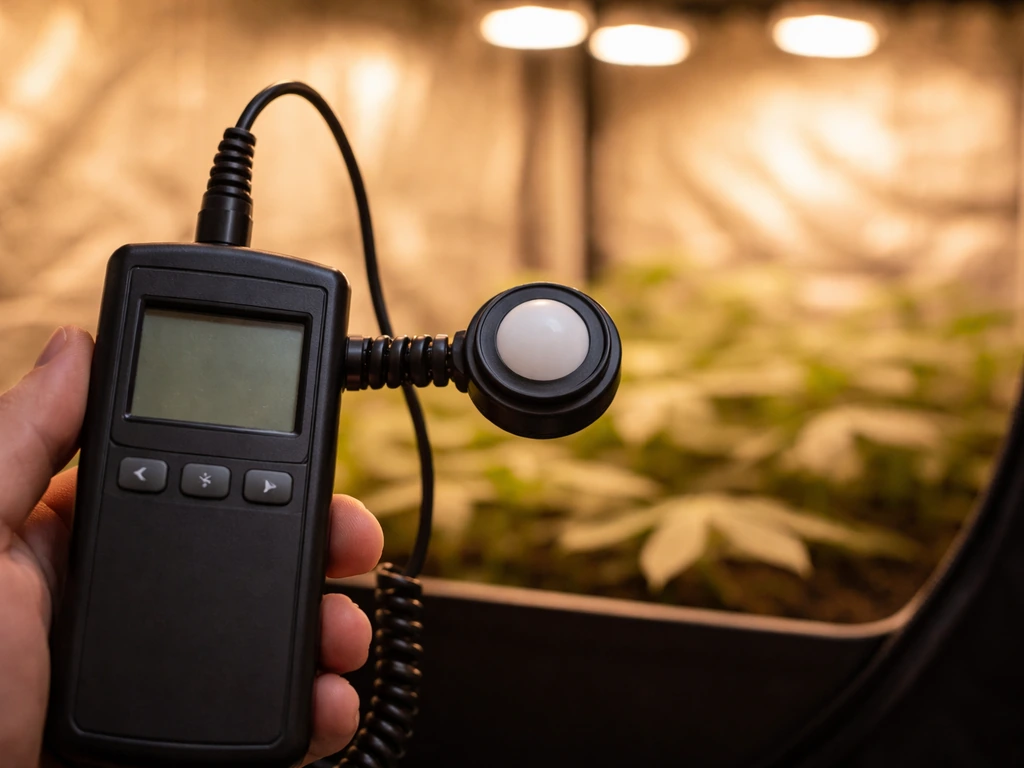
PPFD (photosynthetic photon flux density) is measured in µmol/m²/s and tells you how many photons are hitting a square meter of canopy every second in the 400 to 700 nm range. It's the number that actually predicts whether your plants will grow, and it's the number most E27 grow bulb manufacturers either don't publish or bury in fine print. PPF (photosynthetic photon flux) is the total photon output of the fixture regardless of area, and it's measured in µmol/s. Efficacy is PPF divided by watts consumed, expressed as µmol/J, and it tells you how efficiently the bulb converts electricity into usable plant light.
Serious testing and reporting for horticultural lighting follows methodologies aligned with ANSI/IES LM-79 standards, covering metrics like blank" rel="noopener noreferrer">PPF, spectral quantum distribution (SQD), and photosynthetic photon intensity distribution (PPID). DLC specifies SQD and PPID reporting elements as part of its horticultural LED evaluation and testing documentation requirements SQD, and photosynthetic photon intensity distribution (PPID). These are the numbers that engineering and design tools use, not the "equivalent to 200W" marketing label. When you see a bulb claim a watt-equivalent or a vague "high PAR output" statement without publishing actual PPF in µmol/s and efficacy in µmol/J, treat it with skepticism. Any reputable manufacturer can provide these numbers; if they don't, ask why.
A practical way to cross-check performance claims is through DLI (daily light integral), which is the total photon dose your plants receive over a full day. The formula is: DLI (mol·m⁻²·d⁻¹) = 0.0036 × PPFD (µmol·m²/s) × light-hours per day. So if a bulb delivers a real 150 µmol/m²/s at canopy level and you run it 16 hours for seedlings, your DLI is 0.0036 × 150 × 16 = 8.64 mol/m²/d. Seedlings and propagation typically need DLI in the 6 to 12 range; leafy greens want 12 to 17; tomatoes and cannabis in flower want 30 to 40+. An E27 bulb array that can't hit those numbers for your stage will limit your results no matter how good the spectrum looks.
| Growth Stage | Target PPFD (µmol/m²/s) | Target DLI (mol/m²/d) | Photoperiod |
|---|---|---|---|
| Seedlings / Cuttings | 100–200 | 6–12 | 18 hrs |
| Vegetative | 200–400 | 14–22 | 18 hrs |
| Flowering / Fruiting | 400–700+ | 25–40+ | 12 hrs |
| Low-light herbs / Greens | 100–250 | 10–17 | 14–16 hrs |
Use this table to back-calculate what you need from your E27 setup. If you're growing leafy greens and want a DLI of 15 over a 14-hour day, you need: 15 ÷ (0.0036 × 14) = roughly 298 µmol/m²/s at canopy level, continuously. A single 15W E27 bulb won't do that over more than a few square inches. Multiple bulbs or a tighter spacing arrangement will.
Wattage and bulb count: sizing your E27 array
There's no magic watt-per-square-foot rule that works across all E27 grow bulbs, because efficacy varies too much between products. A well-designed 15W E27 bulb with an efficacy of 2.0 µmol/J is objectively better than a cheap 25W bulb at 1.0 µmol/J, even though the cheap one pulls more watts. That said, a working rule of thumb for planning is to target 30 to 50 actual watts of quality E27 grow lighting per square foot of canopy for flowering crops, and 15 to 25 watts per square foot for vegetative or low-light plants. These numbers assume decent efficacy (above 1.5 µmol/J); if you're buying budget bulbs, bump the wattage up.
Here's how to size a real setup. A 2x2 tent (4 square feet) in flower needs roughly 120 to 200 true watts of quality E27 output. At 15W per bulb, that's 8 to 13 bulbs, which quickly becomes unwieldy and heat-heavy. At 25W per bulb with decent efficacy, you're looking at 5 to 8 bulbs. This is exactly why E27 arrays have a practical ceiling: the fixture management, heat, and wiring complexity scale faster than performance does. For anything larger than a 2x2 in flower, a dedicated panel like a quantum board or a COB LED grow light will outperform an equivalent wattage of E27 bulbs in terms of uniformity, efficacy, and heat distribution.
| Space Size | Growth Stage | Recommended True Watts (E27) | Estimated Bulb Count (15W bulbs) | Estimated Bulb Count (25W bulbs) |
|---|---|---|---|---|
| 1x1 ft (0.1 m²) | Seedlings / Veg | 15–25W | 1–2 | 1 |
| 2x1 ft (0.2 m²) | Veg / Herbs | 30–50W | 2–4 | 1–2 |
| 2x2 ft (0.4 m²) | Veg | 60–100W | 4–7 | 3–4 |
| 2x2 ft (0.4 m²) | Flower | 120–200W | 8–13 | 5–8 |
| 2x4 ft (0.8 m²) | Veg | 120–200W | 8–13 | 5–8 |
| 2x4 ft (0.8 m²) | Flower | 240–400W | 16–27 | 10–16 |
The table above makes the scaling problem clear. Once you move past a 2x2 for flowering, E27 arrays become impractical. For 3x3, 4x4, or 5x5 flowering tents, dedicated fixtures win on every metric. E27 setups shine in compact, purpose-built cabinets, shelving units with individual socket strips, and propagation stations where you can position each bulb independently.
Best-use scenarios and setup recommendations
Seedlings and propagation
This is the sweet spot for E27 grow bulbs. Seedlings need low to moderate PPFD (100 to 200 µmol/m²/s) and respond well to blue-heavy or full-spectrum light. A single 12W to 15W full-spectrum E27 bulb mounted 6 to 12 inches above a seedling tray can cover 6 to 12 plants comfortably. Run it 18 hours a day and you'll hit a DLI in the 6 to 10 range, which is ideal. Heat at this distance is manageable, and you don't need dimming. This is where a $10 to $15 E27 grow bulb in a standard lamp holder can genuinely compete with more expensive purpose-built seedling fixtures.
Vegetative growth
Veg requires more intensity than seedlings but remains achievable with E27 arrays. Target 200 to 400 µmol/m²/s at canopy, and run an 18-hour photoperiod. Full-spectrum or blue-dominant bulbs work well here. Mount bulbs 10 to 18 inches above the canopy and use multiple sockets to build out coverage. If your setup allows for adjustable-height lamp holders, this flexibility is more valuable than any single bulb spec because it lets you tune actual PPFD as the plants grow rather than compensating with watts alone.
Flowering and fruiting
For bloom, you need higher PPFD (400 µmol/m²/s minimum, 600 to 700+ for demanding crops), and you need that 730 nm far-red content to trigger and sustain flowering. Choose full-spectrum E27 bulbs that explicitly list far-red LEDs or a 730 nm channel. Mounting distance will drop to 6 to 12 inches to maximize intensity, which means heat management becomes critical. At this stage, an E27 array in a 2x2 cabinet can work, but you'll need ventilation and ideally active cooling on the socket cluster. For anything bigger, accept that E27 is the wrong tool for this job.
Herbs, greens, and low-light crops
Herbs like basil, mint, and parsley, plus leafy greens like lettuce, are perfectly matched to E27 grow arrays. They need relatively modest PPFD (100 to 250 µmol/m²/s), tolerate wide-spectrum light, and grow in the kind of compact shelving setups where E27 sockets are a natural fit. A single 15W to 20W full-spectrum E27 bulb over a small herb planter on a kitchen shelf, run 14 to 16 hours a day, will produce real results without any complicated fixture work.
Fit, installation, heat, and safety
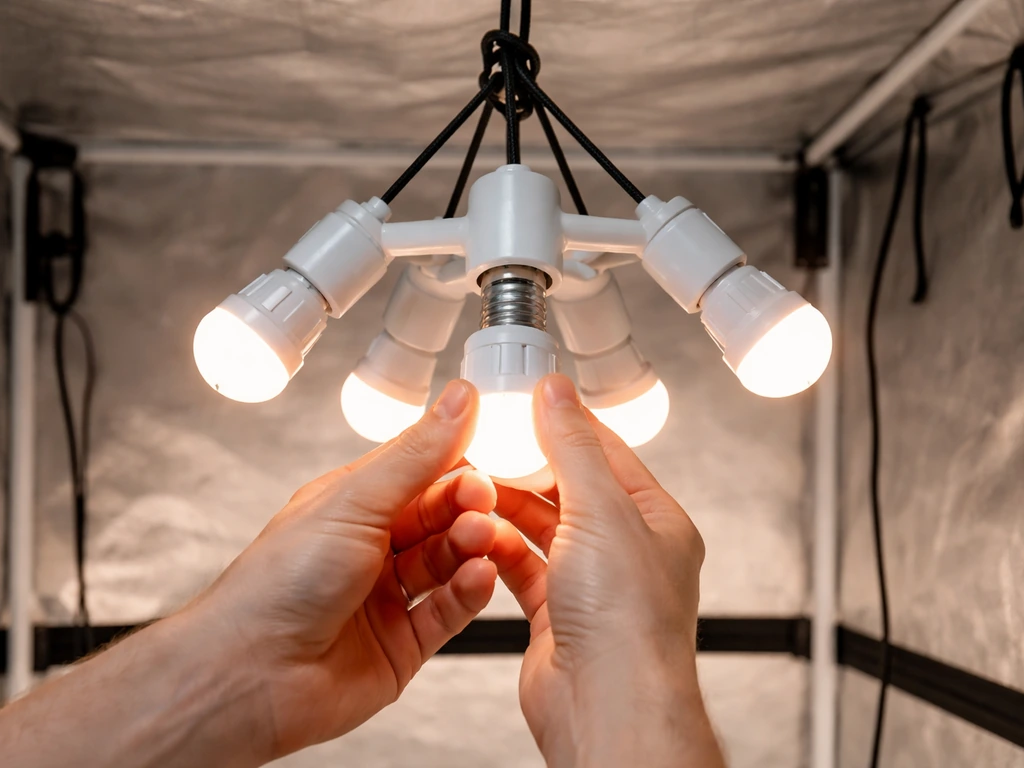
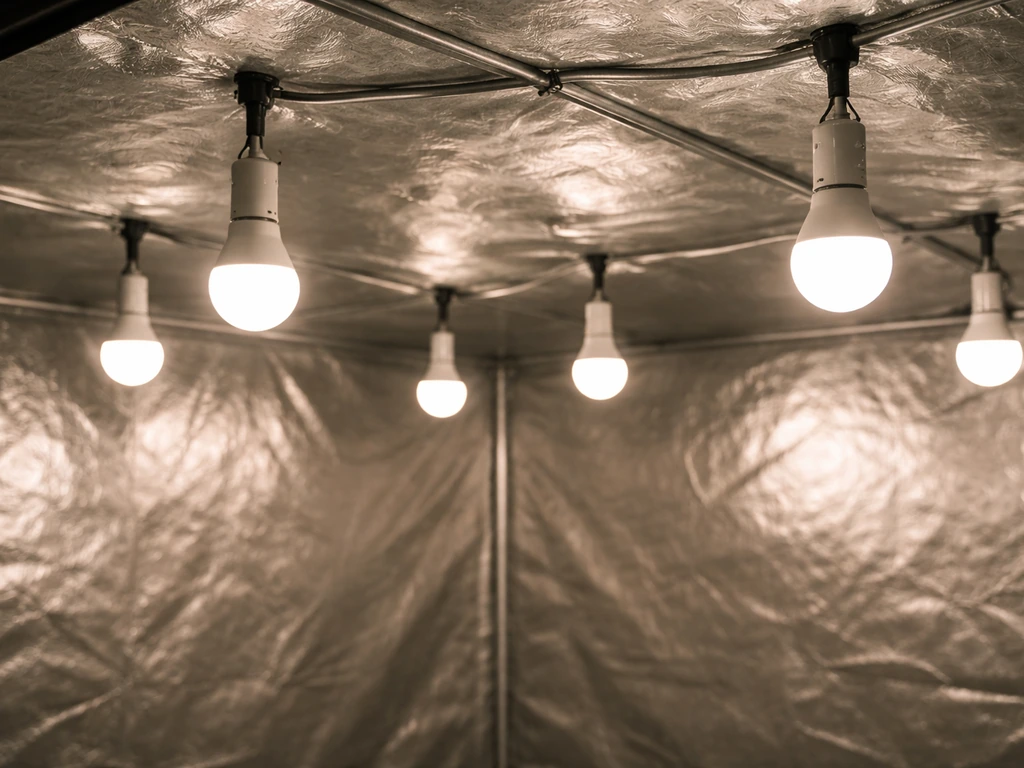
E27 grow bulbs screw directly into any E27-compatible socket or lamp holder. For multi-bulb setups, you'll commonly use E27 socket strips, spider-style multi-socket adapters, or individual pendant sockets on an adjustable cord. Reflector-style E27 grow bulbs (PAR30 format, for example) with wide beam angles around 130 degrees work best in open-top grows or tent setups where you want broad horizontal spread. Narrower-angle bulbs are better for vertical cabinets where you want light to punch down through canopy layers.
Heat is the main practical limitation of E27 grow bulbs. Individual bulbs are fine, but dense arrays generate substantial cumulative heat in a confined space. In a closed cabinet with 6 or more bulbs, you will need active ventilation: at minimum a small inline fan exhausting warm air. Without it, canopy temperatures climb fast, driver efficiency drops, and bulb lifespan shortens noticeably. LED drivers embedded in E27 bulbs are typically rated for 25,000 to 50,000 hours, but that rating assumes operation within thermal spec. Running too hot can cut lifespan in half.
On safety: always use E27 sockets and fixtures rated for the actual power load of your bulb array. The relevant safety standard for horticultural lighting equipment in North America is UL 8800, which is the first standardized set of requirements designed specifically for grow lighting equipment and systems, and it's integrated with the DesignLights Consortium horticultural Qualified Products List framework. For general fixture electrical safety in North America, UL 1598 certification on your lamp holders and sockets indicates compliance with luminaire safety requirements for U.S. and Canadian installation. Look for these markings on socket strips and adapters, not just on the bulbs themselves. A cheap socket strip that isn't rated for continuous load can be a fire risk when running 8 to 12 bulbs at full power for 16 to 18 hours a day.
Photobiological safety is addressed under UL 8800 via requirements aligned with IEC 62471, which matters specifically for high-output grow lights that could pose eye safety risks from prolonged blue-light exposure. Most E27 grow bulbs at typical power levels (12W to 25W) are low risk, but if you're running dense arrays at close range, don't stare into them and consider the same common-sense precautions you'd use with any bright LED source.
Quick buying checklist and shortlists by grow type
Before buying any E27 grow bulb, run through this checklist:
- Does the manufacturer publish actual PPF in µmol/s and efficacy in µmol/J? If not, treat any performance claim as unverified.
- Does the spectrum include 660 nm red and 730 nm far-red if you're growing flowering plants? Confirm this in the spec sheet, not just the product name.
- What is the beam angle? For horizontal shelf coverage, 90° to 130° is practical. For vertical/cabinet grows, tighter angles may work better.
- Is the socket/fixture rated for the continuous load? Use UL 1598- or UL 8800-certified hardware.
- Have you calculated how many bulbs you need based on PPFD and DLI targets, not just on wattage?
- Have you accounted for heat and airflow in your setup?
Recommended shortlists by grow type
- Seedlings and propagation (1 to 2 trays): One or two 12W to 15W full-spectrum E27 bulbs (white LED, 4000K to 6500K color temperature), mounted 8 to 12 inches above the tray. No dimming required. This is the highest-value use case for E27 grow bulbs.
- Herb shelf or kitchen garden (2 to 4 plants per square foot): One 15W to 20W full-spectrum E27 bulb per 0.5 square feet of shelf space, in a standard pendant or shelf-mount E27 socket. Run 14 to 16 hours daily. Prioritize wide beam angle for even coverage.
- Small veg cabinet (up to 2x2 ft): Four to six 15W full-spectrum E27 bulbs on a socket strip, positioned 10 to 16 inches above canopy. Include a small exhaust fan. Choose bulbs with published PPF data.
- Small flowering cabinet (up to 2x2 ft): Six to eight 20W to 25W full-spectrum E27 bulbs with confirmed 660 nm and 730 nm output. Active ventilation is non-negotiable. Expect to upgrade to a dedicated panel for anything bigger.
- Supplemental lighting (alongside a main fixture): One to two E27 grow bulbs in the side walls or corners of a tent to improve edge PPFD and reduce dark spots. Full-spectrum or red-biased bulbs at 12W to 15W each work well here.
The honest bottom line: E27 LED grow bulbs are real grow tools, not just novelties, but they work best in tight, specific use cases. Buy based on published PPFD and efficacy data, size your array using actual DLI math, don't ignore heat and electrical safety, and know when the job has outgrown what screw-in bulbs can reasonably deliver.
FAQ
How can I tell if an E27 grow bulb’s stated coverage is trustworthy?
If the label does not list PPF (µmol/s) and efficacy (µmol/J), assume the coverage and “equivalent watt” claims are unreliable. In that case, use the PPFD target and DLI math from your canopy level instead, and be willing to buy more bulbs or mount them closer, then verify with a basic PPFD meter if possible.
Can I dim E27 grow bulbs to fine-tune intensity?
Dimming can work, but only if the bulb and your dimmer are compatible (LED drivers and E27 bulbs often need specific dimmer types). If you dim by chopping power, spectrum can shift and PPFD can drop more than expected. For seedlings and veg, if you need fewer photons, it’s usually safer to shorten photoperiod or increase hanging height rather than relying on dimmers.
What’s the best way to choose between A-shape bulbs and PAR-style reflector E27 bulbs?
Because reflector angle changes how quickly intensity falls off, “beam angle” is not enough by itself. If you see PAR30 or another reflector bulb with a wide stated beam (around 130 degrees), expect more even spread, but you still need to plan distance for your PPFD target. For narrow-beam bulbs, keep them closer or accept low edge PPFD.
How do I prevent heat from shortening bulb life in a multi-bulb setup?
E27 drivers in dense arrays create heat at two points: the LED module and the screw base/fixture contact. If you smell heat, notice browning on plastic sockets, or see condensation in a cabinet, stop and add airflow immediately. Always keep bulb and socket within the thermal limits intended for that fixture type, not just the bulb’s LED-hours claim.
Will adding more bulbs always improve coverage and uniformity?
Yes, but only in a meaningful way if the lamp holders hold the bulbs at consistent heights and you can control spacing. A “socket strip” that forces uneven bulb placement can create hot spots and weak edges, even if total watts are correct. For the best uniformity, use adjustable pendant sockets or an adapter that lets you level each bulb above the canopy.
Why do two 15W E27 grow bulbs sometimes produce very different results?
No. Lens quality, reflector design, and how the manufacturer measures intensity affect where photons land. Two bulbs with the same rated watts can produce very different PPFD at the same height. Treat wattage as a starting point, then size your array by the PPFD and DLI you actually need.
Does far-red (730 nm) timing matter for flowering?
For photoperiod-sensitive flowering, far-red matters most during the light period, not after lights off. If your crop needs a specific day length, keep the schedule consistent and ensure your far-red is on during that full photoperiod. In practice, avoid running far-red in a separate shorter “booster window” unless you are sure the cultivar responds to that timing.
When does an E27 array become a poor choice compared with a panel or COB light?
In practice, E27 bulbs are not the right tool for large tents because wiring, heat, and spacing become the limiting factors, not just total lumens or total watts. If your planned canopy is larger than what fits into a manageable grid (often around a 2x2 for flower), switching to a dedicated panel usually gives better uniformity per hassle.
How should I use DLI calculations if my canopy edges get less light?
For dense arrays, the DLI formula assumes your PPFD is measured at canopy level. If you only estimate height from the plant shelf, your effective PPFD may be lower at the edges due to spread falloff. Measure or model worst-case points near the corners, then size your bulb count so those areas still hit the DLI target.
How can I tell if my E27 setup is giving enough usable light, not just looking bright?
Don’t use a “sunlight look” check, because human-visible brightness (white light perception) can differ from photosynthetically useful photons. A reliable approach is to confirm the bulb provides spectrum relevant to your stage and has published PPFD/efficacy data. If that’s missing, treat the bulb as low-certainty equipment and verify with a PPFD meter.
What electrical mistakes most often cause issues with E27 grow bulb arrays?
E27 sockets and adapters are often the weak link, especially with 8 to 12 bulbs running 16 to 18 hours daily. Use socket strips and fixtures rated for continuous load, ensure proper wire gauge for the total current draw, and avoid daisy-chaining power strips. If you’re unsure, have an electrician verify the load and wiring.
My plants look stressed, how do I diagnose whether it’s PPFD, spectrum, or placement?
If your plants show slow growth or pale leaves, first confirm you are meeting the PPFD/DLI target for that stage at canopy level. Then check distance and spacing, because it’s easy to overhang too high and starve the canopy. If you are already close to the target, consider spectrum fit (blue/veg versus far-red/bloom) before changing everything at once.
Next Articles
Best CREE COB LED Grow Light: Reviews and Buying Guide
Best CREE COB LED grow light picks and buying guide: COB vs LED, wattage, coverage, spectrum, heat, drivers
Best Full Spectrum 1000W LED Grow Lights: Buyer Guide
Buy the best full spectrum 1000W LED grow light with spec-to-decision tips on PPFD, coverage, wattage, and tent fit.
Best 100W LED Grow Light: How to Choose the Right One
Choose the best 100W LED grow light with PPFD coverage, spectrum, efficiency, dimming, heat, and setup tips.