
If you're running T8 fluorescent fixtures right now and wondering whether to swap to LED, the short answer is: yes, LED T8s are almost always the better move for a grow setup, and in most cases they pay for themselves within a single year. But the longer answer matters, because there are two very different things people mean when they say "T8 LED grow lights," and buying the wrong type can cause real compatibility headaches. Let me break down exactly what you're comparing, what the specs mean, and which option wins for your specific space.
T8 vs LED Grow Lights: Best T8 and LED Options Today
Marcus Rutherford
10 Apr 2026
What "T8" and "LED T8" actually mean (fixtures vs. bulbs)
The "T" in T8 is short for tubular, and the number refers to diameter in eighths of an inch. A T8 tube is exactly 1 inch in diameter (8 eighths). T8 fluorescent tubes are standardized at common lengths (2-foot, 4-foot, and 5-foot being most prevalent) with power draws scaled to length. A standard 4-foot F32T8 lamp draws 32 watts; a 5-foot version can run up to 58 watts. So the T8 designation tells you shape and size, not light technology.
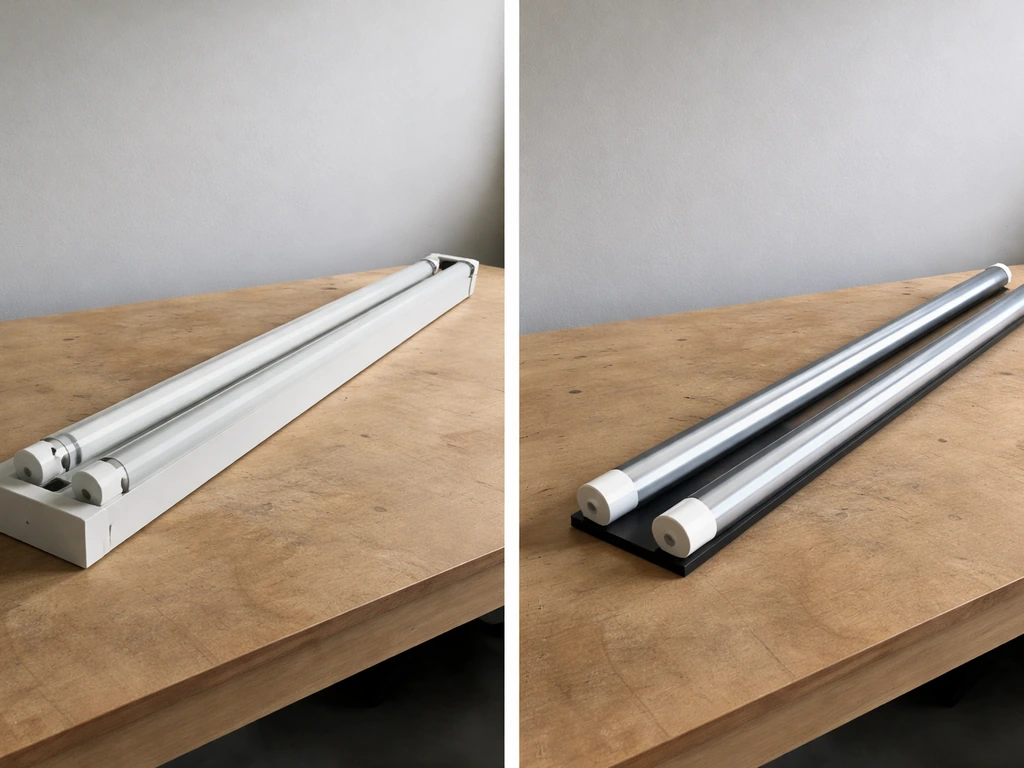
"LED T8" is a retrofit tube built to the same physical form factor as a fluorescent T8. It fits the same fixture, uses the same pin connectors, and occupies the same footprint on your ceiling or fixture rail. This is critically different from a purpose-built LED grow panel or bar light. When someone searches "best T8 LED grow lights," they might mean LED tubes designed to drop into their existing fluorescent shop-light-style fixture, or they might mean modern LED grow bars that happen to use a linear form factor. The shopping experience and compatibility requirements are completely different for each.
Fluorescent T8 fixtures include a ballast, an internal transformer that regulates current to the tube. LED T8 retrofit tubes are sold in two configurations: Type A (ballast-compatible, also called "ballast friendly") and Type B (ballast-bypass, also called "direct wire"). Type A tubes work with your existing ballast and are the simplest drop-in swap. Type B tubes require you to bypass the ballast and wire directly to line voltage, which is more work upfront but removes a failure point and typically delivers better efficiency long-term.
T8 fluorescent vs. LED: what you actually gain and lose
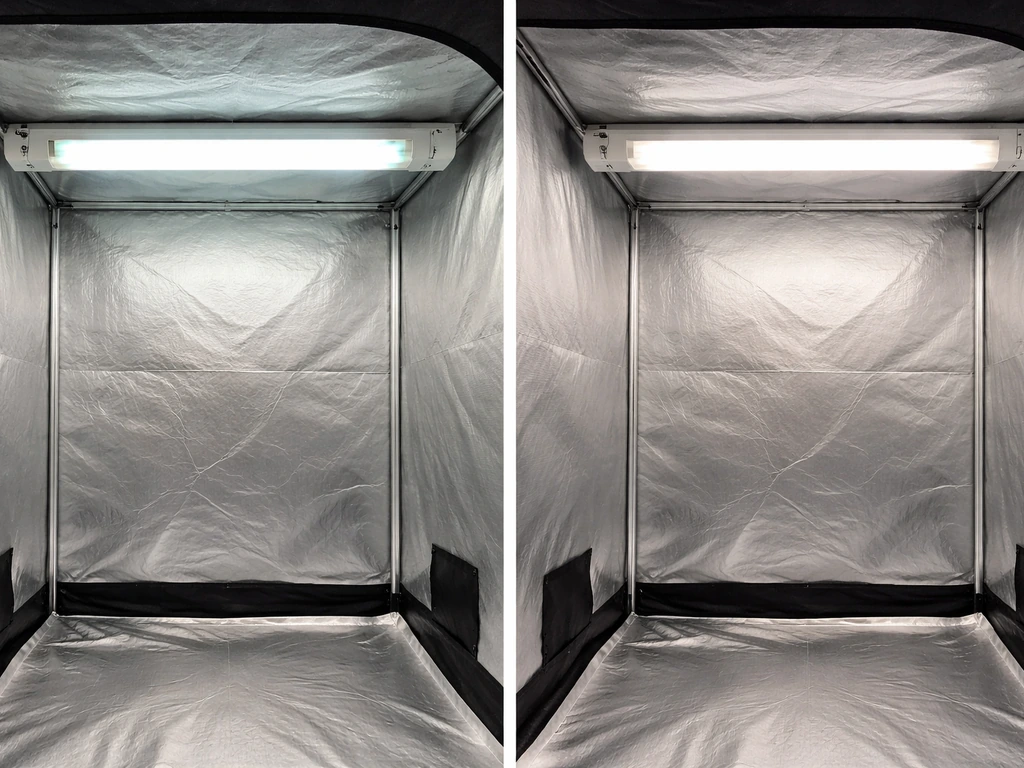
This is where I stop hedging and give you the direct comparison. fluorescent vs LED grow lights comes down to five practical tradeoffs that matter in a grow environment: energy draw, photon output, heat, lifespan, and control.
| Factor | T8 Fluorescent | LED T8 Retrofit |
|---|---|---|
| Typical wattage (4-ft tube) | 32W per tube | 15–18W per tube |
| Efficacy (lumens per watt) | 80–100 lm/W | 100–160 lm/W |
| Useful lifespan | 10,000–20,000 hours | 30,000–50,000 hours |
| Heat output | Moderate, radiated from tube | Low, concentrated in driver |
| Flicker risk | Yes (especially aging ballasts) | Depends on driver quality |
| Dimming/control | Difficult, requires dimmable ballast | Easy with PWM drivers |
| Cold-temperature start | Slow, struggles below 50°F | Instant, unaffected |
| Spectrum tunability | Fixed by phosphor blend | Adjustable in some models |
| Ballast dependency | Yes, critical to output | Eliminated with Type B bypass |
The energy savings are real and measurable. Better Buildings / Better Plants Initiative also notes that retrofitting fluorescent troffers with LED sources can deliver project-level energy savings in the 20% to 60% range, depending on the application. The DOE and BC Hydro data both show that LED T8 replacements can match fluorescent T8 light output while drawing roughly 40–50% less power. At $0.12/kWh running a 4-tube fluorescent fixture (128W) for 18 hours a day during veg, you're spending about $101 per year on just that fixture. The LED equivalent at 68W drops that to about $54. Over a 3x4 grow space with four to six fixtures, the annual savings add up fast.
One real-world caveat from the DOE report: fluorescent output is tied to the ballast factor of the specific ballast installed. In DOE’s CALiPER Report 21.2, researchers evaluate how linear (T8) LED lamp performance compares against benchmark fluorescent lamps across multiple recessed troffer types and beam angles One real-world caveat from the DOE report. A ballast with a factor of 0.88 drives a 32W lamp to only 88% of its rated output. When you're comparing lumens between fluorescent and LED specs, you have to account for this. LED T8 specs typically show output at rated power with no ballast factor adjustment, which means fluorescent systems often underperform their tube's rated specs by 5–15% depending on the ballast.
On flicker: fluorescent ballasts, especially older magnetic ones, can produce significant flicker that stresses plants (and humans). LED T8s are not automatically flicker-free. Driver quality determines flicker behavior. Look for tubes with ripple current specifications below 5% or a Stroboscopic Visibility Measure (SVM) rating near zero for the cleanest light.
Reading specs that actually matter for your plants
PPF and PPFD: the numbers that drive yield
Lumens measure brightness as the human eye perceives it. Plants do not care about lumens. What matters is PPF (photosynthetic photon flux), measured in micromoles per second (μmol/s), which tells you how many photons the fixture emits per second in the wavelengths plants use (400–700nm). PPFD (photosynthetic photon flux density) is PPF divided by area, measured in μmol/m²/s at a specific distance from the light source. PPFD is what your canopy actually receives.
PPF is a property of the fixture itself. PPFD depends on how far your plants sit from the light and how the beam spreads. Move a light 6 inches closer and PPFD at canopy jumps significantly because you're concentrating the same photon budget over a smaller area. This is why manufacturer PPFD claims need a skeptical eye: they're always measured at a specific height and distance, and that number drops fast as you scale up your coverage area or raise the fixture.
For practical targets, the commonly referenced PPFD ranges by grow stage are: seedlings need 100–300 μmol/m²/s, vegetative plants perform well at 400–600 μmol/m²/s, and flowering plants want 600–1,000 μmol/m²/s under standard CO₂ levels. You can also track this via DLI (daily light integral), calculated from PPFD multiplied by the photoperiod in seconds, then divided by one million.
CCT, CRI, and spectrum claims
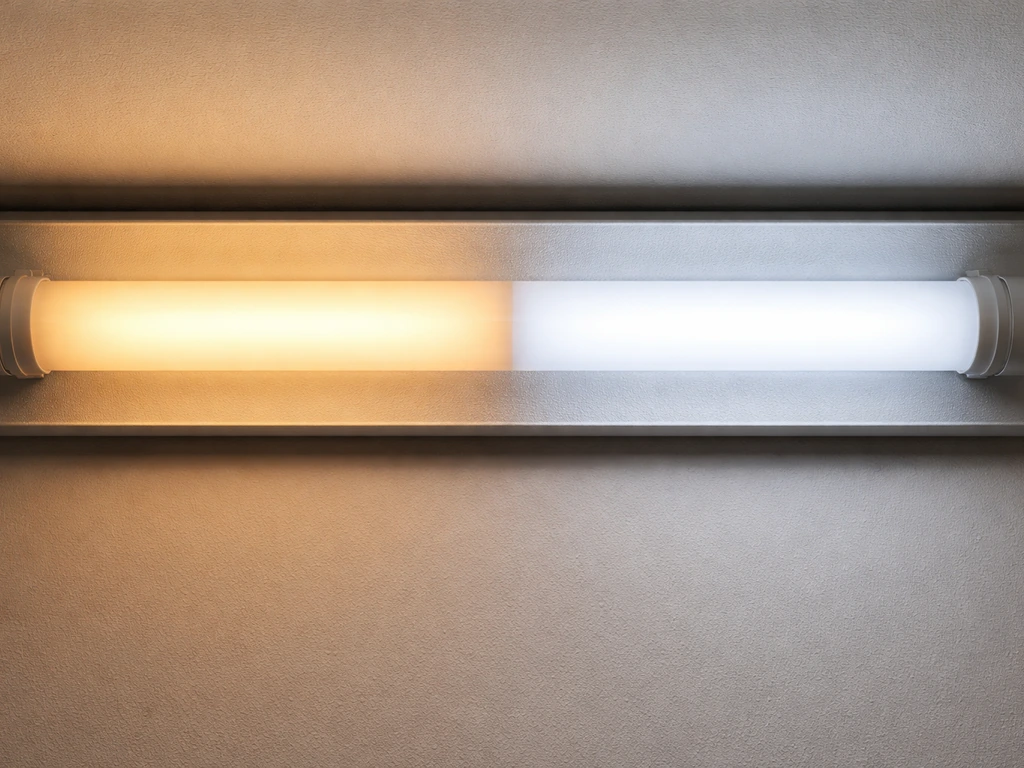
CCT (correlated color temperature) tells you the color appearance of the light. Lower numbers (2700–3000K) skew warm/red, better for flowering. Higher numbers (5000–6500K) skew cool/blue, better for vegetative growth. CRI (color rendering index) measures how accurately a light renders colors versus a reference source. For plant growth, CRI above 80 is generally acceptable, but it's less critical than the actual spectrum distribution and PPF output. Full-spectrum claims are common in marketing; what to actually verify is whether the light covers 400–700nm adequately and ideally includes some far-red (700–750nm) for flowering response.
Compatibility and installation: ballast, bypass, and wiring
This is where most first-time LED T8 buyers run into trouble. Fluorescent T8 fixtures use a ballast, and the LED tube you buy must be matched to that ballast type or wired to bypass it entirely. Ballasts come in three main categories: instant start, rapid start, and programmed rapid start. Type A LED T8 tubes (ballast-compatible) are engineered to work with specific ballast types. Lumentek describes their ballast-friendly LED T8 tubes as compatible with most instant-start, rapid-start, and programmed rapid-start electronic and magnetic ballasts, but "most" is doing a lot of work in that sentence. Always cross-check your ballast brand and model against the manufacturer's compatibility chart before buying Type A tubes.
If your fluorescent ballast is aging, failing, or an unknown model, Type B (ballast-bypass) is the cleaner path. MaxLite's UL Type B ballast-bypass LED T8 tubes, for example, are designed to run directly off line voltage from 120V to 277V, eliminating the ballast entirely. The wiring job is straightforward if you're comfortable with basic electrical work: you disconnect the ballast leads and connect the tombstone sockets directly to the line wires. The upside is a system that runs at full LED efficiency without ballast losses. The USDA cautions that retrofit approaches that rely on the old ballast can introduce system-level inefficiencies because ballast and lamp matching affects real-world output, not just rated specs.
One practical note: if you're bypassing the ballast in a fixture shared with a partner or if the fixture is rented space, label the fixture clearly as ballast-bypassed. Someone dropping in a standard fluorescent tube later will create a short circuit or fire risk.
Best options by grow stage and tent size
Seedlings and clones (small tents, low intensity needed)
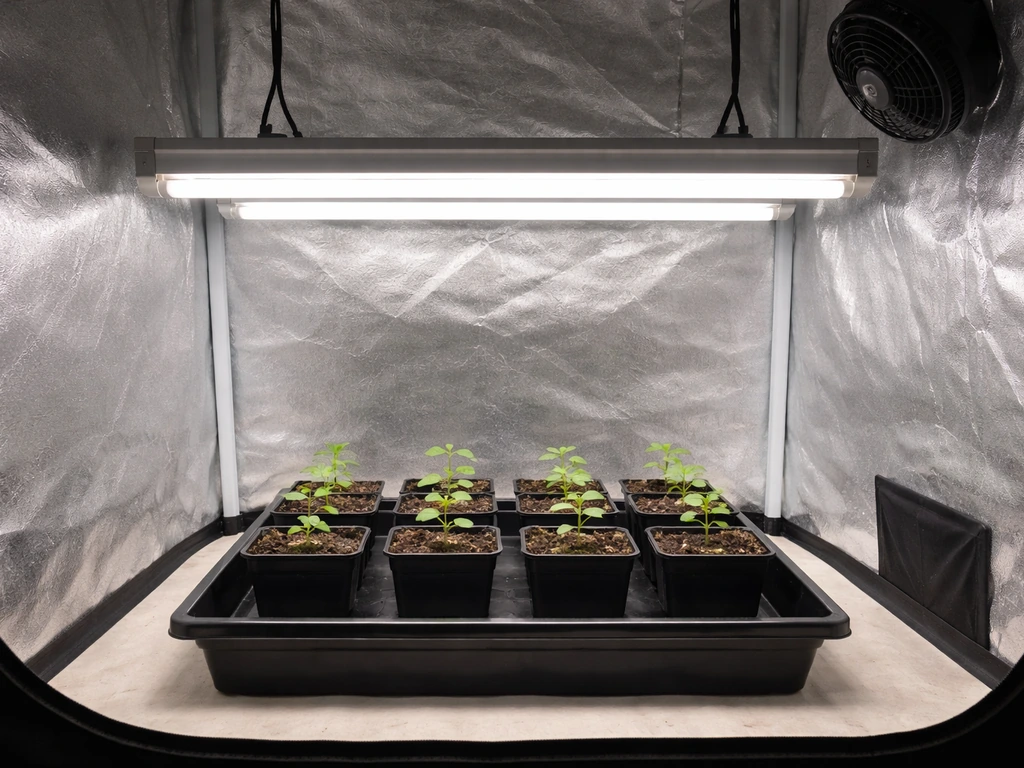
For seedlings and cuttings targeting 100–300 μmol/m²/s, T8 fluorescents actually hold their own, especially if you already own the fixtures. A 4-tube 4-foot fluorescent shop fixture costs almost nothing to run at low intensity because you can disable tubes to reduce output. LED T8 retrofits at this stage are still worthwhile for the lifespan and heat reduction, but the performance difference is smaller here than at any other stage. For a 2x2 or 2x4 propagation area, two to four T8 LED tubes (15–18W each, 5000–6500K) suspended 4–6 inches above the tray give adequate coverage.
Vegetative growth (3x3 to 4x4 tents)
At the veg stage, you want 400–600 μmol/m²/s across your canopy. For a 3x3 tent (about 0. 84 m²), hitting 500 μmol/m²/s requires a total PPF of roughly 420 μmol/s. A high-quality LED T8 tube at 18W can deliver 50–70 μmol/s depending on efficiency, so you'd need six to eight tubes to cover that space adequately.
For a 4x4 tent (1. 49 m²), the math scales to eight to twelve tubes, which starts to look physically crowded and expensive compared to a purpose-built LED bar light system.
This is also the stage where considering whether LED T8 retrofit tubes make sense versus a full LED grow panel becomes important, and it's worth checking how cheap LED grow light vs expensive options compare in terms of real PPF output, since some budget panels punch well above their price point at this wattage range.
Flowering (4x4 and larger)
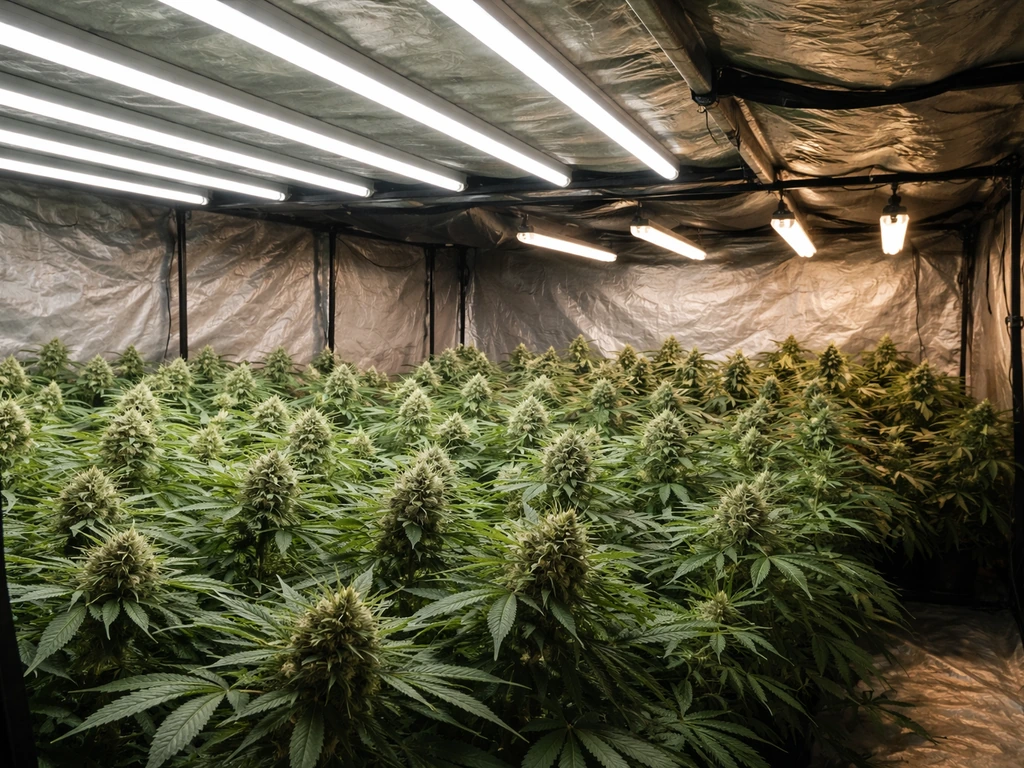
Flowering plants want 600–1,000 μmol/m²/s, and this is where T8 fluorescents fall clearly short without stacking many fixtures. Even with LED T8 tubes at maximum efficiency, you'd need 12+ tubes over a 4x4 footprint to reach 700 μmol/m²/s, and you're still fighting the relatively diffuse output of linear tubes versus more focused panel or bar designs. For flowering, I'd recommend LED T8 retrofits only if you already have a multi-lamp fixture array and can run 10+ tubes. Otherwise, a purpose-built LED grow light is the better investment per photon delivered. LED T8s still outperform fluorescent T8s at this stage, but neither is ideal for serious flowering compared to modern quantum board or LED bar grow lights.
Your buying checklist and upgrade decision
Before you buy anything, run through this process to determine whether T8 LED retrofits make sense for your specific setup or whether you should skip straight to a different LED form factor.
- Measure your grow space and calculate square footage. A 4x4 tent is 16 sq ft / 1.49 m². Write this down, because every other calculation depends on it.
- Decide your target PPFD by stage: 100–300 for propagation, 400–600 for veg, 600–1,000 for flower.
- Multiply target PPFD by your grow area in m² to get the minimum PPF your light system needs to deliver at canopy level. Example: 500 μmol/m²/s × 1.49 m² = 745 μmol/s minimum PPF.
- Check your existing fixtures: identify the ballast brand, model, and type (instant start, rapid start, programmed rapid start). Look up compatibility for the LED T8 tubes you're considering, or plan for a ballast-bypass Type B installation.
- Calculate your current annual energy cost: watts × hours per day × 365 ÷ 1,000 × your electricity rate = kWh cost per year. A 4-tube fluorescent fixture at 128W, 18 hours/day, $0.12/kWh = about $101/year.
- Calculate the LED T8 equivalent annual cost using the same formula at the lower wattage (typically 60–72W for a 4-tube LED T8 setup). The difference is your annual savings.
- Divide the cost of the LED T8 tubes by annual savings to get your payback period in years. LED T8 tubes typically run $10–25 each, so a 4-tube swap costs $40–100 and often pays back in under 12 months.
- Set your mounting height. For seedlings, 4–6 inches works. For veg with adequate tube count, 12–18 inches. For flower with T8s, you want to stay under 18 inches to maintain useful PPFD at canopy level, because PPFD drops sharply with distance for diffuse linear sources.
- If the tube count required to hit your PPFD target exceeds your fixture capacity or would cost more than a purpose-built LED panel, upgrade to a dedicated grow light instead of retrofitting.
The honest recommendation: T8 LED retrofits are a smart upgrade over T8 fluorescents in almost every case, delivering the same or better photon output at 40–50% less energy and lasting 2–3x longer. But they're a transitional solution, not an endpoint. For seedling trays and small veg spaces under 3x3, LED T8 tubes in a repurposed shop-light fixture are genuinely cost-effective and practical. For anything larger or for serious flowering, you'll hit the ceiling of what linear T8s can do efficiently, and a dedicated LED grow light becomes the smarter long-term investment. Know which problem you're solving before you buy.
FAQ
How can I tell if my fixture ballast will work with a Type A LED T8 tube?
Check whether your existing fluorescent fixture uses a magnetic ballast or an electronic ballast, then match that category to the LED tube type. If you are unsure of the ballast model number, do not assume Type A will work, because compatibility charts are specific to ballast type and operating characteristics, and an incorrect pairing can reduce output or cause flicker.
If Type A LED T8s are labeled ballast compatible, why might my results still be weaker than expected?
Yes, many Type A LED T8s are sold as “ballast-compatible,” but the real-world output can still vary because ballasts can drive at different current levels and at different temperatures. If your goal is a specific PPFD range, plan to measure or target conservative tube counts, and expect that a “rated” lumen comparison may overstate canopy light.
What spec should I prioritize, and how do I avoid lumen-based miscalculations when sizing tubes?
Use PPF and PPFD, not lumens, and compare at the same distance. Linear tubes drop PPFD quickly as you increase canopy coverage area or raise the fixture, so the easiest decision aid is to pick your target PPFD, estimate area, then calculate required PPF using the height and spread you can actually achieve in your tent.
Manufacturer PPFD claims look high, how should I account for my tent height and future plant height changes?
Assume brightness claims can be optimistic when they come from a single test height. A practical edge case is tents with tall plant training or hanging changes, since PPFD can swing significantly as distance changes. The fix is to set a target PPFD at your current maximum and plan to adjust suspension height or add tubes, rather than trusting a one-time spec sheet number.
When does an LED T8 retrofit stop being cost-effective for flowering?
For flowering, linear T8 tubes often struggle with both total photon count and beam efficiency across a larger canopy, unless you commit to many tubes or tight mounting. If your plan is 600 to 1,000 μmol/m²/s over a 3x3 or larger, decide early whether you want to spend on tube quantity or switch to an LED bar or panel that concentrates photons more effectively.
How should I evaluate spectrum quality beyond CCT and CRI when buying LED T8s?
Don’t rely on “CRI” alone. For plants, spectral coverage in the 400 to 700 nm range matters, and a useful add-on is far-red (roughly 700 to 750 nm) for flowering response. If the product does not clearly state spectral distribution or usable wavelength coverage, treat it as higher risk even if CRI is listed as 80+.
Are LED T8 tubes automatically flicker-free, and what should I look for if I care about plant and human comfort?
Flicker can come from the driver, and some tubes can also show visible stroboscopic effects with camera movement. Look for manufacturer measurements like ripple current below 5% and an SVM near zero, and if the brand does not provide these, you may need to test in person or choose a tube line known for low flicker performance.
What safety and setup steps matter most if I switch to Type B (ballast-bypass) LED T8s?
If you are bypassing the ballast (Type B), label the fixture and keep a record of how it was rewired, especially in shared or rented spaces. Also verify the fixture is wired for the correct input voltage range (commonly 120V to 277V for many Type B tubes), because using a tube rated outside your supply voltage can create failure or unsafe operation.
If my current T8 fluorescents are old, will LED T8 performance comparisons be misleading?
Aging fluorescent systems can underperform even before you upgrade, because tube output and ballast output degrade over time. If your current lamps are old, you may have been getting less light than the “rated” specs suggest, so the perceived improvement from LED may look larger than expected, even if the new setup is only meeting your target PPFD.
What is the best practical way to test whether LED T8s will meet my PPFD target before buying a full set?
Yes, you can simplify the decision by staging upgrades. Start by upgrading one zone or one tier, measure PPFD at canopy level after install, then decide whether to add more tubes or move to bars/panels. This avoids overspending on tube quantity when your tent layout or mounting height is the real limiter.
Next Articles
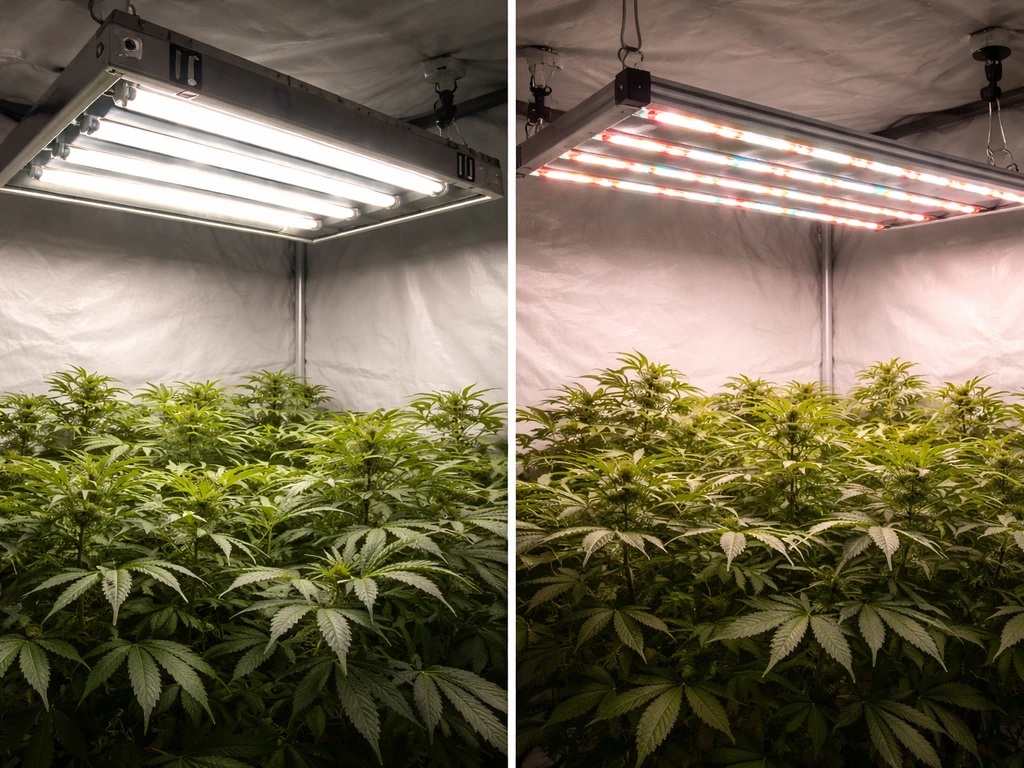
Fluorescent vs LED Grow Lights: Which to Choose Today
Compare fluorescent vs LED grow lights by PPFD, spectrum, heat, lifespan, cost, and choose the right option for your set
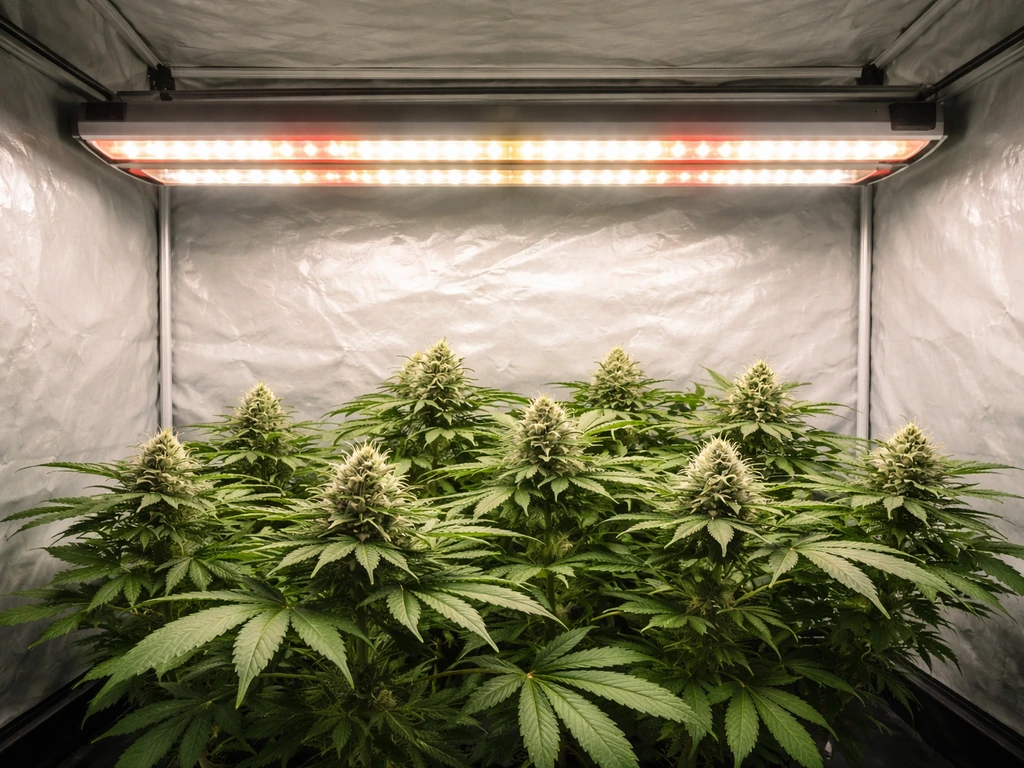
Best Full Spectrum 1000W LED Grow Lights: Buyer Guide
Buy the best full spectrum 1000W LED grow light with spec-to-decision tips on PPFD, coverage, wattage, and tent fit.
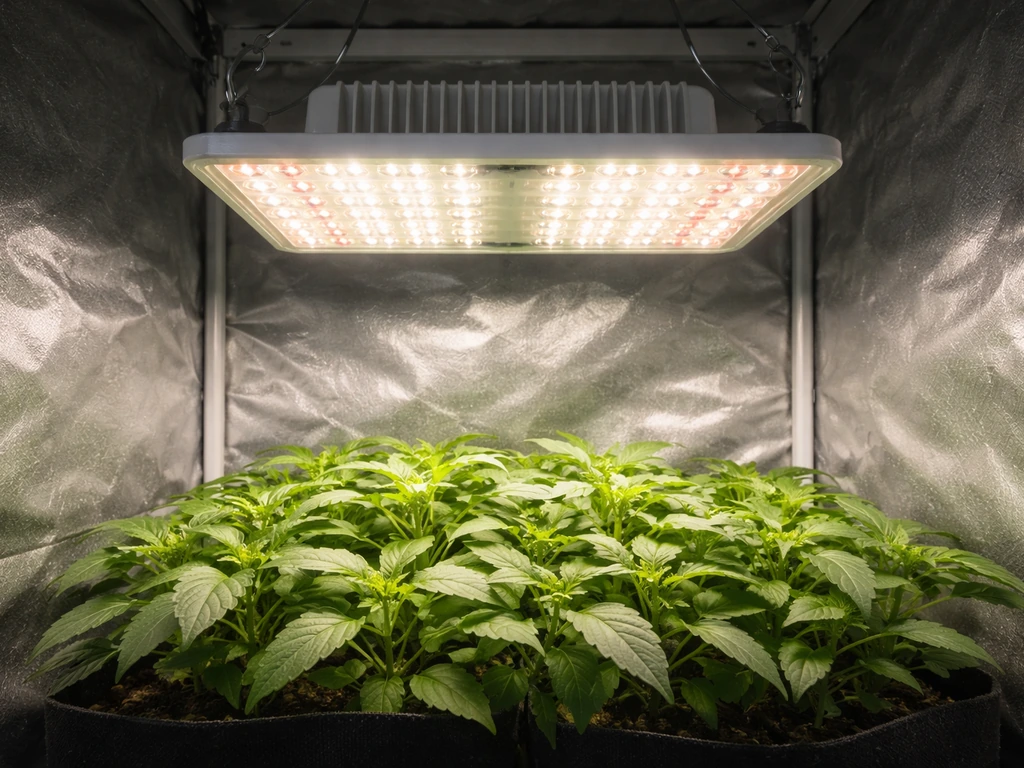
Best 100W LED Grow Light: How to Choose the Right One
Choose the best 100W LED grow light with PPFD coverage, spectrum, efficiency, dimming, heat, and setup tips.