
The best LED grow light for your setup is the one that actually hits your canopy with the right PPFD at the right intensity, fits your space without creating hot spots, and won't leave you hanging two years from now with a dead driver. The problem with "top 10" lists is that they're usually written for a generic grower who doesn't exist. A 2x2 hobbyist and a 5x5 commercial-minded grower need completely different things. So this guide ranks the top 10 LED grow lights while mapping each one to a realistic scenario, because the "best" light depends almost entirely on your coverage area, your budget, and whether you're growing leafy greens or pushing photoperiod plants through a heavy flower cycle.
Top 10 LED Grow Lights: Best Picks by Tent Size
Marcus Rutherford
11 Apr 2026
Quick pick: what "top 10" means for your grow space
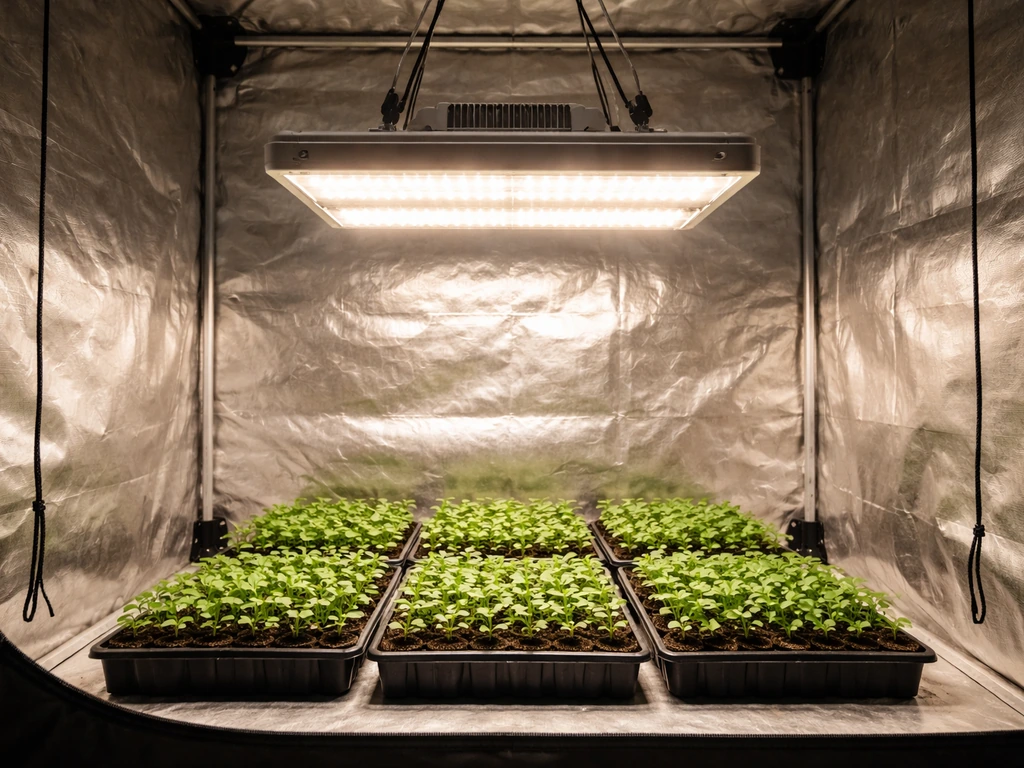
Before you read a single product recommendation, you need to know that "top-rated" is always relative to coverage area and use case. A light that's perfect for a 3x3 tent will either underwhelm or overwhelm a 5x5. The general rule of thumb for flowering cannabis or high-demand crops: you want 600 to 900 µmol/m²/s PPFD across your canopy for veg, and 800 to 1,200+ µmol/m²/s for peak flowering (with CO2 supplementation pushing that ceiling higher). For seedlings and early veg, 200 to 400 µmol/m²/s is enough. Every light on this list is evaluated against those real-world targets, not against the wattage number stamped on the box.
The other thing "top 10" should mean: value across the full ownership cycle. That includes driver quality, heat output, noise level from built-in fans (if any), warranty length, and whether the brand actually honors claims. If you want to dig deeper into a shorter, more curated shortlist, the top 5 LED grow lights breakdown covers the absolute cream of the crop with even tighter scenario matching. And if you're scaling up or just want more options to compare, there's also a broader top 20 LED grow lights list worth bookmarking.
Best LED grow lights list (ranked) across budgets and setups
These rankings are based on a combination of measured PPFD output, efficiency (µmol/J), coverage uniformity, build quality, control features, and real-world grower feedback. They're ranked roughly from most versatile/best overall to more scenario-specific picks.
- Mars Hydro FC-E6500 (best for 5x5 to 4x8 commercial): 650W, 2.8 µmol/J efficacy, PPFD maps available, smart dimming, and a 5-year warranty. This is a serious light for serious grows. At 12.5 inches hanging height, you're hitting around 1,000 µmol/m²/s at the center, though edge coverage tapers off on larger maps.
- AC Infinity IONFRAME EVO6 (best 4x4 all-in-one): 500W, rated at 1,991 PPFD at reference height, covers a 4x4 flowering footprint. Algorithmically spaced diodes eliminate hot spots, and it integrates cleanly with AC Infinity's controller ecosystem.
- Spider Farmer SE Series (best mid-range bar array): Dimmable, controllable bar-style layout for even canopy distribution. Multiple SKUs covering 3x3 to 5x5 footprints, 5-year warranty, and solid build quality. A good step up from panel-style lights without going full commercial.
- Mars Hydro FC Series (best 4x4 budget-friendly bar): The non-E FC series offers comparable coverage to premium lights at a lower entry cost. 5-year warranty applies across the FC/FC-E/TS/SP product families per Mars Hydro's official policy.
- ViparSpectra XS1500 Pro (best for 2x2 to 2x4 hobbyists): Budget-friendly, comes with a PPFD map and dimmer knob guidance in the user manual. Measured ePPFD values from independent testing confirm it performs honestly for small tents. Not the most efficient light on the list but punches above its price tag.
- Spider Farmer SF Series (best beginner panel): Reliable quantum board-style panels from a brand with a documented warranty process and clear service requirements. Good for growers just starting out who want name-brand support without premium pricing.
- Migro Aray 4 240W (best low-profile bar for shelves and propagation): Independently tested bar array with documented average PPFD and usable photon metrics. 240W draw is efficient for the output, and the bar form factor works well in multi-tier shelf setups where headroom is limited.
- HLG 650R (best premium DIY-friendly panel for 4x4 to 5x5): High-efficiency Samsung/Osram diodes, passive cooling (no fan noise), and a 5-year warranty on the Greenhouse Pro product line. Built for serious hobbyists and craft growers who want longevity.
- AC Infinity IONFRAME EVO8 / EVO10 (best for large 5x5 and 4x8 tents): Scaled-up versions of the EVO6 with stage-specific coverage charts in the manual (veg coverage vs. flowering coverage listed separately per model). Integrates with AC Infinity's Advance Grow System for automated scheduling.
- Mars Hydro TS Series (best value beginner panel): Entry-level quantum board at an accessible price. 5-year warranty, simple setup, honest PPFD output for the wattage. Best for 2x4 or 3x3 spaces where you want reliability without complexity.
How to choose: wattage, coverage, spectrum, and dimming
Wattage is a starting point, not the answer
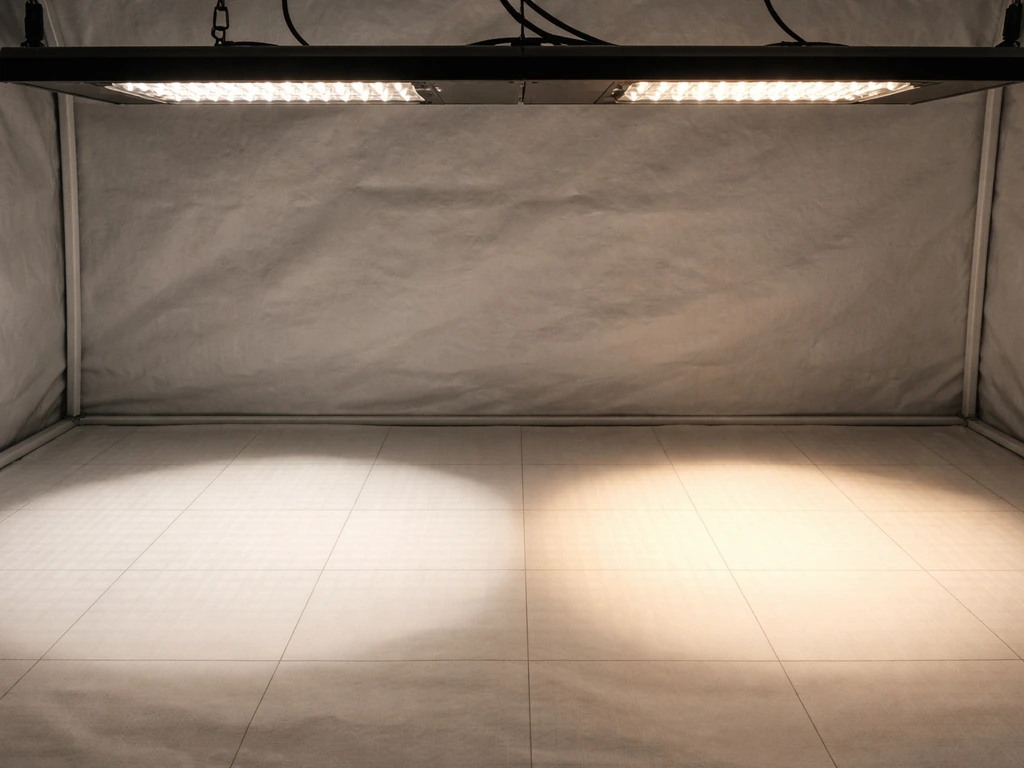
Wattage tells you how much power a light draws from the wall. It does not tell you how much usable light hits your plants. Two 500W lights can have wildly different PPFD outputs depending on their diode quality and driver efficiency. A rough guideline: you need roughly 30 to 50 true watts per square foot for flowering, which means a 4x4 (16 sq ft) space needs 480 to 800 actual draw watts. But a more efficient light at the lower end of that range can easily outperform a cheap light at the top end. Always cross-reference wattage with the stated µmol/J efficiency number.
Coverage area: the spec that matters most
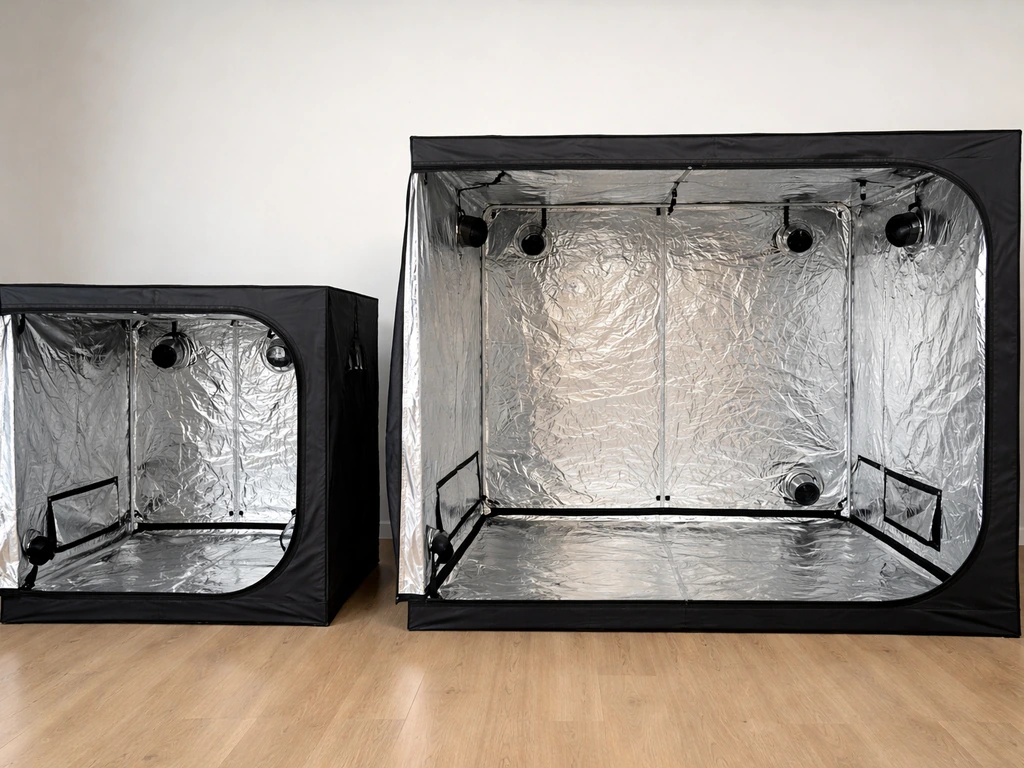
Most brands list both a "vegetative" and a "flowering" coverage area, and they're different for good reason. Veg requires less PPFD and allows more hanging height, so a single light can cover more ground. Flowering needs higher intensity over a tighter footprint. AC Infinity, for example, documents both coverage modes in the IONFRAME EVO series manual, with the EVO6 rated for 4x4 flowering coverage. When comparing lights, always use the flowering coverage number as your baseline if you're growing fruiting or flowering plants.
Full spectrum and why it's not all equal
Every brand markets their light as "full spectrum," but what that actually means varies. You want a spectrum that covers 400 to 700 nm (PAR range) with a good balance of blue (400-500 nm for veg and compact growth), red (600-700 nm for flowering and fruiting), and white/green fill (for canopy penetration and overall plant health). Some lights also include far-red (700-750 nm) to trigger shade-avoidance responses and extend effective photoperiods via the Emerson effect. Check the actual spectral output chart, not just the marketing label.
Dimming: not a luxury, a necessity
Every light on this list has some form of dimming, and that matters. Seedlings can't handle the same intensity as a plant in week 6 of flower. Dimming also lets you dial in the right PPFD without changing hang height, which is useful when headroom is limited. The Spider Farmer GGS Controller takes this a step further with closed-loop PPFD targeting: it reads a sensor and automatically adjusts light intensity to maintain your target PPFD level. That's a meaningful feature for growers who want precision without manually checking levels.
Performance specs that matter: PPFD, efficiency, output uniformity
PPFD (Photosynthetic Photon Flux Density) is measured in µmol/m²/s and tells you how many photons are hitting a specific square meter of canopy per second. It's the most direct measure of light intensity your plants experience. A single-point PPFD measurement at the center of the canopy is essentially meaningless without a full map, because uniformity across the coverage area is what actually drives even growth. Look for PPFD maps that show multiple grid points, ideally at the edges and corners, not just the center.
Efficiency, measured in µmol/J, tells you how many photons you get per watt of electricity consumed. The best lights on the market are hitting 2.7 to 3.0 µmol/J. The Mars Hydro FC-E6500, for example, is rated at 2.8 µmol/J, which is competitive at the top end of mid-range commercial fixtures. Anything below 2.0 µmol/J is leaving electricity dollars on the table, especially at scale.
Uniformity is the spec that separates good lights from great ones. Hot spots (high PPFD at center, rapidly dropping at edges) cause uneven plant development and force you to either under-light the edges or over-light the center. AC Infinity's algorithmically spaced diode arrangement in the IONFRAME EVO series is specifically engineered to eliminate hot spots. Bar-style lights like the Migro Aray 4 and Spider Farmer SE Series naturally produce more uniform canopy coverage than single-source panels because the light is distributed across multiple points.
One more metric worth understanding: ePPFD (extended PPFD), which includes far-red wavelengths beyond the traditional 400-700 nm PAR range. Some independent testers report both PPFD and ePPFD values. The ViparSpectra XS1500 Pro, for instance, has been independently tested with both metrics reported, which gives a more complete picture of total usable photon output. ViparSpectra’s XS1500 Pro product page says its optical lens design is intended to improve uniform PPFD across the coverage area by concentrating light and reducing light loss uniform PPFD across the footprint. If a brand only reports PAR PPFD and never mentions ePPFD, that's not necessarily a red flag, but it's worth asking about.
Form factor & installation fit: tents, shelves, bars vs panels
| Form Factor | Best For | Coverage Uniformity | Heat Distribution | Headroom Needed |
|---|---|---|---|---|
| Quantum Board Panel | Single-tent, standard height grows | Moderate (center-heavy) | Centralized, manageable | 18-24 inches above canopy |
| Bar Array (multi-bar) | Wide tents, multi-tier shelves, ScrOG | High (distributed) | Spread across bars | 12-18 inches above canopy |
| Single COB/Blurple Panel | Small propagation or seedling trays | Low (single point) | High at source | 24+ inches above canopy |
| Folded Panel / Modular | Irregular spaces, retrofits | Varies by design | Depends on heat sink | Manufacturer-specified |
Bar-style lights have become the dominant form factor for a reason: they spread photons more evenly across a canopy without requiring extreme hanging heights. The Migro Aray 4 is a good example of a compact bar array that fits multi-tier shelf setups where a traditional panel would be impractical. If you're building a vertical propagation rack or growing microgreens on shelves, bar lights are the only form factor worth considering.
For standard tent grows, quantum board panels remain practical and affordable, especially for single-light setups in 2x4 or 3x3 tents. The trade-off is that uniformity drops off toward the edges more quickly than with bar arrays. If your tent is 4x4 or larger, a bar-style light or a multi-bar fixture like the FC-E6500 will give you more consistent coverage across the full footprint.
Setup guidance & safety: mounting height, ventilation, heat, drivers
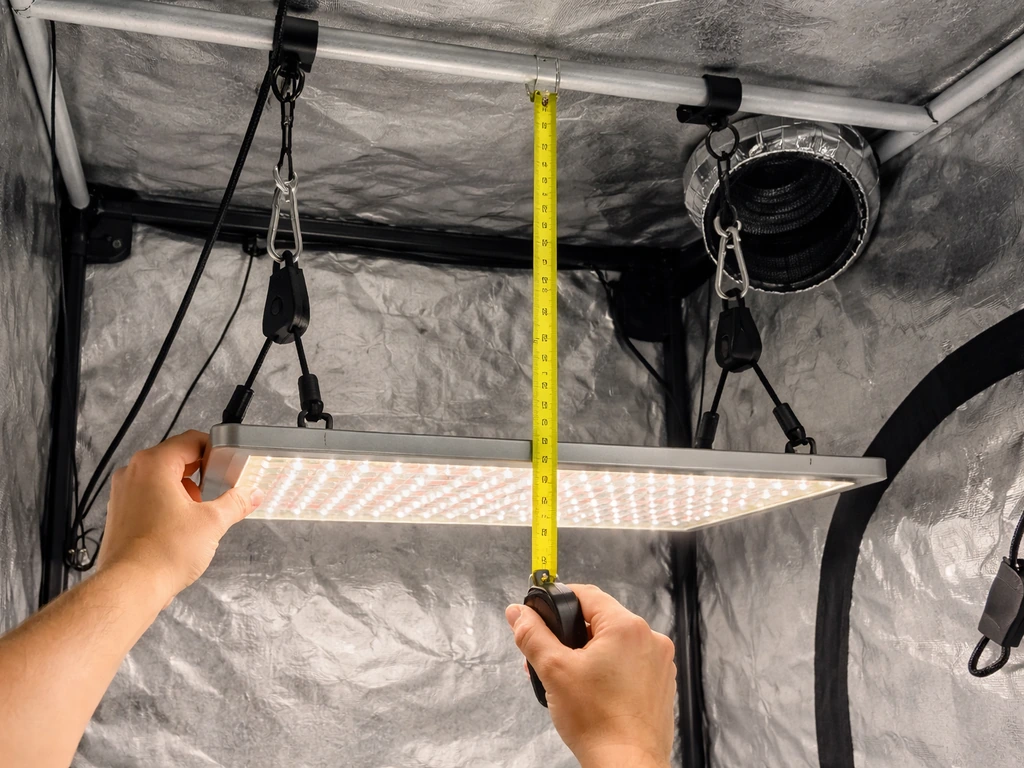
Mounting height by growth stage
Hanging height directly affects PPFD: the closer the light, the higher the intensity, but also the smaller and less uniform the coverage footprint. Most manufacturers provide recommended height ranges in their manuals. For the FC-E6500, independent testers measured at 12.5 inches (32 cm) to hit the 1,000 µmol/m²/s target zone, though edge coverage was below target at that height. The practical takeaway: raise your light a few inches to improve uniformity, then use dimming to bring intensity back up to your target PPFD. Never max out intensity at minimum height hoping for the best.
- Seedlings / clones: 24 to 36 inches above canopy, 25 to 50% intensity
- Early veg: 18 to 24 inches, 50 to 75% intensity, targeting 400 to 600 µmol/m²/s
- Late veg: 18 to 20 inches, 75 to 100% intensity, targeting 600 to 800 µmol/m²/s
- Flowering: 12 to 18 inches depending on light and plant tolerance, targeting 800 to 1,200 µmol/m²/s
Heat and ventilation
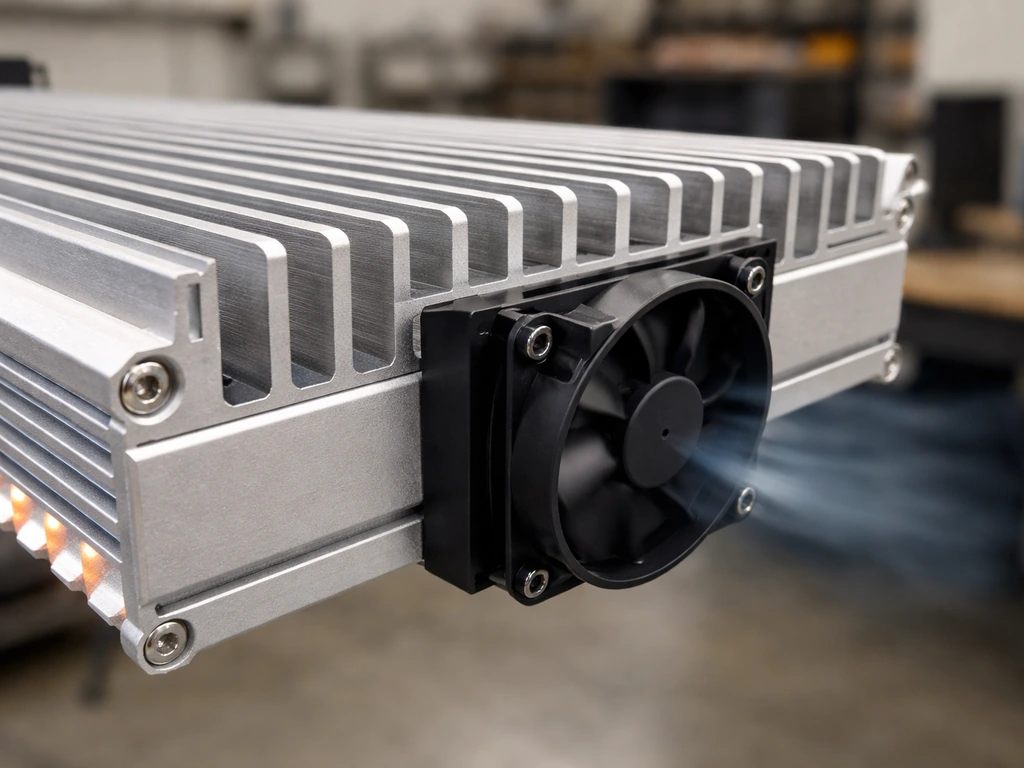
Even the most efficient LEDs generate heat, and that heat has to go somewhere. Passive-cooled lights (like HLG's Greenhouse Pro series) rely entirely on the heat sink and ambient airflow, which means your tent ventilation has to be working properly. Active-cooled lights with built-in fans add noise but move heat more aggressively. In either case, make sure your exhaust fan is sized to exchange your tent volume at least once per minute (ideally every 30 seconds under flowering loads). Under-ventilated tents will see ambient temp creep up, which reduces driver efficiency and can shorten diode lifespan.
Driver quality and long-term reliability
The driver is what converts wall power to the voltage your diodes need, and it's where cheap lights cut corners. Look for branded drivers (Meanwell and Inventronics are the most commonly cited reputable names in this category). A quality driver runs cooler, maintains consistent output over thousands of hours, and doesn't fail prematurely. LED lifetime is typically quoted using LM-80 test data with TM-21 projections, which is the industry standard methodology for predicting how long diodes will maintain at least 70% of their initial output (L70). When a brand cites L70 lifetime numbers, those should be backed by actual test data, not just marketing copy. The DLC horticultural qualification framework specifically references LM-80/TM-21 as requirements for validated lifetime claims.
Buying tips: warranties, noise, quality control, and ROI considerations
Warranty length is a proxy for how confident a manufacturer is in their own product. The brands on this list that offer 5-year warranties (Mars Hydro across their FC/FC-E/TS/SP families, HLG on the Greenhouse Pro series, and Spider Farmer across their lineup) are putting real money behind that confidence. A 3-year warranty is acceptable; anything under 2 years on a $300+ light is a yellow flag. Equally important: does the brand actually process warranty claims? Spider Farmer documents their warranty service process and category-specific requirements clearly. That kind of transparency matters when something goes wrong at month 18.
Noise is underrated as a buying consideration. If your grow space is adjacent to a living area or bedroom, a fan-cooled light running at 50 dB continuously will get old fast. Passive-cooled lights like the HLG lineup are essentially silent. Active-cooled lights vary widely; some are whisper-quiet at low intensity and louder under full load. If noise matters to you, check for reported dB levels or look specifically for passively cooled designs.
Quality control between production batches is a real issue with some brands. Spectrum shift, diode failure rates, and driver inconsistencies can vary between early and late production runs of the same model SKU. Before buying, check recent buyer reviews (within the last 6 months) specifically for mentions of DOA units, early failures, or customer service responsiveness. Established brands with documented processes handle these situations better than no-name imports with no support infrastructure.
For ROI, the math is straightforward: compare the total cost of ownership (purchase price plus electricity cost over the warranty period) against expected yield improvement. A more efficient light (say, 2.8 µmol/J vs. 2.0 µmol/J) at the same PPFD target draws about 28% less electricity. Over 5 years of 12-hour flower cycles, that's a meaningful electricity saving that can offset a higher upfront cost. Add in longer driver lifespan and a warranty that covers the period, and the premium light often wins on pure math.
The bottom line: buy the most efficient light you can afford that fits your actual coverage footprint, verify its PPFD map rather than trusting center-point specs, match the form factor to your space, and always confirm the warranty is documented and enforceable. Those four steps will steer you toward the right choice faster than any brand name will.
FAQ
How do I figure out the right light for my tent if I grow different things (veg one month, flowering the next)?
Use the flowering PPFD target as the baseline, then check the light’s flowering coverage spec and whether you can dim down for veg. If the fixture is rated for flowering at your tent footprint, you can avoid under-lighting during peak demand while still dialing intensity for seedlings and veg.
Is it better to overbuy wattage so I can keep the light higher for uniformity?
Not necessarily. Raising the fixture to improve uniformity often lowers edge PPFD too much, and “maxing out” at minimum recommended height can create hot spots or uneven coverage. A better approach is to pick a light that matches the canopy target, then use dimming to hold PPFD while adjusting hanging height within the manufacturer’s range.
What should I do if a light’s published PPFD map looks great at the center but the edges fall short?
First, confirm the test distance used in the map matches your intended hanging height. If edges still miss the target, increase coverage via a wider fixture, add a second light, or reposition the light to reduce edge drop. Center-only performance usually means you will either stunt edge plants or waste photons at the middle by pushing intensity higher.
Do I need to buy a light meter to get accurate PPFD, or can I rely on brand data?
Brand PPFD maps are a starting point, but for precision you should expect some setup-to-setup variation (height, reflective surfaces, lensing angles). If you cannot measure, at least follow the manufacturer’s recommended hanging height for the target PPFD zone and prioritize lights that publish multi-point uniformity maps.
How important is ePPFD if my brand only lists standard PPFD?
If you are not specifically targeting far-red related responses (shade avoidance or photoperiod extension), lack of ePPFD reporting is often not a dealbreaker. However, if you want the most complete photon picture, prefer fixtures that disclose both metrics from independent testing, especially when comparing premium models head-to-head.
What’s a common mistake when using dimmers with LED grow lights?
People often assume dimming is linear with PPFD without verifying the controller behavior. If you want consistent results, use the manufacturer’s dimming method, confirm the dimming range supports your lowest seedling levels, and if possible test at least one setting with PPFD measurement to validate the relationship in your environment.
How do I decide between a bar-style fixture and a quantum board panel for my tent?
Choose bar-style or multi-bar when your tent is larger (often 4x4 and up) or when you need stronger edge uniformity. Quantum board panels can work well for smaller single-light setups, but if your canopy is wide, edge drop-off may force compromises unless you add supplemental lighting or adjust layout.
Will a passive-cooled LED be enough if my exhaust fan is powerful but the room is warm?
Passive cooling is safe only if your tent ventilation and ambient conditions are stable. If your room temperature is high, driver temperatures can rise and efficiency can drop. If you cannot keep consistent ambient temps, consider an actively cooled fixture or improve airflow, and still size your exhaust to handle peak flowering heat loads.
How can I tell if the driver quality is real or just marketing?
Look for named, reputable driver manufacturers and whether the light specifies driver model or provides clear thermal performance behavior (cool-running, stable output). Then validate through recent reviews for issues like early driver failure or flickering. A great spec sheet with lots of DOA or short-lived driver reports is a warning sign.
What warranty length is actually meaningful for top 10 LED grow lights?
A long warranty matters only if claims are handled smoothly. Check not just the years, but the process details (where to send the unit, what proof is required, turnaround expectations) and whether the warranty applies to drivers and other components. A 3-year warranty with transparent service can be more valuable than 5 years with vague claim rules.
How do I estimate electricity savings between two lights aimed at the same PPFD?
Compare efficiency (µmol/J) and confirm both lights can hit your canopy PPFD at the same hanging height and coverage mode. Higher efficiency typically means lower wall draw for the same target photons, but make sure you are comparing apples to apples, such as flowering settings rather than veg-mode coverage.
What ventilation rate should I plan for, and what happens if I under-ventilate?
Plan airflow so the tent air exchanges frequently, especially during flowering heat peaks. If you under-ventilate, temperatures climb, driver efficiency can fall, and electronics may age faster. The symptom is often rising tent temps across the day plus diminishing performance over time.
How soon should I check for issues after installing a new LED?
Test early and document conditions. Run the light at your intended settings shortly after setup, listen for abnormal fan behavior if it is active-cooled, and check for flicker or uneven output. Also keep receipts and initial setup notes, because warranty claims usually go smoother when you can describe the timeline and operating conditions.
Next Articles
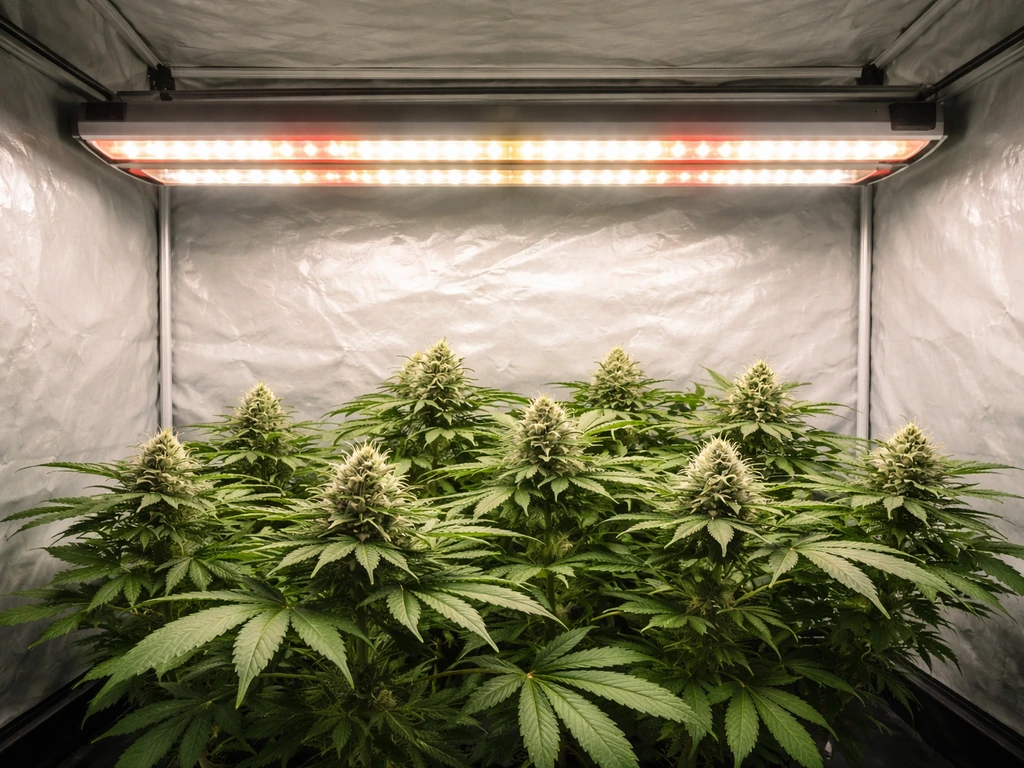
Best Full Spectrum 1000W LED Grow Lights: Buyer Guide
Buy the best full spectrum 1000W LED grow light with spec-to-decision tips on PPFD, coverage, wattage, and tent fit.
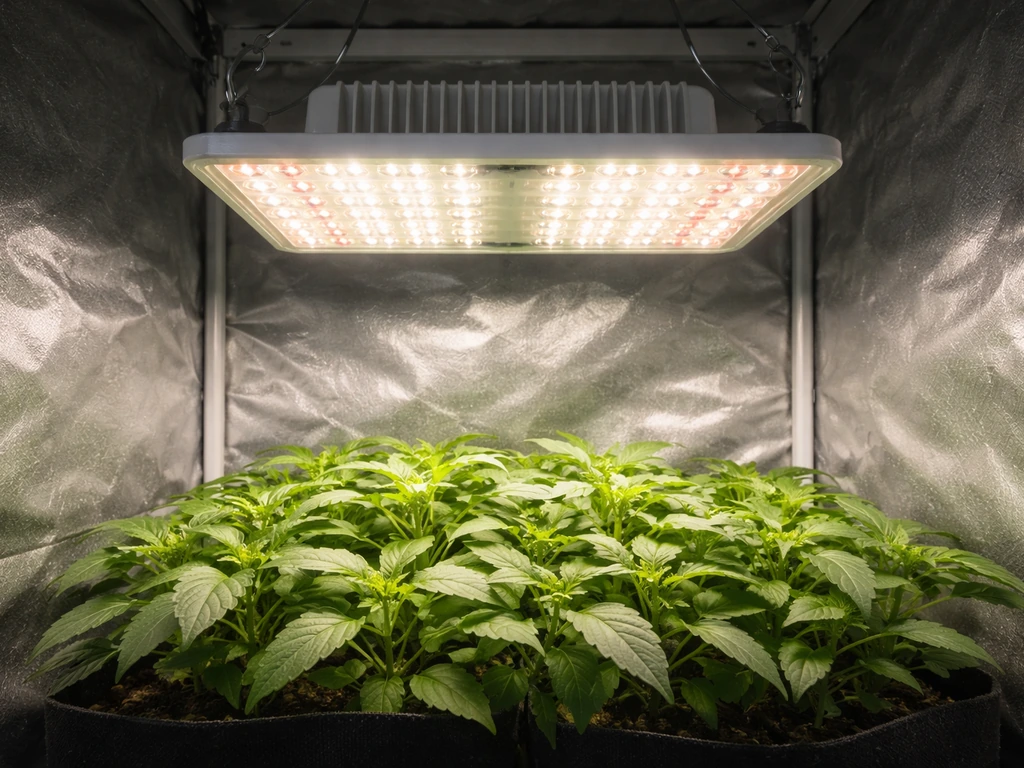
Best 100W LED Grow Light: How to Choose the Right One
Choose the best 100W LED grow light with PPFD coverage, spectrum, efficiency, dimming, heat, and setup tips.
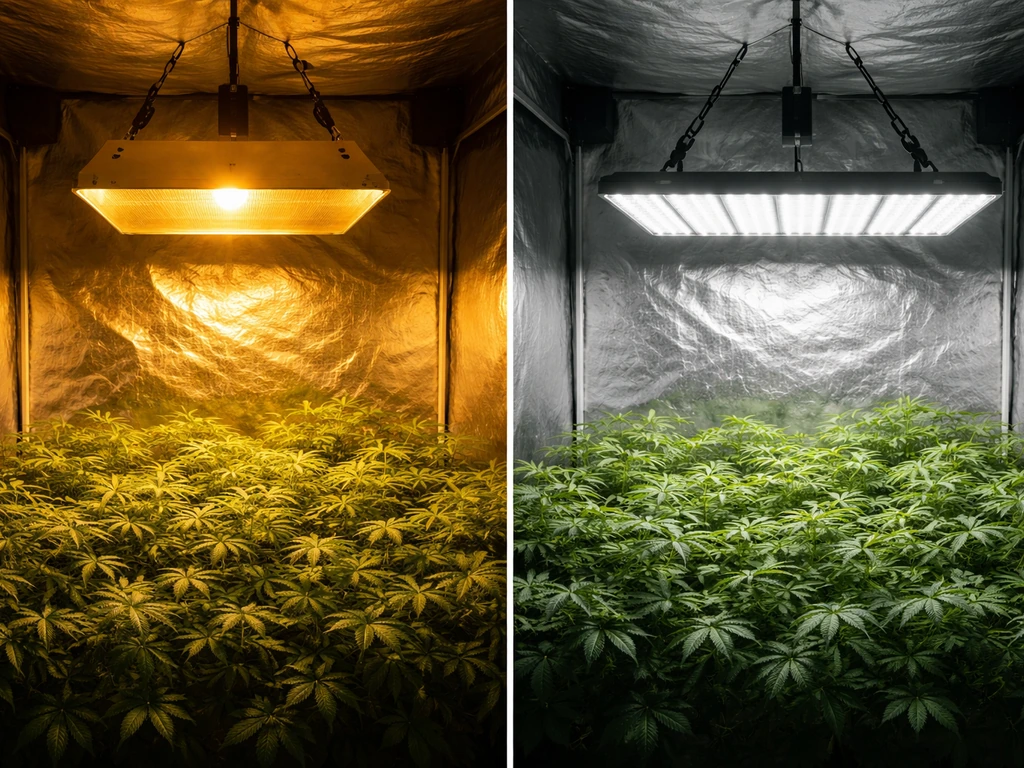
Best LED Grow Light to Replace 1000W HPS: Sizing Guide
Sizing and buying guide to replace a 1000W HPS with the right LED using PPFD, layout, mounting, and spectrum for yields.