The top 5 LED grow lights right now, as of April 2026, are the Spider Farmer SE5000, Mars Hydro FC-E 8000, California LightWorks SolarSystem 550, a compact bar light for smaller tents like the Spider Farmer SF-1000, and a mid-range workhorse panel suited for growers who want solid performance without a premium price. That's the short answer. But picking the right one for your actual setup requires a bit more than a ranked list, so below I'll walk through exactly why each made the cut, what size space and grow stage each fits, and how to verify the claims before you hand over your money. If you want to broaden your shortlist beyond the top 5, check this guide to the top 20 LED grow lights.
What Are the Top 5 LED Grow Lights? Picks by Space
Marcus Rutherford
18 Apr 2026
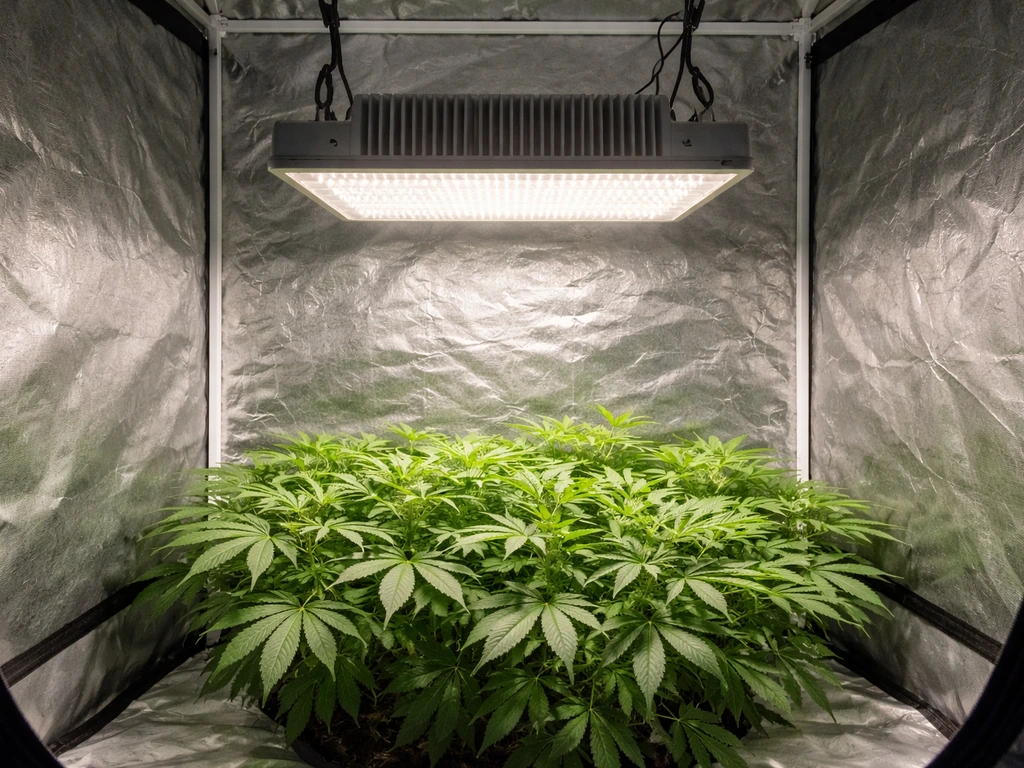
How we pick the top 5 LED grow lights
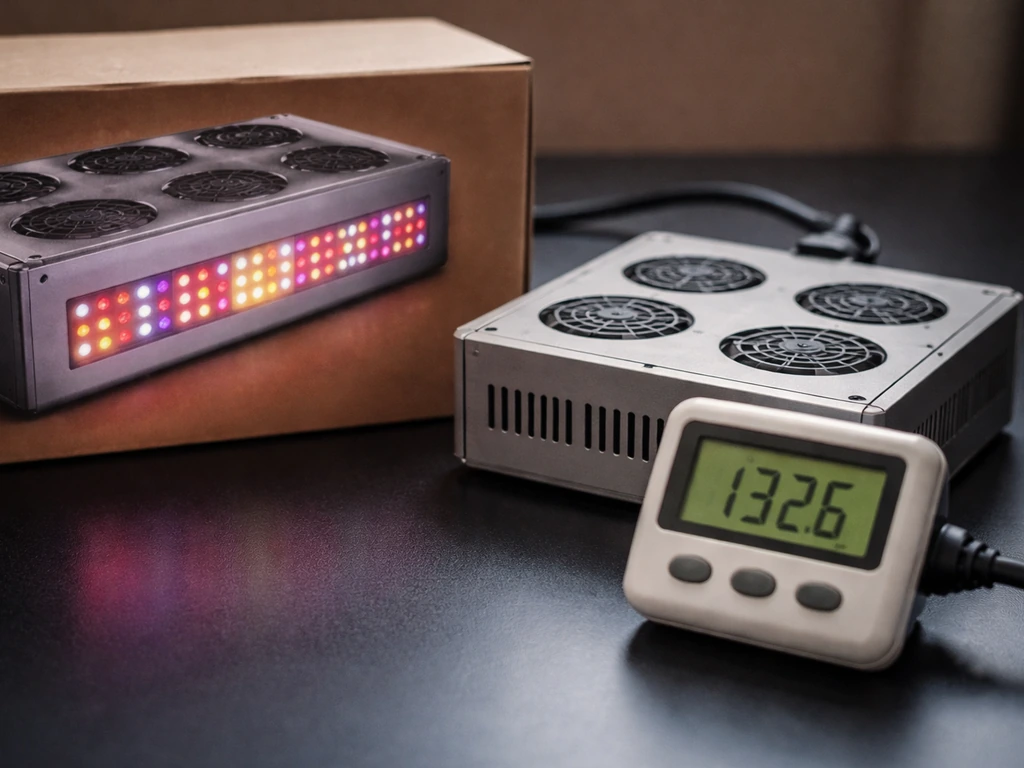
I don't pick lights based on brand recognition or what's getting the most ad spend. The criteria I use are the same ones that matter when you're actually growing: real power draw versus the inflated "equivalent" wattage you see everywhere, measured PPFD output at a stated height over a real footprint, efficacy in μmol/J (not made-up lumen numbers), driver quality and rated lifetime, spectrum design, thermal management, and warranty coverage. Every light on this list had to clear a bar on all of those, not just one or two.
- True power draw (wall watts) vs. marketed wattage: if a brand can't tell you the actual draw, that's a red flag
- PPF output and efficacy in μmol/J: DLC's horticultural spec sets a minimum of 1.9 μmol/J as a baseline; the lights I recommend beat that
- Published PPFD maps with labeled hanging heights and footprint dimensions, not a single-point peak number
- Driver lifetime rated at 50,000+ hours, which aligns with DLC's horticultural requirements
- Warranty covering the full fixture (LEDs, driver, lenses) for at least five years
- Thermal design: passive vs. active cooling, and whether the fixture runs hot enough to affect your tent temps
- Dimming capability: full-range dimming, multi-channel control, or app connectivity for stage-specific recipes
- Third-party test data or independent PPFD mapping, not just factory spec sheets
I also weigh real-world usability: how easy is the fixture to hang and adjust, does it work with a controller, and does the company actually support its warranty claims. A light that measures well in a lab but has no US support channel isn't worth recommending.
Quick shortlist: the top 5 picks and who they're for
Here are the five lights, organized by use case rather than ranking order, because the "best" light is always the one that fits your specific tent and grow goal.
| Light | Best For | Coverage | Grow Stage | Buyer Profile |
|---|---|---|---|---|
| Spider Farmer SE5000 | High-output 4x4 tent with smart controls | 4x4 ft (bloom) | Full-cycle, veg-to-flower | Intermediate to advanced, wants app control |
| Mars Hydro FC-E 8000 | Large footprints and high-intensity flowering | 4x4 (max output) to 5x5 (moderate) | Heavy bloom focus, full-cycle capable | Serious hobbyist or small commercial |
| California LightWorks SolarSystem 550 | Precision multi-channel spectrum control | 4x4 ft (bloom), up to 5x5 (veg) | Full-cycle with programmable stage recipes | Tech-oriented grower, premium budget |
| Spider Farmer SF-1000 | Small tents, seedlings, and supplemental light | 2x2 to 3x3 ft | Seedlings, early veg, clones | Budget-conscious beginner, small space |
| Mars Hydro TS-1000 | Mid-range 3x3 coverage, reliable everyday driver | 3x3 ft (bloom) | Full-cycle, best veg to mid-flower | Budget to mid-range, first grow tent setup |
If your space or situation doesn't map cleanly onto one of these, the guidance below on PPFD, DLI, and tent sizing will help you adapt the selection logic to your actual setup. And if you need to compare beyond five options, there's a broader evaluation covering more models at other points on this site.
Coverage and performance explained: PPFD, DLI, and mounting height
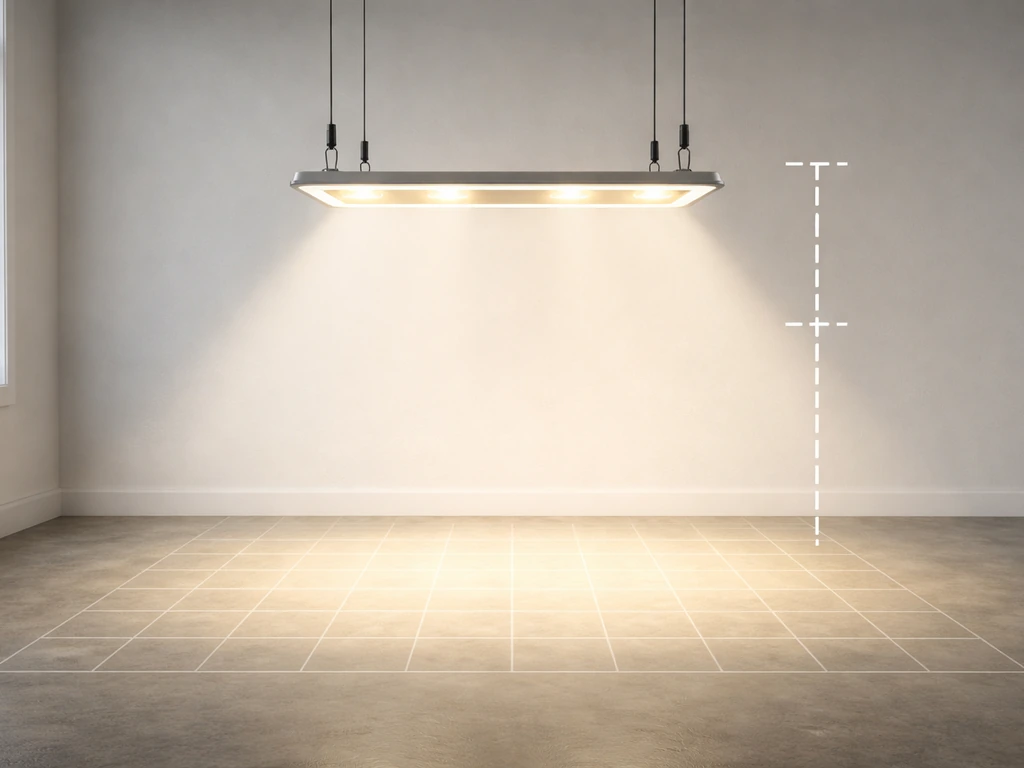
Every coverage claim you see from a manufacturer is tied to a specific hanging height and a specific PPFD target. When a brand says their light covers a 4x4, what they usually mean is that the average PPFD across that footprint hits something usable for flowering (typically 700-900 μmol/m²/s) at one particular height, often 18-24 inches above the canopy. If you hang the same light at 12 inches, your footprint shrinks but intensity spikes. At 30 inches, coverage expands but PPFD drops. The map they publish is only valid at the conditions they tested. Always match the PPFD data to the height you're actually using.
PPFD is measured in μmol/m²/s and represents the photon flux density hitting your canopy in the 400-700 nm PAR range. It tells you how intense the light is at a given point. DLI (Daily Light Integral) tells you the total photon dose your plants receive in a full day, and you calculate it from PPFD using this formula: DLI = 0.0036 × PPFD × photoperiod hours. So if your canopy is getting an average PPFD of 600 μmol/m²/s over an 18-hour veg cycle, your DLI works out to about 38.9 mol/m²/day, which is solidly in the productive range for cannabis veg. Typical DLI targets for indoor grows run 10-30 mol/m²/day for lighter crops and up into the high 30s-40s for high-light-demand plants in flower.
For practical stage-setting: seedlings and clones thrive at 150-200 μmol/m²/s on an 18-hour cycle. Vegetative growth typically targets 400-600 μmol/m²/s. Flowering pushes up to 700-900 μmol/m²/s depending on the crop and CO2 levels. The reason mounting height matters so much is that most of the lights on this list have significant PPFD variation across the footprint, with a hot center and a falloff toward the edges. A published average PPFD hides that distribution. Look for PPFD heatmaps, not just a single peak number.
How to verify a coverage claim yourself
If a manufacturer provides a PPFD map (the Spider Farmer SE5000 manual, for example, includes heatmaps labeled by hanging height), use those to calculate average PPFD across your specific footprint, then run the DLI formula against your planned photoperiod. If the brand only provides a peak PPFD number with no map, treat it as a marketing figure and look for independent test data. Independent testers running grid measurements across common tent sizes (2x2, 3x3, 4x4) at multiple heights give you much more usable data. Coco For Cannabis also reports blank" rel="noopener noreferrer">hands-on testing for the Mars Hydro FC-E8000 ePPFD and average PPFD at specific hanging heights, including a highest ePPFD around a 59 cm height. blank" rel="noopener noreferrer">The ANSI/ASABE S642 standard defines exactly how this kind of measurement should be done, which is why third-party lab testing matters for verification.
Spectrum choices for veg vs bloom vs full-cycle grows
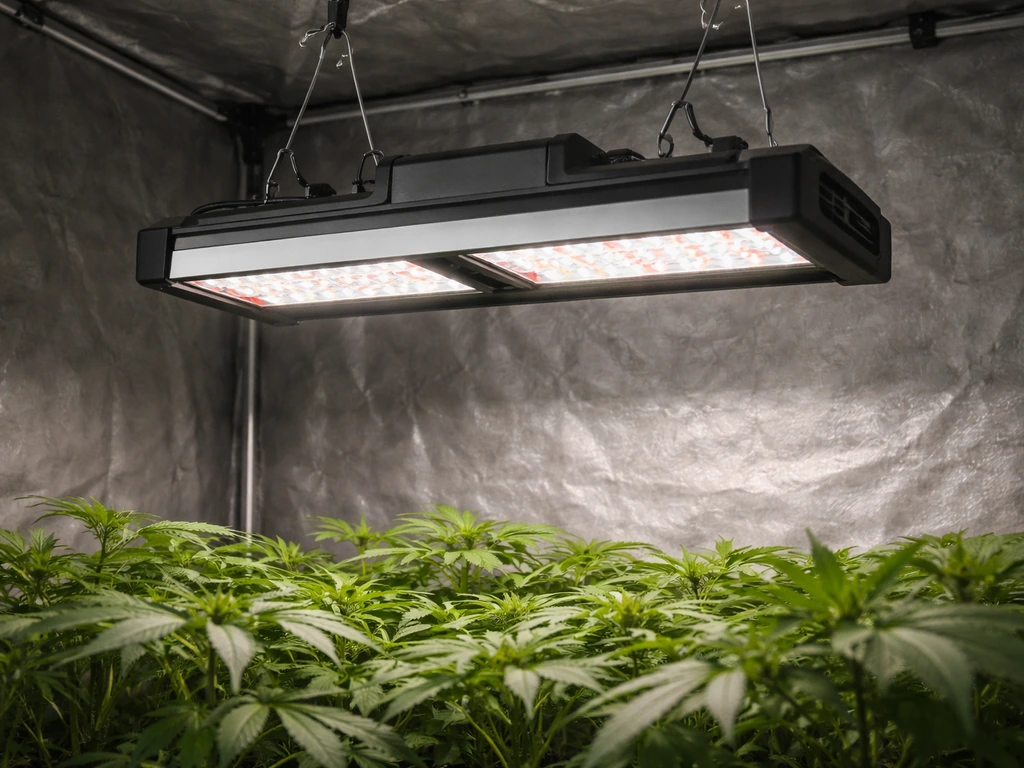
Full-spectrum white LEDs with a broad 400-700 nm output are the dominant design in 2026 for good reason: they work well across all grow stages without requiring you to swap lights or tune channels. The SF-1000 and TS-1000 both use this approach, and it's why they're approachable for beginners. The trade-off is that you get less per-stage optimization compared to a programmable multi-channel fixture.
The SolarSystem 550 from California LightWorks separates this out with multi-channel (2- or 3-channel) programmable dimming, letting you shift the red/blue balance between veg and bloom. Red-heavy (around 660 nm) spectra support flowering and photosynthesis efficiency. Blue-heavy spectra support compact vegetative structure and help avoid stretch. Research confirms that spectrum ratios affect morphology, nutrient content, and energy use efficiency even at the same total PPFD, so for growers who want tight control, a multi-channel programmable light genuinely earns its premium.
Far-red (around 730 nm) is increasingly common in newer fixtures, including some bar-style designs. Far-red supplementation can promote leaf expansion, influence canopy size, and trigger photosynthesis responses through the Emerson enhancement effect. It's a real tool, not just marketing, but the fixture needs to actually include meaningful far-red output at the right peak wavelength. UV supplementation (specifically UV-B, not UV-C) has been shown to boost secondary metabolite production without harming photosynthesis at appropriate doses, but UV outputs in budget fixtures are often minimal. Verify the spectral power distribution chart, not just the marketing language.
What to check before you buy
This is where a lot of buyers get burned. Here are the specific things to look at before committing to any LED grow light, regardless of brand.
- True wall watts: confirm the actual power draw, not the "equivalent HPS" number or LED chip wattage. A 5000W-equivalent light drawing 480W is a 480W light.
- Efficacy in μmol/J: anything below 2.0 μmol/J is below average for current-generation fixtures. Premium bar lights hit 2.6-2.9 μmol/J. If no efficacy number is published, that's a warning sign.
- PPF output: total photon output in μmol/s. The SE5000 reports 1,333-1,420 μmol/s, for example. This lets you compare output independently of coverage footprint claims.
- PPFD map at your hanging height: must include the height, footprint size, and ideally a full grid (not just center and corners). Ask for it if the brand doesn't publish it.
- Driver rating: look for 50,000+ hours rated lifetime. Meanwell drivers are widely considered reliable. Unknown no-name drivers in budget fixtures are a longevity risk.
- Warranty: minimum five years covering the complete fixture including LEDs, driver, and optics. If the fine print excludes the driver or diodes, that warranty is mostly useless.
- Thermal design: fanless passive fixtures run quieter but depend on good heat sinking. Active cooling fans add noise but handle heat better at high power densities. Check operating temperature specs.
- Dimming range: full 0-100% analog dimming is more useful than fixed presets. App or controller compatibility matters if you're running multiple lights or automated schedules.
Red flags to watch for
- Wattage listed as 'equivalent' or 'replaces X watts HPS' with no real draw number
- PPFD claims without a labeled height or footprint size
- Efficacy numbers above 3.5 μmol/J that aren't backed by third-party testing (current technology tops out around 3.0 μmol/J at the fixture level)
- Warranties that exclude the driver or list different terms for different components
- No published spectral power distribution chart
- Coverage areas that seem too large for the wattage (a 200W light does not cover a 5x5 at flowering intensity)
How to choose the right one for your tent size and budget
Start with your tent size and target PPFD for your grow stage, then work backward to wattage and fixture count. A 4x4 tent (16 sq ft) at flowering needs roughly 700-900 μmol/m²/s average PPFD. At ~2.5 μmol/J efficacy, that works out to approximately 400-500W of true draw from a quality fixture. That's why the SE5000 and FC-E 8000 both land in that power range for a 4x4 bloom footprint.
| Tent Size | Recommended Light | Est. True Draw | Target Stage |
|---|---|---|---|
| 2x2 ft | Spider Farmer SF-1000 | ~100W | Seedlings, clones, early veg |
| 3x3 ft | Mars Hydro TS-1000 | ~150W | Full-cycle veg to mid-flower |
| 4x4 ft | Spider Farmer SE5000 or Mars Hydro FC-E 8000 | ~480-500W | Full-cycle with heavy bloom output |
| 4x4 ft (precision control) | California LightWorks SolarSystem 550 | ~400W | Programmable full-cycle or bloom-focused |
| 5x5 ft or larger | Mars Hydro FC-E 8000 at moderate output, or two SE5000 units | 500-800W total | Veg at moderate PPFD, or bloom with supplemental |
Budget framing: the SF-1000 and TS-1000 sit in the $100-200 range and are legitimate entry points for small spaces. The SE5000 and FC-E 8000 run $400-600 and are where the performance-per-dollar ratio gets very strong for a 4x4 bloom setup. The SolarSystem 550 costs more and earns it through programmability and California LightWorks' support track record, but if you just want raw output without multi-channel control, the Spider Farmer and Mars Hydro options are harder to beat on value.
On supplemental lighting: if your tent is larger than the fixture's rated bloom coverage, the honest answer is to either add a second light or reduce your expectations on edge-of-canopy PPFD. A single 480W fixture spread across a 5x5 will drop average PPFD below the flowering threshold. Two lights at the right spacing will outperform one oversized claim every time.
Ventilation and heat considerations
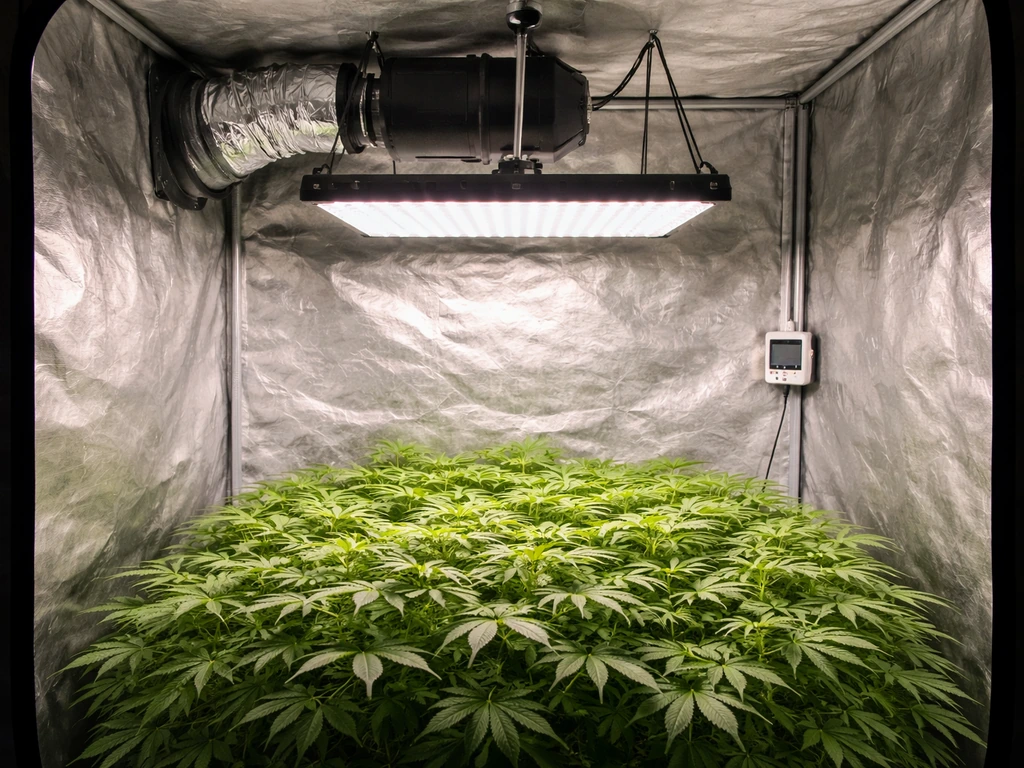
LED fixtures produce less heat than HPS at the same light output, but they're not zero-heat. A 480W fixture in a sealed 4x4 tent will raise temps meaningfully. Budget at least one inline fan sized for your tent volume (a common rule is to exchange tent air every 1-3 minutes), plus a carbon filter if you need odor control. Fanless LED bars typically run their heat into the heatsink fins and then into tent air, so airflow across the fixture still matters for maintaining rated efficacy and driver lifetime. High ambient temps in the driver degrade both output and lifespan faster than any other variable.
Your next steps
Match your tent size to one of the fixtures above, then pull the manufacturer's PPFD map for that light at your planned hanging height. Plug the average canopy PPFD into the DLI formula (DLI = 0.0036 × PPFD × photoperiod hours) and check it against the target for your current grow stage. If the DLI lands in range, you're set. If it's short, either lower your mounting height (within safe limits) or plan for a second fixture. For anyone evaluating a wider field beyond these five, this site covers expanded lists at different wattage tiers and form factors if you want to go deeper on the comparison.
FAQ
Which of the top 5 led grow lights is actually best for my tent, if I don’t know the exact hanging height yet?
Because “top 5” depends on footprint and canopy height, the best choice is the one whose published PPFD map matches your real hanging height and target DLI. If you only know your tent size (for example, 5x5) but not your planned photoperiod and stage, you cannot reliably pick among the top options, and you may end up with a fixture that hits a high peak in the center but undershoots average PPFD at the edges.
If a light claims it covers 4x4 or 5x5, how do I tell whether that’s real at my canopy height?
Look at average PPFD across the usable footprint, not the peak number. Many brands quote a single maximum value or a narrow testing point, so a “4x4” claim may only be true at one specific height and at a particular photoperiod/driver setting. Ask yourself whether you can find a heatmap or grid test results, then confirm your canopy receives the stage target (veg 400-600, flower 700-900 μmol/m²/s average).
What should I do if my tent size is larger than the coverage rating of one of these top 5 led grow lights?
If your tent is bigger than the fixture’s rated coverage, a single light typically cannot deliver the required DLI across the whole canopy. The practical fix is either add a second identical (or closely comparable) fixture at the right spacing, or accept intentionally lower edge PPFD by running the light closer and trimming canopy to keep most plants within the higher-intensity zone.
How can I verify whether a light’s far-red or UV claims are meaningful, not just marketing?
Far-red and UV claims can be marketing-heavy in budget fixtures, so verify the spectral power distribution rather than trusting “full spectrum” wording. Specifically, check that far-red output has a meaningful peak around the expected wavelength range (often ~730 nm) and that UV-B is actually present at non-trivial levels if the manufacturer advertises it. If the S P D is missing or the UV section is blank, treat UV as negligible.
Why does equivalent wattage or lumens not reliably tell me which of these led grow lights will perform best?
Don’t convert a “lumen” spec to decide power for plants. Instead, use μmol/J efficacy (or independent draw and grid PPFD testing) to estimate whether the fixture’s true photon output matches your target DLI. Two lights can have similar wattage but very different real efficacy and heat management, which changes both canopy intensity and long-term reliability.
If I plan to change my schedule from veg to flower, how should I re-evaluate these top choices?
The key is that DLI depends on both PPFD and your photoperiod, so a fixture that seems “strong enough” for veg may be short in flower if you extend dark cycle or run fewer light hours. Example check: compute DLI using DLI = 0.0036 × PPFD × photoperiod hours, then compare against stage expectations (veg often aims 10-25 mol/m²/day, flower often wants high 30s to around 40 for high-light-demand setups).
Do I lose spectrum control if I dim one of these led grow lights?
Many fixtures include dimming, but the spectrum at lower power can change when channels are not independently controlled. If you want stage-specific tuning, prioritize multi-channel lights where each channel can be adjusted separately (like the SolarSystem-style approach described). With single-channel dimming, you can reduce total PPFD, but you may not preserve the exact red-to-blue balance you wanted.
What’s the most common setup mistake that makes a good LED grow light perform worse than expected?
Always budget for airflow and consider driver heat in the tent’s microclimate. Even though LEDs run cooler than HPS, elevated ambient temperatures reduce output and shorten driver lifespan. A common mistake is using a small, undersized exhaust fan or pointing the airflow so it doesn’t move air across heatsink fins, which can quietly erode performance over months.
What should I do if the manufacturer only provides peak PPFD and no PPFD map for the hanging height I use?
If you can only find independent tests for one fixture height (or no heatmaps at all), you should plan conservatively. Treat peak PPFD as an upper bound and aim for your stage target using average PPFD assumptions, then keep a little slack by either raising target DLI margin or preparing to add a second light if your plants show edge deficiency.
How do I decide whether I need a controller-compatible, multi-channel light versus a simpler full-spectrum option?
A controller matters only if it actually supports the control features you need, like channel switching, dimming granularity, and reliable operation at your intended power levels. If you are planning multi-stage spectrum changes, confirm compatibility with the fixture’s dimming method and that the warranty does not restrict controller use. If you are a beginner, a simpler single-spectrum design can outperform a complex one if it is easier to set up correctly.
Next Articles
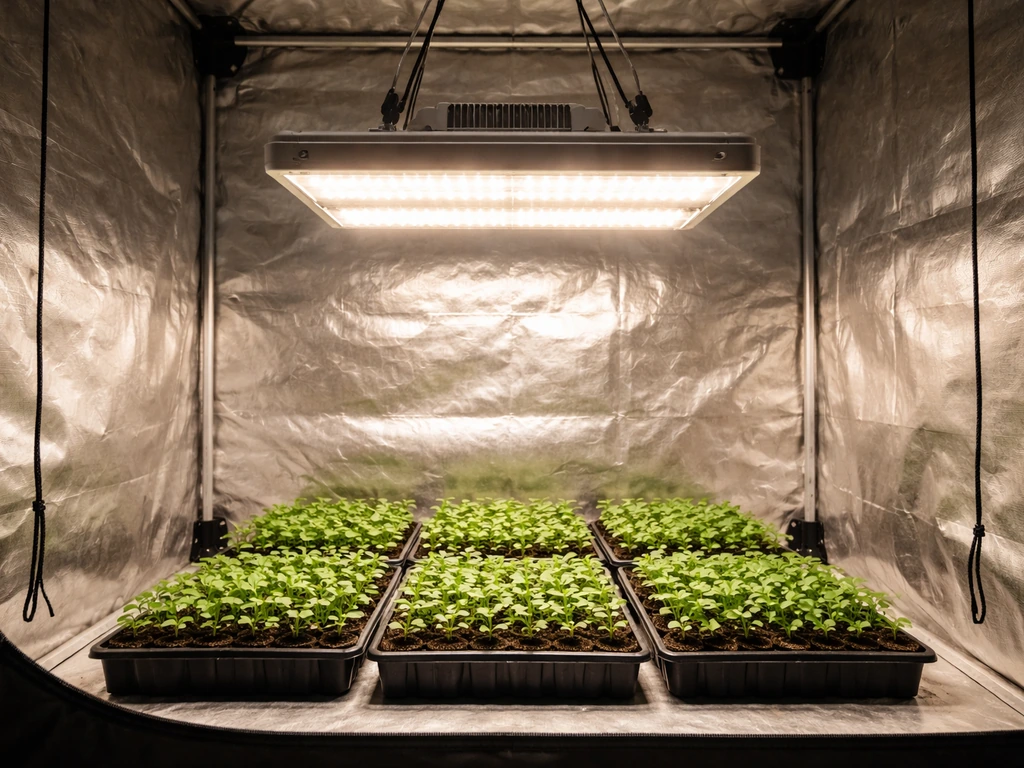
Top 10 LED Grow Lights: Best Picks by Tent Size
Ranked top 10 LED grow lights by tent size with coverage, PPFD, efficiency, and setup tips for 2x2 to 5x5
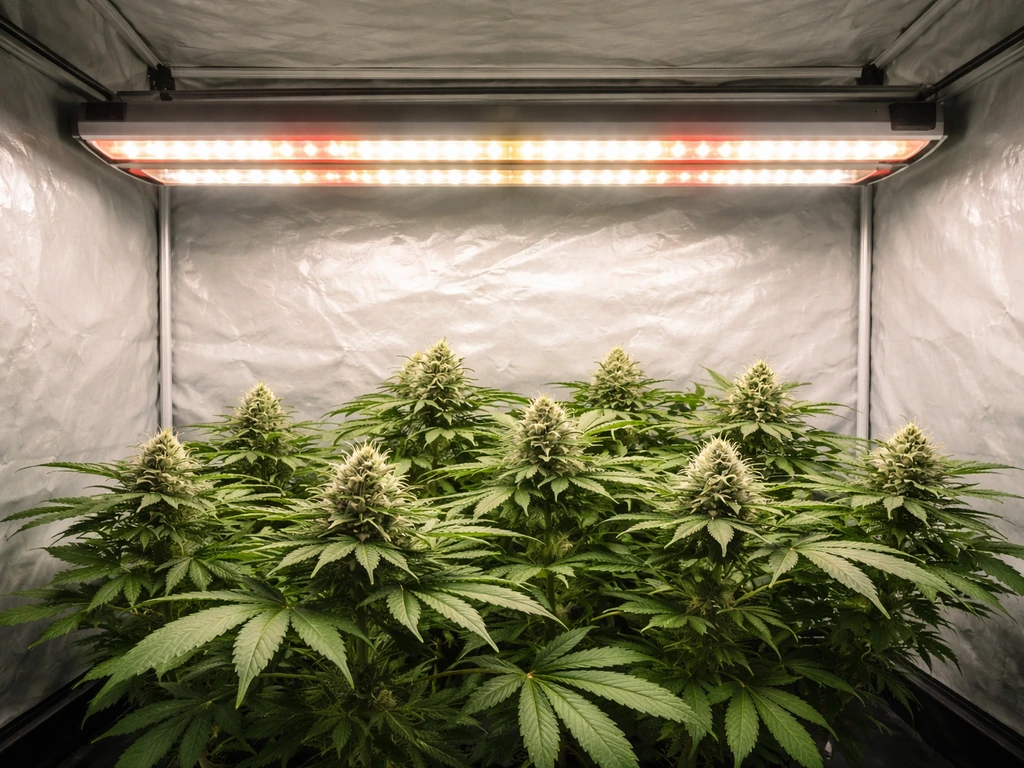
Best Full Spectrum 1000W LED Grow Lights: Buyer Guide
Buy the best full spectrum 1000W LED grow light with spec-to-decision tips on PPFD, coverage, wattage, and tent fit.
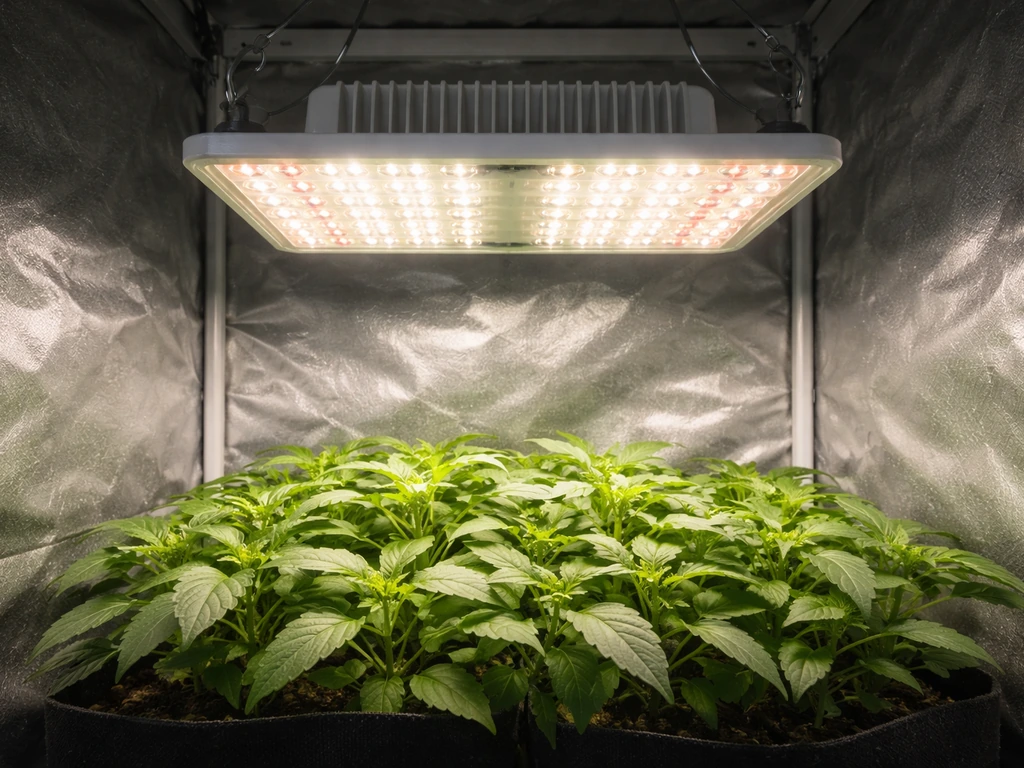
Best 100W LED Grow Light: How to Choose the Right One
Choose the best 100W LED grow light with PPFD coverage, spectrum, efficiency, dimming, heat, and setup tips.