For a single bonsai on a tabletop, a compact full-spectrum LED bar or small panel delivering 100–200 µmol·m⁻²·s⁻¹ at canopy level is enough for most species. For multiple trees on a shelf, you want a bar-style fixture (or two) that covers the full shelf footprint evenly, targeting 150–300 µmol·m⁻²·s⁻¹ depending on whether your species is shade-tolerant or sun-demanding. Run it 12–16 hours per day, keep a uniformity ratio above 0.85 across the canopy, and make sure there's enough blue content in the spectrum to prevent leggy growth. That's the short version. Everything below is how to apply it to your exact setup.
Best LED Grow Lights for Bonsai: Buy Guide and Setup
Marcus Rutherford
23 Apr 2026
What bonsai actually need from a grow light
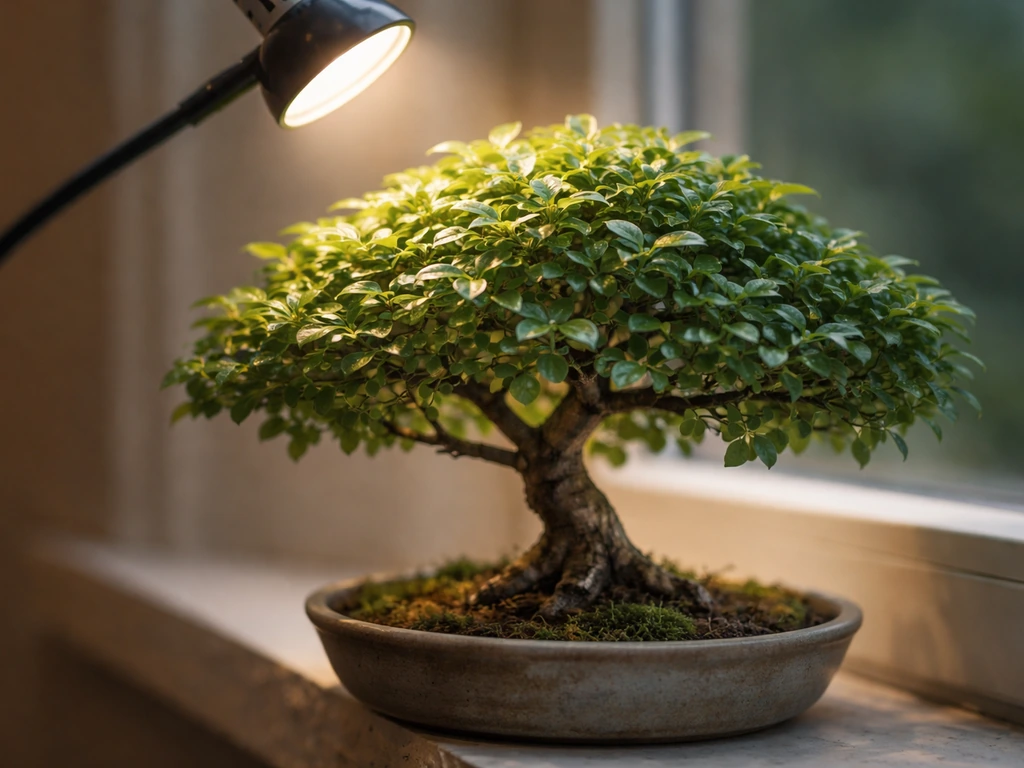
Bonsai have the same photosynthetic needs as any other plant, but the practical constraints are different. You're lighting a small, compact canopy, often indoors where heat and aesthetics matter, and you need the light to promote tight internodes rather than stretchy, leggy growth. That means you care about three things: intensity, spectrum, and uniformity.
Intensity for bonsai is measured as PPFD (photosynthetic photon flux density, in µmol·m⁻²·s⁻¹) at canopy level. Most indoor bonsai species sit comfortably in the 100–250 µmol·m⁻²·s⁻¹ range. If you run a 12-hour photoperiod at 185 µmol·m⁻²·s⁻¹, you're delivering roughly 8 mol·m⁻²·day⁻¹ DLI, which is within the 8–12 mol·m⁻²·day⁻¹ target that MSU Extension research ties to strong root and shoot development.
MSU Extension also notes that a common target minimum average Daily Light Integral (DLI) for many bedding plants and potted crops is 10, 12 mol·m⁻²·d⁻¹ a common target minimum average Daily Light Integral (DLI) is 10–12 mol·m⁻²·d⁻¹.
High-demand species like juniper or ficus can push toward 300 µmol·m⁻²·s⁻¹ or higher, while shade-lovers like serissa or fukien tea sit happily at the lower end.
Spectrum matters more for bonsai than for many other crops because you're actively managing plant shape. Blue light (roughly 400–500 nm) activates cryptochromes and phototropins that suppress internode elongation and increase chloroplast density, which translates to darker, more compact foliage. Too little blue light, or a high far-red content that throws off the red-to-far-red ratio, triggers shade-avoidance responses that stretch internodes and ruin the look of a bonsai. Full-spectrum LEDs that include a solid blue component (typically 15–25% of output) and moderate far-red content work well. Avoid lights that are heavily red/blue 'blurple' in ratio without meaningful green and blue breadth, and be cautious with any fixture that pumps heavy far-red to boost PAR numbers.
Uniformity is the most overlooked spec. A bonsai canopy is small but three-dimensional, and one side getting twice the light of the other leads to uneven growth that undermines the whole aesthetic. A uniformity ratio (minimum PPFD divided by average PPFD across the canopy) of at least 0.85 is the practical target. This is where fixture type and mounting height interact, which is covered in the next section.
Translating specs into a buying decision
PPFD and coverage area
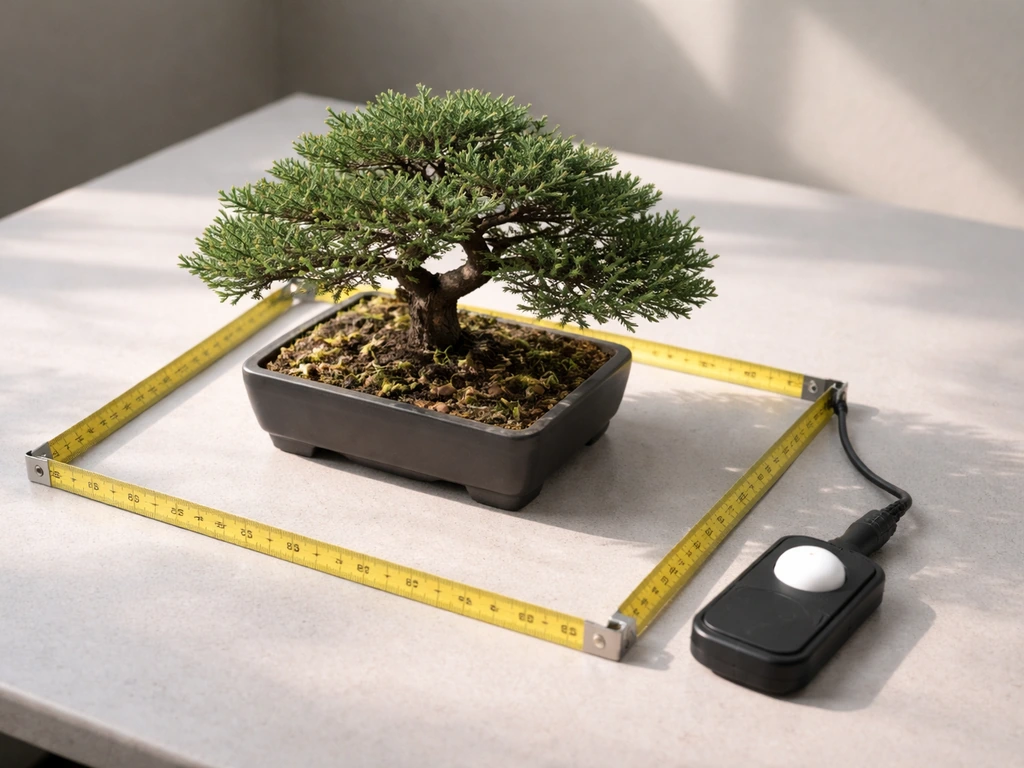
Start by knowing your footprint. A single bonsai pot rarely covers more than a 12x12 inch (0. 09 m²) canopy area. A shelf with four to six trees might span 24x48 inches (0.
75 m²). Once you know the area, work backwards from your target PPFD and photoperiod to calculate DLI using the formula: blank" rel="noopener noreferrer">DLI = 0. 0036 × PPFD × light-hours. A 14-hour schedule at 175 µmol·m⁻²·s⁻¹ delivers about 8.
8 mol·m⁻²·day⁻¹. Fixture manufacturers often publish PPFD maps at specific hanging heights; use those maps to check whether the coverage zone matches your footprint, not just the center-point number. HLG publishes PPFD chart resources for specific bar fixtures like the 650R, including how output changes at different mounting heights PPFD maps at specific hanging heights.
Wattage and efficiency
For bonsai, you rarely need a high-wattage fixture. Most single-tree setups are well-served by 20–40W. A multi-tree shelf might want 60–120W depending on footprint and species. What matters more than wattage is photon efficacy: how many µmol of PAR photons you get per joule of electricity (µmol/J). Modern quality LEDs hit 2.5–3.0 µmol/J. Anything below 1.8 µmol/J is leaving photons on the table as heat. Higher efficacy also means less heat output for the same amount of useful light, which is a real benefit in a living room or bedroom where you don't want a hot fixture baking your trees.
Beam angle
Beam angle determines how the light spreads. A narrow beam (60–90 degrees) concentrates intensity at close range but creates hot spots and drops off fast at the edges. A wide beam (120 degrees or more) spreads light more evenly but requires a higher fixture wattage to hit the same center PPFD. For a single bonsai at close range (12–18 inches above canopy), a 90–120 degree beam angle is usually the sweet spot.
For a shelf of multiple trees, a 120-degree or wider beam, or a bar fixture spanning the shelf length, gives better edge-to-edge uniformity. The general installation guideline is that the mounting height should be at least five times the maximum dimension of the fixture's light-emitting surface to achieve uniform coverage, so a small bar fixture gives you more flexibility than a point-source bulb at low mounting heights.
Fixture types that make sense for bonsai
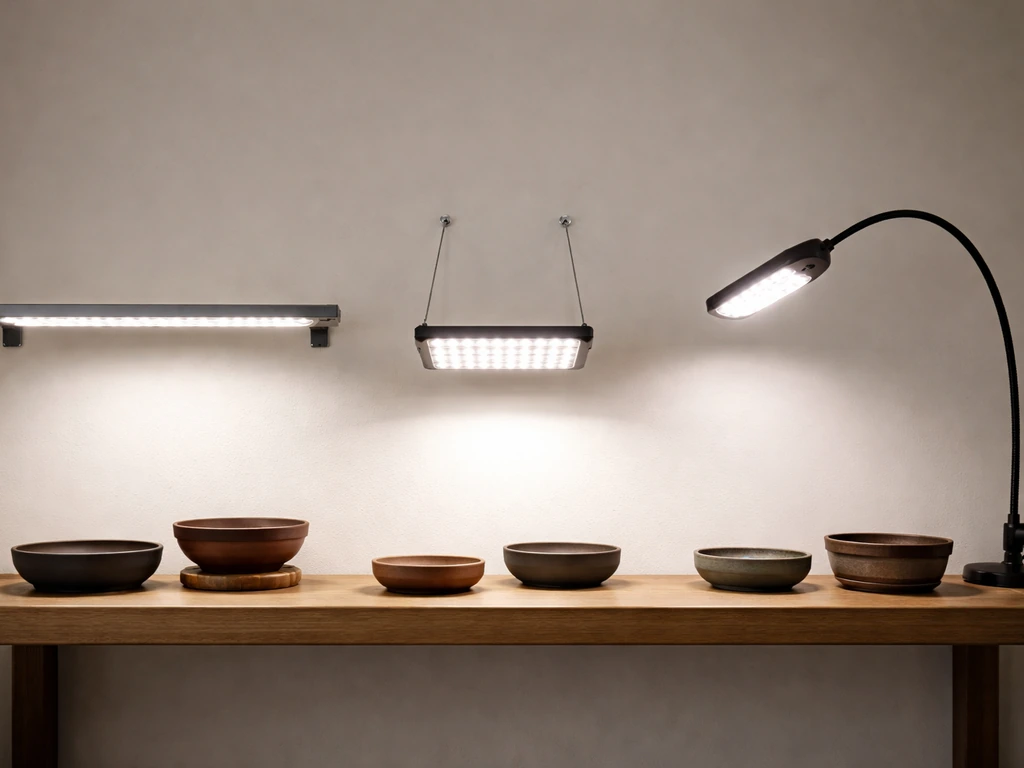
| Fixture Type | Best For | Typical Wattage Range | Uniformity | Heat Output | Aesthetics |
|---|---|---|---|---|---|
| LED Bar / Strip | Multi-tree shelves, linear coverage | 20–80W per bar | Excellent over long footprint | Low | Sleek, low profile |
| Small Panel / Quantum Board | Single tree or tight 2x2 ft area | 25–65W | Good center, drops at edges | Low to moderate | Compact, functional |
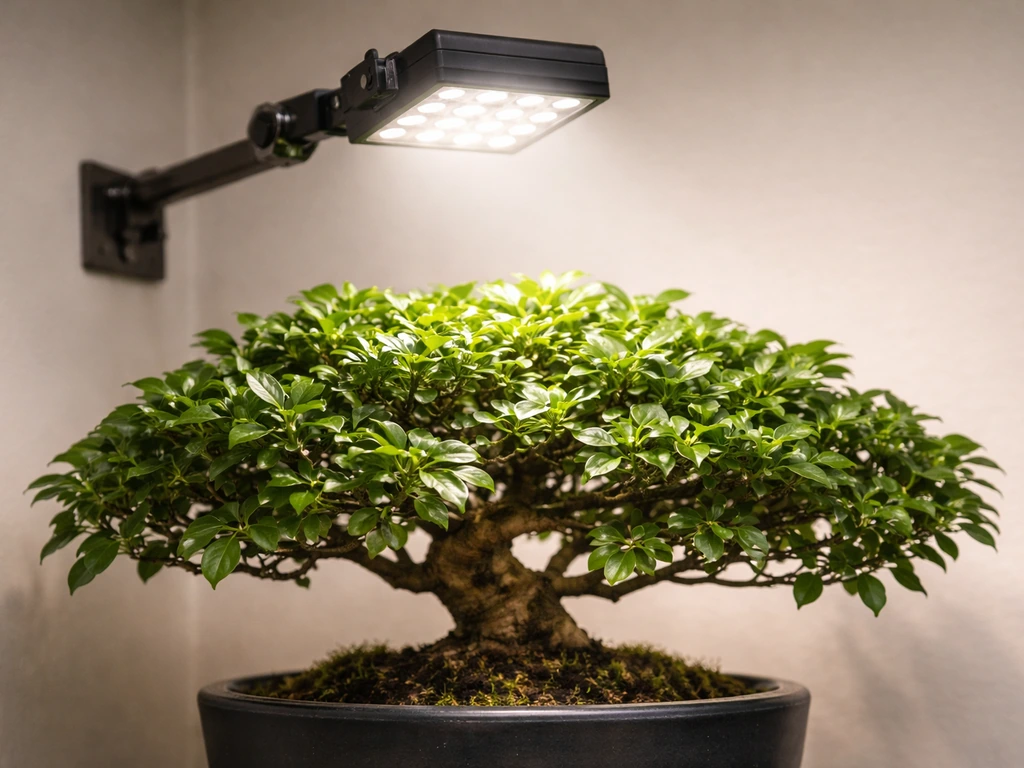
| Adjustable Arm / Clip-On | Single tree, tabletop use | 10–30W | Fair, depends on beam angle | Low | Discreet, flexible placement |
| Full-Size Panel (>100W) | Not ideal for bonsai | 100W+ | Overkill for small canopy | Moderate to high | Intrusive indoors |
LED bars are genuinely the best all-around choice for a bonsai shelf. They distribute photons along their full length, which maps naturally onto a row of trees. Many bar systems let you daisy-chain multiple bars off one driver, which keeps the wiring tidy and lets you scale as your collection grows. Small quantum board panels work well for a single tree where you want a bit more coverage area than a strip provides.
Clip-on or adjustable arm fixtures are the most convenient for a tabletop single bonsai, but check the PPFD specs carefully, because a lot of clip-on 'grow lights' on the market are dramatically underpowered. Avoid the worst LED grow lights, since many are dramatically underpowered or skew the spectrum in ways that lead to leggy, stretched growth. A 10W clip-on making 30 µmol·m⁻²·s⁻¹ at canopy level is not going to sustain healthy bonsai long-term.
For bonsai specifically, fanless LED fixtures are strongly preferable. Fan noise is irritating in a living space, fan dust accumulation is a maintenance headache, and most compact, efficient LEDs run cool enough to not need active cooling at bonsai-relevant wattages. Look for passive heat sink designs with aluminum housings.
How to set up your light correctly
Mounting height and aiming
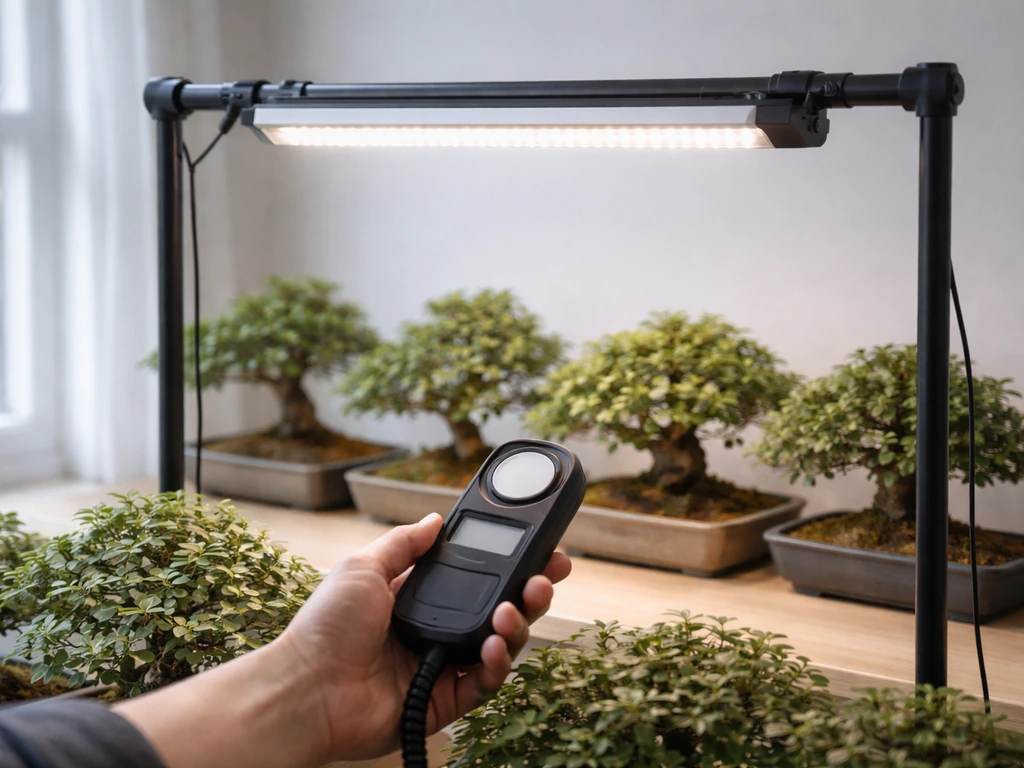
Most compact LED bars and panels used for bonsai perform well at 12–24 inches above the canopy. Start at 18 inches and measure actual PPFD with a meter. If you're hitting above 300 µmol·m⁻²·s⁻¹ on a shade-tolerant species, raise it. If you're below 100 µmol·m⁻²·s⁻¹ on a sun-demanding species at 18 inches, bring it down or increase wattage. Aim the light so it covers the full crown of the tree, not just the center. For a shelf setup, the bar should run the full length of the shelf, centered above the row of trees.
Timer schedule and photoperiod
Most temperate bonsai species (maples, junipers, pines) benefit from 12–14 hours of light per day indoors. Tropical species (ficus, fukien tea, jade) can handle 14–16 hours. Do not try to compensate for a low-output light by running it 20 hours a day, because many bonsai species require a dark period for healthy metabolism. Use a simple plug-in timer and keep the schedule consistent. Wildly varying photoperiods stress the plant and can trigger undesired dormancy or flowering responses at the wrong time.
Preventing leggy growth
Leggy growth (long internodes, pale leaves, reaching stems) is almost always a light-deficiency problem, a spectrum problem, or both. If your bonsai is stretching toward the light, first check actual PPFD at canopy level. If it's below 100 µmol·m⁻²·s⁻¹, the plant is starved. If PPFD is adequate but the growth is still leggy, look at the spectrum. A fixture with very little blue output or very high far-red content can trigger shade-avoidance elongation even at adequate intensity. Choose a fixture with a meaningful blue peak and a balanced spectrum rather than one optimized purely for flower-stage output.
Common mistakes bonsai growers make with LEDs
- Buying underpowered clip-on lights: Many decorative 'plant grow lights' are marketed to bonsai but deliver 20–50 µmol·m⁻²·s⁻¹, which is barely above typical indoor ambient light. The plant survives but doesn't thrive.
- Placing the light too close: Compact LEDs at 4–6 inches can deliver 500+ µmol·m⁻²·s⁻¹ on the nearest branch, causing bleaching or leaf burn on fine bonsai foliage. Start at 18 inches and work down.
- Using a light optimized for flowering: High red-heavy, high far-red fixtures designed for cannabis flowering promote elongation in bonsai. That's the opposite of what you want.
- Ignoring uniformity: Hanging a single point-source light over a wide shelf means the center tree gets three times the light of the end trees. Use a bar or space multiple lights for even coverage.
- Skipping a timer: Manual on/off schedules drift. Inconsistent photoperiods stress the plant and make it harder to diagnose growth problems.
- Assuming watts equal output: A 45W LED from a quality manufacturer with 2.7 µmol/J efficacy produces significantly more PAR than a 45W 'blurple' panel from five years ago running at 1.5 µmol/J. Always look for PPFD data or efficacy specs, not just wattage.
Which light to get for your specific setup
Here are the scenarios that cover most bonsai growers, with concrete direction for each.
Single tree on a tabletop (budget pick)
Look for a full-spectrum LED panel or adjustable arm light in the 20–35W range from a brand that publishes actual PPFD data. For shelf and multi-tree comparisons, you can also look at guides for the best led grow light canada options to match coverage to your footprint. You want to see at least 150 µmol·m⁻²·s⁻¹ at 12 inches. Budget options from brands like Barrina, Haus Bright, or similar no-fan bar fixtures in the $25–$45 range can genuinely work here if you verify the PPFD spec. Avoid anything marketed primarily as a 'decorative accent' plant light.
Single tree on a tabletop (top pick)
A small quantum board panel like those using Samsung LM301H or LM301B diodes in the 30–45W range gives you excellent spectral quality, high efficacy (2.5–2.8 µmol/J), and precise dimming control. Brands like Spider Farmer (SF-1000 or smaller), Mars Hydro TS600, or similar compact panels in the $60–$90 range are consistently strong performers. These are the same diode families you'll find discussed in guides covering the best Samsung LED grow lights. Dimmability is a major plus here since you can dial back to 50% for shade-tolerant species and push higher for sun-lovers without changing mounting height.
Multiple trees on a shelf (2–4 ft shelf)
This is where LED bars shine. A 24-inch or 48-inch bar fixture, or a pair of daisy-chained 24-inch bars, gives linear coverage that aligns perfectly with a shelf of trees. Look for full-spectrum bars in the 40–80W range with published PPFD maps showing at least 150 µmol·m⁻²·s⁻¹ uniformly across the shelf width. Govee, Barrina T5-style full-spectrum bars, and grow-specific bars from Spider Farmer or Horticulture Lighting Group (HLG) all have relevant products in this size range. For a collection that's expanding, the daisy-chain capability is worth prioritizing.
High-demand species or a mini grow tent setup
If you're growing sun-demanding species like juniper, olive, or citrus bonsai indoors, or you've set up a small grow tent (a 2x2 or 2x4 is common for bonsai collections), you need more output. Target 250–350 µmol·m⁻²·s⁻¹ at canopy level. A 65–100W full-spectrum quantum board with dimming control covers a 2x2 area well and gives you headroom to adjust. HLG 65 V2, Spider Farmer SF-1000, or similar boards are worth the price for serious growers. Check out broader coverage comparisons if you're scaling up to a tent setup, since full 4x4 grow scenarios involve different fixture sizing logic than a single bonsai shelf.
| Scenario | Target PPFD | Wattage Range | Fixture Type | Budget Range |
|---|---|---|---|---|
| Single tree, casual grower | 100–175 µmol·m⁻²·s⁻¹ | 20–35W | Clip-on arm or small bar | $20–$45 |
| Single tree, serious grower | 150–250 µmol·m⁻²·s⁻¹ | 30–50W | Compact quantum board | $60–$95 |
| Multi-tree shelf (2–4 ft) | 150–250 µmol·m⁻²·s⁻¹ | 40–80W | Full-spectrum LED bar(s) | $40–$120 |
| High-demand species / grow tent | 250–350 µmol·m⁻²·s⁻¹ | 65–100W | Quantum board with dimmer | $100–$200 |
Verifying your light is actually doing the job
The single most useful tool after buying a grow light is a quantum PAR meter. The Apogee MQ-500 or MQ-510 are the most accurate consumer-level options (measurement range up to 4000 µmol·m⁻²·s⁻¹, calibration uncertainty around ±5%) and cost $250–$350. That's overkill for a casual hobbyist with one tree. For most bonsai growers, a budget PAR meter in the $30–$60 range (like the Uni-T or Sper Scientific models) gives accuracy within 10–15%, which is good enough to confirm you're in the right ballpark. Take readings at canopy level at the center and at the outer edges of each tree to check uniformity.
If you don't want to spend anything on a meter, use visual indicators: healthy compact growth with dark green leaves and short internodes means your light is working. Pale yellow-green leaves or stretching stems means more intensity or better spectrum is needed. Bleached, crispy, or brown leaf tips mean the light is too close or too intense. These visual checks are slower feedback loops than a meter, but they work.
Post-installation checklist
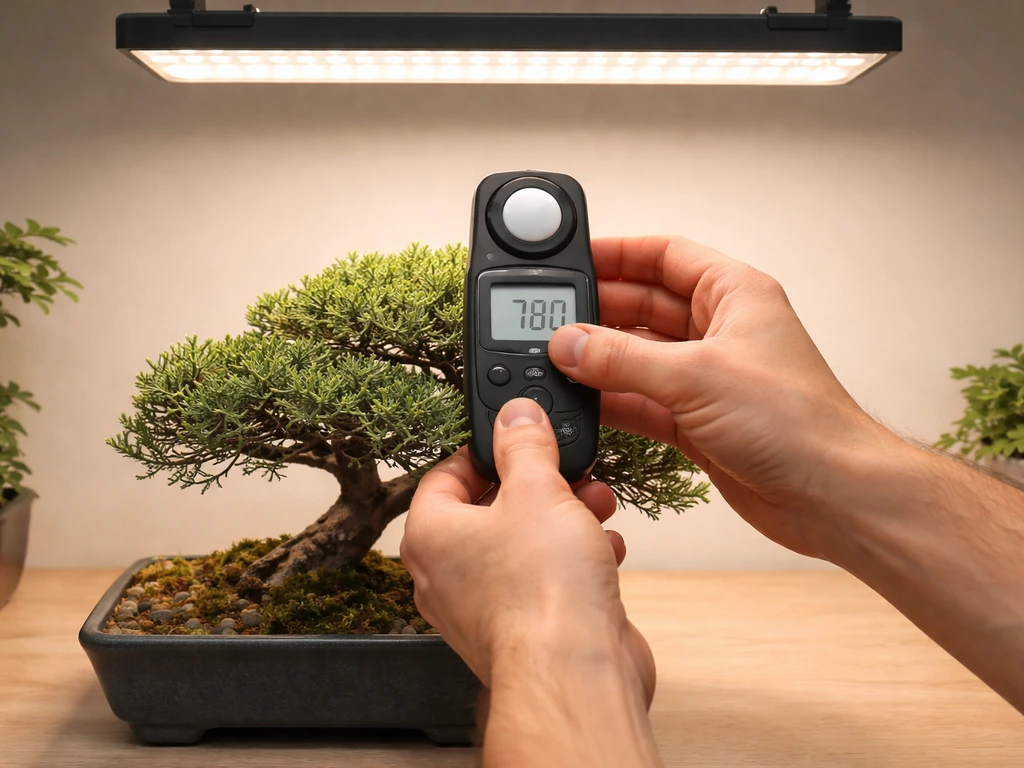
- Measure PPFD at canopy center and at least two edge points to confirm uniformity above 0.85 ratio.
- Set your timer and verify the light runs the correct photoperiod for at least three consecutive days.
- Check mounting height against the fixture's published PPFD map and adjust until you hit your target range.
- Inspect foliage after two weeks for signs of stretch (too little light) or bleaching (too much).
- After 30 days, check for any unexpected growth patterns and adjust spectrum, intensity, or photoperiod as needed.
- Re-measure PPFD every 6–12 months, because LED diodes do degrade slowly over time and output drops measurably after 2–3 years of heavy use.
One final note: the fixtures that perform best for bonsai are often the same quality LED boards and bars that dominate performance comparisons for other small-scale growing scenarios. If you've already been evaluating grow lights for other uses, you're not starting from scratch. The spectrum and efficiency criteria that make a light good for compact vegetative growth in any context make it good for bonsai. The difference is scale: you need less total output, more attention to uniformity across a small footprint, and a spectrum that keeps internodes tight rather than promoting elongation.
FAQ
Do I need a full-spectrum light, or will a red-blue “blurple” style LED work for bonsai?
A blurple light can sometimes keep plants alive, but for shaping bonsai it often underperforms because spectrum balance matters. If the fixture’s blue output is weak or far-red is too high, you can get internode elongation even when PPFD looks adequate. For decision-making, prioritize published PPFD maps plus a meaningful blue component (roughly 15–25% output) and a spectrum that is not just red and blue peaks.
How do I tell if my light is strong enough without buying a PAR meter?
Use a two-step visual plus placement check. First, confirm leaf color stays in a normal green range and internodes remain short (no consistent “reaching” direction). Second, if you see stretching, lower mounting height or increase output, but avoid boosting intensity by moving closer if leaf tips begin to brown or crisp. This avoids the common mistake of using brightness alone instead of canopy-level adequacy and spectrum.
What if my bonsai is getting uneven growth, one side bigger than the other?
Treat it as a uniformity and positioning problem. Make sure the bar or panel covers the entire crown, not just the center, and check edge-to-edge readings if you use a meter (minimum PPFD to average PPFD target is at least 0.85). If you cannot measure, rotate the tree and observe whether the “better lit” side changes, that helps confirm whether the issue is lighting geometry versus species traits or watering.
Should I run bonsai lights longer if my trees look slow?
Usually no. Extending beyond typical photoperiods can stress metabolism and does not fix spectrum deficiencies. If growth is slow, first verify actual canopy PPFD at the tree height, then adjust mounting height or dimming. Only change light-hours after you confirm you are already in the correct intensity and spectrum range.
What photoperiod should I use if I have both tropical and temperate bonsai on the same shelf?
Avoid one photoperiod for mixed types if you can. Ideally split them into separate areas or use dimming plus different schedules via separate fixtures. If you must combine them, choose the schedule that matches the most light-demanding species and control intensity so the shade-tolerant ones are not overdriven, over-intensity often shows up as tip burn rather than stretching.
How close should I mount the LED to prevent leggy growth without burning leaves?
Start around 18 inches above the canopy as a baseline for many compact bars and panels, then measure or observe feedback. If you are below about 100 µmol·m⁻²·s⁻¹ on a sun-demanding species, lower the fixture or increase output. If leaf tips turn brown, crispy, or bleached, back off by raising the light or reducing dimming. A common mistake is moving too close to chase PPFD without checking for heat stress or localized hotspots.
What beam angle should I choose for a tabletop single bonsai versus a shelf with multiple trees?
For a single tree close-range setup, a 90–120 degree beam is usually a good balance between coverage and hotspot avoidance. For multiple trees across a shelf, wider coverage (120 degrees or more) or a linear bar spanning the shelf width helps maintain uniformity across the entire footprint. If you pick a narrow-beam light for a shelf, you often end up with strong center light and weak edges.
Is fanless cooling really necessary for indoor bonsai lights?
It is strongly recommended for living spaces, mainly for noise and dust maintenance. Most efficient LEDs at bonsai-relevant wattages can stay within safe temperatures using passive aluminum heat sinking. If a fixture has active fans, plan for cleaning cycles and check whether the fan noise is noticeable at the distance you actually use in the room.
Can I daisy-chain multiple LED bars safely and still maintain good performance?
Sometimes, but only if the fixture and driver are designed for it. Use the manufacturer’s approved daisy-chain capability to avoid overloading drivers or creating uneven power distribution across the run. After chaining, verify uniformity at canopy level because multiple bars can still create edge drop-off depending on hanging height and beam angle.
How important is dimming for bonsai?
It can be very important because different species and seasons may need different PPFD. Dimming also helps prevent overshooting on shade-tolerant species without changing mounting height. If your light supports dimming, start at a moderate setting, measure or observe at canopy level, then adjust for sun-lovers upward while pulling shade-tolerant types back to avoid bleaching and tip burn.
What wattage should I choose, and does higher wattage always mean better for bonsai?
Higher wattage can mean higher output, but it does not guarantee useful PPFD at canopy level or good spectrum. Choose based on published efficacy (µmol/J) and, most importantly, measured or mapped PPFD coverage at your intended hanging height. A fixture with poor photon efficacy can waste electricity as heat and still fail to deliver the intensity your bonsai needs uniformly.
Are quantum board panels good for bonsai, and what makes them different from bars?
Quantum board panels can be excellent, especially for a single tree, because they often provide higher spectral control and dimming options. The key difference is coverage shape. If your canopy area is wider than the board’s effective spread, you may get edge drop-off compared to a bar that matches a linear row. For a shelf of multiple trees, bars often produce more naturally aligned uniformity.
What should I do if my bonsai looks pale and the leaves feel thin?
Pale, washed-out leaves and weak growth often indicate either insufficient intensity or an imbalance in spectrum. First check canopy PPFD at the outer edges as well as the center. If PPFD is low, raise light output or move the fixture closer within safe limits. If PPFD is adequate, evaluate spectrum quality, especially blue content and excess far-red that can alter growth patterns.
How do I measure uniformity correctly if I can use a meter?
Measure at canopy level across points that represent each tree’s crown, including the outer edges and the center. Uniformity ratio uses minimum PPFD divided by average PPFD across the measured canopy area. Make adjustments to hanging height, beam angle selection, or fixture spacing until the minimum value stays close enough to the average (at least 0.85) to preserve bonsai aesthetics.
Should I acclimate my bonsai when switching to a stronger LED grow light?
Yes, acclimation helps prevent shock from a sudden increase in PPFD. Start slightly lower than your final target (or start with reduced dimming if available), then adjust over several days while monitoring leaf color and tip condition. This reduces the common mistake of going from a weak “decorative” light to a high-output fixture overnight.
Next Articles
Best LED Grow Light Canada Guide for Indoor Plants
Canada guide to the best LED grow lights: choose wattage, coverage, spectrum, and avoid misleading claims for seedlings
Best Samsung LED Grow Lights Review and Buying Guide
Hands-on review and guide to the best Samsung LED grow lights, with PPFD coverage, mounting tips, and top picks for tent
Worst LED Grow Lights: How to Spot Bad Lights Fast
Spot bad LED grow lights fast: red flags, placement checks, specs to verify, and fixes for tents and flowering.