
The honest answer to 'what's the best 1500W LED grow light' depends almost entirely on which definition of 1500W you're working with, because in 2026 that label still means two very different things. A true 1500W fixture pulls 1500 watts from the wall. A '1500W-equivalent' fixture might draw anywhere from 300W to 700W and is simply marketed against the output of a 1500W HPS. Neither is automatically better, but confusing the two is the fastest way to buy the wrong light. This guide walks you through how to read the specs correctly, what numbers actually predict canopy performance, and how to pick the right 1500W-class LED for your specific grow.
Best 1500 Watt LED Grow Light: Buyer Guide for True Performance
Marcus Rutherford
19 Apr 2026
What '1500W' really means on the label
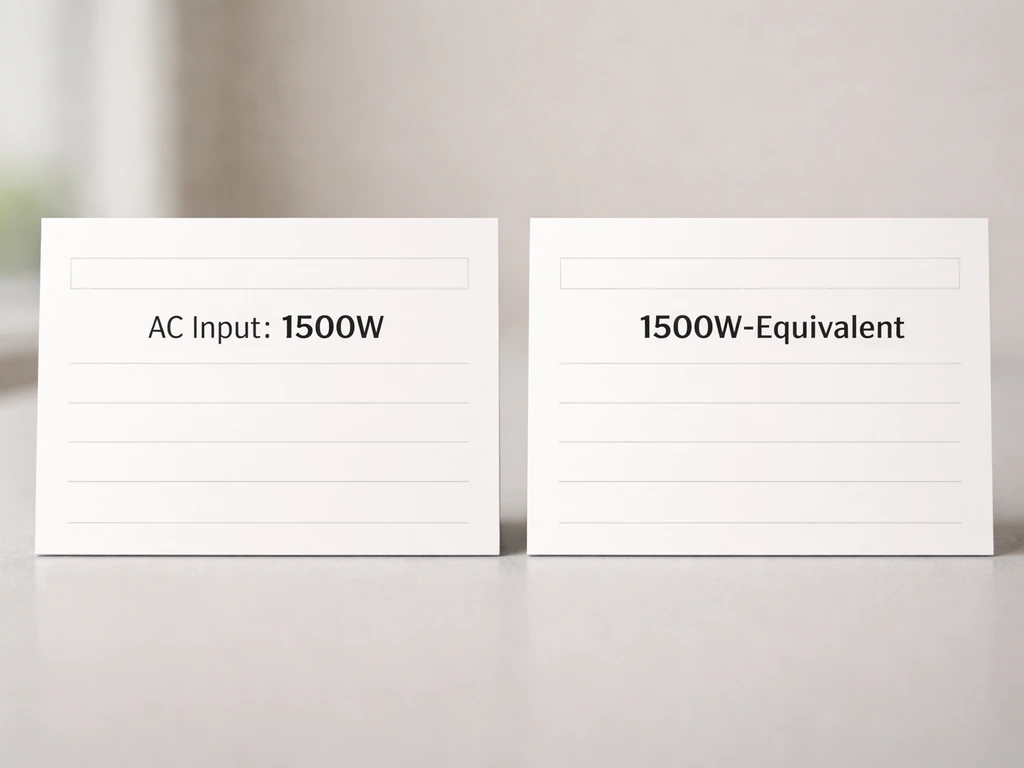
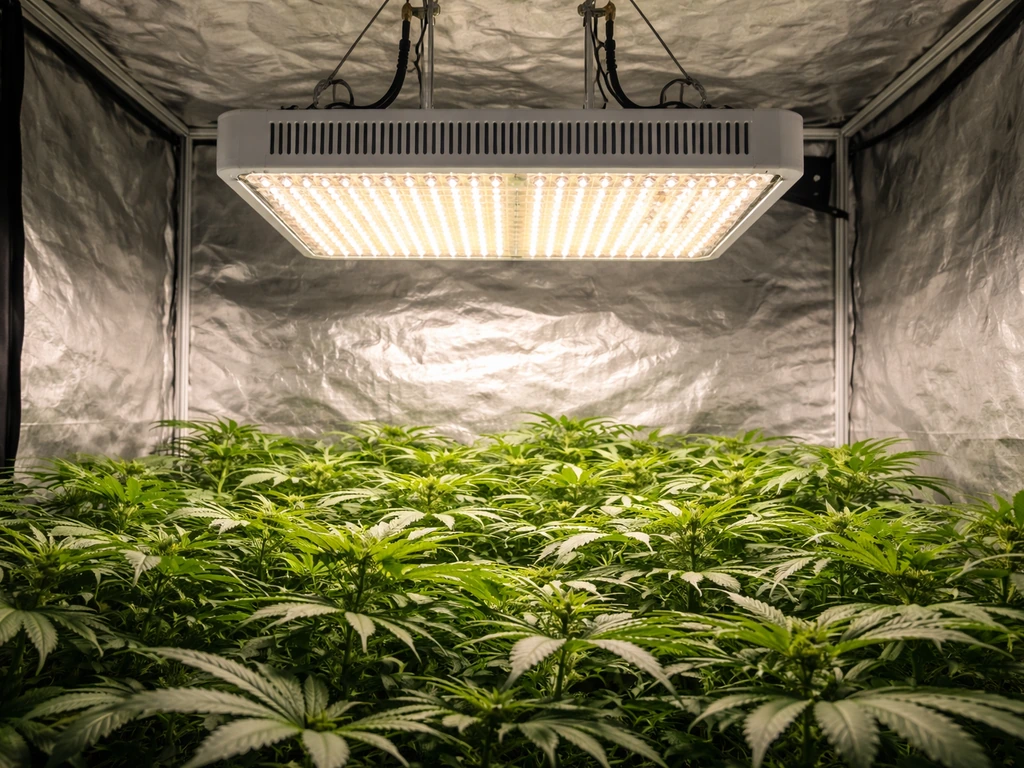
When you see '1500W' on a grow light listing, check whether it refers to actual power draw or HPS-equivalent marketing. Reputable brands list AC input power in their specs, usually in watts at a specific voltage (e.g., 1065W @ 230V AC). That number is what matters for your breaker and your electricity bill. The 'equivalent' claim is a rough marketing comparison to a 1500W double-ended HPS, and it typically means the LED is hitting a similar photon output at a fraction of the electrical draw, somewhere in the 500W–800W range for a mid-to-high-efficiency fixture.
The cleaner way to categorize 1500W-class lights is by their PPF output, which is the total photosynthetically active photons the fixture produces per second, measured in micromoles per second (µmol/s). Some commercial manufacturers, like Dimlux with their Xtreme series, actually name fixtures by their PPF output (e.g., a '1500 µmol/s' model) rather than watts, and pair that with the actual AC input power so you can calculate real efficiency. That is the right way to shop. If a brand doesn't list PPF alongside actual draw, treat the wattage claim skeptically.
| Label Type | What It Tells You | What to Verify |
|---|---|---|
| True 1500W draw | Actual electrical consumption; ~1500W from your outlet | PPF output, µmol/J efficiency, coverage area |
| 1500W HPS-equivalent | Marketing comparison; real draw typically 300W–800W | Actual wattage, PPF, and real PPFD at your canopy height |
| 1500 µmol/s PPF-rated | Photon output is labeled directly (commercial standard) | AC input power to confirm efficiency (µmol/J = PPF ÷ watts) |
As a rule of thumb: divide the stated PPF (µmol/s) by the actual wattage draw to get efficiency in µmol/J. In 2026, a solid LED sits at 2.5–3.0 µmol/J. Anything below 2.0 µmol/J is either old technology or a budget panel that's leaning hard on the marketing. Anything above 3.0 µmol/J is genuinely high-end, like the Gavita RS 1900e territory at ~3.0 µmol/J.
The specs that actually predict canopy performance
Wattage is just the starting point. The four metrics that tell you what the light will actually do at your canopy are PPF, PPFD, efficiency (µmol/J), and uniformity. Here's how to use each one.
PPF: the fixture's total photon output
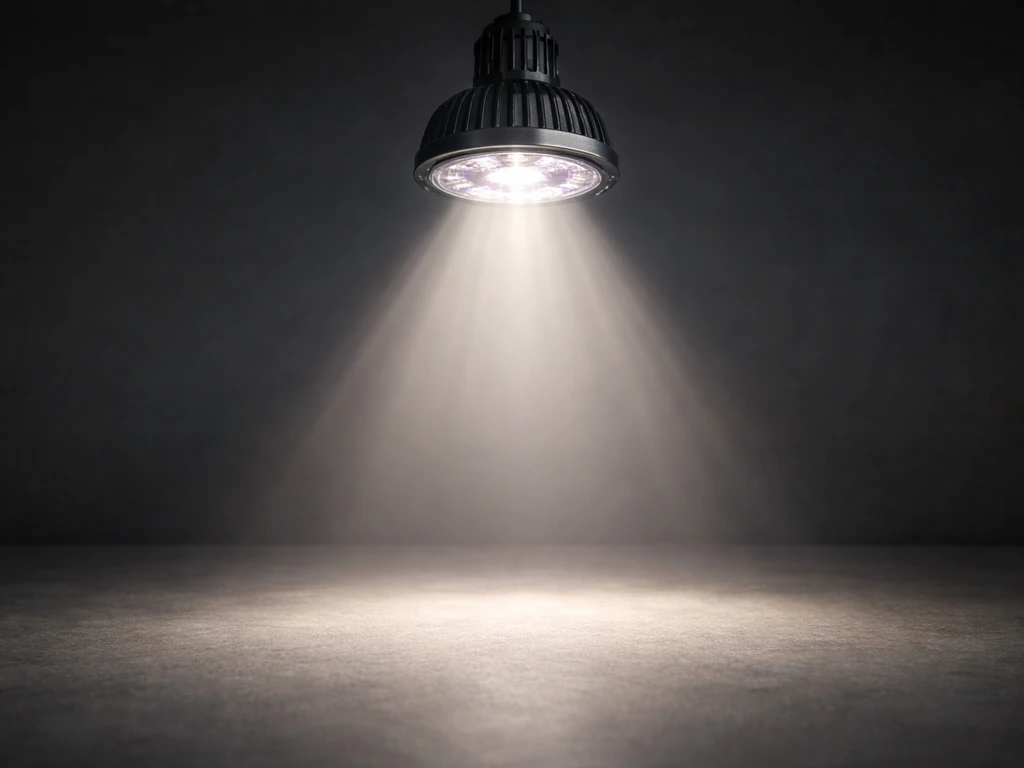
PPF (photosynthetic photon flux) is the total PAR photons (400–700 nm) a fixture produces per second, in µmol/s. It's a fixture-level number, independent of distance and area. A fixture drawing 480W at 2.5 µmol/J efficiency produces 1,200 µmol/s PPF. That PPF is then spread across your canopy area, giving you PPFD. Higher PPF at the same draw means a more efficient fixture.
PPFD: what the plant actually receives
PPFD (photosynthetic photon flux density) is the photon delivery rate at a specific point on the canopy, measured in µmol/m²/s. It's what you're really targeting for each growth stage. PPFD changes with mounting height, and it changes dramatically: dropping the fixture by a few inches concentrates the intensity; raising it spreads the footprint and reduces peak PPFD. Always look at manufacturer PPFD maps at the specific hanging height you plan to use, not just the headline number.
Efficiency and DLI
Efficiency (µmol/J or PPE) tells you how many photons you get per watt consumed. DLI (daily light integral) translates your PPFD target into total daily photon dose, using the formula: DLI (mol/m²/day) = 0.0036 × PPFD (µmol/m²/s) × light hours per day. If you're running 18-hour veg at 400 µmol/m²/s, your DLI is about 26 mol/m²/day, which is solid for most leafy crops and cannabis veg. This is how you decide if a fixture, at your planned mounting height and photoperiod, actually delivers enough light for your specific crop.
Uniformity: the number brands hide
Uniformity is the ratio of minimum PPFD to average PPFD across the canopy. A min:average ratio of 0.75 or higher means your canopy is getting reasonably even light, so plants at the edges aren't getting dramatically less than plants under the center. The minimum acceptable threshold for a functional grow is around 0.6 (the conservative benchmark used in academic lighting evaluation), but 0.75–0.80 is a more realistic target for a commercial or serious hobbyist setup. If a brand doesn't publish a PPFD map with uniformity data, it's usually because the uniformity is bad.
Spectrum: matching your light to the growth stage
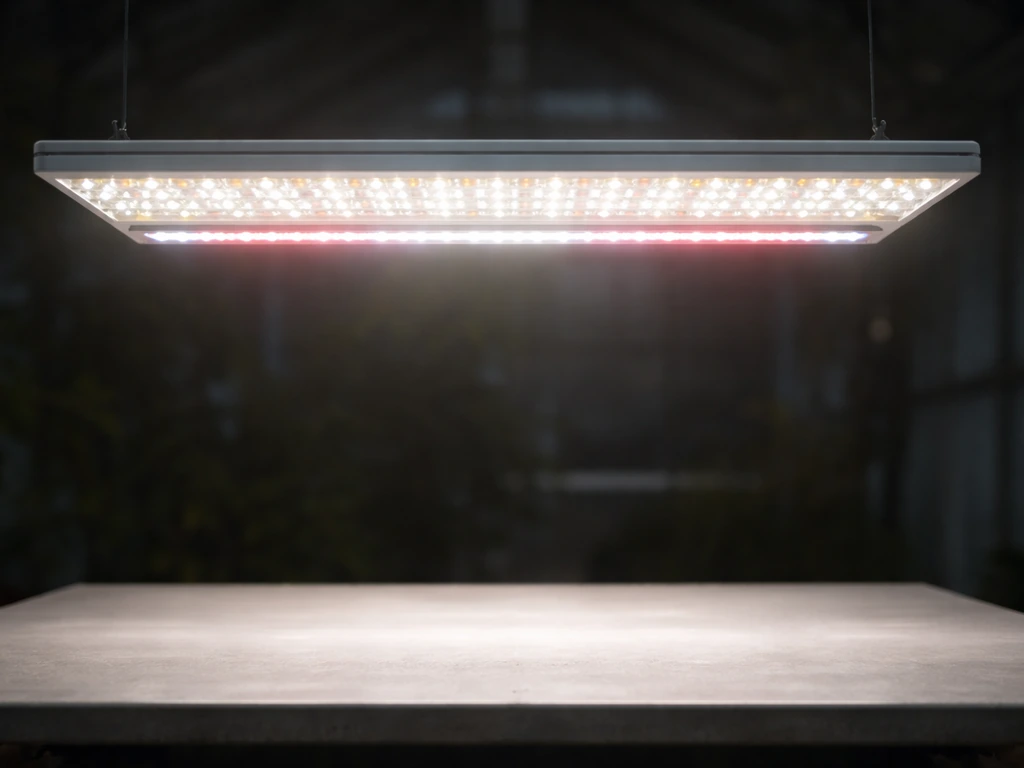
Full-spectrum LEDs in the 1500W class cover the entire PAR range (400–700 nm) with a white broad-spectrum output, typically from high-efficiency Samsung or similar diodes. Most quality fixtures at this wattage also include supplemental far-red (around 730 nm) and sometimes UV (around 395 nm) channels. Far-red at 730 nm drives the Emerson enhancement effect and accelerates flowering responses, so it's particularly useful in the final weeks of bloom. UV at 395 nm can stimulate trichome production and improve resin density in cannabis, though the research on this is more nuanced and fixture implementations vary widely.
For most growers, a quality white-spectrum LED with integrated far-red covers all stages well. Veg and seedling work doesn't require specialized spectrum; it's mostly about PPFD intensity, with seedlings needing just 100–300 µmol/m²/s and vegetative growth ranging from 400–600 µmol/m²/s. Bloom is where higher PPFD (600–900+ µmol/m²/s for high-light crops like cannabis) and far-red supplementation pay off.
- Seedling/clone stage: 100–300 µmol/m²/s; mount the fixture high or dim it significantly
- Vegetative growth: 400–600 µmol/m²/s; full-spectrum white light is ideal
- Early flower: 600–750 µmol/m²/s; far-red supplementation starts to matter
- Peak bloom: 750–900+ µmol/m²/s for high-light crops; UV can be beneficial here
- CO2-enriched environments: can push to 1,000–1,200 µmol/m²/s at peak bloom
Veg/bloom switchable fixtures let you run fewer diodes in veg (saving electricity) and switch on additional channels for flower. That's a nice feature but not essential if you have dimming control. What matters more is whether the base spectrum is balanced and the far-red channel is actually at 730 nm, not just a warm white boost being marketed as 'bloom mode.'
What grow sizes the 1500W class actually fits
A true 1500W fixture at 2.5–3.0 µmol/J efficiency produces roughly 3,750–4,500 µmol/s PPF. Spread across a 5x5 canopy (2.3 m²), that's a theoretical average of about 1,630–1,960 µmol/m²/s before accounting for spread losses, which is more than enough for even CO2-enriched environments. In practice, at a real hanging height of 18–24 inches, you'd dial this down with dimming to avoid bleaching. That's why a true 1500W fixture is really a 5x5 to 6x6 light, and it's overkill for a single 4x4.
A '1500W-equivalent' fixture drawing 500–700W at 2.5 µmol/J produces 1,250–1,750 µmol/s PPF, which maps well to a 4x4 canopy (1.6 m²) at flowering PPFD targets of 700–900 µmol/m²/s at 18–24 inch hanging height. This is the sweet spot for the most common grow tent size and the category where most budget and mid-range 1500W-labeled fixtures actually live.
| Fixture Type | Actual Draw | Typical PPF | Best Canopy Fit | Typical Tent Size |
|---|---|---|---|---|
| True 1500W LED | ~1,500W | 3,750–4,500 µmol/s | 5x5 to 6x6 ft canopy | 5x5 or 6x6 tent |
| 1500W-equivalent LED (mid-range) | 500–700W | 1,250–1,750 µmol/s | 4x4 to 5x5 ft canopy | 4x4 or 4x8 tent |
| 1500W-equivalent LED (budget) | 300–500W | 600–1,100 µmol/s | 3x3 to 4x4 ft canopy | 3x3 or 4x4 tent |
If you're shopping for a 4x4 tent, the 1500W-equivalent category is your range, and it overlaps considerably with what's covered in best 1200W LED grow light guides. If you're running a 5x5 or larger, you're looking at either a true 1500W draw fixture or multiple 1500W-equivalent bars. For smaller spaces like a 3x3, the 1500W class is usually oversized and a 150W or 200W-class fixture is a better match.
The feature checklist that separates real performers from marketing
Once you've found fixtures with transparent wattage and PPF specs, here's what to look at in the build itself. These are the factors that predict long-term performance and reliability.
LED type and form factor
Bar-style fixtures distribute LEDs across multiple strips, which improves uniformity across wide canopies and reduces heat concentration. Board-style (quantum board) fixtures concentrate LEDs on a single panel, which works well for smaller footprints but can create a hot center. COB fixtures use dense, high-intensity chips and have excellent penetration depth, which makes them a good match for thick canopies, but they require careful spacing to avoid center-heavy PPFD distribution. For a 4x4 or 5x5 canopy, bar-style is generally the easier choice for achieving good uniformity without precise spacing work.
Driver quality and dimming
The driver (the power supply running the LEDs) is the most failure-prone component in a grow light and the biggest separator between quality fixtures and cheap ones. Look for Meanwell or similar industrial-grade drivers. Dimming capability matters because you need to back off intensity for seedlings and can tune PPFD precisely for each growth stage without raising the fixture. Analog 0–10V dimming is more precise and reliable than PWM dimming for horticulture use. Fixtures with onboard digital controls that let you set exact dimming percentages are worth paying for if you're growing multiple stages at once.
Optics and light spread
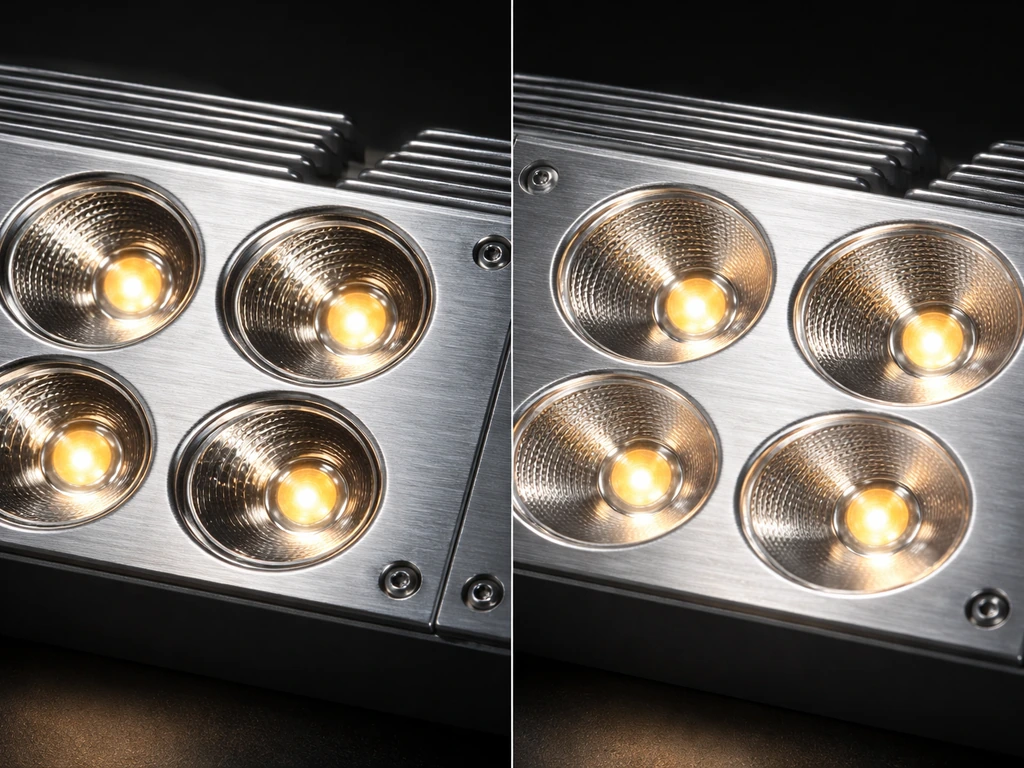
Secondary optics (lenses over individual diodes) concentrate photons and improve canopy penetration, especially useful for taller plants. Bare-diode designs on reflective aluminum spread light more diffusely, which helps uniformity in shorter canopies. Neither is strictly better; it depends on plant height and canopy density. What you want to avoid is a fixture with no published PPFD map, because without that data you're guessing at both intensity and uniformity.
Cooling and noise
Passively cooled (fanless) fixtures run silently and have fewer failure points, but they require adequate airflow in the grow space to prevent heat buildup on the heatsink. Actively cooled fixtures with fans run cooler in still air but add noise and introduce another component that can fail. In a tent with good circulation fans, passive cooling is usually fine for fixtures up to around 600–800W draw. For true 1500W draw fixtures, active cooling or very large heatsink designs are necessary.
Safety certifications
Look for UL 8800 listing (or ETL equivalent) for any serious purchase. UL Code Authorities notes that evaluating safety for horticultural lighting equipment includes photobiological effects under UL 8800 aligned with IEC 62471 blank" rel="noopener noreferrer">UL 8800 listing. UL 8800 is the first U.S. safety standard specifically designed for horticultural lighting equipment, covering photobiological safety (aligned with IEC 62471) alongside standard luminaire requirements. UL Solutions also notes that UL 8800’s photobiological safety requirements are consistent with IEC 62471 blank" rel="noopener noreferrer">photobiological safety (aligned with IEC 62471). It's also a requirement for DLC's horticultural Qualified Products List, which matters if you're in a commercial setting and need documented performance verification. IP66 rating is worth having if your grow area has high humidity or you run a wet wall system. Fixtures with IP66 ratings are tested for operation in wet conditions and typically handle condensation and splash without risk.
Warranty and support
A 3-year warranty is the minimum I'd accept on a 1500W-class fixture. Five years is the standard for quality commercial fixtures. Driver warranties are often listed separately, so check both. A brand that can't tell you PPF, actual draw, and warranty length in plain language on their product page is one I'd skip.
Installation, power, and setup: getting it right the first time
The most common setup mistake with 1500W-class lights isn't buying the wrong fixture, it's hanging it at the wrong height and not verifying actual PPFD at the canopy. Here's how to do it correctly.
Mounting height and PPFD verification
Start with the manufacturer's recommended hanging height for your target PPFD and adjust from there. A general starting point for a 4x4 canopy in flower is 18–24 inches above the canopy at full power, or 12–18 inches at 50–70% dimming. For veg, raise the fixture to 24–30 inches or dim to 40–50% to hit the 400–600 µmol/m²/s target range. If you have a PAR meter (and you should, especially at this light intensity), take readings at a 3x3 grid across the canopy at canopy height. Aim for a min:average uniformity of 0.75 or better. If your edge readings are less than 75% of your center reading, try raising the fixture slightly or repositioning it.
Power requirements and circuit planning
A true 1500W fixture on 120V draws about 12.5 amps, which means it needs its own 15-amp circuit with no other significant loads, or better, a dedicated 20-amp circuit. At 240V the draw is around 6.25 amps, which is why commercial growers prefer higher voltage, it reduces wire gauge requirements and leaves more headroom on the circuit. A '1500W-equivalent' fixture drawing 600W pulls 5 amps at 120V, which is comfortable on a shared circuit as long as total load stays under 80% of breaker capacity. Always add up your total tent load, including fans, pumps, and other equipment, before assuming you have enough circuit capacity.
Hanging and leveling
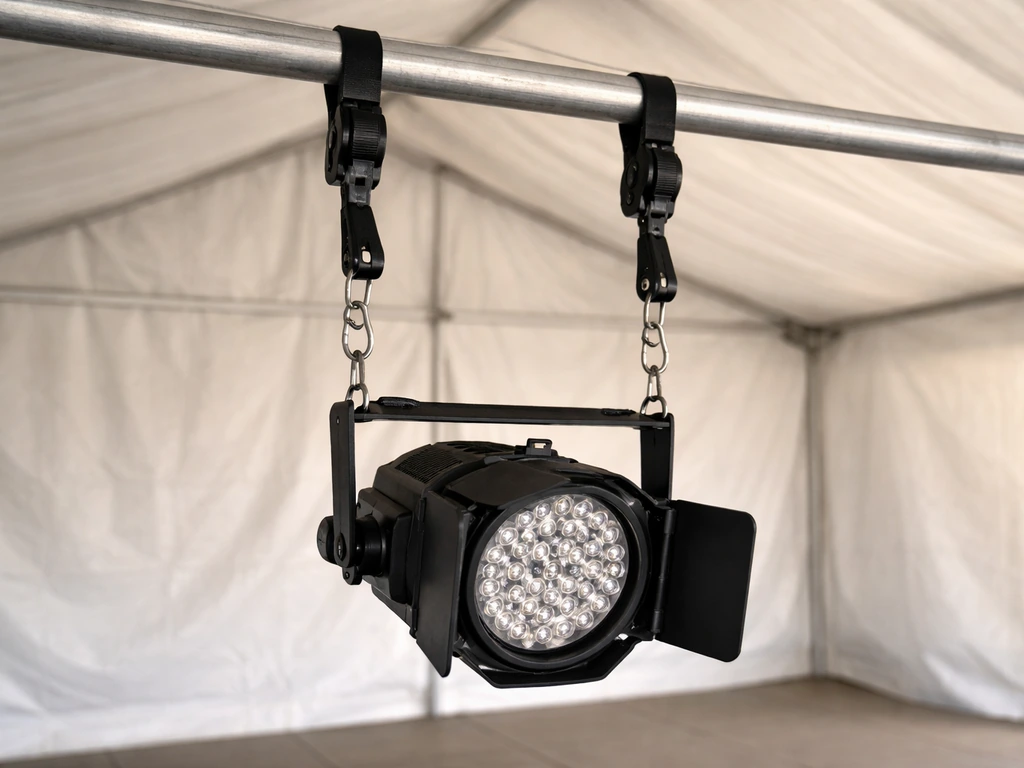
Use ratchet hangers rated for at least twice the fixture weight. Most bar-style fixtures in the 1500W class weigh 15–30 lbs (7–14 kg), and a quality tent crossbar handles that fine. Level the fixture so all bars are at the same height; tilted fixtures create uneven PPFD distribution that shows up immediately in plant response. For wide canopy fixtures over 4 feet, use a center support point in addition to the end hangers to prevent sagging over time.
Airflow and heat management
A 1500W-equivalent LED drawing 600W still dumps 600W of heat into your grow space. Even at 90% efficiency, which no fixture achieves, that's at minimum 60W as heat and realistically 200–300W of heat output. Size your exhaust fan and ducting to handle that load. In a 4x4 tent, a 4-inch inline fan (rated for 200–300 CFM) is the minimum; a 6-inch fan gives you more headroom for temperature control. Keep the canopy temperature in the 75–85°F (24–29°C) range and leaf surface temperature below 85°F (29°C) to avoid heat stress even when PPFD is optimal.
Troubleshooting coverage and bleaching
Bleaching (light-induced stress causing white or yellow coloration at the tops of plants) happens when PPFD exceeds what the plant can process, typically above 900–1,100 µmol/m²/s for most cannabis strains without CO2 supplementation. If you see bleaching, raise the fixture by 2–4 inches or reduce dimming by 10–15% before the next light cycle. Under-lighting (slow growth, stretching, thin internode spacing in veg) means PPFD is too low; lower the fixture or increase dimming percentage. Both issues are solved with a PAR meter and small adjustments, not fixture swaps.
How to pick the right 1500W-class light for your budget and goals
Here's how I'd approach the decision based on the most common grower situations. If you want a shortcut, compare options using a best 150 watt led grow light style shortlist, then scale up to the 1500W-class performance you actually need 1500W-class LED. If you want to jump ahead, you can compare top options for the best 3000w led grow light and then choose based on real draw, PPF, and efficiency.
4x4 tent, one light, flowering cannabis or similar high-light crops
You want a 1500W-equivalent fixture with an actual draw of 480–650W, minimum PPF of 1,200 µmol/s, efficiency of 2.5 µmol/J or better, and dimming to at least 10%. A bar-style quantum board design with a Meanwell driver, 730 nm far-red, and a published PPFD map showing 700–900 µmol/m²/s at 18 inches over a 4x4 is the target. Budget for a UL 8800 or ETL-listed fixture; it's not optional at this power level.
5x5 tent or larger, serious production
Move up to a true 1000–1500W draw fixture or pair two quality 600–700W units. At this scale, DLC QPL listing and documented PPFD uniformity data matter more, because you're making a real investment and need the performance data to be honest. Commercial-grade fixtures from established brands with published photometric reports are worth the premium. This is where you'd look at fixtures in the same class as 3000W-equivalent multi-bar systems as an alternative.
Budget-constrained, 4x4 tent, mixed crops or first grow
You can find capable 1500W-equivalent fixtures drawing 400–500W for under $200 that produce 1,000–1,200 µmol/s PPF. If you want the best led grow light under 200, focus on real draw, published PPF, and a usable PPFD map rather than marketing numbers 1500W-equivalent fixtures. The trade-offs at the budget end are typically lower uniformity, cheaper drivers, shorter warranties, and limited dimming resolution. If you're starting out, these are acceptable compromises. Just verify the actual draw is listed, check for a published PPFD map (even a basic one), and budget for a simple PAR meter so you can verify what you're actually delivering to the canopy.
The shortlist checklist
- Actual power draw (watts) listed clearly in specs, not just the 'equivalent' claim
- PPF (µmol/s) stated, so you can calculate efficiency (PPF ÷ watts, target 2.5+ µmol/J)
- Published PPFD map at your planned hanging height (18–24 inches for flower)
- Uniformity data or a PPFD map that lets you estimate min: average ratio (target 0.75+)
- Full-spectrum white diodes with 730 nm far-red for bloom; UV optional but noted
- Dimming capability down to at least 20% (10% preferred) for seedlings and veg
- Meanwell or equivalent industrial-grade driver with stated warranty (3 years minimum)
- UL 8800 listing or ETL certification; IP66 if growing in a humid environment
- Passive cooling acceptable up to ~600W draw in a well-ventilated tent; active for higher draws
- Brand provides clear customer support contact and a documented return/warranty process
One more thing worth saying: the gap between a well-spec'd $300 mid-range bar light and a $700 premium fixture has closed significantly in 2026. At 2.5–2.7 µmol/J, a good mid-range LED delivers real results for most home growers. The premium fixtures justify their cost mainly through better uniformity data, stricter quality control, longer warranties, and commercial-grade certifications. If you're growing for personal use in a 4x4, don't let anyone talk you into spending $800 when a $350 fixture with solid specs will do the job. Spend the difference on a PAR meter and a good environmental controller instead.
FAQ
When a listing says “1500W LED grow light,” how can I quickly tell if it is true 1500W or just equivalent marketing?
Look for the AC input power in the specs (watts at a specific voltage, often shown as something like 1065W @ 230V AC). If the product only says “1500W” and never gives real input draw, treat it as marketing, not a power rating, and use PPF plus efficiency to estimate real output.
If two lights both claim the same PPF, which one is likely better for my canopy?
Compare efficiency (µmol/J) and uniformity. A higher-efficiency fixture will run cooler at the same photon output, and a published PPFD map with better min-to-average uniformity usually means fewer edge plants that underperform.
Do I need a PAR meter if the brand already provides PPFD maps?
A meter is still useful because your hanging height, tent reflectivity, and dimming settings can differ from the manufacturer test conditions. At minimum, verify at your planned height and check a few points across the canopy, especially the edges.
What is the most common reason growers end up with bleaching even when they bought the “right” wattage class?
Hanging height and dimming are usually the culprit, not the SKU. Even with a correct fixture, running at full power too low, or using a far-red or UV mode that increases total photon load, can push PPFD above what your plants can process.
Is far-red at “730 nm” actually required for good results, or can I skip it?
You can skip it for many grows, especially if you are dialing PPFD correctly. Far-red is mainly a flowering acceleration and morphology tool, its impact depends on plant stage and cultivar, so prioritize accurate PPFD first, then add far-red if your results or goals specifically benefit.
How do I convert a PPFD goal into an expected DLI for my photoperiod?
Use DLI (mol/m²/day) = 0.0036 × PPFD (µmol/m²/s) × light hours per day. Then confirm your crop target by stage, for example, veg often sits comfortably around the mid-20s mol/m²/day range depending on strain and CO2.
What if the manufacturer gives efficiency but not PPF, or gives PPF but not efficiency?
If one number is missing, you can still sanity-check, but it is harder. If you have PPF, you can estimate efficiency only if you know the real input draw. If you do not have either PPF or real draw clearly listed, avoid the light or budget for measurement because the “1500W class” label alone is not enough.
Are bar-style lights always better than quantum-board or COB for a 4x4 tent?
Not always. Bar-style fixtures often make uniformity easier across larger widths, but COB can work well if spacing and optics are engineered for your height and canopy thickness. If a brand publishes a PPFD map for your height, that evidence matters more than the fixture category name.
Can I run a true 1500W draw fixture in a small grow space by turning it down?
Yes, but you must still manage heat and ensure your dimming range is practical. Some fixtures dim poorly at the low end, and even reduced power still dumps meaningful waste heat, so confirm driver dimming specs and size exhaust and ducting for the worst-case thermal load you will actually use.
What electrical circuit do I need, and how do I account for other tent equipment?
Treat the grow light as its own load at minimum if it is true 1500W on 120V, because it draws roughly 12.5A. Then add fans, dehumidifiers, controllers, and pumps, and keep the total under about 80% of breaker capacity to avoid nuisance trips or overheating.
What mounting hardware should I use so the fixture does not sag and ruin uniformity over time?
Use ratchet hangers rated at least twice the fixture weight, and ensure the fixture is level across bars. For wide fixtures, use a center support point if the manufacturer recommends it, sag changes PPFD distribution gradually and can show up as uneven growth weeks later.
How should I respond if my plants show slow growth, but I already set the PPFD “target” on the dimmer?
First verify actual PPFD at canopy height with a meter, because dimmer percentages do not always equal proportional photon output. Then check for incorrect mounting height, wrong stage setting (veg vs bloom channel), or environmental limits like too-cool leaf temperatures or inadequate airflow that reduce photosynthesis even when light is available.
What should I do when I see yellowing or edge drop that looks like under-lighting rather than heat stress?
Edge drop is often a uniformity problem, not a total wattage problem. Raise the fixture slightly or adjust position, then confirm uniformity (min-to-average around 0.75 or better is a strong target). If your tent has low reflectivity, upgrading reflective liner can also improve edge PPFD.
Is an IP66 rating worth paying for in a grow tent?
It can be worth it if you have high humidity, condensation, or a wet wall setup. For typical tents with normal ventilation, you may not need IP66, but if splashing water or frequent wet cleaning happens, IP66 reduces risk around moisture exposure points.
What warranty length should I demand on a 1500W-class LED, and what else should I check besides the years?
Aim for at least a 3-year total warranty, with 5-year common among higher-end commercial fixtures. Also check whether the driver warranty is listed separately, and confirm the brand clearly states what is covered, because a warranty that is vague is harder to use if the driver fails.
What is the fastest “shopping checklist” for choosing the best 1500 watt led grow light for a 4x4 versus a 5x5?
For a 4x4, target the 1500W-equivalent category with real draw (for example 480 to 650W), minimum PPF (around 1,200 µmol/s or higher), efficiency (about 2.5 µmol/J or better), and a usable PPFD map at your planned height. For a 5x5, plan for a true higher draw fixture or multiple units, then rely on PPFD maps to confirm footprint coverage rather than headline wattage.
Next Articles
Best Full Spectrum 1000W LED Grow Lights: Buyer Guide
Buy the best full spectrum 1000W LED grow light with spec-to-decision tips on PPFD, coverage, wattage, and tent fit.
Best 100W LED Grow Light: How to Choose the Right One
Choose the best 100W LED grow light with PPFD coverage, spectrum, efficiency, dimming, heat, and setup tips.
Best LED Grow Light to Replace 1000W HPS: Sizing Guide
Sizing and buying guide to replace a 1000W HPS with the right LED using PPFD, layout, mounting, and spectrum for yields.