
If you need a straight answer: a genuine 300W-class LED grow light, one that actually draws around 250 to 320 watts from the wall, will comfortably cover a 3x3 foot tent for most crops and can push into a 4x4 if you pick an efficient model with a solid PPFD map. The trouble is that "300W" means almost nothing on its own. Some fixtures labeled 300W only pull 150 to 180 watts at the wall. Others pull a true 300W and deliver serious intensity. This guide will show you how to tell them apart and find the best 300 watt LED grow light for your specific setup.
Best 300W LED Grow Lights: How to Choose and Set Up
Marcus Rutherford
14 Apr 2026
What "300W" really means for LED grow lights
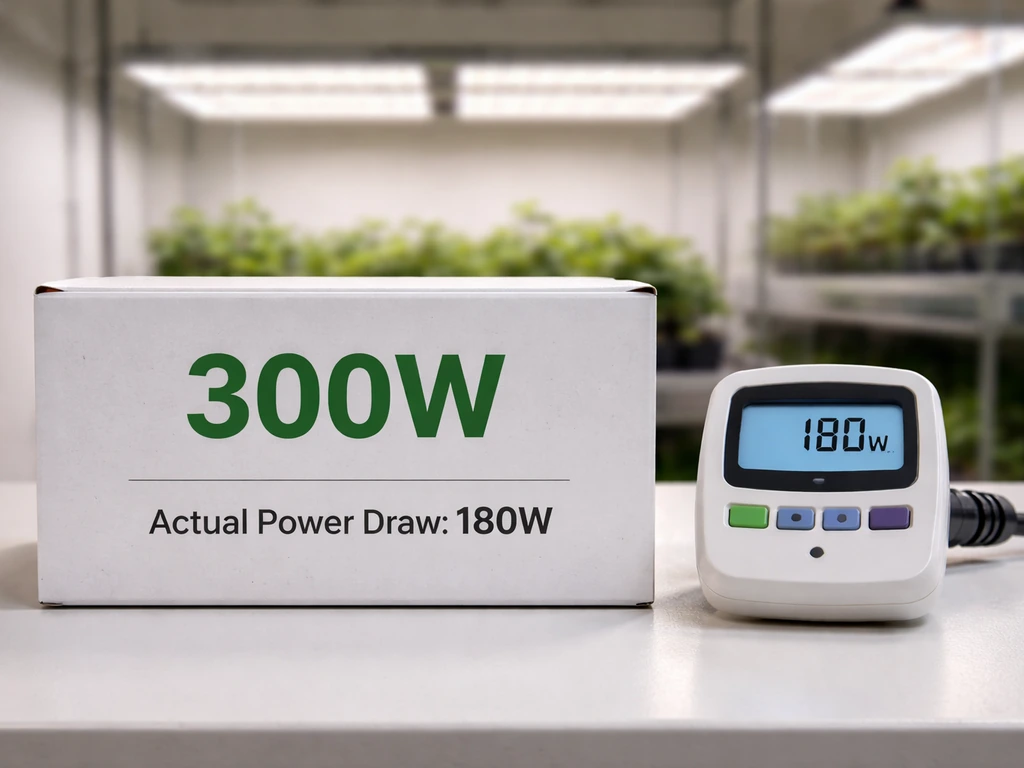
The number printed on the box is often a marketing class, not a wall-draw figure. One well-documented example: a manufacturer lists "Actual Power Draw: 180W" alongside "HID Wattage Equivalent: 300W" right on the spec sheet. That means the light is being marketed as a 300W replacement for an HPS or CMH fixture, not that it actually consumes 300 watts of electricity. This is extremely common, and it's the single biggest source of confusion when shopping in this wattage class.
The distinction matters because plant growth is driven by photons, not by marketing equivalence claims. A fixture that draws 180W of real power will produce fewer total photons than one drawing 300W, assuming similar efficiency. LED manufacturers sometimes inflate the advertised "LED watt" number by rating each diode at its theoretical maximum rather than its actual operating current. When the driver steps the diodes down to safe, cool-running levels, the real draw is much lower than advertised. Always look for "actual power draw" or "true watts" on the spec sheet. If a listing only shows one wattage figure and doesn't clarify whether it's wall draw or LED rating, that's already a yellow flag.
Key specs to compare: PPF, efficiency, spectrum, and coverage
Once you've confirmed actual wall draw, the next numbers that matter are PPF, PPFD, and photon efficacy. PPF (photosynthetic photon flux) measures total photons emitted by the fixture per second in micromoles per second (μmol/s). PPFD (photosynthetic photon flux density) measures how many of those photons land on a square meter of canopy per second, expressed as μmol/m²/s. PPF tells you how powerful the light is overall. PPFD tells you what your plants actually receive at a specific distance and position. Both matter, but PPFD is the number you'll use day-to-day to dial in your grow.
A single center-point PPFD reading is not enough. PPFD can vary wildly across a canopy, so edge plants may be receiving half the intensity of center plants even under the same fixture. What you want is a PPFD map: a grid showing intensity at multiple points across the full coverage area at a stated hanging height. Reputable brands like Spider Farmer publish full PPFD maps alongside PPF and PPE (photon efficacy) data for their fixtures, which gives you everything you need to assess real-world coverage.
Photon efficacy is reported in μmol/J and tells you how efficiently the fixture converts electricity into plant-usable photons. In 2024 to 2026, a competitive full-spectrum LED in the 300W class should deliver at least 2.5 to 2.8 μmol/J. Premium quantum board and bar-style designs push 3.0 μmol/J or higher. Lower efficacy means more heat, higher electricity bills, and less light per dollar spent over the fixture's lifetime.
| Spec | What it measures | Target for a quality 300W fixture |
|---|---|---|
| Actual power draw | Real watts consumed at the wall | 250–320W (match to your intended coverage) |
| PPF | Total photons output per second (μmol/s) | 600–900+ μmol/s depending on draw |
| PPFD at canopy | Photon intensity per square meter (μmol/m²/s) | 400–600 for veg, 600–1000+ for flower |
| Photon efficacy | Efficiency of photon production per joule | 2.5–3.0+ μmol/J |
| Coverage map | Uniformity across stated footprint | Full PPFD grid map at stated height, not single-point |
For spectral documentation, the gold standard is third-party LM-79 photometric testing or blank" rel="noopener noreferrer">compliance with DLC Horticulture Technical Requirements, which mandate full spectral data in standardized formats. If a brand can point to this kind of testing, their published numbers are much more trustworthy than self-reported data from uncertified sources.
Choosing the right 300W light for your grow space
Matching wattage to tent size
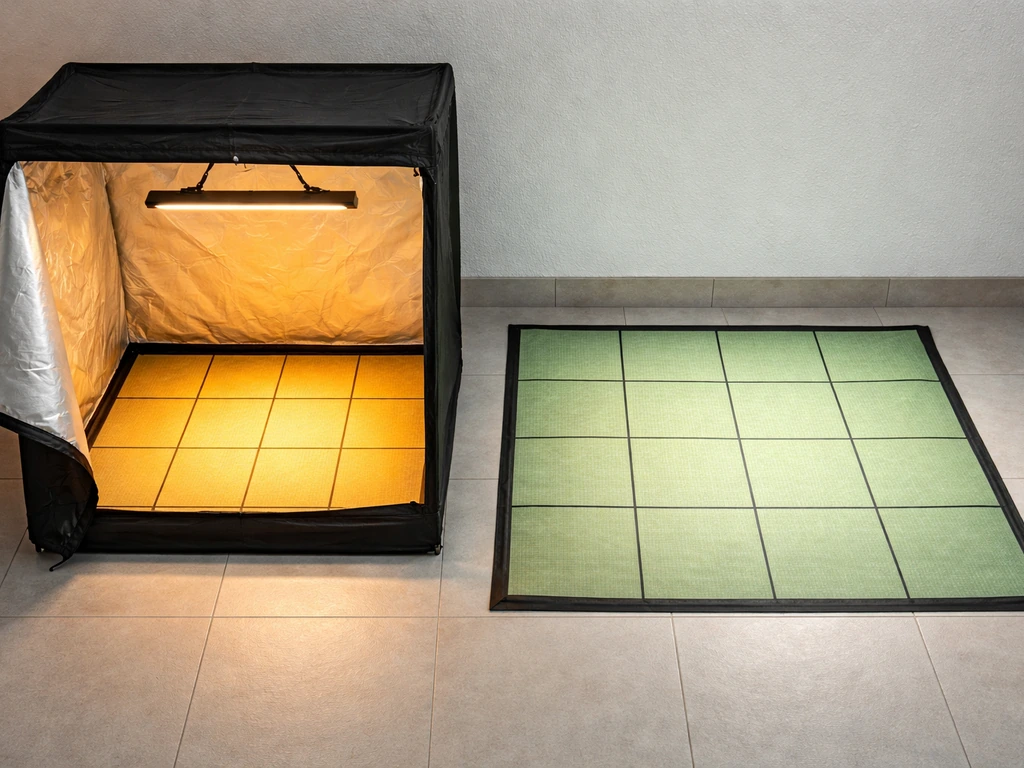
A practical rule of thumb: plan for roughly 200 to 300 actual wall watts per 3x3 foot area for flowering crops, or 150 to 200W for vegetative stages and lower-light plants. That means a genuine 300W fixture is well-matched to a 3x3 tent for most fruiting crops. For a 4x4 tent (16 sq ft), a single 300W fixture can work for high-efficiency models, but you'll likely see lower PPFD at the edges. If your tent is 4x4 and you're growing dense, light-hungry plants like cannabis in flower, you'd be better served looking at a 400W option or pairing two 300W lights. You can compare the step up in output and coverage in the best 400 watt LED grow light guide if you're on the fence.
For a 2x2 tent, 300W of true draw is often overkill unless you're running CO2 or high-demand cultivars. A dimmable 300W fixture works fine here because you can run it at 50 to 60% output, which also reduces heat in a small space. For 5x5 tents and larger, a single 300W light will leave significant dead zones. Two lights or a larger single fixture (like those covered in the best 500 watt LED grow light comparison) will serve you better.
Single vs multiple fixtures
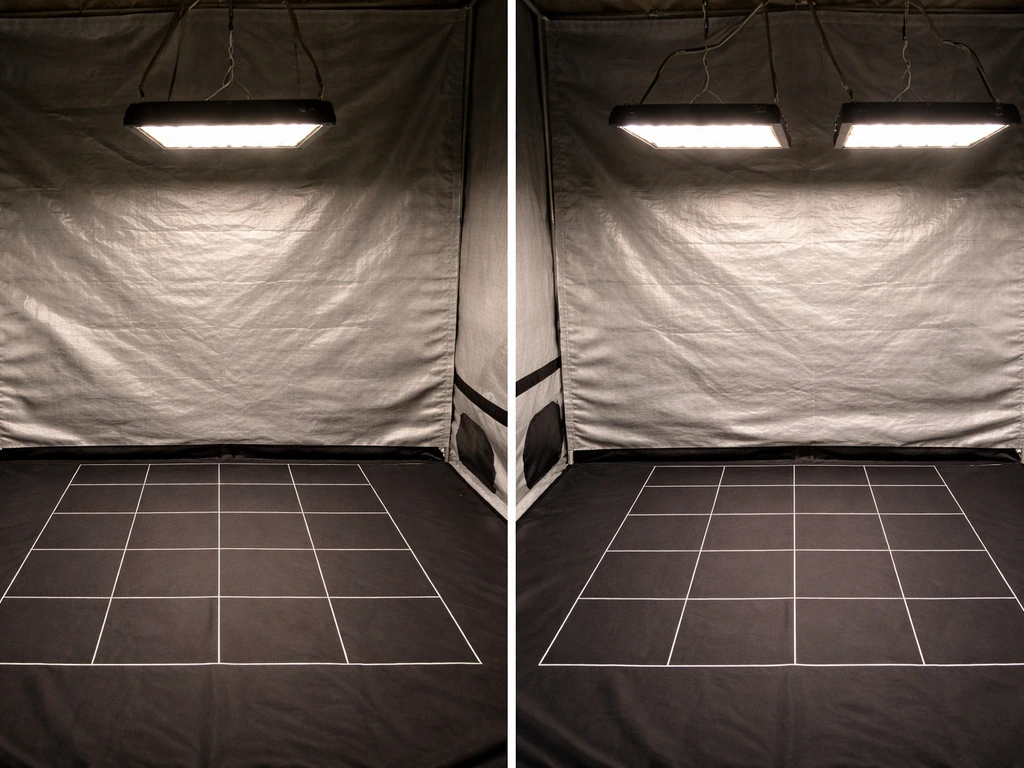
One fixture vs two is often a closer call than it looks. PPFD maps for a single 300W bar or quantum board light on a 4x4 grid typically show strong center intensity (700 to 900 μmol/m²/s at 18 to 24 inches) but a noticeable drop at corners (sometimes 400 to 500 μmol/m²/s). Two fixtures arranged in parallel over the same space will produce a much more uniform canopy map. For hobbyists growing in a 3x3 or running lower-demand plants like lettuce, herbs, or seedlings, uniformity is less critical. For dense canopy crops in flower, uniformity pays off in even bud development.
Form factors to know
At the 300W class, you'll encounter four main form factors, each with different strengths:
- Quantum board panels: wide, flat PCB with densely packed diodes. Excellent uniformity, low heat per diode, high efficacy. Best all-around choice for 3x3 to 4x4 tents.
- Bar-style fixtures: multiple LED bars on a frame. Superior light distribution and canopy penetration, great for taller plants. Many use lenses like 120-degree optics per diode to spread photons evenly across a large footprint. A strong choice for 4x4 coverage and commercial-style grows.
- Chip-on-board (COB) panels: high-intensity point sources. Great canopy penetration but less uniform spread; usually need to run closer to canopy or use multiple COBs per tent.
- Blurple or older panel designs: many still use outdated diode configurations with poor efficacy and minimal spectral balance. Generally not worth buying in 2026 when quantum boards and bars are available at similar price points.
Full-spectrum vs other spectrum strategies for 300W fixtures
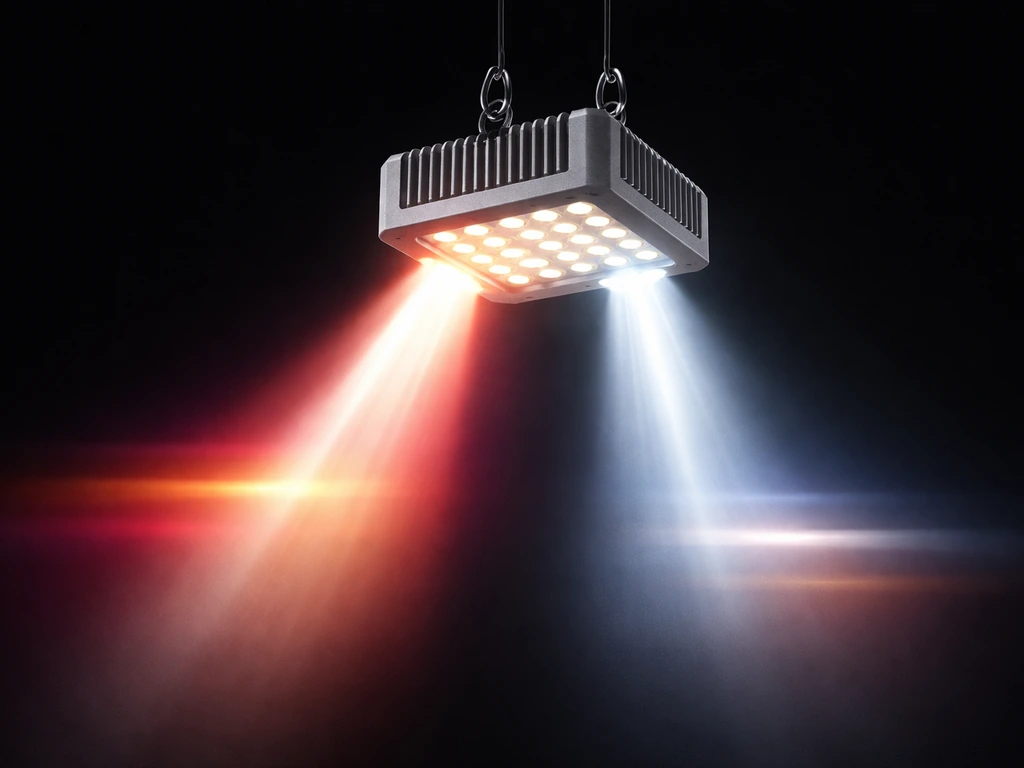
Most reputable 300W fixtures sold today are marketed as "full spectrum," which typically means a white LED base (mixing phosphor-converted blue LEDs to produce a broad white spectrum) with targeted supplemental wavelengths added. A common configuration includes white diodes providing the broadband base, plus supplemental deep red at 660 to 665 nm and far-red at 730 to 740 nm. The red and far-red additions target key chlorophyll absorption peaks and the Emerson effect (far-red boosting the efficiency of red-driven photosynthesis during flowering).
For most growers, a quality white-plus-red full-spectrum fixture handles both vegetative and flowering stages without spectrum-switching. If you're optimizing for a specific crop or stage, a few things are worth knowing. During late veg and early flower, increasing the intensity of 660 nm red promotes faster transition and stronger floral sites. During mid-to-late flower, some growers add UVA for terpene and secondary metabolite production, though not all 300W fixtures include UV diodes. Color temperature also matters for vegetative growth: a light balanced toward cooler, bluer output (around 6500K) tends to support compact, dense vegetative development. If you're running a dedicated veg room or vegetative-stage seedling space, you might want to check out the best 6500K LED grow light options for that specific application.
It's also worth understanding that spectrum changes affect total photon output, not just "color temperature." A fixture that lets you boost red intensity at the driver level may be increasing PPFD as well as changing spectral balance. This means a PPFD map done at a specific spectrum setting may not hold when you change that setting. Always verify PPFD at your intended operating spectrum.
Installation and performance setup
Mounting height
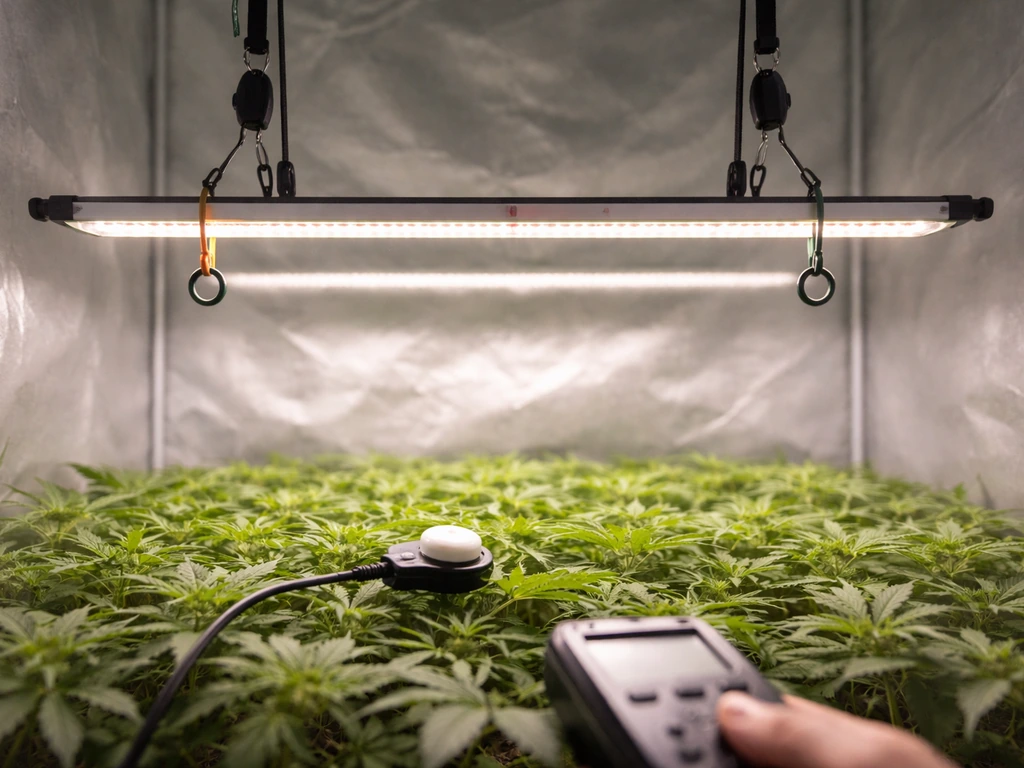
Hanging height directly controls PPFD at the canopy. Most 300W bar and quantum board lights are optimized for 18 to 24 inches above canopy during flower and 24 to 30 inches during veg or seedling stages. Reddit growers discussing SE3000 hanging height also emphasize dialing the distance using canopy response, such as checking leaf tips for signs the light is too close or too far and using reported target ranges like around 18 to 20 inches for different stages. Bar-style fixtures often publish PPFD at 24-inch hanging height as their reference measurement, so use that as your starting point and adjust from there. Lowering the light increases intensity and reduces coverage area. Raising it spreads photons more evenly but reduces intensity per square meter. For seedlings, start high (24 to 30 inches) and low dimming (20 to 40%) to avoid light stress.
Stage-based guidance: seedlings and clones need around 100 to 200 μmol/m²/s. Vegetative growth performs well at 300 to 600 μmol/m²/s. Flowering cannabis and other high-demand crops target 600 to 1000 μmol/m²/s at canopy. A dimmable 300W fixture lets you hit all these targets from one light by adjusting output percentage as plants mature.
Dimming and driver quality
Driver quality is one of the most underrated specs in this price range. A good driver (Mean Well is the benchmark name in this space) runs efficiently across its dimming range, handles heat well, and extends fixture life. Cheap drivers run hot, don't dim smoothly, and fail earlier. Dimming is especially valuable in small tents: running a 300W fixture at 60% in a 2x2 during veg keeps heat down, saves electricity, and still delivers plenty of intensity. During peak flower in a 3x3, run it at 80 to 100% and supplement airflow.
Airflow and heat management
A real 300W draw produces meaningful heat. In a 3x3 tent, that's roughly 1000 BTU per hour that your ventilation system needs to handle. Passive-cooled quantum boards and bar-style fixtures spread heat across a larger surface area and generally run cooler than enclosed COB panels. Plan for an inline fan sized for your tent volume, plus an oscillating fan at canopy level to prevent hot spots and strengthen stems. If your tent is in a warm room (above 75°F ambient), you'll need more aggressive ventilation or will need to run the light at reduced intensity during peak heat hours.
Electrical basics
A 300W fixture on a standard 120V US circuit draws about 2. For a 120V LED load, you can blank" rel="noopener noreferrer">estimate current as I ≈ Power/Voltage, so a 300W load works out to about 2.5A before factoring in power factor and other electrical factors. 5 amps. That's well within the capacity of a standard 15-amp circuit even if you're also running a fan and a timer. Running multiple lights changes this math quickly: two 300W fixtures plus fans and a pump on one circuit can push 7 to 8 amps. Most growers on a 4x4 or larger setup should plan for a dedicated 20-amp circuit. If you're eventually scaling to larger setups, reviewing what drives power requirements at higher wattage classes like those in the best 600 watt LED grow light roundup will help you future-proof your electrical planning.
One practical verification tool worth mentioning: a PAR meter or PAR-reading app like Photone lets you measure actual PPFD at canopy level in your specific tent, with your reflective walls and fixture at your exact hanging height. Listing PPFD data is generated in controlled testing environments; your real tent conditions may differ by 10 to 20%. Measuring yourself removes the guesswork.
Common buying mistakes and red flags
The most common mistake is buying based on the wattage number on the title alone. As covered above, "300W" can mean anything from 120W of true draw to a genuine 300W fixture. If a product listing doesn't show actual wall draw separately from the LED rating or "equivalent" claim, move on or ask the seller directly. Legitimate brands are transparent about this because their real specs are competitive.
Watch out for these specific red flags when evaluating listings:
- Only one wattage number with no explanation of whether it's wall draw, LED rating, or HPS equivalent.
- No PPFD map, only a single center-point PPFD value or vague "coverage area" claims.
- Missing or unverifiable photon efficacy (μmol/J) data.
- No third-party test data, no LM-79 references, and no DLC listing.
- Heavily padded LED counts listed as the power spec (e.g., "1000 x 0.3W LEDs = 300W").
- Blurple-dominant spectrum (heavy purple/pink cast) with no white balance. Modern full-spectrum fixtures appear white or warm white to the eye.
- Warranty shorter than 3 years. Reputable brands offer 5 years on fixtures in this class.
- No actual power draw spec on the product page or in downloadable documentation.
Outdated models are another quiet problem. LED technology has moved fast. A fixture designed in 2019 or 2020 with older Samsung or Bridgelux diodes may still be listed as new stock in 2026 but will have noticeably lower efficacy than a current-generation design. Check the release date or ask about the diode generation. If a brand can't tell you what diode generation their product uses, that's a signal.
Also be cautious about fixtures positioned as budget alternatives to the major wattage steps. If you need to cover more than a 3x3 efficiently and a 300W option isn't cutting it, there's a solid set of reviewed options in the best 1500W LED grow light category for larger commercial or multi-canopy setups, where wattage accuracy and build quality matter even more. Similarly, if you're shopping in the UK market, light availability and certifications differ enough that looking at a dedicated best 600W LED grow light UK guide may save you time on regional sourcing.
How to pick your best 300W option today
Here's a practical checklist to work through before hitting buy. Go through these in order and you'll eliminate 80% of bad options before reading a single review.
- Measure your tent: length x width gives your canopy footprint. Confirm you need 300W class coverage, not a step up or down.
- Identify your primary crop and stage: seedlings and veg need different PPFD targets than flowering crops. Know your target intensity range before comparing lights.
- Find the actual wall draw: search the product page or spec sheet for "actual power," "true watts," or "power draw." Ignore the marketing wattage number until you have this confirmed.
- Check for a full PPFD map: not a single center point, but a grid map at a stated hanging height over your target footprint. If it's not available, the listing is not transparent enough to trust.
- Calculate photon efficacy: divide PPF (μmol/s) by actual watts. Anything below 2.3 μmol/J is below current standards. Target 2.5 to 3.0+ μmol/J.
- Confirm spectrum composition: look for white-base LEDs plus supplemental red (660 nm) and ideally far-red (730 nm). Blurple-only panels are a pass in 2026.
- Check driver brand and dimming range: Mean Well or equivalent quality. Confirm 0-10V or knob dimming is available. This matters for managing intensity across growth stages.
- Verify warranty: 3 years minimum, 5 years preferred. Short warranties signal low confidence in build quality.
- Look for third-party validation: DLC listing, LM-79 test report, or independent review with measured PPFD data. Not required, but a strong confidence signal.
- Decide: single fixture or two? If your tent is 4x4 or larger and your crop is flower-stage with high light demand, budget for two 300W fixtures and compare PPFD uniformity maps for each rather than relying on a single light.
If you work through that checklist and find that the 300W class is just slightly short of what your setup needs, the jump to the next tier is worth calculating. The best 400 watt LED grow light options offer roughly 30% more total photon output for a proportionally small price increase and are often the better fit for a 4x4 in full flower. Conversely, if a true 300W seems like too much for a small space, many of the fixtures in this class are dimmable to 50% or lower, making them more versatile than their peak wattage suggests.
The bottom line: a quality 300W LED grow light in 2026 should pull 250 to 320 watts at the wall, deliver 600 μmol/s or more in PPF, hit 600 to 900 μmol/m²/s PPFD at 18 to 24 inches over a 3x3 canopy, and come with a published PPFD grid map and at least a 3-year warranty. Fixtures that check all those boxes are genuinely excellent lights. Fixtures that skip any of those specs are usually cutting corners somewhere that will cost you plants or money later.
FAQ
If a 300W LED grow light listing has only one wattage number, how do I know whether it’s wall draw?
Look for “actual power draw” (or “true watts”) on the spec sheet, not the wattage in the title or marketing equivalence. If the listing only shows one number, ask the seller whether it is wall draw at the driver level and what wattage they measure (usually at full output).
Can I safely use a PPFD map if my light is dimmed (for example, 60% output)?
Yes, but only if the PPFD map (or test data) was generated at the same hanging height and at the same dimming setting you plan to use. Dimming can change the photon output and sometimes the spectrum balance, so you should rely on manufacturer data for your exact percent setting, not the full-power map.
Do 300W full-spectrum lights always provide even coverage across a 3x3 tent?
It can be, even for “full spectrum” lights, if the fixed lens optics create strong center hot spots. In practice, you want either a published PPFD grid for a 3x3 at your target height, or a uniformity expectation check (edge values not dropping to half the center). If the brand only shows a single center-point number, assume edge coverage may be weak.
Does dimming a true 300W light always waste performance, or does it still work well?
If the driver runs at the right efficiency, dimming is typically a way to save electricity and reduce heat without hurting efficiency drastically. The key is to avoid running so low that you miss your target PPFD range for the crop stage. For example, seedlings need far less than flowering, so dimming to 40 to 60% is often fine for that stage.
Is a single best 300W LED grow light enough for a 4x4 grow?
A 300W fixture can be used in a 4x4, but you must manage coverage expectations and canopy uniformity. The practical approach is to either use a high-efficiency model with strong PPFD at the edges (from a grid map), or use two lights for a more even distribution, especially for dense flowering crops.
How should I use a PAR meter or app to verify actual PPFD in my tent?
A PAR meter or phone app reading is most useful if you measure at the same distance and angle where plants are, and then compare to the manufacturer’s test grid conditions. Real tents with reflective walls can shift results, so it helps to measure multiple points (center and corners) and confirm you are not relying on the peak value only.
What’s the quickest way to tell whether a brand’s spectrum and efficacy claims are trustworthy?
Check whether the fixture comes with third-party photometric data (often LM-79 style) or compliance documentation that includes spectral information in standardized formats. If the brand provides no verifiable testing details and only claims “better spectrum,” treat the efficacy and output numbers as less reliable.
What should I do if I suspect a 300W fixture is an older model being sold as new?
Many “older stock” issues show up as lower photon efficacy (μmol/J) and weaker PPFD for the same wall draw. If the seller cannot tell you the diode generation or the driver year (or gives vague marketing only), you may be paying more for less output than a current design.
How do I plan ventilation for a true 300W LED grow light in a small tent?
Heat and airflow become the limiting factors, not just the light output. Plan for ventilation sized for roughly 1000 BTU per hour from a genuine 300W draw, then add canopy-level circulation to prevent hot spots. If your room stays above about 75°F, expect to run the light at reduced intensity or increase ventilation.
How many best 300W LED grow lights can I safely run on one electrical circuit?
Yes, but be careful with how you distribute loads. A true 300W on 120V is around 2.5A by itself, but adding multiple lights, fans, and pumps can overload a circuit. If you plan to run more than one 300W light in the same circuit, calculate total current and strongly consider a dedicated 20A circuit for 4x4 and larger builds.
Will the same 300W LED work equally well for veg and flowering without rethinking placement?
Not necessarily. If the light is set up for a specific crop stage and hanging height, you may get enough intensity but not the right spectral emphasis or PPFD range. For cannabis and similar high-demand flowering crops, you should confirm that your target canopy PPFD is reached at your intended dimming level and distance.
If my PPFD is low at the corners, should I buy a stronger light or change the layout?
If your PPFD is short at the edges, the best fix is usually not “higher wattage without a plan,” it is improved layout or additional fixtures. Two lights placed for overlap often deliver better canopy uniformity than one stronger light in the middle, especially in a 4x4 where corners fall off.
Next Articles
Best 1500W LED Grow Light: How to Choose and Set Up
Choose the best 1500W LED grow light by PPF, PPFD, spectrum, coverage, and setup for tent or room.
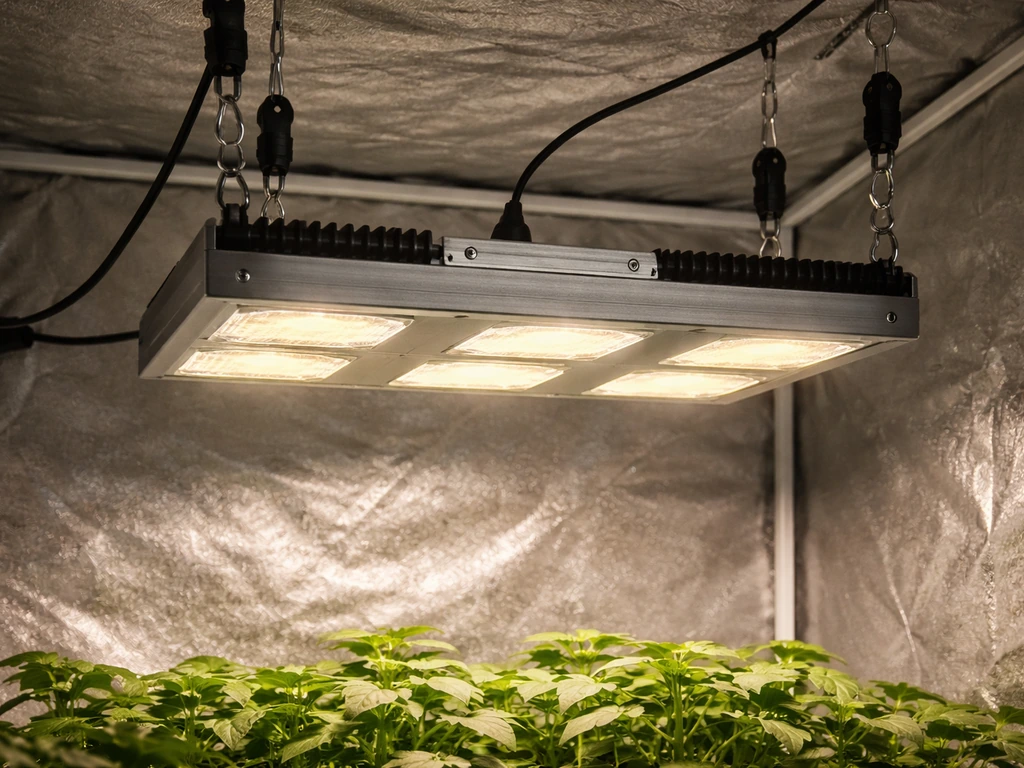
Best 300 Watt LED Grow Light: How to Choose and Buy
Buy the best 300 watt LED grow light with coverage, PPFD, spectrum, dimming, heat, and setup checks for your tent.
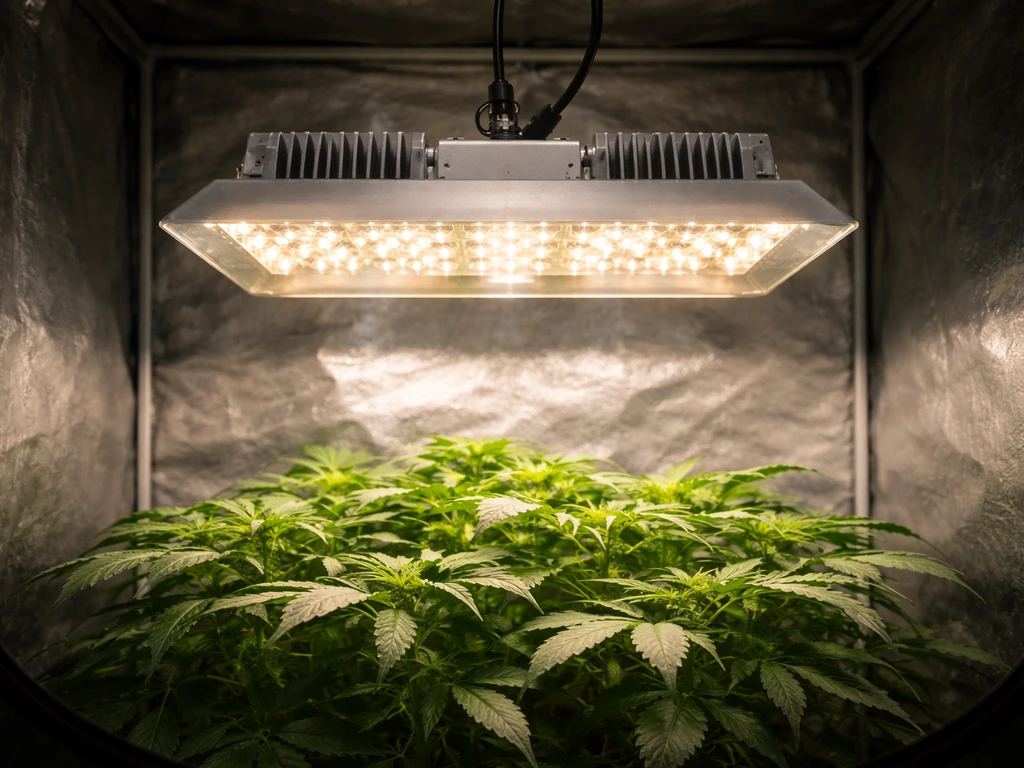
Best 500 Watt LED Grow Light: Buyer Guide and Setup Tips
Real guide to the best 500W LED grow light: compare PPFD, coverage, spectrum, efficiency, setup height, and safety.