
The best 600W-class LED grow light for UK growers right now depends almost entirely on your tent size, plant stage, and how seriously you take the specs behind the marketing label. If you want the short answer: a quality full-spectrum quantum board or bar-style fixture drawing 600W at the wall, with an efficacy of at least 2.5 µmol/J and a verified PPFD map, will outperform most HPS 600W setups while running cooler and costing less to run over a full grow cycle. But 'best' for a 2x4 vegetative setup looks completely different to 'best' for a 4x4 heavy-flowering tent, so let's work through it properly.
Best 600W LED Grow Light UK: How to Choose and Buy
Marcus Rutherford
21 Apr 2026
What '600W' actually means for LED grow lights
This is the single biggest source of confusion in this wattage class, and it catches out a lot of buyers. When a light is marketed as '600W', that number can mean at least three different things: the nameplate input wattage (what the fixture is nominally rated to draw), the 'equivalent' HPS wattage (a marketing comparison claim), or the total LED chip capacity if you were to run every diode flat out at maximum rated current.
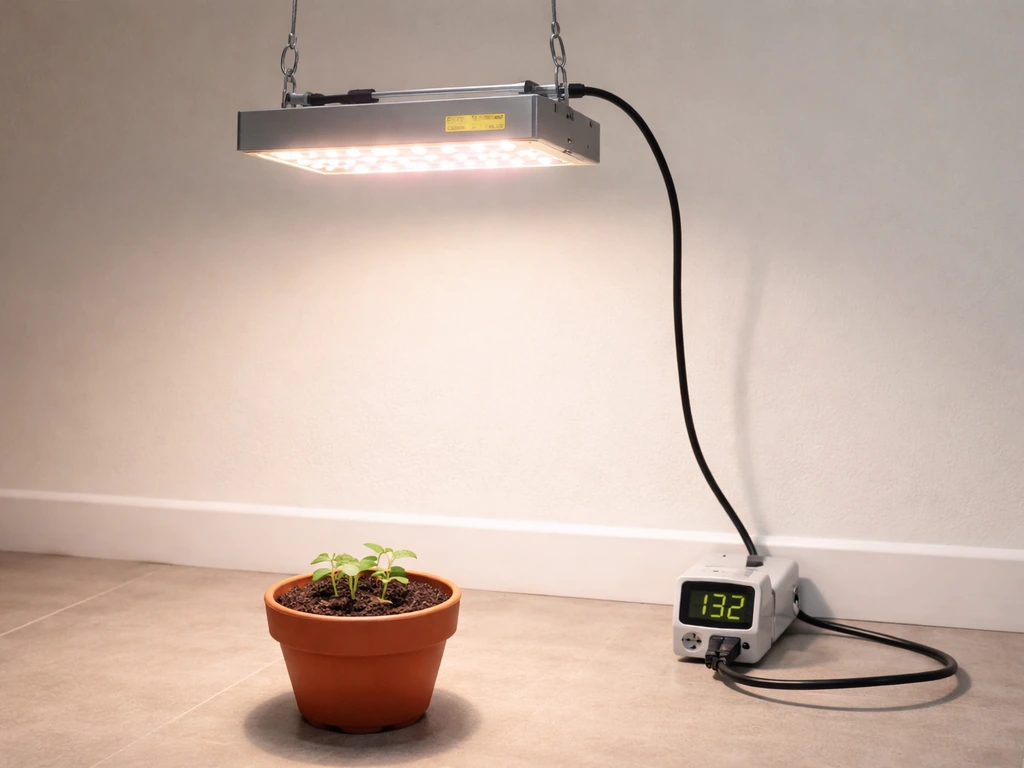
In practice, many budget 600W LED panels are drawing closer to 100W to 200W at the wall, not 600W. The Mars Hydro TS-600, for example, is sold with '600' in the name but consumes around 100W in real use. That's not a scam per se, but it is a completely different light to a fixture genuinely pulling 600W.
True 600W-class LEDs, meaning fixtures that actually draw 550W to 650W from your socket, are a real and useful category. A spec sheet from Kingrowlight's foldable 600W unit, for instance, shows actual input power ranging from approximately 600W to 616W depending on supply voltage, which is what 'nameplate 600W' should look like. When you're comparing options, ignore the headline wattage and go straight to the actual wattage draw column. That's the number that tells you what you're really buying, what it'll cost to run, and roughly what photon output to expect.
The other number that matters is efficacy, expressed in µmol/J. A high-quality modern LED fixture should be achieving 2.5 µmol/J or better. At 600W actual draw, that translates to roughly 1,500 µmol/s of photosynthetically active radiation (PPF). A 1500W-class LED grow light can be a better fit if you're scaling up to larger tents or multiple grow areas at once. Budget older-technology panels or anything with blurple (red/blue only) diodes typically land between 1.5 and 2.0 µmol/J. That gap is significant over a full grow.
Match your wattage class to tent size and plant stage
UK growers searching for '600W LED' are usually running one of a handful of tent sizes: 60x60cm, 80x80cm, 1.2x1.2m (4x4ft), 1.2x2.4m (4x8ft), or occasionally a 1.5x1.5m. A true 600W draw LED is genuinely suited to a 1.2x1.2m flowering tent and can cover a 1.2x2.4m space in vegetative growth if you're strategic about placement. Going smaller than that, say a 60x60 or 80x80, means a 600W unit will almost certainly be overkill and will create heat management headaches in a tight space. Going bigger, like a 1.5x1.5m or 2.4x1.2m flowering run, means you'll be light-limited at the edges and your canopy PPFD will be uneven.
| Tent Size | Recommended Stage | Target PPFD (µmol/m²/s) | Actual Wattage Needed |
|---|---|---|---|
| 60x60cm (2x2ft) | Veg / seedling | 200–600 | 100–200W |
| 80x80cm | Veg to early flower | 400–700 | 200–350W |
| 1.2x1.2m (4x4ft) | Full flower / veg | 600–900 | 500–650W |
| 1.2x2.4m (4x8ft) | Veg or multi-plant flower | 500–800 | 900–1,200W |
| 1.5x1.5m (5x5ft) | Full flower | 700–1,000 | 700–900W |
For plant stage, the recommended PPFD targets change considerably. Seedlings need roughly 100 to 300 µmol/m²/s. Vegetative growth sits comfortably in the 400 to 600 range. Flowering and fruiting plants want 600 to 900 µmol/m²/s, with some strains pushing toward 1,000+ if CO2 is supplemented. A 600W fixture with dimming gives you the flexibility to cover all three stages in the same space, which is one of the best practical arguments for buying in this class over a fixed-output budget panel.
If you're also looking at other wattage classes, 300W-class options suit smaller tents well, and 400W to 500W fixtures fill the gap between compact and full-power setups. If you are deciding between a 300W option and the 600W class, the best 300w led grow lights are often the better match for smaller tents where you want efficient coverage without oversizing.
If you're also looking at other wattage classes, 300W-class options suit smaller tents well, and a best 6500k led grow light can be a useful adjacent choice when you want a specific colour temperature direction rather than just wattage. A good 500W LED grow light can be a smart step down if you want strong results without paying for a full 600W class.
If you are shopping for smaller footprints, the best 300 watt led grow light options are designed to deliver enough PPFD without needing the full power budget of a 600W fixture. At the other end, 1,500W-class lights are a different conversation entirely and are aimed at commercial or multi-light installations. For most solo hobbyist grows in a 1. 2x1.
2m tent, the 600W class is the sweet spot.
Key specs to compare before you buy
PPF and PPFD: the numbers that actually matter
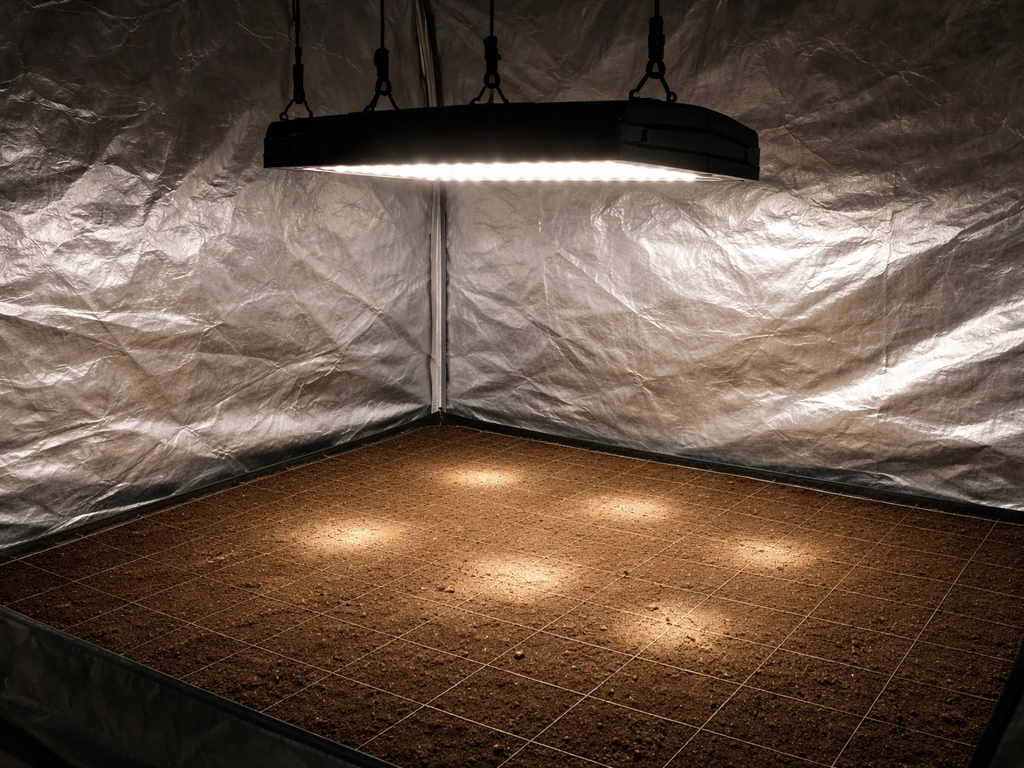
PPF (photosynthetic photon flux) is the total light output of the fixture in µmol/s, measured at the source. PPFD (photosynthetic photon flux density) is what your plants actually receive at canopy level, measured in µmol/m²/s at a specific hanging height. PPF tells you how much light the fixture produces. PPFD tells you how much your plants get. Always check that any PPFD claim comes with a stated hanging height and a coverage area, ideally a full PPFD map rather than a single centre-point reading. A fixture claiming 1,000 µmol/m²/s but only at the centre point of a 30cm hotspot is not the same as one delivering 800 µmol/m²/s uniformly across a 1.2x1.2m canopy.
Efficacy (µmol/J)
This is your efficiency metric. Divide the fixture's PPF by its actual watt draw and you get µmol/J. Anything below 2.0 is relatively inefficient by 2025/2026 standards. 2.5+ is solid. 2.8+ is market-leading. Mars Hydro claims 2.8 µmol/J for their FC-E6500, though as with all manufacturer figures, treat those as initial-condition lab values. blank" rel="noopener noreferrer">Philips notes that performance values apply when the product is new and should reference recognised measurement standards. blank" rel="noopener noreferrer">Look for fixtures where efficacy claims are tied to IES LM-79 testing, which is the recognised standard for measuring LED fixture output. If a brand can't tell you what standard their figures are based on, that's a red flag.
Spectrum: full-spectrum vs blurple vs targeted
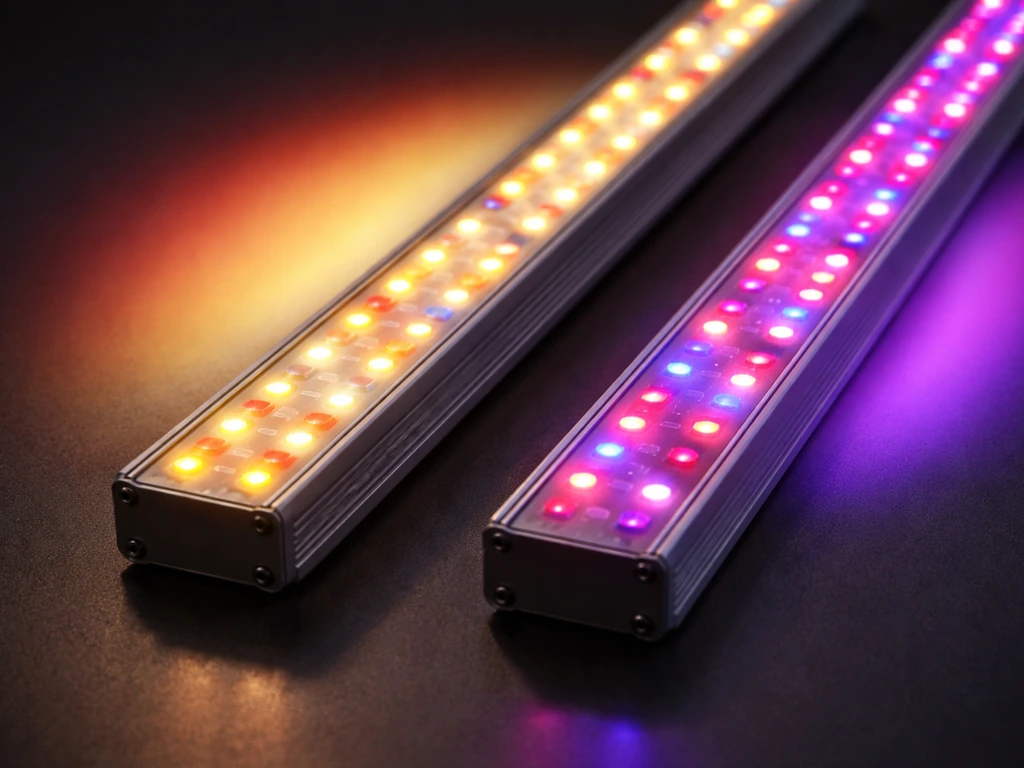
Full-spectrum white-based LEDs (typically 3000K to 4000K with added deep red and far red diodes) have largely replaced old-school blurple (red/blue only) panels in any serious grow. Blurple lights are cheaper upfront but deliver lower efficacy, less uniform canopy penetration, and the unsettling purple glow that makes it hard to spot plant health issues. Full-spectrum fixtures give you a much more accurate view of your plants and perform better across veg and bloom. Some advanced fixtures add specific wavelengths like 660nm deep red, 730nm far red (which triggers Emerson enhancement and can accelerate flowering), and UV, giving you more control over plant responses. For most UK growers, a quality full-spectrum board with a good red component is the practical choice.
Dimming and control
Dimmability matters more than many growers realise. Being able to run a 600W light at 30% for seedlings and ramp it to 100% for peak flower is genuinely useful and saves electricity during early stages. Look for a 0-10V dimming interface or RJ45 connectivity if you want to daisy-chain and control multiple lights. Manual rotary dimmers work fine for single-light setups. At current UK electricity prices (24.67p per kWh as of April 2026 under the Ofgem energy price cap), running a 600W light 18 hours a day costs roughly £2.67 per day. Dimming to 60% during veg cuts that to around £1.60, which adds up meaningfully over a 4 to 5 week veg period.
Best 600W-class LED options in the UK right now
Rather than a single ranked list, here's a scenario-based breakdown of what to look at depending on your situation. These cover the main form factors: quantum board panels, folding bar lights, and legacy blurple-style panels for those on extreme budgets.
Best for a 1.2x1.2m flowering tent: bar-style or quantum board around 600W actual draw
Mars Hydro's FC-E series is a reasonable starting point in this class. The FC-E6500 draws around 730W and targets larger spaces, but their 600W-adjacent models (check the actual draw on each variant) use Samsung or equivalent diodes, achieve competitive efficacy figures, and come with a 5-year warranty and IP65 water/dust resistance. The IP65 rating is genuinely useful in UK tent environments where condensation is common, particularly in winter.
Bar-style form factors in this wattage class distribute light more evenly across a 1. 2x1. 2m canopy than a central-mount panel, reducing hotspots and improving uniformity scores. Quantum board panels from brands like HLG (Horticulture Lighting Group) are also widely available in the UK via importers and are respected for driver quality and diode longevity, though they carry a price premium.
Best for a budget-conscious 1.2x1.2m veg or mixed-use tent
If you're primarily vegging or running a mixed veg/flower cycle and want to keep costs down, consider stepping down to a genuinely-drawing 400W to 500W unit from a reputable brand rather than buying a budget '600W' panel that actually draws 150W. If you are shopping specifically for the best 400 watt led grow light, treat 400W actual draw and efficacy as the key deciding factors rather than the marketing wattage.
A quality 400W to 500W full-spectrum board will outperform almost any cheap 600W-labelled panel by a significant margin. The money saved on electricity over a 6-month grow can offset the price difference. If budget is genuinely the priority and you're aware of the limitations, a well-reviewed Chinese-brand quantum board drawing 550W to 600W (look for models with Samsung LM301H or similar diodes and a Meanwell driver) gives reasonable performance for the price.
Best for a foldable or portable setup
Foldable LED grow lights in the 600W nominal class (like the Kingrowlight foldable 600W unit that spec-sheets at around 600W actual input) are worth considering if you need a light that travels, fits awkward spaces, or needs to be stored between grows. These tend to use multiple fold-out panels and can be adjusted for coverage width. Check the actual wattage draw column on any spec sheet carefully. Some foldable designs achieve good uniformity when fully extended; others sacrifice edge coverage for portability.
What to avoid: the blurple/cheap 600W panel trap
The Amazon marketplace is full of lights sold as '600W LED grow lights' that draw 80W to 150W, use old blurple diode arrangements, and deliver PPFD numbers that won't sustain a serious flower cycle. The Mars Hydro TS-600 is a real product with a real use case, but it draws around 100W and is correctly used in a 60x60cm tent at most. Buying it expecting 600W performance is a mismatch between name and capability. If you see a 600W LED panel for under £50 and the spec sheet doesn't list actual watt draw, assume you're looking at a sub-200W fixture at best.
| Scenario | Recommended Form Factor | Actual Draw Target | Key Feature to Verify |
|---|---|---|---|
| 1.2x1.2m full flower | Bar light or quantum board | 550–650W | PPFD map at 45cm, uniformity |
| 1.2x1.2m veg/mixed | Quantum board with dimmer | 400–600W | Dimming range, driver brand |
| Foldable/portable setup | Foldable multi-panel | 550–620W | Actual draw on spec sheet |
| Extreme budget, aware of limits | Budget QBoard w/ Samsung diodes | 500–600W | Diode type, driver brand |
| Avoid | Blurple panel, '600W' name only | Often 80–200W actual | Won't sustain flower stage |
Setup guidance: hanging height, coverage, dimming, and airflow
Hanging height is one of the most direct ways growers either get the best or worst out of a 600W LED. Too close and you risk light burn and bleaching at the canopy tips. Too far and your PPFD drops below the effective threshold for the stage you're in. For a true 600W full-spectrum quantum board or bar light, a starting point of 45 to 60cm above the canopy during vegetative growth is typical. During flowering, you can often bring it down to 35 to 45cm if your PPFD map supports it and your plants aren't showing stress. Always cross-reference with the manufacturer's own PPFD map at stated heights rather than guessing.
Unlike a 600W HPS, a quality 600W LED will not be radiating the same volume of infrared heat downward into your canopy. This is one of the genuine advantages of LED over HPS at this wattage. You can typically hang it closer without heat stress at canopy level. However, the driver and heatsink on the fixture itself still generate heat, and in a sealed or poorly ventilated tent that heat builds up in the air. A 1.2x1.2m tent running a 600W LED needs at minimum a 4-inch (100mm) inline extraction fan, and realistically a 5 or 6-inch unit if you're running the light at full power in summer. UK summer ambient temperatures make this particularly relevant.
For dimming, the practical approach is: start seedlings at 20 to 30% output at maximum height, ramp to 60 to 70% during early veg, and push toward 80 to 100% through peak flower. This also reduces stress on the fixture and extends LED lifetime. Most quality drivers will handle this dimming range without any flicker or colour shift issues. If you're running multiple lights in a tent, make sure they can be controlled together, either via a controller box or daisy-chain RJ45 setup.
Cost, safety, and reliability checks
Running costs at UK electricity prices
At the current Ofgem energy price cap rate of 24.67p per kWh (April to June 2026), running a genuine 600W LED for 18 hours a day costs approximately £2.67 per day, or around £80 per month. Over a typical 8 to 10 week flower period, that's roughly £150 to £190 in electricity for the light alone, not including fans, timers, or other equipment. Compare this to a 600W HPS setup: the HPS draws a similar wattage for the lamp but also requires a ballast drawing additional power, plus a separate extraction system to manage its significantly higher heat output. The LED comes out meaningfully cheaper to run over a full cycle.
Warranty, certifications, and build quality
For a fixture drawing 600W, you want at least a 3-year warranty, preferably 5 years. Mars Hydro offers a 5-year limited warranty on their FC-E series, which is a reasonable industry benchmark for this class. HLG and similar premium brands also offer multi-year warranties. For certifications, look for CE marking (required for UK sale as retained from EU standards), and RoHS compliance. IP65 rating is worth having in a tent environment where humidity and condensation are real factors. For drivers, Meanwell (and to a lesser extent Inventronics) are the reputable names. If a spec sheet doesn't name the driver brand, that's often a sign it's a no-name unit with unpredictable longevity.
On LED lifetime claims: manufacturers often quote 50,000+ hours based on L70 (the point at which output drops to 70% of initial). These projections should reference LM-80 test data and TM-21 extrapolation methodology, as described by IES and endorsed by quality manufacturers including Philips. If a brand claims a 100,000-hour lifespan with no reference to testing standards, apply skepticism. What's practically relevant for growers is that a quality LED with a good driver will maintain useful output across several years of regular cycling; a cheap driver will fail first, usually within 12 to 18 months of heavy use.
Safety checks specific to UK setups
UK growers should check that any fixture purchased through a marketplace is sold by a UK-based or EU-compliant supplier, not a grey-market import without proper documentation. Post-Brexit, the UK has its own UKCA marking scheme for certain product categories, though many grow lights still carry CE marks that are accepted. For a 600W draw fixture, make sure your electrical circuit can handle the load. A standard 13A UK plug socket handles up to 3,120W, so a single 600W light is fine on a normal socket, but if you're running lights, fans, a timer, and other equipment on the same circuit, check your total draw. Use a surge-protected extension if running from a single outlet.
How to choose: a practical step-by-step method
- Confirm your tent size in metres. This determines the PPFD coverage area you need and rules out fixtures with insufficient uniformity for your footprint.
- Identify your primary plant stage (seedling, veg, flower, or all three). If all three, make sure the fixture has a wide dimming range.
- Set a target PPFD: 200–400 for seedlings, 400–600 for veg, 600–900 for flower. This is the number you'll use to filter fixtures.
- Find the actual watt draw on every fixture you're considering. Ignore the marketing name. Use the spec sheet input power figure.
- Calculate the PPF output (actual watts × efficacy in µmol/J) and check whether the manufacturer's PPFD map shows your target PPFD across your tent size at a sensible hanging height.
- Check the spectrum: full-spectrum white-based with red supplement is the baseline. Far-red and UV are useful extras, not essentials for most growers.
- Verify the driver brand and warranty length. Minimum 3 years, Meanwell or equivalent driver preferred.
- Check certifications: CE or UKCA, IP rating if tent humidity is a concern.
- Calculate your running cost: actual watts ÷ 1000 × hours per day × 24.67p = daily cost in pence. Multiply by grow length to confirm it fits your budget.
- Buy from a UK-based supplier or established importer with clear returns/warranty support.
Buying checklist and common mistakes to avoid
Quick checklist before you click buy
- Actual wattage draw confirmed on spec sheet (not marketing name)
- Efficacy figure stated in µmol/J (target 2.5+ for 2025/2026)
- PPFD map or average PPFD provided at a stated hanging height
- Coverage area matches your tent size at target PPFD
- Full-spectrum diodes (not blurple unless you specifically want it)
- Dimming function covers seedling through flower range
- Driver brand named (Meanwell preferred)
- Warranty of 3 years minimum, 5 years better
- CE, UKCA, or RoHS certification confirmed
- UK-based supplier with clear warranty/returns process
Common mistakes that cost growers money
- Buying by marketing wattage name rather than actual draw: the '600W' label means nothing without the spec sheet.
- Assuming a '600W equivalent' light performs like a 600W HPS: the comparison is a marketing convention, not a reliable guide to light output.
- Choosing a fixture too large for the tent: a genuine 600W LED in a 60x60cm space creates unmanageable heat and overkill intensity with no room to adjust.
- Ignoring the PPFD map: a great centre-point reading hides poor edge coverage, which directly hits your peripheral plant yield.
- Skipping the driver check: a cheap no-name driver is the most likely failure point in any LED fixture, and it can take the whole unit down before the diodes degrade.
- Not accounting for UK electricity costs: at 24.67p/kWh, a genuine 600W light running an 18-hour photoperiod adds up fast; factor this into your total grow budget before buying.
- Running the light at full power from day one: ramp up intensity gradually with seedlings and young plants to avoid stress, light bleaching, or stunted early growth.
FAQ
Can I run a true 600W draw LED at a much lower power long-term to save money and extend lifespan?
Yes, but only if the dimming hardware and driver support it consistently. Look for a dimming interface (0-10V or RJ45) on the light itself, and confirm the manufacturer states safe dimming percentages under normal UK mains conditions. If the driver supports dimming, start at 50 to 60% in early veg and watch for colour shift or flicker under your grow tent lighting conditions, since cheap drivers can behave inconsistently at low output.
If two lights both say 600W, how do I know which one will actually cover the canopy evenly?
Wattage alone will not tell you actual canopy coverage. Two fixtures with the same “600W” can deliver very different PPFD patterns, due to lensing, diode layout, and how the driver distributes power. Prioritise a PPFD map at your intended hanging height and tent width, and if there is no map, use coverage claims only as a rough guide and expect edge under-lighting.
What are the signs my 600W LED is hung at the wrong height, and what should I change first?
Check the stated hanging height range alongside the PPFD map, not just the minimum distance. Many 600W units can be hung closer than HPS, but you can still bleach or stress tips if your canopy is too close during peak output. If your plants show clawing, bleached upper leaves, or tacoing after raising output, raise the light by 5 to 10cm and re-adjust your dimming ramp.
How do I set dimming and hanging height during flowering if my PPFD is uneven across the tent?
For flowering targets, you should aim to match PPFD at canopy level for your stage rather than chasing “max brightness”. If you are hitting the top end of your stage PPFD and yields plateau, keep output steady and focus on uniformity and plant training. If you are consistently below target at the edges, increase height slightly only if your map shows centre-point is too high, or reposition and use multiple fixtures for large tents.
If a light’s spec sheet looks good, why might it still underperform in my home setup?
Not always. Some lights will meet the same PPF/efficacy numbers on paper but still lose real-world performance due to driver quality, thermal behaviour, or inconsistent diodes. Aim for named driver brands and published measurement standards, and if you live in a hot room, test by running at full power for a few hours and confirm the fixture stays within a safe operating temperature range stated by the manufacturer.
Is extraction sizing for a 600W LED the same as for a 600W HPS?
You should plan for separate climate control, not just extraction. A sealed or low-ventilation tent can make the driver and heatsink run hotter, which can reduce performance over time. In a 1.2x1.2m tent, you typically need at least a 100mm inline extraction fan, and 125mm or 150mm is often more practical at full output during summer. Consider adding intake passive vents to avoid negative pressure that starves airflow.
When is the more expensive high-efficacy 600W LED actually worth it versus a cheaper option?
Higher efficacy lights usually cost more, but they can still be the cheaper choice over a full cycle if your electricity usage is high and you run close to full output often. Use actual draw wattage from the product listing to estimate cost, then compare total fixture cost plus replacement risk. A 5-year warranty and reputable driver brand can be worth more than a small efficacy difference if you tend to run lights at high intensity frequently.
What should I verify in a 600W LED warranty before buying in the UK?
Check the warranty terms for what “limited” covers, especially shipping and labour, and whether you need to return the driver or whole unit. Also confirm warranty eligibility if the product is used in a tent environment with high humidity, since some manufacturers set conditions for condensation exposure. Keep proof of purchase and serial number records to make claims easier.
Can I daisy-chain or control multiple 600W LED lights together, and what wiring mistakes should I avoid?
For multiple lights, only use a control method the lights explicitly support together. If the fixtures both support 0-10V or RJ45 dimming, you can often control them as a group via a controller, otherwise you may need individual dimming. Avoid using random third-party dimmers unless the light manufacturer confirms compatibility, because some drivers can misbehave and flicker.
How do I know if my UK plug socket setup can handle a 600W LED plus fans and timers?
Generally, a single genuine 600W draw light is fine on a standard UK 13A circuit, but the whole setup matters. Add fans, dehumidifier (if used), oscillating fans, and any additional lighting on the same ring. If you are near the limit or using an extension with multiple appliances, use a surge-protected extension and avoid daisy-chaining extension leads.
Does full-spectrum really matter for results, or is it mostly about the look?
Yes, and the reason matters. Full-spectrum white-based LEDs can give a more accurate visual assessment of plant health, but you should still rely on PPFD targets and dimming, because colour look does not guarantee correct photon delivery. If you use supplemental far-red or UV, confirm the fixture has those diodes and that your dimming range does not effectively “turn off” the extra wavelengths.
Is a 600W LED safe to use on UK mains if I’m importing it, and what specs should I check?
Usually, but confirm the driver’s input range and any stated operating conditions for voltage and mains fluctuations. UK mains is typically stable, yet cheap drivers can be less tolerant. If you have frequent power drops or storms, consider a quality surge protector, and if the fixture has an “input voltage” specification, match it to your region’s voltage.
Next Articles
Best 300W LED Grow Lights: How to Choose and Set Up
Choose the best 300W LED grow light with real power draw, PPF, coverage, spectrum, and setup tips for your tent size.
Best 1500W LED Grow Light: How to Choose and Set Up
Choose the best 1500W LED grow light by PPF, PPFD, spectrum, coverage, and setup for tent or room.
Best 300 Watt LED Grow Light: How to Choose and Buy
Buy the best 300 watt LED grow light with coverage, PPFD, spectrum, dimming, heat, and setup checks for your tent.